
Right of First Refusal Solicitors: A Guide to Securing Your Freehold in 2026

Right of First Refusal Solicitors: A Guide to Securing Your Freehold in 2026

If your landlord decides to sell your building, the law doesn’t just suggest they offer it to you first; it demands it, and failing to do so is a criminal offence. It’s a high-stakes moment that often triggers immediate anxiety for leaseholders. You might worry about coordinating with your neighbours or fear that a missed statutory deadline will see your building sold to an unknown third party. Partnering with specialist right of first refusal solicitors ensures you don’t just react to a notice, but proactively secure your property’s future.

We understand that you want more than a “conveyancing factory” for such a complex transaction; you need a sophisticated guide who values personal rapport and professional integrity. This article explains how to exercise your statutory right to purchase your freehold and gain full autonomy over service charges and building management. We’ll break down the essential timelines for 2026, the impact of the Renters’ Rights Act 2025 on the broader property market, and the exact steps required to move from leaseholder to freeholder with confidence.

Key Takeaways

  • Recognise your legal protections under the Landlord and Tenant Act 1987, which ensures your landlord cannot sell the building to a third party without offering it to you first.
  • Confirm your building’s eligibility by verifying the 50% residential floor area requirement and your status as a qualifying long leaseholder.
  • Act decisively within the strict two-month statutory window following a Section 5 notice to ensure you do not forfeit your right to purchase the freehold.
  • Partner with specialist right of first refusal solicitors to manage the complex coordination and interpersonal dynamics required for a successful collective acquisition.
  • Secure long-term autonomy over your building’s management and service charges whilst permanently eliminating future ground rent obligations.

Understanding the Right of First Refusal: A Critical Protection for Leaseholders

The Right of First Refusal (RFR) is a powerful statutory shield established by the Landlord and Tenant Act 1987. It dictates that most landlords of residential blocks cannot dispose of their interest to a third party without first offering it to the qualifying tenants on the same terms. This isn’t merely a courtesy; it’s a legal obligation. If a landlord fails to comply, they may be committing a criminal offence and could face a fine of up to £5,000. For leaseholders, this provides a unique, time-sensitive opportunity to take control of their building’s destiny.

Understanding the Right of First Refusal is essential for any flat owner who receives a formal notice. In the 2026 property market, the value of this right has been bolstered by the Leasehold and Freehold Reform Act 2024. While the 1987 Act provides the “right to buy” when the landlord decides to sell, the 2024 reforms have simplified the valuation process and made it easier for leaseholders to manage their buildings once they acquire them. Engaging expert right of first refusal solicitors ensures that these distinct yet overlapping pieces of legislation are used to your maximum advantage, bridging the gap between established statutory rights and modern procedural efficiencies.

The Benefits of Freehold Ownership

Owning the freehold fundamentally changes your relationship with your home. You move from being a tenant to a co-owner of the land itself. This shift offers several tangible advantages:

  • Eliminating Ground Rent: You effectively cancel future rent payments to a third party, removing a common financial burden.
  • Service Charge Control: You and your neighbours decide who manages the building and how your money is spent, ensuring transparency and fairness.
  • Market Appeal: Properties with a share of freehold are significantly more attractive to buyers and lenders, often commanding a premium.

A peppercorn rent is a symbolic, nominal payment of no financial value that maintains the legal validity of a lease whilst ensuring the leaseholder pays nothing in practice.

Why Landlords Sell and What it Means for You

Landlords often sell for reasons unrelated to the building’s performance, such as portfolio restructuring or a shift in investment strategy. When a “Right of First Refusal” notice arrives, it signals a transition point. Unlike a voluntary statutory enfranchisement claim, where leaseholders initiate the purchase, an RFR notice is a reactive process with strict deadlines. This distinction is vital; you aren’t fighting to buy, you are being given the first chance to do so. If you ignore the notice, the landlord is free to sell to a potentially less favourable management company. This could leave you with no say in the building’s future for years to come. Our right of first refusal solicitors provide the steady, professional guidance needed to coordinate with your neighbours and respond before the statutory window closes.

Eligibility and Qualification: Does Your Building Meet the Criteria?

Determining whether you have the legal right to purchase requires a methodical review of both the building’s structure and your specific lease terms. Most residents holding a long lease, originally granted for more than 21 years, are considered qualifying tenants. This includes individuals and, in many cases, companies holding the lease. By 2026, the legislative landscape has shifted to favour leaseholders, meaning that old barriers like the two-year residency rule no longer obstruct most from exercising their rights. This change ensures that the right to take control of your building is based on your legal interest in the property rather than your personal living arrangements.

The building itself must also meet strict criteria to fall under the Landlord and Tenant Act 1987. It must contain at least two flats, and at least 50% of the total number of flats in the block must be owned by qualifying tenants. Understanding the nuances of these requirements is where professional right of first refusal solicitors become invaluable. They can verify your standing before you commit to the process, ensuring your group is legally robust before responding to the landlord. This verification is the essential first step in The Statutory Timeline: Navigating the Section 5 Notice Process, protecting you from procedural challenges later on.

The 25% Non-Residential Limit

Mixed-use developments often present the greatest challenge for eligibility. For the Right of First Refusal to apply, the non-residential part of the building, such as ground-floor shops or offices, must not exceed 50% of the total internal floor area. It’s a common point of confusion because other forms of enfranchisement often cite a tighter 25% limit. We recommend engaging a specialist surveyor to measure the internal floor space precisely. Even a small discrepancy in these calculations can disqualify a building from statutory protection, so professional accuracy is vital for mixed-use blocks.

Qualifying Tenants and Exclusions

Not every leaseholder automatically qualifies for the Right of First Refusal. If you own more than two flats in the building, either in your own name or through a company you control, you are excluded from being a qualifying tenant for that specific block. Additionally, certain landlords, such as charitable housing trusts or resident landlords in small conversions, may be exempt from the requirement to serve a notice. Our right of first refusal solicitors can help you identify intermediate interests and “Head Leases” early in the process. This prevents costly delays and ensures your claim is built on a solid legal foundation from the outset.

The Statutory Timeline: Navigating the Section 5 Notice Process

When a Section 5 notice arrives, the clock starts immediately. It isn’t a casual invitation; it is a formal statutory offer that requires a precise, coordinated response. This document outlines the terms of the landlord’s intended sale, including the price and any specific conditions. The most critical factor is the strict two-month acceptance window. If you and your fellow leaseholders fail to serve a formal acceptance notice within this timeframe, the landlord is legally entitled to sell the building to a third party. They can do so at the same price and on the same terms offered to you for the following twelve months. Delay is the greatest risk in this process, as there is no statutory mechanism to extend this deadline.

Experienced right of first refusal solicitors play a vital role in managing this high-pressure window. They ensure that the “Acceptance Notice” is drafted correctly and served on the landlord in a way that leaves no room for dispute. Coordination is often the most significant hurdle for leaseholders. You must ensure that more than 50% of the qualifying tenants are willing and able to proceed. The Leasehold and Freehold Reform Act 2024 has streamlined many of the administrative hurdles that used to plague these transactions, making the 2026 completion process smoother than in previous years. For a foundational look at these entitlements, the official Right of First Refusal guidance provides a helpful baseline for leaseholders beginning this journey.

The Five Types of Section 5 Notices

Landlords must serve the specific notice that corresponds to their method of disposal. Section 5A is the most common, used for a simple sale by contract. If the landlord intends to sell via public auction, they must serve a Section 5B notice, which involves a slightly different set of deadlines to align with the auction date. Sections 5C, 5D, and 5E cover more complex arrangements, such as the grant of an option, a right of pre-emption, or non-contractual disposals. Identifying which notice you’ve received is the first task for your legal team, as the procedural requirements for each vary significantly.

From Acceptance to Completion

Once the offer is accepted, you have a further two months to nominate the “Nominee Purchaser.” This is typically a company formed by the participating tenants to hold the freehold title collectively. Your right of first refusal solicitors will then handle the formal conveyancing, which includes reviewing the contract and managing the transfer of purchase funds. The process concludes with the final registration at HM Land Registry. This registration is the definitive act that secures your freehold title, officially transferring control of the building from the landlord to the residents’ company.

Right of First Refusal Solicitors: A Guide to Securing Your Freehold in 2026

Financial commitments in a Right of First Refusal (RFR) claim extend beyond the purchase price listed in the Section 5 notice. When a landlord decides to sell, the premium they quote is typically the market value they expect to achieve on the open market. Because the law prohibits them from selling to a third party at a lower price for twelve months if you reject the offer, there is often little room for negotiation. However, verifying that this price is accurate requires a specialist enfranchisement surveyor who understands the nuances of the 2026 property market. Beyond the premium, leaseholders are generally responsible for the landlord’s “reasonable” legal and valuation fees, making early budgeting essential for a successful acquisition.

Stamp Duty Land Tax (SDLT) also represents a significant collective cost. For a group purchase, the tax is calculated on the total price paid for the freehold. While the abolition of Multiple Dwellings Relief in 2024 changed the calculation landscape, your legal team can advise on the most tax-efficient way to structure the purchase through your Nominee Purchaser company. To ensure your group is financially prepared for these outgoings, contact our right of first refusal solicitors for a detailed breakdown of the anticipated costs and a pragmatic plan for your building.

The Impact of the 2024 Act on Valuations

The Leasehold and Freehold Reform Act 2024 brought a welcome shift towards transparency by abolishing Marriage Value for leases with fewer than 80 years remaining. In 2026, this means the “hope value” landlords once squeezed from leaseholders is largely gone, though the remaining lease length still dictates the premium based on lost future ground rent. Professional legal due diligence is vital to prevent overpaying the landlord or inadvertently assuming hidden financial liabilities buried in the transfer deed. Our approach ensures that the price you pay reflects the true statutory value of the asset without unnecessary inflation.

Coordinating the Collective Fund

The most significant hurdle in an RFR claim isn’t always the law; it’s the logistics of group cohesion. To proceed, you must secure the 50% participation requirement and ensure the necessary capital is ready before the statutory deadlines expire. We recommend setting up a “Nominee Purchaser” company early in the process. This entity holds the freehold title on behalf of the participating owners, providing a clear structure for future management. To protect every owner’s investment, we assist in drafting Participation Agreements. These private contracts define how the purchase is funded, how costs are split, and how future decisions are made, preventing disputes and ensuring the group remains a steady, unified force.

Securing your building’s freehold is rarely a simple transaction; it’s a strategic manoeuvre that requires precise legal timing and expert coordination. Whilst the statutory framework provides the right, the path to completion is often obstructed by procedural traps and complex interpersonal dynamics. Partnering with specialist right of first refusal solicitors ensures that your group isn’t just following a process, but actively protecting a significant financial asset. At Feltons Solicitors LLP, our approach is sophisticated, pragmatic, and fundamentally people-first. We recognise that behind every Section 5 notice is a community of leaseholders seeking security and control over their homes.

Managing the delicate interpersonal dynamics of collective enfranchisement is where we provide the most value. Coordinating 50% or more of your neighbours requires a steady, authoritative hand to ensure everyone remains aligned and informed. We act as a calm presence, resolving internal disagreements and presenting a unified front to the landlord. This level of care is essential when navigating residential property law, as even minor delays in consensus can lead to missed statutory deadlines. If you encounter a recalcitrant landlord who attempts to ignore the notice or inflate the premium, our team employs proactive dispute resolution to keep the transaction on track without unnecessary litigation.

The Boutique Advantage

We pride ourselves on offering a boutique level of service that prioritises personal connection over high-volume processing. Unlike “conveyancing factories” where your file might be passed between junior clerks, our clients enjoy direct access to senior practitioners. This ensures meticulous attention to detail and a level of professional integrity that is increasingly rare. By handling your freehold acquisition with this degree of precision, we help secure your investment for long-term estate planning goals. A well-managed freehold doesn’t just improve your daily life; it provides a stable legacy for future generations.

Your Next Steps with Feltons Solicitors LLP

The journey begins with an initial consultation to assess your Section 5 notice and verify your building’s eligibility. We don’t just look at the paperwork; we evaluate the practicalities of your specific group. From the first acceptance notice to the final TR1 transfer at HM Land Registry, we guide you through every statutory milestone. Our right of first refusal solicitors handle the technical heavy lifting, allowing you to focus on the benefits of your new ownership. Secure your property rights with confidence; contact our leasehold enfranchisement experts today to begin your collective purchase.

Taking the Next Step Toward Full Property Autonomy

Securing your freehold is a transformative step that provides permanent relief from ground rent and grants you full autonomy over building management. As explored, the statutory window following a Section 5 notice is incredibly narrow; this makes immediate action and coordination with your neighbours essential. With the 2024 reforms now fully integrated into the 2026 property market, the path to ownership is more transparent and accessible than ever before.

Success in these complex matters hinges on more than just administrative filing. It requires a partner who understands the intricate interpersonal dynamics of collective enfranchisement and the strict requirements of the 1987 Act. Our team provides the sophisticated, discreet legal support necessary to handle national property matters with a boutique level of care. We offer pragmatic advice focused on protecting your long-term property value whilst ensuring every statutory deadline is met with unwavering precision. Partnering with expert right of first refusal solicitors ensures your collective investment is handled with the professional integrity it deserves.

Instruct our specialist Right of First Refusal solicitors to secure your freehold today and transition from leaseholder to owner with confidence. Your building’s future is within your reach, and we’re here to provide the steady guidance you need to claim it.

Frequently Asked Questions

What happens if my landlord sells the freehold without offering it to us first?

If a landlord sells the freehold without serving a Section 5 notice, they are committing a criminal offence punishable by a fine of up to £5,000. In this scenario, the qualifying tenants have a statutory right to “step into the shoes” of the purchaser. You can serve a notice on the new owner requiring them to sell the freehold to you at the same price they paid. This protection ensures landlords cannot bypass your legal rights through a private deal.

How many leaseholders need to participate in a Right of First Refusal purchase?

More than 50% of the qualifying tenants in your building must participate to accept the landlord’s offer. For example, in a block of ten flats where everyone qualifies, at least six leaseholders must agree to the purchase. If you fall below this threshold, the right is lost, and the landlord may sell to a third party. Coordinating these numbers quickly is why many residents instruct right of first refusal solicitors to manage the initial group organisation.

Is the price of the freehold negotiable under a Section 5 notice?

The price stated in a Section 5 notice is generally non-negotiable because it represents the terms the landlord is prepared to accept on the open market. You are being offered the “first refusal” at that specific valuation. If you reject the offer, the landlord cannot sell to anyone else at a lower price or on better terms for twelve months. Whilst you cannot haggle, a specialist surveyor can verify if the quoted price reflects true market value.

How long do we have to raise the funds once we accept the landlord’s offer?

You have a structured timeline to organise your finances once the offer is accepted. After your group serves the acceptance notice within the initial two-month window, you have a further two months to nominate your purchaser company. Following this, the landlord has one month to provide a contract, and the group then has at least two months to exchange. This gives participating tenants roughly five to six months from the first notice to finalise their funding arrangements.

Can a landlord withdraw the Section 5 notice after we have accepted it?

A landlord is legally permitted to withdraw a Section 5 notice at any time before a binding contract is exchanged. However, doing so carries a significant penalty for the landlord. Once they withdraw the notice, they are prohibited from selling the freehold to any third party for a period of twelve months from the date of withdrawal. This prevents landlords from testing the water or attempting to circumvent the leaseholders’ rights through repeated notices.

What is a “Nominee Purchaser” and do we need to form a company?

The Nominee Purchaser is the legal entity that will acquire and hold the freehold title on behalf of the participating leaseholders. Whilst you could technically name individuals, we almost always recommend forming a private limited company where each participant is a shareholder. This structure simplifies future management and ensures that the freehold remains a stable asset even if individual flats are sold. It’s a vital component of the “people-first” approach to long-term property control.

Does the Right of First Refusal apply to commercial properties?

The Right of First Refusal does not apply to purely commercial buildings; it is a protection designed specifically for residential leaseholders. However, mixed-use buildings are covered if the non-residential internal floor area does not exceed 50% of the total. If your block contains ground-floor shops or offices that take up more than half the space, the landlord is free to sell without offering it to the tenants first. Accurate measurement by a surveyor is essential here.

What are the risks of using a non-specialist solicitor for this process?

Using a non-specialist firm carries the significant risk of missing strict statutory deadlines, which can lead to the permanent loss of your right to buy. Specialist right of first refusal solicitors focus on the complex interplay of the 1987 and 2024 Acts, ensuring that notices are served correctly and coordination with all parties remains efficient. A generalist “conveyancing factory” often lacks the meticulous attention to detail required to handle the criminal liabilities and group dynamics inherent in these property claims.

Collective Enfranchisement Solicitors: A How-To Guide for Buying Your Freehold in 2026

Collective Enfranchisement Solicitors: A How-To Guide for Buying Your Freehold in 2026

The building you call home should be your greatest asset, not a source of mounting anxiety. You have likely felt the frustration of rising service charges and the looming worry of a lease dipping toward that 80-year threshold. It is often difficult to organise neighbours, and the fear of hidden legal costs can keep many leaseholders stuck in a cycle of poor maintenance and diminishing property value. Partnering with experienced collective enfranchisement solicitors is the first step toward turning that shared frustration into a valuable, self-managed asset.

We understand that the legal landscape in 2026 feels complex, especially with the phased implementation of the Leasehold and Freehold Reform Act 2024. These reforms provide a significant opportunity to gain total control over your building and eventually secure 990-year leases with zero ground rent. This guide provides a clear blueprint for navigating the enfranchisement process, from understanding the updated 50% non-residential limits to managing group strategy. You will discover how to successfully secure your freehold and increase your property’s market value whilst avoiding the common pitfalls of property litigation. We will explain exactly how to move from leaseholder to freeholder with confidence and professional support.

Key Takeaways

  • Understand how collective enfranchisement empowers you to take full control of your building’s management and eliminate escalating service charges.
  • Learn the updated eligibility criteria for 2026, including the expanded 50% non-residential limit that makes buying the freehold possible for more mixed-use blocks.
  • Discover why instructing specialist collective enfranchisement solicitors is essential for navigating strict statutory deadlines and ensuring a smooth transition of ownership.
  • Identify how a robust Participation Agreement protects your group’s financial interests and ensures the stability of your claim from start to finish.
  • Master the strategic steps required to secure 990-year leases and zero ground rent, significantly increasing the long-term value of your home.

What is Collective Enfranchisement and Why Buy Your Freehold?

Collective enfranchisement isn’t just a legal procedure; it’s a fundamental shift in how you own your home. Essentially, it’s the right for a group of leaseholders to join forces and purchase the freehold of their building. This process transforms you from a tenant into a part-owner of the land your building sits on. For many, the catalyst is a history of opaque service charges, skyrocketing insurance premiums, or neglected communal areas. When you research What is Collective Enfranchisement, you quickly realise it’s about reclaiming autonomy over your living environment and your long-term financial security.

A lease is often described as a ‘wasting asset’ because its value diminishes as the term gets shorter. By buying the freehold, you and your neighbours can grant yourselves new leases, typically for 999 years, effectively stopping the clock on depreciation. It removes the stress of future extensions and makes your property far more attractive to buyers who might otherwise be wary of a lease dropping towards the 80-year mark. Instructing collective enfranchisement solicitors early in the process ensures the transition of the title is handled with the poise and professional integrity required to protect your investment.

The Core Benefits of Owning the Freehold

Statutory Rights Under the 1993 Act

The legal framework is the Leasehold Reform, Housing and Urban Development Act 1993. This legislation provides a structured route to force a sale, even if the freeholder is reluctant. Engaging collective enfranchisement solicitors ensures every notice is served correctly and that the freeholder cannot use delay tactics. The law is designed to protect your right to ownership, provided the process is followed with precision.

Eligibility Criteria: Does Your Building Qualify in 2026?

Before embarking on the journey toward ownership, it’s essential to confirm that your building meets the specific legal requirements. The process begins with understanding your leasehold property structure. To qualify, the building must be a self-contained block of flats or a part of a building that is capable of independent management. This means it must have its own vertical division and be able to function without relying on services from an adjacent structure. If your block shares communal heating or structural components with another building, the eligibility assessment becomes more nuanced.

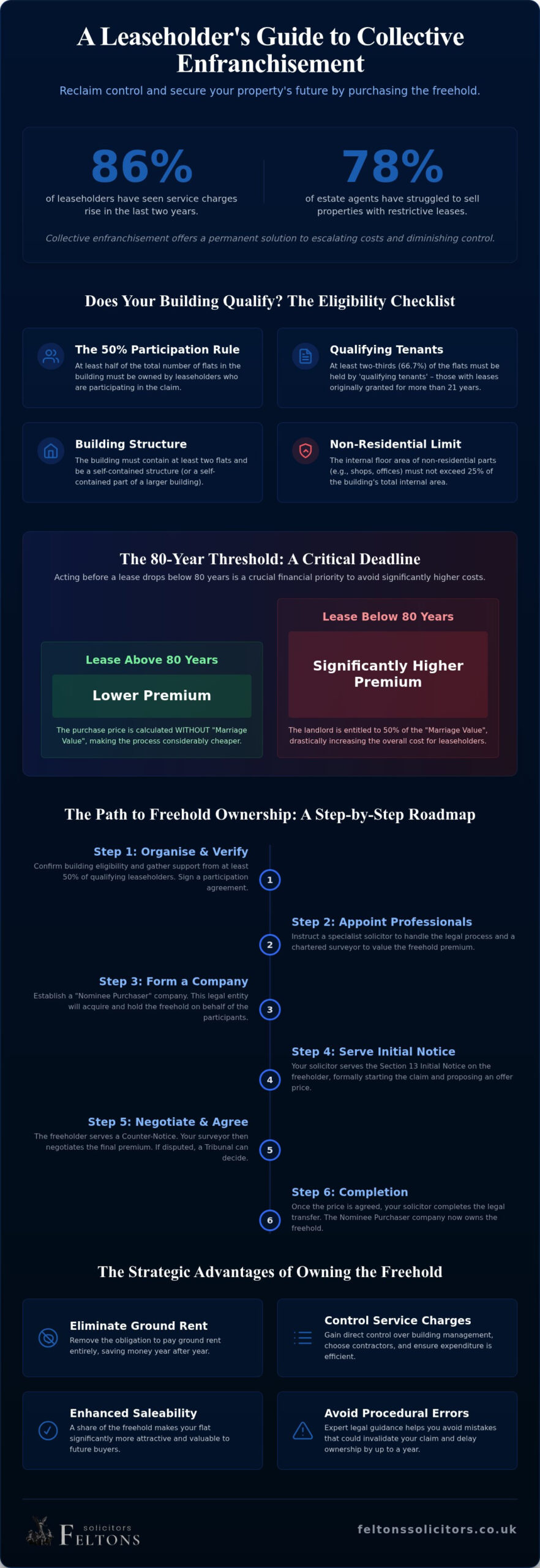
One of the most significant shifts in 2026 is the expanded eligibility for mixed-use buildings. Previously, if more than 25% of the internal floor area was used for non-residential purposes, the building was disqualified. However, the Leasehold and Freehold Reform Act 2024 has increased this limit to 50%. This change allows leaseholders in buildings with substantial commercial space, such as shops or offices on the lower floors, to finally take control. Additionally, at least 50% of the total number of flats in the building must agree to participate in the purchase. If you live in a block of ten flats, you need at least five neighbours to commit to the claim.

Another core requirement involves the status of the tenants themselves. At least two-thirds of the flats in the building must be held by ‘qualifying tenants’. These are leaseholders whose original lease term was for more than 21 years. If you are unsure whether your block meets these thresholds, seeking advice from collective enfranchisement solicitors early on can prevent costly missteps. The team at Feltons Solicitors LLP can help you audit your building’s eligibility before you begin formal negotiations.

Defining the ‘Qualifying Tenant’

A qualifying tenant can be an individual or a company. However, if a single person or entity owns more than two flats in the building, they are excluded from being a qualifying tenant for the purposes of the claim. It’s also important to remember that the two-year ownership rule was abolished in early 2025. You can now participate in a collective enfranchisement claim from the day you complete your property purchase, regardless of how long the previous owner held the title. Your current lease length doesn’t affect your right to participate; even those with very short leases can be part of the group.

Common Eligibility Pitfalls to Avoid

Buildings with complex flying freeholds or those owned by specific charitable housing trusts can present unique challenges. In some cases, the freeholder may be exempt from the statutory process if the property is part of a charitable mission. Identifying these exemptions requires a methodical review of the title deeds and the freeholder’s status. Missing these details can lead to a claim being rejected at the first hurdle, which is why collective enfranchisement solicitors conduct thorough initial searches as part of the due diligence process.

The Collective Enfranchisement Process: A Step-by-Step Guide

Successfully purchasing a freehold is as much about group dynamics as it is about legal precision. Whilst the statutory route provides a clear framework, the process requires a methodical approach to ensure every participant remains committed and every deadline is met. Unlike a voluntary negotiation, which relies on the landlord’s whims, the statutory process under the 1993 Act grants you the power to compel a sale. This journey begins with internal organisation and ends with the transfer of the title to a company owned by you and your neighbours.

The first critical step involves organising your group and establishing a formal Participation Agreement. This document is a legally binding contract that governs the behaviour of the participants, securing financial commitments and outlining how decisions will be made. Without this, the claim is vulnerable if a neighbour decides to withdraw at a late stage. Once the group is secure, collective enfranchisement solicitors will help you form a ‘Nominee Purchaser’ company. This entity is specifically designed to hold the freehold title on behalf of the participating leaseholders, ensuring a professional structure for future building management.

Following the company formation, your legal team will serve the Section 13 Notice on the freeholder. This formal document triggers the legal timetable and sets out the proposed price for the freehold. If the freeholder agrees to the terms, the process moves toward completion. However, if an agreement on the premium cannot be reached through negotiation, an application to the First-tier Tribunal may be necessary to determine a fair price. In 2026, the fees for such an application are typically £200, with an additional £300 for a hearing, representing a modest cost for securing a fair valuation.

The Role of the Specialist Valuer

You should never serve a Section 13 Notice without a professional valuation. A specialist valuer provides a realistic estimate of the premium, ensuring your opening offer is neither too high nor so low that it risks being deemed unrealistic. By 2026, the abolition of ‘marriage value’ has significantly simplified these calculations, making the process more transparent for buildings with leases under 80 years. Understanding how these valuations are constructed is just as important for individual leaseholders; a detailed lease extension estimate can help each participant appreciate the financial stakes before the group commits to the collective purchase. Your valuer and collective enfranchisement solicitors work in tandem to counter the freeholder’s opening demands, using market data to protect your financial interests.

Serving the Section 13 Notice

The Section 13 Notice is the most important document in the claim. It must include precise details of the participating flats, the proposed premium, and the details of the Nominee Purchaser. Any technical error can lead to the notice being declared invalid, which may prevent you from starting a new claim for twelve months. The landlord is given a minimum of two months to respond with a Counter-Notice. If they fail to respond by the stated deadline, the group can apply to the court for a Vesting Order, allowing the purchase to proceed on the terms set out in your initial notice.

Collective Enfranchisement Solicitors: A How-To Guide for Buying Your Freehold in 2026

Mitigating Risks: Participation Agreements and Group Management

Whilst the legal framework provides the statutory right to buy, the human element often presents the greatest challenge to a successful claim. Collective enfranchisement requires a group of neighbours to act as a single, disciplined unit for several months. The most significant risk to any claim is a participant dropping out at a late stage. If one person withdraws, the remaining group is often left to cover the financial shortfall, which can jeopardise the entire project. This is why establishing a robust Participation Agreement is the most critical step you can take before serving any formal notice.

A Participation Agreement is a legally binding contract between the leaseholders that governs the group’s behaviour and financial obligations. It provides a safety net, ensuring that everyone is committed to the same goals and understands their share of the costs. Specialist collective enfranchisement solicitors will tell you that a claim’s success often rests on the strength of this internal contract. It prevents stalemates during negotiations by defining exactly how decisions are made, whether by a simple majority or a dedicated committee. Without this structure, a single dissenting voice can halt progress during a critical negotiation window.

What Should Your Participation Agreement Include?

A well-drafted agreement should leave no room for ambiguity. It must clearly outline the following provisions:

  • Defaulting members: Clear consequences for participants who fail to pay their share of the premium or legal fees on time.
  • Lease valuations: The mechanism for granting new 999-year leases to participants at a peppercorn rent, whilst ensuring non-participants remain on their current terms.
  • Future management: How the building will be managed once the freehold is acquired, including the appointment of directors for the Nominee Purchaser company.
  • Cost sharing: A precise breakdown of how the purchase price and the freeholder’s reasonable legal costs will be divided amongst the group.

Managing Apathy and Non-Participants

It’s common to encounter neighbours who want the benefits of a freehold purchase but are unwilling or unable to contribute to the costs. In these cases, the participating group must decide whether to ‘carry’ the cost of the non-participant’s flat to secure the building. For those who cannot join the collective purchase, they still retain their individual tenant lease extension rights, which can be pursued separately. Furthermore, if your freeholder is ‘missing’ or ‘untraceable’, your collective enfranchisement solicitors can apply for a Vesting Order through the county court, allowing the purchase to proceed even in their absence.

Managing a group claim requires a steady, poised hand to ensure all stakeholders remain aligned. If you are ready to formalise your group’s commitment, you should contact our enfranchisement team to draft a Participation Agreement tailored to your building’s specific needs.

Why Specialist Collective Enfranchisement Solicitors are Vital

The legal journey of buying your freehold is paved with rigid statutory deadlines that leave no room for error. If a single notice is served incorrectly or a counter-proposal deadline is missed by just one day, the law can treat the claim as ‘deemed withdrawn’. This doesn’t just stall your progress; it often prevents the group from serving a new notice for another twelve months, during which time property values may rise and leases grow shorter. Instructing specialist collective enfranchisement solicitors is the only way to ensure these procedural traps are avoided. At Feltons Solicitors LLP, we provide the poised, steady guidance required to manage the many moving parts of a group claim, ensuring your interests remain protected from the initial audit to the final transfer of title.

Our approach combines modern efficiency with the traditional professional integrity you expect from a trusted advisor. We understand that behind the legal filings are homeowners seeking peace of mind and financial security. Our methodology is deeply pragmatic; we aim to avoid unnecessary litigation through skilled negotiation, whilst remaining prepared to defend your rights at a tribunal if the freeholder’s demands are unreasonable. We act as the central hub for your claim, coordinating between specialist valuers, dozens of participants, and the freeholder’s legal team to keep the process moving at a reassuring pace.

Avoiding Costly Technical Errors

A common pitfall in these claims is the incorrect structuring of the ‘Nominee Purchaser’ company. This entity must be fit for purpose not just for the purchase, but for the long-term management of the building. We ensure the Articles of Association are drafted to reflect the internal agreements of the group, preventing future disputes amongst the owners. Additionally, we navigate the increasingly complex Land Registry requirements, including the registration of overseas entities where a participant or the freeholder is based abroad. As Leasehold enfranchisement experts, we handle these technical hurdles with a level of precision that general practice firms often lack.

The Feltons Approach: Boutique Care for Complex Claims

The final stage of the process involves complex conveyancing to transfer the freehold title and the simultaneous creation of new, 999-year leases for every participant. This ensures that your ‘wasting asset’ is officially transformed into a secure, long-term investment. Feltons Solicitors LLP provides a boutique level of care that prioritises personal connection, ensuring you aren’t just another file in a high-volume system. If you’re ready to take the first step toward building autonomy, we invite you to contact us for a consultation. We will assess your building’s eligibility and provide a clear, methodical path toward successfully buying your freehold in 2026.

Take Control of Your Building’s Future Today

The transition from a passive leaseholder to an empowered freeholder is one of the most effective ways to protect your long-term investment. By consolidating your group’s interests and leveraging the 2026 reforms, you can finally eliminate the uncertainty of third-party management and the financial drain of ground rents. As we have explored, success requires more than just meeting eligibility criteria; it demands a disciplined approach to group strategy and a thorough understanding of the statutory framework. This shift in ownership doesn’t just lower your annual outgoings; it fundamentally changes the nature of your property from a wasting asset to a permanent, self-governed home, where you can directly appoint specialist contractors like CavClear to manage structural maintenance and damp proofing.

The path to property independence is significantly smoother when guided by specialist collective enfranchisement solicitors who understand the nuances of the current legal landscape. Feltons Solicitors LLP has provided this level of expert guidance since 2010, offering pragmatic and jargon-free advice on a national scale. We take pride in our boutique approach, ensuring that your building’s specific challenges are met with tailored solutions and professional integrity. Our role is to act as your steady advisor, managing the complex coordination between valuers and participants whilst you focus on the future of your community.

Secure your property’s future with Feltons Solicitors LLP to discuss how we can help you achieve full building autonomy. With the right professional partnership, the vision of a self-managed, ground-rent-free building is entirely within your reach.

Frequently Asked Questions

How many tenants do we need to buy the freehold?

You need at least 50% of the total number of flats in your building to participate in the claim. For example, in a block of ten flats, at least five leaseholders must join together to trigger the legal process. It’s also required that at least two-thirds of the total flats in the building are owned by qualifying tenants. This ensures the group has a sufficient collective interest to compel the freeholder to sell.

Can the freeholder refuse to sell the freehold to us?

No, the freeholder cannot refuse the sale if your building and the participating group meet the statutory eligibility criteria. The law grants you a legal right to purchase the freehold under the 1993 Act. Whilst a landlord might challenge the validity of your initial notice or the proposed price, they cannot simply reject the purchase itself. Expert collective enfranchisement solicitors ensure your claim is structurally sound to prevent such challenges from succeeding.

How much does collective enfranchisement cost on average?

The total cost depends on the premium payable for the freehold and the professional fees involved in the claim. You’ll be responsible for your own legal and valuation fees, as well as the freeholder’s reasonable legal and valuation costs. Since the abolition of marriage value in 2024, the premium for buildings with leases under 80 years has become more predictable. A specialist valuer can provide a detailed estimate before you formally commit to the process.

What is a Participation Agreement and do we really need one?

A Participation Agreement is a legally binding contract between the participating leaseholders that governs the group’s financial and procedural commitments. You absolutely need one to protect the group if an individual decides to withdraw or fails to pay their share of the costs. It establishes a clear framework for decision-making and cost-sharing, preventing the claim from collapsing due to internal disputes. It’s the foundation of a secure and professional group strategy.

Does buying the freehold automatically extend my lease?

Buying the freehold doesn’t automatically extend your lease, but it gives your group the power to do so once the purchase completes. Most groups choose to grant themselves new 999-year leases at a peppercorn rent immediately after acquiring the title. This process is handled by your collective enfranchisement solicitors as part of the final conveyancing stage. It effectively removes the ‘wasting asset’ nature of your property and increases its long-term market value.

Can we buy the freehold if some tenants don’t want to join in?

Yes, you can proceed with the purchase as long as at least 50% of the flats in the building participate. Those who don’t join will remain as leaseholders, but their landlord will change from the current freeholder to the new Nominee Purchaser company owned by you and your neighbours. Non-participants won’t benefit from the new 999-year leases or the removal of ground rent unless they negotiate a separate deal with your group later.

What happens if we can’t agree on a price with the freeholder?

If negotiations reach a stalemate, you can apply to the First-tier Tribunal (Property Chamber) to determine the fair premium. As of July 2026, the application fee is £200, with a hearing fee of £300. The Tribunal acts as an independent body that reviews evidence from both sides’ valuers to set a final price. Most cases are settled through negotiation before reaching this stage, but the Tribunal remains a vital safety net for leaseholders.

How long does the collective enfranchisement process take?

The entire process typically takes between nine and twelve months from the service of the initial notice to final completion. This timeline accounts for the statutory response periods, valuation negotiations, and the final conveyancing work. If the case proceeds to a Tribunal, the timeline can extend by several months depending on the court’s availability. Staying organised and responding to your solicitor’s requests promptly is the best way to keep the claim moving efficiently.