

What if the property is registered in your former partner’s name, but you paid towards the deposit, mortgage or renovations? The title deeds matter, but they may not tell the whole story. Cohabitation property dispute lawyers UK can help you assess the ownership evidence and understand the options available.
If you’re unsure whether bank transfers, messages or an informal understanding support your position, you’re not alone. Unmarried partners don’t acquire the same rights as married couples simply by living together, and there is no “common law marriage” in England and Wales. A dispute is usually assessed under property and trust law, where the details of your contributions and any agreements may matter.
This guide explains the legal rules that may apply, the documents and other evidence to gather, and how a solicitor can help you consider negotiation, settlement or a court decision. It also covers the 2026 reform consultation. As of October 2026, the law has not changed, so understanding your position under the current rules remains essential.
Key Takeaways
- Separate legal ownership shown on the title from any claimed beneficial interest, then identify exactly what is in dispute.
- Gather title records, bank statements and messages. Distinguish evidence of payments from evidence of what both partners intended.
- Consider negotiation or mediation as possible ways to resolve the disagreement before deciding whether formal proceedings are appropriate.
- Cohabitation property dispute lawyers UK can assess the ownership evidence, potential claims and practical options for your circumstances.
- A solicitor can help you understand the strengths and risks of your position, but the outcome depends on the facts and applicable law.
Unmarried partner rights in UK property disputes
A breakup can be difficult enough without uncertainty over who owns the home, who should keep paying the mortgage or whether a deposit should be repaid. A cohabitation property dispute arises when former partners disagree about their legal or beneficial interests in a property, including who owns it or how its value should be shared.
In England and Wales, living together doesn’t make a couple legally married, however long they have been together. Unmarried partners don’t automatically gain the same financial claims on separation as spouses. That doesn’t mean a non-owning partner can never have an interest in a home. A claim may depend on the property arrangements, contributions and evidence of what the parties intended. The applicable rules also depend on where the property is and which jurisdiction’s law applies.
Does living together create ownership rights in a home?
The title register identifies the legal owner or owners. A separate beneficial interest may also be claimed, even where the legal title is in one partner’s name, but living together alone doesn’t establish that interest. In England and Wales, disputes about interests in land may involve the Trusts of Land and Appointment of Trustees Act 1996 (TOLATA). The legal route and evidence needed depend on the circumstances.
Paying household bills, such as utilities or groceries, doesn’t necessarily prove a share of the property. Mortgage payments, a deposit or substantial renovation costs may be relevant, but no single payment automatically decides ownership. The key question is what the evidence shows about the parties’ intentions and the arrangement they made.
Which jurisdiction’s rules apply to a cohabitation dispute?
“UK law” isn’t one set of rules for every property dispute. England and Wales, Scotland and Northern Ireland have distinct legal systems, so the legal tests and procedures can differ. This article’s references to TOLATA and the absence of “common law marriage” relate to England and Wales. They shouldn’t be treated as a UK-wide statement of procedure or rights.
Start by establishing where the property is, then get advice based on the relevant jurisdiction before deciding how to proceed. The phrase cohabitation property dispute lawyers UK may describe the search, but a useful assessment must account for the specific legal system and facts.
In many property disputes, ownership evidence, not relationship status alone, shapes the claim. A solicitor can help distinguish what the title establishes from any beneficial interest being asserted, and assess how the available evidence may affect your options.
How courts assess ownership and interests in shared homes
In England and Wales, the property title is usually the starting point for working out legal ownership. A dispute may also concern beneficial ownership: the interests in the property that determine who is entitled to its value. Legal title shows who owns the property in law; beneficial ownership concerns who is entitled to its value, and in what shares.
The court will consider relevant documents and the parties’ intentions, which may be recorded expressly in a declaration of trust or other written agreement. Where there’s no clear agreement, intention may sometimes be inferred from conduct and the wider circumstances. The legal approach depends on whether the property is registered in one or both partners’ names, and the law differs across the UK.
Two leading England and Wales decisions illustrate how a court may consider shared ownership. In Stack v Dowden [2007] UKHL 17, the House of Lords considered how the beneficial shares of a home registered in joint names could differ from equal shares, taking account of the parties’ whole course of dealings. In Jones v Kernott [2011] UKSC 53, the Supreme Court considered how shares in a jointly owned home could be assessed when the parties’ intentions changed over time. These cases don’t create a simple formula for every dispute. Their application depends on the facts and legal context.
What if only one partner is named on the title deeds?
Sole legal ownership is a significant starting point, but it may not settle whether the other partner has a beneficial interest. A person asserting such an interest needs to establish it through the relevant facts and evidence. The court may consider what was agreed or understood, alongside conduct connected with acquiring or dealing with the home. The length of the relationship alone doesn’t transfer ownership, and no particular contribution guarantees a share.
Can mortgage payments, deposits or renovations affect a claim?
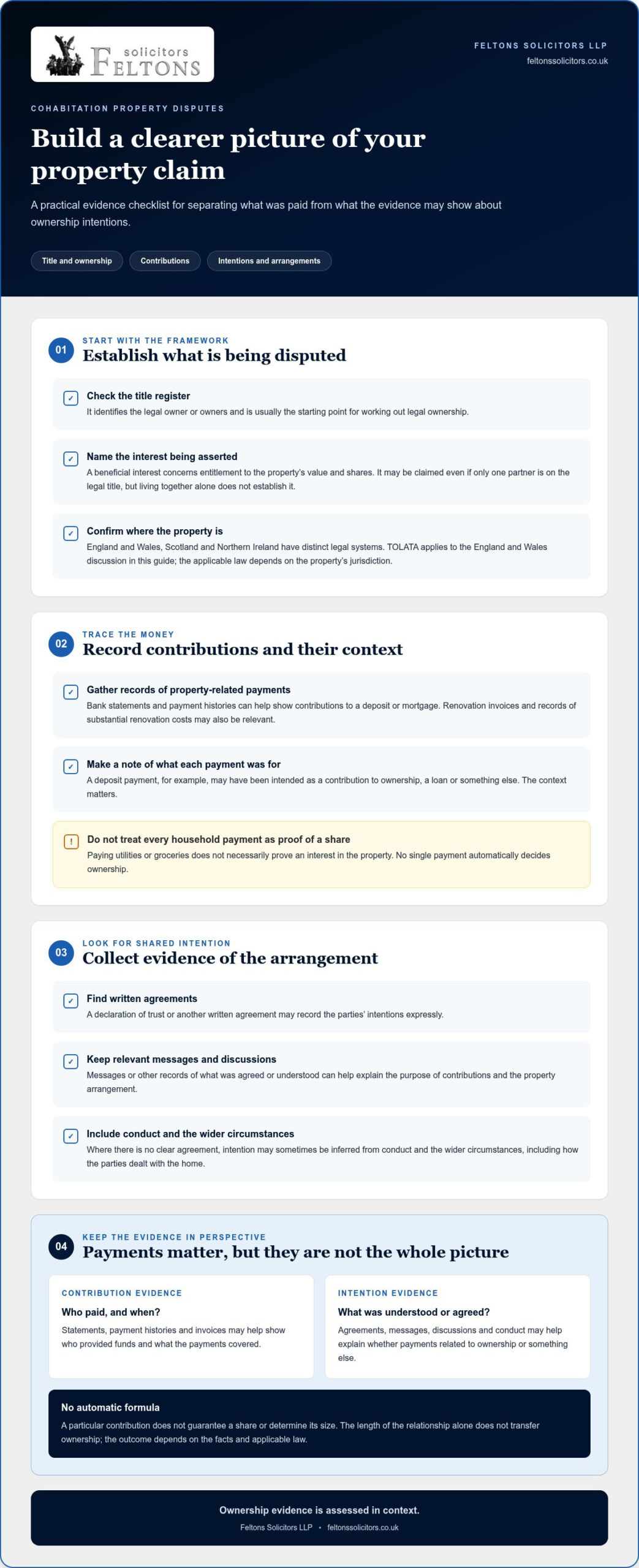
They can be relevant evidence, but they don’t automatically determine whether an interest exists or calculate its size. A deposit transfer may show who provided funds, for example, but context matters: was it intended as a contribution to ownership, a loan or something else? Mortgage statements, renovation invoices and payment histories may help build that picture, as can discussions, written agreements and later conduct.
Keep records together and note what each payment was for, rather than assuming that spending on the home speaks for itself. A careful review can help distinguish evidence of contribution from evidence of shared intention. Advice on property and dispute resolution can help clarify how those issues may apply to your circumstances.
What evidence can strengthen or weaken a cohabitation property claim?
Useful evidence helps show two different things: what each person paid, and what those payments or arrangements were understood to mean. A bank transfer may confirm that money changed hands, for example, but it may not establish whether it was intended as a contribution to ownership, a loan or an ordinary shared expense. The relevance and weight of evidence depend on the facts and the law of the applicable jurisdiction.
Before seeking advice, keep complete copies of relevant records and prepare a dated chronology. Note key payments, conversations and changes to the property as accurately as you can. Preserve original messages and documents. Don’t alter records or select only the parts that appear helpful. Missing paperwork doesn’t automatically defeat a claim, but it may make it harder to establish what was agreed or intended.
Which documents should you gather before seeking advice?
Start with records showing ownership, funding and the history of the home. Depending on the dispute, these may include:
- Title documents and conveyancing correspondence, including records of how the property was purchased.
- Mortgage statements, deposit records and bank statements showing transfers or payments.
- Renovation invoices, receipts and related payment records.
- Emails, text messages and other communications about ownership, contributions, repayments or plans for the property.
- Any written agreement, such as a declaration of trust, alongside records of later discussions or changes in the arrangement.
For your chronology, record dates, amounts, the purpose of each payment and any relevant changes to the property. Add a short note of who was present for significant conversations and what you remember being said. Mark clearly where a date or detail is uncertain rather than filling gaps with assumptions.
How should you handle disputed contributions and informal promises?
Separate direct payments towards a deposit or mortgage from renovation spending, unpaid work, household bills and general living costs. These may provide different kinds of evidence, and none automatically proves a particular share. For instance, a transfer towards the mortgage shows a payment, while a message discussing whether that payment would give someone an interest may help explain its intended meaning.
Keep messages in their original context, including the surrounding conversation and date, rather than relying on isolated quotations or screenshots without context. Record informal promises as accurately as possible, but don’t assume a promise has one guaranteed legal effect. Cohabitation property dispute lawyers UK can review the documents and chronology together, assess what they may establish and identify gaps or conflicting accounts that need careful consideration.
What happens when cohabiting partners cannot agree about the property?
A disagreement doesn’t have to move straight to court. A measured approach can help you understand the issues, preserve options and avoid escalating matters before you know what each person is asking for. The right route depends on the property, the evidence, the jurisdiction and whether constructive discussion is possible.
A practical sequence is to:
- Clarify the dispute: identify whether it concerns ownership shares, a proposed sale, occupation or the handling of mortgage payments.
- Organise the evidence: bring together title documents, financial records and communications relevant to the disagreement.
- Explore resolution: consider whether direct negotiation or mediation could help narrow the issues or reach agreed terms.
- Assess formal options: take tailored advice on the available legal route and its risks before deciding whether to apply to court.
This staged approach can make discussions more focused. It also helps each person understand what remains unresolved, rather than treating every issue as one indivisible dispute.
Can negotiation or mediation resolve a property dispute?
Structured discussion may help former partners agree practical arrangements, such as a proposed sale or how to address a disputed payment. Mediation can provide a setting to explore those issues, but it isn’t suitable in every case or a guaranteed solution. Safety, each person’s willingness to participate and the nature of the disagreement all matter. Nobody should assume mediation is appropriate in every circumstance.
If you reach an agreement, make the terms clear and record them in writing. Consider legal review before relying on them, particularly where ownership interests, a sale or ongoing financial obligations are involved. For a broader view of alternatives and formal routes, read about dispute resolution options.
When might a court application under TOLATA be considered?
In England and Wales, the Trusts of Land and Appointment of Trustees Act 1996, commonly called TOLATA, may provide a route to ask the court to determine questions about interests in land. Depending on the circumstances and the application, the court may be asked to address matters such as the parties’ interests, sale of the property or occupation. The available orders depend on the facts and legal basis of the claim, so no particular result can be assumed.
A court application is a formal step. Before taking it, consider the evidence needed, the likely costs and procedural consequences, as well as whether another resolution route remains practical. TOLATA applies in England and Wales; Scotland and Northern Ireland have different legal systems. Cohabitation property dispute lawyers UK can assess which jurisdiction applies and help you weigh proportionate options without promising an outcome.
How UK cohabitation property lawyers can help you
A solicitor can bring structure to a dispute by reviewing the registered title, available documents and each partner’s account of what was agreed. They can assess possible claims, identify evidence gaps and explain the risks and practical implications of different routes, from further discussion to formal proceedings. The aim is to help you make informed decisions, not to promise a particular result before the facts have been examined.
Advice should be tailored to the property’s jurisdiction and your circumstances. A solicitor can help clarify the ownership position, consider how evidence may support or weaken a claim, and compare realistic resolution options. That assessment can also help you focus on the outcome you need, whether it involves discussing a sale, occupation or a disputed interest.
What should you prepare before speaking to a solicitor?
A concise summary makes it easier to identify the key questions. Gather what you can, even if some records are incomplete:
- Title information, mortgage documents and conveyancing paperwork.
- Deposit and payment records, including bank statements and mortgage contributions.
- Any cohabitation agreement, declaration of trust or other written arrangement.
- A brief timeline of the relationship, purchase and ownership arrangements, significant payments and changes to the property.
Also note the outcome you’re seeking and any immediate concerns, such as a proposed sale, transfer or alteration to the property. Bring the key questions you want answered. You don’t need to resolve every detail before seeking advice. Flag uncertainties clearly rather than making assumptions.
What should tailored legal advice help you understand?
After reviewing the information, advice should help you identify which jurisdiction’s rules apply, what the title establishes and whether further evidence may be needed. It should also set out possible routes to resolution and their practical implications, so you can consider what is proportionate for your objectives. The available options depend on the facts, and no outcome can be guaranteed in advance.
If you’d like more context on title and ownership concepts, consult the firm’s residential property law guide. For advice on a cohabitation property dispute, speak with Feltons Solicitors LLP. The firm’s family law, property and dispute resolution experience can help you assess your position and consider sensible next steps. Cohabitation property dispute lawyers UK should offer clear, practical guidance grounded in the evidence and your circumstances.
Take a clear next step with your property dispute
A cohabitation property dispute is assessed under the applicable law and on the evidence, not simply on how long you were together. The title is an important starting point, but documents, payments and what you both intended may also matter. Keep relevant records together and note where the facts or your former partner’s account differ.
Negotiation or mediation may help resolve some disagreements, while formal options may need consideration if agreement isn’t possible. The right route depends on your circumstances and the jurisdiction involved. Advice can clarify your position and practical choices, but no outcome can be guaranteed before the facts are reviewed.
If you’re looking for cohabitation property dispute lawyers UK, Feltons Solicitors can bring family law, property and dispute resolution experience to a tailored, pragmatic assessment of your situation. Discuss your property dispute with Feltons Solicitors and take an informed step towards resolving the issues. You don’t have to work through your options alone.
Frequently Asked Questions
Does living together for years give me rights to my partner’s house?
No. The length of time you’ve lived together doesn’t automatically give you ownership of your partner’s home. The registered title identifies the legal owner, but you may be able to assert a beneficial interest, depending on the facts, evidence and jurisdiction. Contributions to the purchase or mortgage, and evidence of shared intentions, may be relevant, but don’t guarantee a particular share. Seek tailored legal advice before making decisions about the property.
Can I claim a share of a house if my name is not on the deeds?
Possibly. Sole registered ownership is an important starting point, but it doesn’t necessarily resolve whether another person has a beneficial interest. Relevant evidence may include an agreement, payments towards the property and the parties’ conduct. No single contribution automatically creates an entitlement to a share. The legal framework differs across the UK, so advice should reflect where the property is and the circumstances of your claim.
What evidence do I need for a cohabitation property dispute?
Gather the title documents, mortgage statements, deposit records, bank transfers, renovation invoices and relevant correspondence. Messages or written agreements may help show what you and your former partner intended, not just who paid. Keep original records and prepare a dated chronology of key payments, discussions and property changes. Evidence is assessed as a whole, and which documents matter most depends on the dispute’s facts and the applicable jurisdiction.
Can I force the sale of a home after separating from my partner?
A sale may be agreed between the owners or, in some circumstances, sought through a court process. Whether that is possible depends on the legal ownership, any beneficial interests, the circumstances and the relevant jurisdiction. In England and Wales, an application under the Trusts of Land and Appointment of Trustees Act 1996 may be relevant. A court won’t necessarily order a sale, so obtain individual legal advice before taking formal steps.
Does the UK have common-law marriage?
Living together doesn’t generally give unmarried partners the same legal status as spouses simply because time has passed. In England and Wales, there’s no “common-law marriage”. That doesn’t mean a partner can never claim an interest in a home: property rights may arise through legal ownership or beneficial-interest principles, depending on the facts and jurisdiction. The rules aren’t identical across the UK, so consider advice specific to your circumstances.
How can a solicitor help with a cohabitation property dispute?
A solicitor can review the title, documents and each partner’s account, identify relevant legal issues, and explain possible evidence gaps. They can also discuss proportionate options, which may include negotiation, mediation or formal proceedings. Advice helps you understand your position and choices; it can’t guarantee a particular result. Feltons provides family law, property and dispute resolution services, with pragmatic advice tailored to individual circumstances.
Are cohabitation property laws the same across the UK?
No. There isn’t one uniform property dispute procedure for every UK jurisdiction. England and Wales, Scotland and Northern Ireland have distinct legal systems, and the applicable framework may depend on where the property is located. Avoid relying on a rule described as UK-wide without checking how it applies to your circumstances. Jurisdiction-specific legal advice can help clarify your position before you negotiate, make decisions about the property or take formal action.