

A simple filing error on the Register of Overseas Entities is no longer just an administrative oversight; in 2026, it’s a direct path to a frozen property portfolio and potential criminal prosecution. This register of overseas entities guidance serves as your definitive roadmap through the increasingly stringent requirements of the Economic Crime Act 2022. Companies House has shifted its focus from encouraging transparency to robust enforcement, making precision more critical than ever before.
We recognise that identifying beneficial owners within multi-layered corporate structures often feels like solving a complex puzzle where the rules are constantly shifting. It’s natural to feel a sense of unease regarding the threat of heavy fines or the difficulty of securing a regulated UK verification agent whilst managing international interests. You deserve a legal partner who provides calm, expert clarity instead of added pressure.
By following this framework, you’ll master the intricacies of the new trust disclosure rules and ensure your property transactions remain seamless and secure. We will examine the registration process, the necessity of professional verification, and the strict 14-day window for your mandatory annual updates. This guide ensures you remain in full compliance, protecting both your reputation and your UK assets.
Key Takeaways
- Identify registrable beneficial owners with precision by applying the three primary tests and the 25% control threshold.
- Secure your property interests by obtaining expert register of overseas entities guidance to navigate mandatory verification through a regulated UK professional.
- Protect your assets from Land Registry blocks and criminal penalties by mastering the strict 14-day filing window for annual update statements.
- Recognise how a tailored legal approach integrates compliance into your broader property strategy to ensure seamless long-term management.
Understanding the Register of Overseas Entities (ROE) Requirements
The Register of Overseas Entities (ROE) serves as a critical transparency tool within the UK’s legal system. Its primary purpose is to reveal the true owners of UK land held through foreign structures, curbing the use of anonymous offshore vehicles for illicit gains. This requirement was formalised under the Economic Crime (Transparency and Enforcement) Act 2022, which fundamentally altered the compliance obligations for international investors. By creating a public record of beneficial ownership, the government aims to foster a more accountable and secure property market.
An “overseas entity” is broadly defined as any legal person, such as a corporation or partnership, that is governed by the law of a country or territory outside the United Kingdom. If your entity owns, or intends to acquire, qualifying UK property, registration with Companies House is mandatory. Failing to adhere to this register of overseas entities guidance can lead to severe repercussions. Beyond the daily fines that can reach thousands of pounds, officers of the entity face potential imprisonment. We understand how daunting these criminal sanctions appear, yet they are avoidable with a methodical approach to your legal duties.
The Scope of the Legislation in 2026
The current framework is comprehensive, covering various legal structures including foreign companies and limited partnerships. One of the most significant aspects is its retrospective nature. In England and Wales, the rules apply to all land purchased on or after 1 January 1999. Once registered, the entity receives a unique Overseas Entity ID (OEID). This number is the “golden ticket” for any modern property transaction. Without a valid OEID, you cannot complete a purchase, sale, or lease of more than seven years. It’s a simple identifier that carries immense weight in the eyes of the law.
The Interplay with HM Land Registry
Compliance is enforced through a symbiotic relationship between Companies House and HM Land Registry. The Land Registry places a restriction on the title of any property owned by an overseas entity. This restriction effectively freezes the asset. You won’t be able to register a transfer of title, a lease, or a legal charge unless the entity is fully compliant and its registration is up to date. Proactive management is vital. Waiting until a disposal is underway to seek register of overseas entities guidance often leads to costly delays and broken chains in the conveyancing process. A clear status at the Land Registry ensures your property remains a liquid asset rather than a legal burden.
Identifying and Disclosing Registrable Beneficial Owners (RBOs)
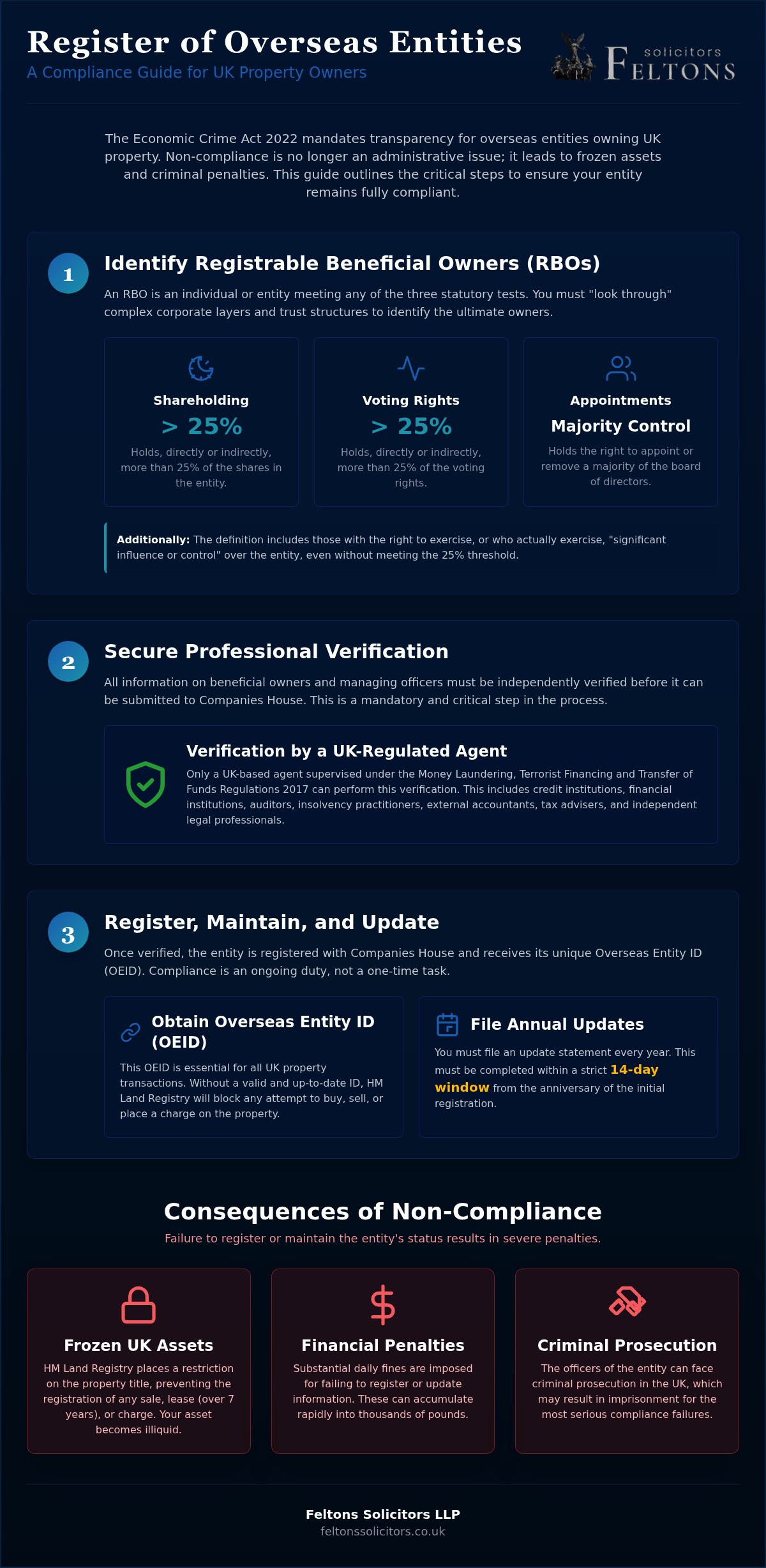
Determining who truly holds the reins of a foreign company requires more than a glance at a share certificate. This register of overseas entities guidance prioritises the accurate identification of Registrable Beneficial Owners (RBOs), a process that involves three rigorous statutory tests. An individual or legal entity is typically registrable if they meet any of the following criteria:
- Holding, directly or indirectly, more than 25% of the shares in the entity.
- Holding, directly or indirectly, more than 25% of the voting rights.
- Holding the right, directly or indirectly, to appoint or remove a majority of the board of directors.
Some individuals exert power through “significant influence or control” without holding a formal majority. This often occurs amongst family offices or private equity arrangements where veto rights or bespoke articles of association exist. If your exhaustive search yields no RBOs, you must instead provide details for every “managing officer” of the entity. Following official Companies House guidance is essential to ensure these declarations are legally sound and prevent future disputes with the registrar.
Complex Ownership and Trust Structures
Navigating chains of ownership that span multiple offshore jurisdictions is a common hurdle. You must “look through” each layer until a registrable individual or a “legal entity subject to its own disclosure requirements” is found. When trusts are part of this chain, the level of detail required increases significantly. Trustees, settlors, and even certain beneficiaries must be disclosed. If you find yourself managing a web of international interests, seeking professional legal support can clarify these opaque structures whilst ensuring your privacy is protected where the law permits.
New Rules for Trust Transparency in 2026
The landscape for trust privacy changed fundamentally on 31 August 2025, when the UK government enabled public access to trust information held on the register. Whilst this data isn’t visible on the public search by default, third parties can now apply to Companies House to view specific trust details. The Register of Overseas Entities (Protection and Trusts) Regulations 2026, which came into force in July 2026, further refined how this information is handled and protected. Under these rules, a registrable beneficial owner in the context of a trust is any person who serves as a trustee, settlor, or beneficiary, or who otherwise exercises significant control over the trust’s assets and administration.
The Critical Role of UK-Regulated Verification Agents
The integrity of the UK’s property market depends on the accuracy of the data submitted to Companies House. For this reason, the legislation strictly prohibits self-verification by the overseas entity itself. This register of overseas entities guidance emphasises that an independent, regulated professional must scrutinise every piece of information before it’s submitted. This requirement acts as a safeguard, ensuring that the transparency intended by the Economic Crime Act is actually achieved in practice.
Only “relevant persons” as defined by the Money Laundering Regulations can act as verification agents. This group primarily includes solicitors, accountants, and financial institutions regulated in the UK. Choosing the right partner is a decision that shouldn’t be taken lightly. Verification agents carry significant legal liability; providing false or misleading information is a criminal offence that can lead to unlimited fines or imprisonment. Whilst some high-volume service providers offer basic checks, a boutique law firm provides a superior level of due diligence that protects your corporate reputation and ensures absolute precision.
The Verification Process Step-by-Step
The verification journey follows a methodical three-stage path to ensure compliance. First, your agent gathers original corporate documentation, including certificates of incorporation and registers of members, to trace the ownership chain. Second, the agent conducts comprehensive “know your client” (KYC) and anti-money laundering checks on all identified beneficial owners. Finally, once satisfied, the agent issues a formal verification statement to Companies House using their unique agent assurance code. This structured approach, supported by official UK government guidance, ensures your entity receives its Overseas Entity ID without delay.
Maintaining the Integrity of the Register
Compliance is a recurring commitment rather than a one-off task. You must re-verify your information during every annual update to confirm that the beneficial ownership details remain accurate. If changes occur between filing dates, such as the transfer of shares or a change in trustees, these must be recorded and verified during the next update statement. A methodical approach prevents issues with your agent assurance code, which Companies House can revoke if they suspect negligent or fraudulent verification practices. Staying organised ensures your property assets remain liquid and your legal standing remains beyond reproach.
Managing Annual Update Statements and Removal Procedures
Registration is the initial hurdle, but the legal race continues every year. The statutory duty to file an update statement remains one of the most overlooked aspects of the regime. This register of overseas entities guidance confirms that every entity must submit a statement once every 12 months. The filing window is surprisingly tight. You have exactly 14 days from the anniversary of your initial registration to complete the submission. Missing this deadline is a criminal offence. It can also lead to a daily fine, which accumulates rapidly and creates unnecessary financial strain.
Calculating your filing period is straightforward but requires diligence. Your “update period” is the 12 months following registration or your last update. Even if your ownership structure hasn’t changed a single percentage point, you still have a legal obligation to confirm this fact with Companies House. Staying ahead of this calendar is the only way to ensure your property interests remain protected and your corporate standing remains clear. We often find that clients feel a sense of relief once a reliable tracking system is in place, as it removes the fear of accidental non-compliance.
The Annual Update Checklist
A methodical review is the best defence against compliance failures. Before filing, you should verify that your current list of beneficial owners and managing officers is exhaustive and accurate. Ensure that all personal details, including names and residential addresses, are current. If significant changes in ownership occurred during the year, you must secure fresh verification from a UK-regulated agent before the update can be accepted. This prevents the administrative blocks that can derail future transactions. For expert assistance in managing these recurring duties, you can instruct Feltons Solicitors LLP to handle your annual compliance.
Removal from the Register of Overseas Entities
Many owners wonder what happens when they no longer hold UK property. If your entity has disposed of all qualifying land interests, you may be eligible for removal from the register. This is not an automatic process. You must submit a formal application for removal, which includes a declaration that the entity is no longer a registered owner of any relevant land. Once the application is submitted, Companies House enters a processing period to verify the claim with the Land Registry. Maintaining thorough records of your property disposals is vital during this stage. Even after removal, you should retain your compliance documentation for at least seven years to satisfy any future regulatory enquiries.
Professional Legal Support for Overseas Entity Compliance
For high-net-worth property owners, the Register of Overseas Entities isn’t just an administrative hurdle; it’s a critical component of a broader wealth management and risk mitigation strategy. Large corporate firms often treat these registrations as high-volume, impersonal data entries. In contrast, a boutique firm like Feltons Solicitors LLP offers the discreet, high-standard service that complex international matters require. We provide a calm, steady presence, ensuring that your privacy is respected whilst every regulatory box is ticked with absolute precision. This register of overseas entities guidance is designed to help you move from confusion to complete confidence.
Compliance shouldn’t exist in a vacuum. By aligning your registration with broader residential property law strategies, you ensure that your assets remain liquid and ready for any future transaction. Our team specialises in the intricate details of overseas entity beneficial owner registration, allowing you to focus on your investment goals rather than administrative burdens. This integrated approach prevents the Land Registry blocks and criminal liabilities discussed earlier, providing a seamless experience from the moment of acquisition to the point of disposal.
A Tailored Approach to International Clients
We understand that our international clients operate across different time zones and diverse corporate cultures. Providing effective register of overseas entities guidance requires more than technical knowledge; it demands an appreciation for the human impact of legal work. For South African entrepreneurs, you can learn more about Express Shelf Company to ensure your domestic compliance is managed alongside your UK obligations. We act as a sophisticated guide, handling cross-border communications with the poise and dependability you expect from a trusted advisor. This people-first philosophy ensures that even the most complex or stressful property transactions feel manageable and secure under our care.
Next Steps for Your Overseas Entity
The best time to address your compliance status is before a deadline looms or a property sale is agreed. An initial consultation allows us to identify potential hurdles in your ownership structure, such as missing documentation from a foreign jurisdiction or complex trust arrangements. Whether you need to begin a new registration or submit an urgent annual update statement, our methodical process provides the security you need. Ensure your UK property assets remain secure with expert oversight by contacting our team today to discuss your specific requirements and safeguard your interests for 2026 and beyond.
Securing Your UK Property Interests for 2026
Navigating the UK property market as an international investor requires more than just capital; it demands rigorous adherence to transparency laws that are only becoming more stringent. By prioritising the accurate identification of beneficial owners and respecting the critical role of UK-regulated verification agents, you protect your assets from unnecessary freezes or legal complications. This register of overseas entities guidance provides the foundation for a compliant future, yet the practical application of these rules often requires a more personalised touch to navigate the nuances of international corporate structures.
Feltons Solicitors LLP offers the discreet, high-standard service needed to manage these complex requirements alongside your broader residential and commercial property interests. As regulated legal professionals, we provide the reassurance of absolute precision whilst maintaining the boutique level of care that high-net-worth individuals deserve. You don’t have to face these regulatory shifts alone. Instruct Feltons Solicitors LLP for your Overseas Entity Registration today to ensure your portfolio remains liquid and your reputation remains beyond reproach. We look forward to acting as your trusted advisor in these sensitive matters.
Frequently Asked Questions
What is the Register of Overseas Entities (ROE)?
The Register of Overseas Entities is a public database managed by Companies House to identify the true owners of foreign organisations holding UK property. Established under the Economic Crime Act 2022, it serves as a transparency tool to combat financial crime. Every foreign entity must register to receive a unique ID number. Without this identifier, you’ll find it impossible to buy, sell, or lease land in the United Kingdom.
Which overseas entities are required to register with Companies House?
Any legal person, such as a corporation or partnership, governed by laws outside the UK is considered an overseas entity. If your organisation owns or plans to acquire UK land, registration is a statutory requirement. This applies retrospectively to land purchased in England and Wales since January 1999. Identifying your entity type correctly is the first step in ensuring your property portfolio remains compliant with current transparency regulations.
What happens if an overseas entity fails to register its beneficial owners?
Failure to register results in a complete freeze on your property assets at HM Land Registry. You won’t be able to sell, lease, or charge the land until the entity is compliant. Beyond these civil restrictions, non-compliance is a criminal offence. The entity and its officers may face unlimited fines or prison sentences. These penalties are designed to ensure that transparency is not treated as an optional administrative task.
How often does an overseas entity need to update its registration?
Overseas entities must submit an update statement to Companies House every 12 months. This is mandatory even if your beneficial ownership structure has remained entirely unchanged since the last filing. You have a narrow 14-day window from the anniversary of your registration to complete this duty. This register of overseas entities guidance stresses the importance of punctuality, as missing this deadline can lead to immediate criminal prosecution and significant daily fines.
Can I sell my UK property if my overseas entity is not registered?
You cannot complete a property sale if your entity is not correctly registered. The Land Registry will block the transfer of title, meaning the buyer cannot become the legal owner. This often results in breached contracts and significant financial loss. It’s vital to verify your status well before a sale is agreed. Ensuring your registration is active avoids the stress of a last-minute scramble that could jeopardise your entire transaction.
Who can act as a verification agent for the Register of Overseas Entities?
Only UK-regulated professionals, such as solicitors, accountants, or financial institutions, can act as verification agents. These individuals must have a valid assurance code from Companies House to submit your data. Choosing a law firm provides a higher level of security, as solicitors are bound by strict professional standards. This ensures your data is verified with the precision required to satisfy the registrar and protect you from the consequences of inaccurate submissions.
Is information on the Register of Overseas Entities available to the public?
Most details on the register, including names and the nature of control, are visible to the public via Companies House. However, sensitive data like residential addresses and full dates of birth are kept private. Recent changes in 2025 mean that trust information is now accessible to the public upon application. If an individual faces a serious risk of harm, they can apply for their information to be protected from public disclosure entirely.
What is a “registrable beneficial owner” in the context of UK land?
A registrable beneficial owner is anyone who meets the 25% threshold for shares or voting rights in an entity. It also includes those who can appoint or remove the majority of the board of directors. This register of overseas entities guidance also covers individuals who exercise significant influence or control through other means. Correctly identifying these individuals is essential for a valid registration and requires a thorough analysis of your entity’s corporate governance.