

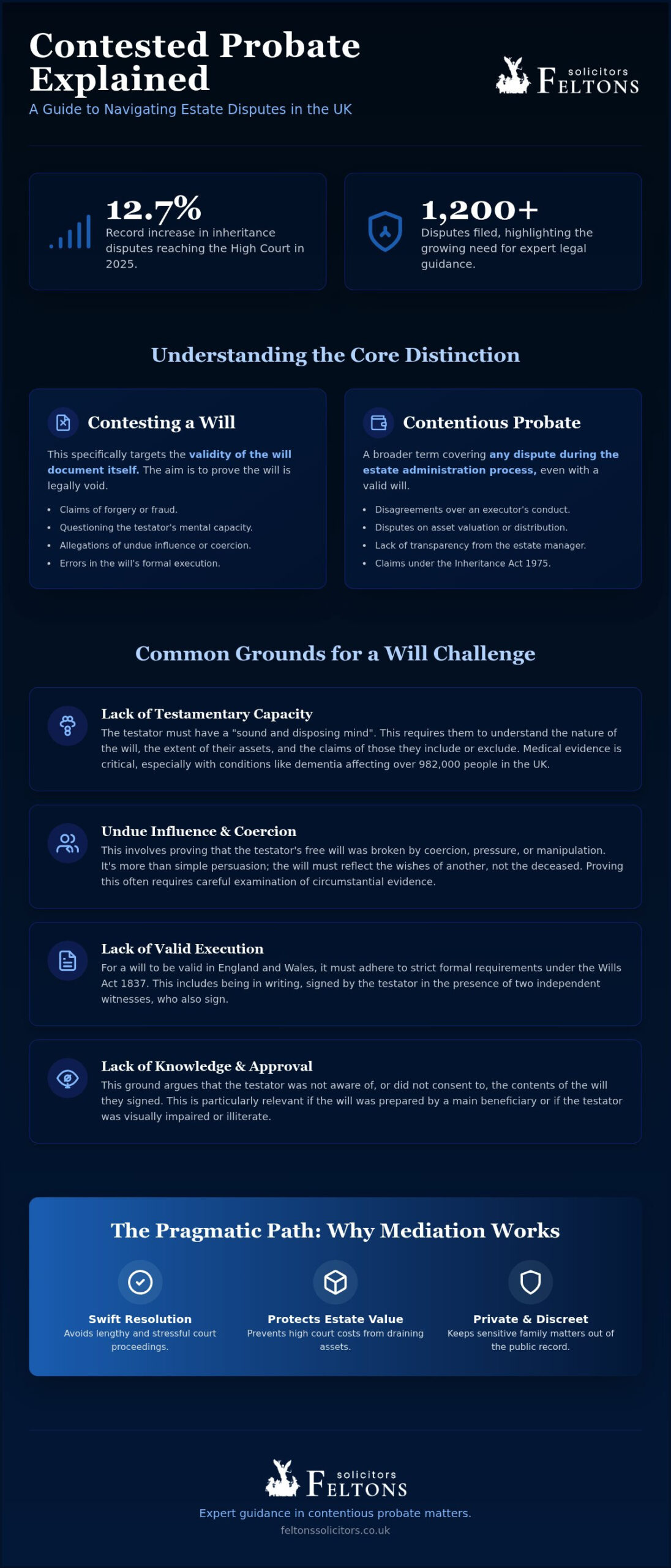
With over 1,200 inheritance disputes reaching the High Court in 2025, a record 12.7% increase from the previous year, estate litigation is no longer a rarity in the UK. Facing a legal challenge during a time of grief is incredibly draining, especially when family tensions rise and the fear of mounting costs begins to overshadow your inheritance. You’re likely looking for clarity amongst complex laws and a way to ensure the deceased’s wishes are truly honoured. Engaging experienced contested probate lawyers uk can provide the steady, professional presence you need to manage these sensitive matters with precision and care.
We understand that your priority is a fair outcome that doesn’t exhaust the estate’s value in court fees. Whether you’re seeking the removal of an incompetent executor or challenging the validity of a will, this guide outlines the essential steps for a resolution in 2026. You’ll learn how to navigate strict time limits and why mediation is often the most pragmatic path to a swift, private settlement. By focusing on strategic discretion, you can protect your interests whilst preserving what matters most.
Key Takeaways
- Understand the vital distinction between challenging a will’s validity and disputing the probate process itself to ensure your legal strategy is accurately targeted.
- Learn about the legal requirements for testamentary capacity and why securing medical evidence early is essential for a robust claim.
- Explore how experienced contested probate lawyers uk utilise mediation to resolve disputes swiftly whilst preventing high court costs from draining the estate’s value.
- Gain clarity on the “costs follow the event” rule and how to navigate the financial risks associated with inheritance litigation in 2026.
- Discover the benefits of a pragmatic, people-first approach that focuses on achieving a fair distribution of assets through discreet and professional negotiation.
Understanding Contested Probate in the UK
Contentious probate refers to any legal disagreement arising during the administration of a deceased person’s estate. It’s a broad term that encompasses far more than just arguments over a final testament. Whilst many people use “contesting a will” and “contested probate” interchangeably, they represent distinct legal challenges that require different strategic approaches. Seeking the guidance of contested probate lawyers uk early in the process is a pragmatic way to protect the estate’s value and ensure your interests are professionally represented during a sensitive time.
Contested Probate vs. Contesting a Will
Contesting a will specifically targets the validity of the document itself. This might involve claims of forgery, lack of testamentary capacity, or undue influence during the document’s creation. In contrast, contentious probate covers a wider range of issues, such as the conduct of an executor or disagreements over how assets are being managed and distributed. Both areas require specialist estate planning knowledge to navigate the nuances of the law effectively. Understanding which path your dispute falls under is the first step toward a resolution.
When Does an Estate Administration Become Contentious?
Disputes often begin with subtle red flags that suggest the administration isn’t proceeding as it should. You might notice a lack of transparency from the person managing the estate or experience unexplained delays in receiving basic information. Common triggers include the discovery of unexpected beneficiaries or the realisation that significant assets appear to be missing from the inventory. In many instances, a claimant might feel they were unfairly excluded from a will, leading them to seek relief under the Inheritance (Provision for Family and Dependants) Act 1975.
Disagreements amongst beneficiaries regarding the valuation of unique assets, such as property or private business interests, can also stall the process. If a resolution isn’t immediately visible, a “caveat” can be lodged at the Probate Registry. This formal notice prevents the court from issuing a Grant of Probate, effectively pausing the administration whilst the dispute is settled. This is often a necessary safeguard to ensure that assets aren’t distributed incorrectly whilst legal questions remain unanswered. Expert contested probate lawyers uk can help you determine if a caveat is the right tool for your specific situation.
Taking legal action isn’t about being aggressive; it’s about ensuring the deceased’s true intentions are honoured and that the estate is handled with integrity. Early intervention often prevents minor misunderstandings from escalating into costly, long-term litigation.
Common Grounds for Contesting Probate and Wills
For a will to be legally binding in England and Wales, it must adhere to strict formalities. It must be in writing, signed by the testator, and witnessed by two independent adults. Beyond these technicalities, the testator’s mental state and intentions are equally critical. If you suspect these standards weren’t met, consulting professional legal advisors can help clarify your options. One often overlooked ground is “Knowledge and Approval,” which requires proof that the deceased truly understood and consented to the specific contents of the will. This is particularly relevant if the document was drafted by a beneficiary or if the testator had significant sensory impairments.
Lack of Testamentary Capacity and Undue Influence
Under the criteria established in Banks v Goodfellow (1870), a testator must understand the nature of their will, the extent of the assets they are distributing, and the moral claims of those they are excluding. Capacity disputes often hinge on medical evidence; with 982,000 people in the UK currently living with dementia, medical records have become the cornerstone of many modern claims. Expert contested probate lawyers uk use these records to determine if the testator possessed a “sound and disposing mind” at the moment of execution.
Undue influence represents a different challenge. Legally, there is a sharp distinction between “influence,” which is common in families, and “undue influence,” which involves coercion that breaks the testator’s free will. Proving this requires showing that the will does not reflect the deceased’s actual wishes, but rather the demands of another. Because coercion often happens behind closed doors, these cases require a meticulous review of circumstantial evidence and witness testimony.
Inheritance Act 1975: Reasonable Financial Provision
Even a valid will can be challenged if it fails to make “reasonable financial provision” for certain individuals. Under the Inheritance (Provision for Family and Dependants) Act 1975, spouses, civil partners, children, and those financially dependent on the deceased can bring a claim. The court’s assessment of “reasonable” varies. For a spouse, the standard is usually higher than for other dependants, who are typically limited to provision for their maintenance. Specialist support from contested probate lawyers uk is often the most effective way to quantify these claims and negotiate a fair settlement.
Time is the most significant factor here. Claims must be filed within six months of the Grant of Probate. Missing this deadline often means losing the right to claim entirely. If you’re considering a challenge, the first step is often stopping a probate application by entering a caveat. This provides the necessary time to investigate the grounds for your dispute without the estate being distributed prematurely.
The Legal Process of Resolving Estate Disputes
Resolving an inheritance dispute requires a methodical approach that balances legal rigour with emotional sensitivity. Whilst the image of a dramatic courtroom battle is common, the reality of modern estate litigation in the UK is far more measured. The process typically begins with a formal Letter of Claim, which clearly outlines the legal grounds for the challenge and the evidence supporting it. If the dispute involves the circumstances under which a will was drafted, Challenging a will often involves requesting a “Larke v Nugus” statement from the original drafting solicitor to gain clarity on the deceased’s intentions.
In situations where family members are at an impasse, appointing a professional executor can be a pragmatic solution. These neutral third parties manage the estate administration with total impartiality, ensuring that assets are protected whilst the underlying legal issues are resolved. This step often prevents the “pot” of assets from being diminished by ongoing conflict. Expert contested probate lawyers uk act as sophisticated guides through these stages, ensuring every procedural requirement is met whilst maintaining a focus on a swift resolution.
The Role of Mediation and Alternative Dispute Resolution
Over 95% of UK probate disputes are settled through Alternative Dispute Resolution (ADR) before they ever reach a full court hearing. Mediation is the most common form of ADR; it involves a neutral third party facilitating a private discussion between the parties to reach a mutually acceptable agreement. This approach is highly effective for high-value estates where privacy is paramount. Unlike a court trial, which is a matter of public record, mediation allows sensitive financial and family details to remain confidential. It is a discreet way to reach a settlement that respects the deceased’s legacy whilst providing beneficiaries with a certain, final outcome.
Entering a Caveat: Preventing the Grant of Probate
A caveat is a powerful procedural tool that prevents the Probate Registry from issuing a Grant of Probate. It essentially pauses the administration of the estate, giving parties time to investigate potential claims. Once a caveat is in place, the person seeking the Grant can issue a “Warning.” This requires the person who entered the caveat to file an “Appearance” within eight days to explain their interest in the estate. Entering a caveat without merit can lead to cost penalties, so it’s a step that should only be taken with the advice of contested probate lawyers uk. When used correctly, it ensures the estate isn’t distributed whilst legitimate questions remain unanswered.
Navigating the Costs and Timelines of Litigation
One of the most persistent myths in estate litigation is that the estate always pays the legal fees. In reality, the court follows the general principle that costs follow the event. This means the unsuccessful party is typically ordered to pay a significant portion of the winner’s legal costs. For this reason, contested probate lawyers uk place immense value on early, pragmatic risk assessments. Whilst the court has discretion to order costs from the estate, this is usually reserved for cases where the deceased’s own actions, such as an ambiguous will, caused the litigation. If the court finds a claim was brought without merit, the individual claimant may be held personally liable for the expenses.
Resolving a dispute is rarely an overnight process. A straightforward claim settled via mediation might conclude within six to nine months. However, if a case proceeds to a full High Court trial, the timeline can easily extend to eighteen months or two years. These delays often stem from the time required to gather medical records, witness statements, and expert reports. If you are concerned about the financial implications of a dispute, speaking with our litigation and dispute resolution experts can provide the clarity you need to proceed with confidence.
Assessing the Merits of Your Claim
Before a claim is issued, a solicitor will often make a “Larke v Nugus” request. This allows for the collection of information from the professional who drafted the will, providing vital insight into the testator’s intentions and the circumstances of the signing. This evidence is a cornerstone of any merit assessment. We also evaluate the proportionality of the claim; it is rarely in a client’s interest to pursue a dispute where the projected legal costs outweigh the potential inheritance. A pragmatic early assessment ensures that your resources are focused on achievable, fair outcomes rather than speculative legal battles.
Time Limits and the Statute of Limitations
As previously noted, claims under the Inheritance Act 1975 must be brought within six months of the Grant of Probate. However, other claims have different windows. For example, a claim for a share of a person’s estate under a will or the rules of intestacy typically has a twelve-year limit. Despite these longer statutory periods, the court does not look favourably on those who stand idly by. If you wait several years whilst the estate is distributed and assets are spent, the court may strike out your claim under the doctrine of laches. Urgency is essential to preserve the estate’s assets and ensure witnesses’ memories remain fresh. Seeking counsel immediately upon discovering a potential dispute is the most effective way to safeguard your position.
Why Feltons Solicitors for Contentious Probate Matters
Choosing the right contested probate lawyers uk is a decision that impacts both your financial future and your family’s long-term harmony. Feltons Solicitors LLP, established in 2010 by Paula Felton, combines modern legal delivery with traditional professional values. We position ourselves as a discreet partner for those facing sensitive family matters, providing a boutique level of care that prioritises personal connection over high-volume processing. This people-first philosophy remains at the heart of our practice, guiding every case we handle, whether we are assisting with complex probate litigation or divorce and financial arrangements.
A Discreet and Pragmatic Approach to Disputes
We act as a steady, calm presence during what is often one of the most stressful periods of a client’s life. Our approach is rooted in the belief that litigation should be a tool for resolution, not an end in itself. By focusing on bespoke, tailored solutions, we ensure that the specific nuances of your situation are understood and addressed. We don’t believe in a one-size-fits-all methodology. Instead, we serve as a sophisticated guide, weighing the human impact of every legal strategy alongside its technical merits. This pragmatic mindset helps us avoid unnecessary conflict whilst securing the best possible outcome for our clients. As a trusted advisor, we value your privacy and personal rapport, ensuring that every step taken is in your best interests.
National Expertise for Complex Estates
Whilst we maintain a boutique feel, our experience is global in scope. We possess the worldly expertise necessary to handle complex, high-value disputes for both national and international clients. This includes resolving matters involving overseas entities, intricate trust structures, and unique asset portfolios that require a sophisticated level of legal analysis. We are fully equipped to represent your interests in any UK court or mediation centre, providing a consistent standard of high-end reliability regardless of your location. Our firm is deeply rooted and community-conscious, yet we have the reach to handle international-scale matters with ease. We understand that high-net-worth estates often involve cross-border complications that demand a higher standard of service. We invite you to contact us for a confidential consultation to discuss the unique complexities of your estate dispute and how we can help you navigate them with confidence.
Securing Your Inheritance with Strategic Guidance
Navigating an inheritance dispute requires more than just legal knowledge; it demands a partner who understands the delicate balance between protecting assets and preserving family relationships. By identifying grounds for a claim early and utilising procedural tools like caveats, you can ensure the estate is managed with integrity. Whilst the prospect of litigation is daunting, the rise in mediation offers a private, cost-effective alternative to the public courtroom.
As a boutique firm established in 2010, Feltons Solicitors LLP provides the high-end, tailored support necessary for complex litigation. We are specialists in dispute resolution with a national reach, yet we maintain a people-first philosophy that prioritises your personal well-being. Our team acts as a sophisticated guide, helping you assess the merits of your case whilst avoiding unnecessary expenditure. If you are facing an estate disagreement, engaging experienced contested probate lawyers uk is the most pragmatic step toward a fair distribution.
Contact Feltons Solicitors today for discreet, professional advice on your probate dispute. We are here to provide the steady, reliable presence you need to resolve these matters with confidence.
Frequently Asked Questions
What is the difference between contested probate and contesting a will?
Contesting a will specifically challenges the document’s legal validity, such as claims of forgery or lack of capacity. Contested probate is a broader term covering any dispute during the estate administration, including the conduct of executors or the valuation of assets. Experienced contested probate lawyers uk can assist with both, ensuring that either the document itself or the subsequent distribution process adheres to strict legal standards.
How long do I have to contest probate in the UK?
The time limit depends entirely on the type of claim you’re bringing. For claims under the Inheritance Act 1975, you must file within six months of the date the Grant of Probate is issued. Challenges to a will’s validity technically have no statutory limit, but waiting too long can be fatal. If the assets have already been distributed amongst beneficiaries, the court may refuse to hear your case.
Can an executor be removed if they are not acting properly?
Yes, the court has the authority to remove an executor who is found to be incompetent, dishonest, or causing significant delays. This usually requires an application under Section 50 of the Administration of Justice Act 1985. You must provide evidence that the estate’s welfare is at risk. Replacing a difficult executor with a neutral professional is often a pragmatic way to ensure the deceased’s wishes are finally honoured.
Who pays the legal costs in a contested probate case?
The general rule in UK litigation is that costs follow the event, meaning the unsuccessful party usually pays the winner’s legal fees. It is a common misconception that the estate always covers these expenses. If a claim is found to be without merit, the individual bringing the challenge may be held personally liable. Consulting contested probate lawyers uk for a merit assessment is vital to avoid significant financial risk.
Do I have to go to court to resolve an inheritance dispute?
No, the vast majority of inheritance disputes are resolved through Alternative Dispute Resolution without ever reaching a courtroom. Mediation is a highly successful method where a neutral third party helps all sides reach a private settlement. This approach is often preferred because it’s faster, less expensive, and keeps sensitive family financial details off the public record. It allows for a more flexible and empathetic resolution than a judge’s ruling.
Can I contest a will if I was left out of it entirely?
You can bring a claim if you fall into a specific category of eligible persons under the Inheritance Act 1975. This includes spouses, civil partners, children, and anyone who was being financially maintained by the deceased. The court will examine whether the will made reasonable financial provision for your needs. These cases are complex and require a detailed review of your financial position and your relationship with the deceased.
What happens to the estate whilst probate is being contested?
The administration of the estate is typically paused to ensure assets aren’t distributed whilst their ownership is in question. Entering a caveat is the standard procedural step to stop the Grant of Probate from being issued. In some instances, the court might appoint a professional administrator to manage assets like property or investments. This prevents the estate’s value from diminishing whilst the parties work toward a final legal resolution.
What is a Larke v Nugus statement and do I need one?
A Larke v Nugus statement is a formal response from the solicitor who prepared the will, detailing the circumstances of its execution. It’s an essential piece of evidence if there are concerns about the testator’s mental capacity or potential undue influence. Your legal advisor will request this statement early in the dispute. It provides a clear, professional account that often helps determine the merits of a claim before formal litigation begins.