

A disputed will does not automatically mean the estate will be distributed under intestacy rules. In England and Wales, what makes a will invalid can include lack of testamentary capacity, coercion, fraud or forgery, or failure to meet the signing and witnessing requirements. If a court declares the will invalid, an earlier valid will may apply. If there is no earlier valid will, the estate may pass under intestacy rules.
It is understandable to worry that a problem with a will could change who inherits, but the reason for the challenge matters. This article explains how capacity, signing and witnessing, and undue influence affect validity, then sets out what may happen to the estate. It also explains how the outcome can differ depending on whether an earlier valid will exists or intestacy rules apply.
Key Takeaways
- Understand how testamentary capacity affects whether a will can stand, including the importance of the will-maker’s understanding when it was made.
- Learn which signing and witnessing requirements matter when assessing a will’s validity.
- Recognise how pressure, coercion, fraud or forgery may lead to a challenge.
- See how an earlier valid will or intestacy rules may determine what happens to the estate next.
What is testamentary capacity and why does it matter?
Capacity concerns whether the person making a will could make that decision when the document was executed. It can be central to a challenge about what makes a will invalid in the UK.
Testamentary capacity and mental capacity
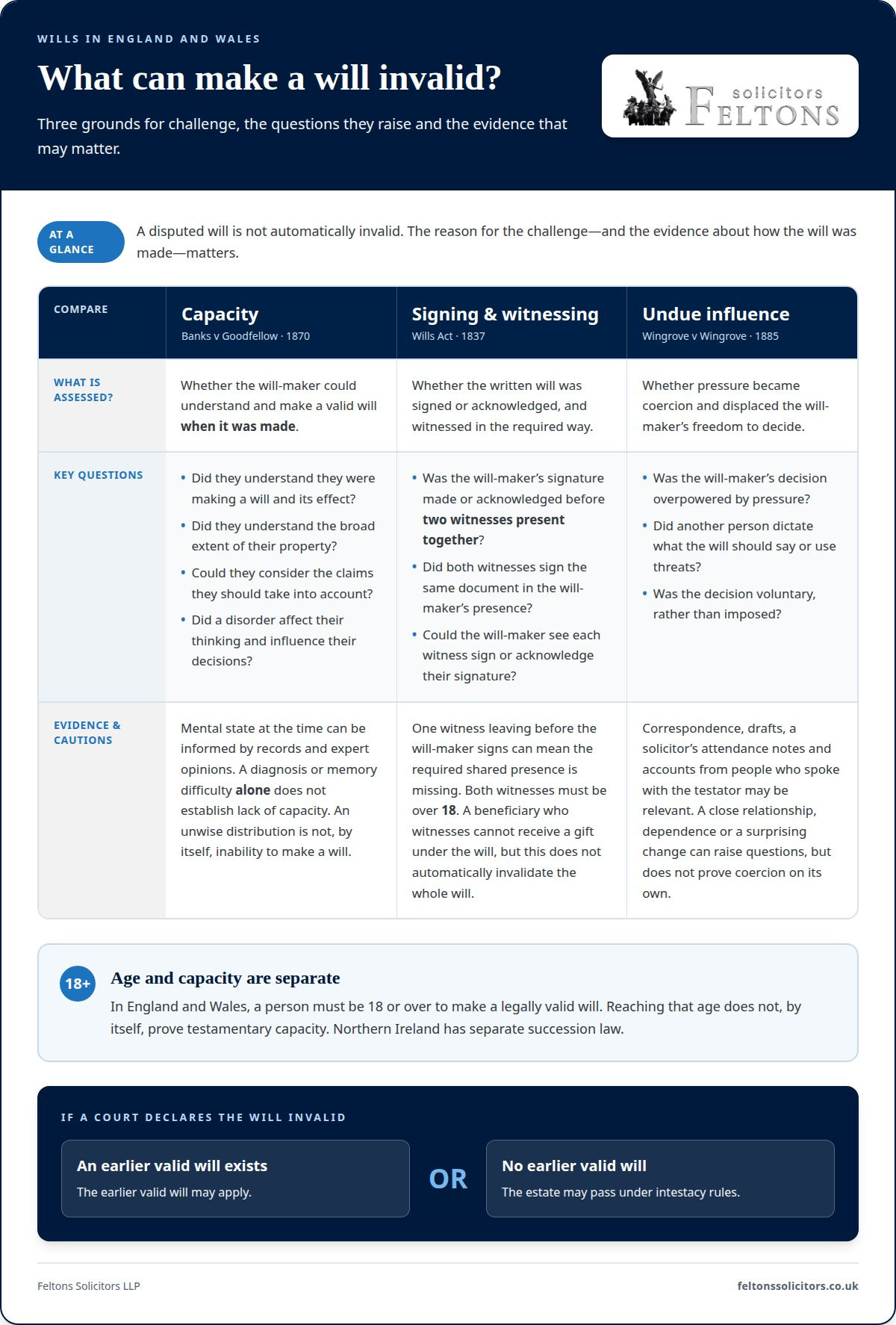
Testamentary capacity is the mental ability to understand and make a valid will. A diagnosis or memory difficulty alone does not establish that capacity was absent. The relevant question is what the person understood when making the will. Evidence about their mental state at the time can affect whether the estate is distributed under the disputed will or another route.
The Banks v Goodfellow test
Banks v Goodfellow, a case from 1870, established the test courts apply to assess testamentary capacity. It considers whether the will-maker understood they were making a will and its effect, the broad extent of their property, and the claims they should consider. A disorder affecting their thinking may also matter if it influenced the decisions made. The test helps distinguish an unwise distribution from an inability to make a will.
Age and capacity to make a will
Age and mental capacity are separate requirements: reaching the required age doesn’t by itself prove capacity. According to GOV.UK, a person must be 18 or over to make a legally valid will. Northern Ireland has separate succession law, so the England and Wales rules described here shouldn’t be treated as its full requirements. A later valid will generally revokes an earlier one; a codicil can change it, but changes must follow the same signing and witnessing process.
Medical review and susceptibility to influence
An expert medical review can assess capacity and susceptibility to undue influence using medical records and other evidence. In England and Wales, records and expert opinions are frequently used when capacity is challenged. An expert medical advisor may discuss the will-maker’s capacity or susceptibility to undue influence by telephone for 30 minutes. Costs and timescales for a challenge depend on its evidence and complexity, and whether negotiation resolves the dispute or court proceedings are needed.
Will signing and witnessing requirements
In England and Wales, the execution formalities determine whether a written will can be relied on. A missing signature or flawed witnessing process may provide grounds for a challenge.
Formal signing requirements
According to UK Parliament, the Wills Act 1837 sets out the requirements for a legally valid will in England and Wales. The will must be in writing, and the person making it must sign or acknowledge their signature before two witnesses present together. These formalities matter because an unwitnessed document, or a signature made without the witnesses seeing it, may not be properly executed.
Witnessing and proper execution
Proper execution requires the witnesses to sign the same document in the person making the will’s presence. The person making it must be able to see each witness sign or acknowledge their signature. GOV.UK says both witnesses must be over 18. The witnesses need not sign at precisely the same moment as each other, but both must be present with the will-maker when the will is signed or acknowledged.
For example, if one witness leaves before the will-maker signs, the required shared presence is missing. A solicitor may help prepare and oversee the signing, but the circumstances of execution still matter. Later changes to the document must follow the same signing and witnessing process. Handwritten alterations alone may not take effect as intended.
Beneficiaries as witnesses
A beneficiary or their married partner can witness a will, but the beneficiary cannot receive a gift under it. This restriction affects the gift to that witness or partner, rather than automatically invalidating the entire will. If a challenge concerns an inheritance, the will’s other provisions may still operate if the execution requirements were otherwise met.
Independent witnesses who are not beneficiaries help avoid this complication. If a gift is affected, the estate may need to be administered without that benefit, even though the document remains relevant. Advice on wills and estate planning can help clarify how execution problems affect a will’s validity.
Undue influence and coercion
A will must reflect the testator’s voluntary wishes, rather than another person’s imposed instructions. In Wingrove v Wingrove, an 1885 case, undue influence was described in law as coercion. Ordinary persuasion or a family discussion about inheritance does not, by itself, show that coercion occurred. The central concern is whether pressure overpowered the will-maker’s freedom to decide.
Influence can take different forms. A relative, for example, might threaten to withdraw essential care unless the testator changes a gift, or repeatedly dictate what the will should say. A close relationship, dependence or a surprising change to the will may raise questions, but none proves coercion on its own. The circumstances surrounding the decisions and signing must be considered together.
Evidence can help establish how the will was prepared and whether the testator expressed independent wishes. Relevant material may include correspondence, drafts, a solicitor’s attendance notes and accounts from people who spoke with the testator. A sudden change that benefits the person who arranged the appointment may warrant scrutiny, especially if that person controlled access or communication. The detail and reliability of each account matter.
After the testator’s death, someone disputing the will can raise concerns through a probate challenge. The question is not simply whether the distribution seems unfair, but whether coercion displaced the testator’s own decision. Legal advice can help assess the evidence, identify gaps in the account of how the will was prepared, and explain whether negotiation may resolve the dispute. If the parties cannot agree, a court decides whether the will is valid. A clear record of the testator’s wishes, drafting discussions and signing circumstances can therefore be important.
Distribution after a will is declared invalid
If a court declares a will invalid, the estate may still pass under an earlier valid will. If no earlier valid will applies, the estate is distributed under intestacy rules. The reason for invalidity matters because it determines whether another signed will can take effect or whether statutory inheritance rules apply instead.
Under the intestacy rules described for England and Wales, a surviving spouse with children receives personal possessions and the first £322,000 of the estate, plus half of anything above that amount. For example, if the estate is worth more than £322,000, the spouse receives half the excess; the children share the other half. The nature of the family and estate therefore affects who inherits.
If the person died without children but had living parents or siblings, those relatives may inherit a share under intestacy. The personal representatives administer the estate under the applicable rules, rather than following gifts in the invalid will. The dispute may be resolved through negotiation. If the parties cannot agree, the court decides whether the will is legally valid.
Marriage can revoke an existing will unless it was made in contemplation of that marriage. Divorce or dissolution of a civil partnership can revoke provisions relating to the former spouse or partner, unless the will expressly provides otherwise. These changes can affect which document is present and legally operative when the estate is distributed.
Scotland has separate succession law, so the England and Wales rules in this section do not determine whether a Scottish will is valid. Capacity, whether the will reflects the maker’s voluntary wishes, and proper execution are relevant issues, but their legal effect must be assessed under Scottish law.
If a disputed will could change who inherits, discuss the estate and probate options with Feltons Solicitors LLP.
Feltons Solicitors LLP: Wills, Probate, and Estate Planning
Feltons Solicitors LLP provides Wills, Probate, and Estate Planning support when questions arise about a will’s validity or an estate’s administration. If a will is challenged, the outcome may affect which document applies and how beneficiaries inherit. Advice can help you understand the probate issues and options relevant to your circumstances.
Support is also available with making or updating a will, so your wishes are recorded clearly and the document is prepared with care. This can be useful after a major life change or when your estate arrangements need review.
For help with a will or estate matter, contact Feltons Solicitors LLP.
Take a considered next step
Understanding what can make a will invalid in the UK is a starting point, not a decision about what should happen next. The practical priority is to understand how the dispute affects the estate and any connected family or property arrangements. Keeping those wider considerations in view can help you approach the next decisions with greater clarity.
Feltons Solicitors LLP provides Wills, Probate, and Estate Planning, alongside Divorce and Financial Arrangements and Residential and Commercial Conveyancing. These services may be relevant when questions about an estate sit alongside family finances or property matters. The appropriate focus depends on the issues involved and what you need to resolve.
If you would like to discuss your circumstances and possible next steps, contact Feltons Solicitors LLP. A measured conversation can help you decide how to proceed.
Frequently Asked Questions
What Happens If a Will Is Invalid?
If a will is declared invalid, an earlier valid will may govern the estate. If there is no earlier valid will, intestacy rules determine who inherits. The personal representatives administer the estate under whichever route applies. Gifts in the disputed document may not be made, and the people entitled to inherit may differ from those named in it.
Can an invalid Will be contested and changed?
A will-maker who is still alive can make a new will or a codicil, provided it is validly executed. After death, beneficiaries cannot simply edit the will to change its gifts. They can dispute its validity, and the parties may resolve the dispute through negotiation. If they cannot agree, a court decides whether the will is valid.
What Makes a Will Legally Valid in the UK?
Requirements depend on which part of the UK applies; the rules here describe England and Wales. The will must be written, made voluntarily by someone with testamentary capacity, and signed or acknowledged before two witnesses present together. According to GOV.UK, the will-maker must be at least 18, and both witnesses must be over 18. Correct execution matters even for an online will.
What are grounds for challenging the validity of a Will?
Grounds can include lack of testamentary capacity, coercion, fraud, forgery, or defective signing and witnessing. A challenge may also arise if a newer valid will revoked the document being relied on. The concern must relate to a legal requirement or the circumstances in which the will was made, not simply disagreement with its distribution. Evidence is central to assessing the claim.
Can a Will be contested after probate has been granted?
A grant of probate does not prevent a dispute about whether the will is valid. The people involved may try to resolve the issue through negotiation. If they cannot reach agreement, a court decides validity. Because the grant may already allow estate administration to proceed, a dispute can raise practical questions about distributions or actions already taken by the personal representatives.
Can a Will be invalidated if it was not properly executed?
Yes. In England and Wales, failure to follow the required signing and witnessing formalities can provide grounds to challenge a will’s validity. For example, the witnesses must be present together when the will-maker signs or acknowledges the signature. A court considers whether the document met the legal requirements. Any concern about one signature should be assessed in the context of the will’s execution as a whole.