

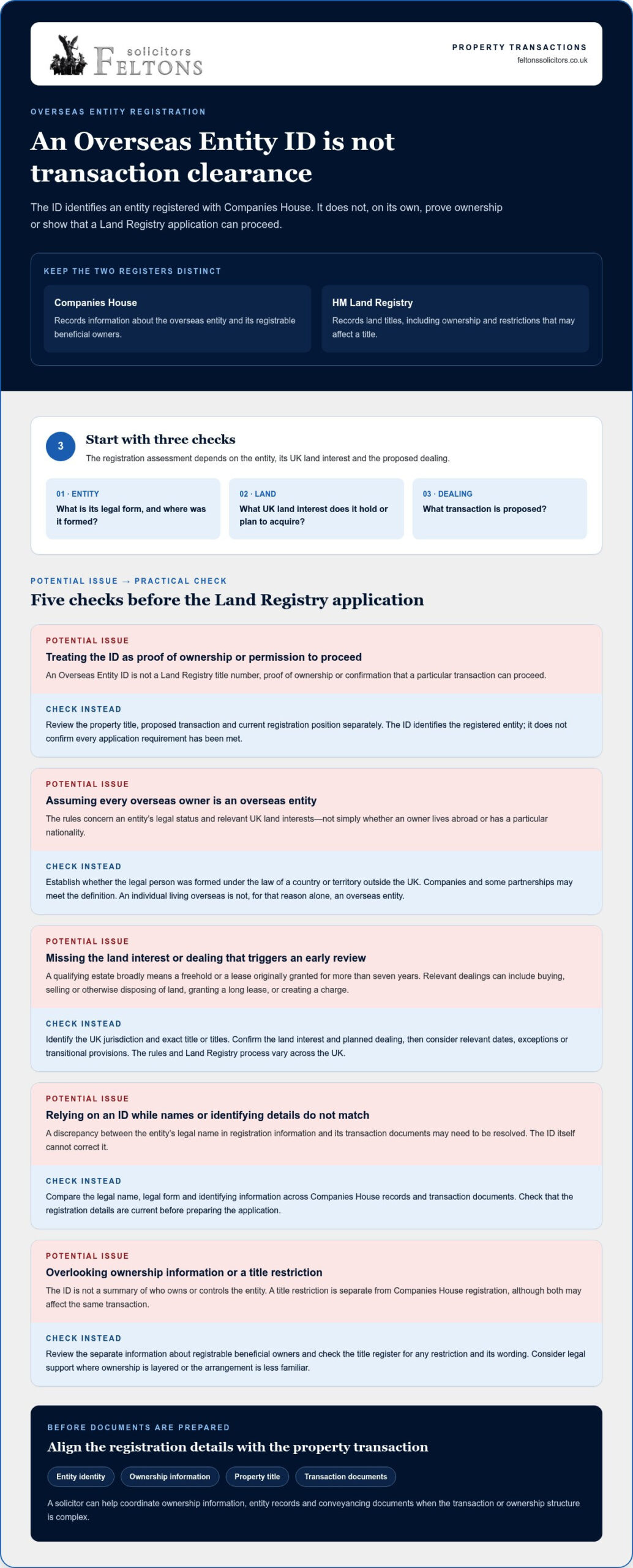
An Overseas Entity ID is a registration reference, not a green light for a UK property transaction. The land registry overseas entity ID requirements involve registering the entity with Companies House and checking that its details support the Land Registry application. An ID alone does not resolve inconsistencies or fill gaps in the information needed for a transaction.
To assess whether the rules apply, look at the entity’s legal status, its UK land interests and the activity proposed. Companies House registration and a Land Registry application are separate steps, so check that the relevant details align before documents are prepared. Doing this early can help identify issues before they affect an application.
This 2026 checklist explains when an Overseas Entity ID may be needed, what information to prepare and what to review before an application is made. It also covers how to check registration details and where legal support can help. Feltons Solicitors LLP advises on overseas entity registration and complex property transactions, helping clients coordinate registration information and conveyancing documents.
Key Takeaways
- Start by reviewing the entity’s UK land interests and proposed transaction to establish which requirements may apply.
- Use the land registry overseas entity ID requirements checklist to organise the registration and transaction details before applying.
- Compare the entity’s legal name, form and identifying information across Companies House records and transaction documents.
- Check that registration details are current, then review the property title restriction and transaction type before preparing the Land Registry application.
- A solicitor can help coordinate ownership information, entity records and conveyancing documents when the transaction or ownership structure is complex.
What does a Land Registry overseas entity ID prove?
An Overseas Entity ID is the reference issued by Companies House when an overseas entity is entered on the Register of Overseas Entities. It identifies the registered entity. It is not a Land Registry title number, proof of ownership or confirmation that a particular property transaction can proceed.
The two registers serve different purposes. Companies House records information about the overseas entity and its registrable beneficial owners. HM Land Registry records land titles, including ownership and restrictions that may affect a title. An ID may be necessary for a property transaction, but it does not show that every registration or application requirement has been met. Check the title, proposed transaction and current registration position separately.
Which overseas entities are within the registration rules?
An overseas entity is a legal person formed under the law of a country or territory outside the UK. Companies and some partnerships may meet this definition. The rules concern the entity’s legal status and relevant UK land interests, not simply whether an owner lives abroad or has a particular nationality.
An individual who lives overseas is not, for that reason alone, an overseas entity. However, an individual may be a beneficial owner of an entity, which is a separate part of the registration analysis. The entity’s legal form and the law under which it was formed can affect whether the rules apply. Less familiar arrangements and layered ownership structures may need case-specific legal analysis before a transaction proceeds.
What is the difference between an entity ID and an owner’s details?
The ID is a reference for the registered entity. It is not a summary of the people who own or control it, and it does not replace the information required about registrable beneficial owners. Those details are assessed separately as part of the registration process.
Beneficial ownership analysis looks at relevant information about people or legal entities that own or exercise control over the overseas entity. The assessment depends on the structure and applicable rules. An ID alone does not establish that ownership information is complete, current or suitable for the transaction.
- Entity identity: the overseas entity’s legal name and form.
- Entity reference: the Overseas Entity ID issued after registration.
- Ownership and control: the separate information required about registrable beneficial owners.
When checking the land registry overseas entity ID requirements, keep these elements distinct. A mismatch between the entity’s legal name in registration information and its transaction documents may need to be resolved. The ID itself cannot correct that discrepancy. Feltons Solicitors advises on overseas entity registration and complex property transactions, helping clients align ownership information with conveyancing documents.
Who needs an overseas entity ID for a UK property transaction?
Start with three questions: what kind of entity is involved, what interest in UK land does it hold or plan to acquire, and what transaction is proposed? Under the overseas entities regime, a legal entity governed by the law of a country or territory outside the UK may need to register if it owns or seeks to acquire a qualifying estate. Broadly, this means a freehold or a lease originally granted for more than seven years. The rules and Land Registry process vary across the UK, so identify the relevant jurisdiction before assessing the transaction.
This is a starting point, not a universal answer. The land registry overseas entity ID requirements can depend on the property interest, transaction date, title and applicable exemptions or transitional provisions. The regime also covers certain earlier acquisitions, with relevant dates varying across the UK. Review the transaction and title rather than relying on a general summary.
Which property dealings should prompt an early eligibility check?
Check the position early if an overseas entity is buying a qualifying estate, selling or otherwise disposing of relevant land, granting a long lease, or creating a charge over it. The effect of the rules depends on the dealing and circumstances. Having an ID does not automatically satisfy every Land Registry requirement.
Review the property title alongside the Companies House registration. A restriction on a title is a Land Registry entry that can limit registration of specified dispositions unless its stated condition is met. It is separate from registration on the Register of Overseas Entities, although both may affect the same transaction.
- Identify the relevant UK jurisdiction and exact title or titles.
- Confirm whether the entity owns or proposes to acquire a freehold or qualifying lease.
- Describe the planned dealing, such as a transfer, lease or charge.
- Review the title register for a restriction and note its wording.
- Check relevant dates and whether an exception or transitional provision may apply.
How can ownership structures change the assessment?
Look beyond the name shown on the title. An overseas entity may be owned through several companies, or control may be exercised through arrangements that are not obvious from a simple ownership chart. Registration analysis must identify any registrable beneficial owners under the applicable tests. Shareholders and directors are not automatically decisive in every case.
Trust arrangements need particular care. Depending on the facts and rules, trustees and other people connected with a trust may be relevant to the ownership or control assessment. The treatment differs between structures. Record the chain of ownership and control, and flag trusts, intermediate entities or disputed control for legal analysis before preparing documents.
Where the structure or title raises questions, overseas entity registration and conveyancing support can help align the ownership analysis with the proposed property dealing and its Land Registry requirements.
What information should you check before relying on an overseas entity ID?
Review the details before relying on the ID in a property transaction. A valid-looking reference could be linked to the wrong entity, or the records may no longer reflect its legal name or ownership structure. The land registry overseas entity ID requirements are one part of the check: compare the Companies House record with the title and transaction documents.
Consistent records make it easier to show that the registered entity, property title and application documents refer to the same legal person. Differences in spelling, legal form or identifying details may need an explanation or correction. Deal with discrepancies early rather than waiting until the application is being prepared.
How should the entity’s registration details be checked?
Start with the Companies House Register of Overseas Entities. Find the entity and compare its record with the proposed transfer, lease or charge. Check the exact legal name and form, then confirm that the Overseas Entity ID belongs to that entity, not another group company with a similar name. Review the registration details for changes since the ID was issued.
Check the entity’s current position as well as its original registration. Overseas entities must file an annual update statement within 14 days of each registration anniversary, even if there have been no changes. Review the Companies House record for the latest filing and the next update date. Confirm the evidence and checking process required for the particular application against current Companies House and HM Land Registry guidance.
What owner and control information may need attention?
Compare the ownership and control information on the register with the entity’s current structure. Trace intermediate companies and consider whether changes in ownership, control or relevant personal details have been reflected in the required filings. Investigate missing or inconsistent entries rather than assuming they are immaterial. Trust arrangements may also require careful analysis. The people and information relevant to the disclosure depend on the circumstances and applicable rules.
- Match the entity: compare the exact legal name, legal form and identifying details across the Companies House record and transaction documents.
- Check the ID: confirm it is recorded against the entity that will be party to the transaction.
- Review current status: check registration details, the latest update statement and its next due date.
- Compare ownership: review beneficial owner and control information against the current structure, noting changes or uncertainties.
- Check the property records: examine the relevant HM Land Registry title information and ensure the application documents address any restriction.
- Organise supporting material: keep relevant records together and submit sensitive information only through the appropriate official process.
For complex structures, a solicitor can help reconcile entity records, beneficial ownership information and conveyancing documents before an application is lodged. This review can identify inconsistencies early and clarify which points need further attention under the current rules.
How do overseas entity ID requirements affect a Land Registry application?
Companies House registration and a Land Registry application are separate steps. Companies House records the overseas entity and issues its Overseas Entity ID. HM Land Registry deals with the property title and applications to register transactions. Having an ID does not, by itself, establish that an application meets the requirements for the title or the particular dealing.
The land registry overseas entity ID requirements need to be considered alongside the title register, transaction and supporting documents. A restriction on the title may specify conditions that must be satisfied before a disposition can be registered. Its wording matters. Do not assume that the same evidence or process applies to every sale, lease, charge or other dealing.
What should be checked on the title and application?
Begin with the current title information and identify any restriction referring to an overseas entity. Compare the registered proprietor and transaction parties with the Companies House details. A group may have several overseas companies with similar names, so confirm that the ID belongs to the legal entity named in the transaction and title records.
Next, establish which Land Registry application and evidence are appropriate for the transaction. Requirements can depend on the title, restriction and nature of the disposition. Check the current HM Land Registry guidance, forms and evidence standards rather than reusing documents from a different matter. The September 2026 version of Practice Guide 78 may require evidence that an overseas entity has existed continuously since it was first registered as proprietor. Assess whether that point is relevant to the title and application.
- Read the restriction on the title and note the condition it sets.
- Match the entity named on the title and in transaction documents to its Companies House record and ID.
- Identify the transaction type and the application being made.
- Check current Land Registry guidance for the applicable evidence and filing requirements.
What can happen if the ID or application details do not match?
An inconsistency may prompt HM Land Registry to raise questions or requisitions, or delay consideration of the application. The outcome depends on the issue and relevant rules. An administrative difference is not necessarily the same as a substantive eligibility or compliance problem, but it should be explained or corrected through the appropriate process.
For example, if a transfer names “Northstar Holdings Ltd” but the title or Companies House record uses a different legal name, the application may need clarification or supporting evidence. The mismatch could be a naming discrepancy, or it could indicate that the ID for a different entity has been supplied. These situations require different responses, so investigate the cause rather than making assumptions.
Where a restriction, ownership structure or supporting evidence raises questions, get legal support with your Land Registry application to coordinate registration details and conveyancing documents before submission.
How can legal support help you complete the overseas entity ID checklist?
A checklist helps organise the facts, but it cannot replace advice on the specific entity, title and transaction. The land registry overseas entity ID requirements involve separate Companies House and Land Registry processes. A solicitor can bring the records together, identify gaps in ownership information and assess how a title restriction applies to the proposed dealing.
Coordination is especially useful when registration details and conveyancing documents were prepared at different times or by different parties. For example, a change to an entity’s legal name or control structure may need to be reflected in relevant records and considered alongside the transaction documents. Legal review can identify what needs attention and which steps apply, without assuming a particular outcome or timetable.
When is tailored legal advice particularly useful?
Consider transaction-specific advice if ownership runs through several entities, a trust is involved, the entity’s details have changed, or the transaction is time-sensitive. These circumstances can raise questions that a general checklist cannot resolve by itself.
A solicitor can review the entity and ownership information alongside the title restriction and planned dealing. This joined-up assessment can help distinguish a record discrepancy from a wider eligibility or compliance issue, and clarify what to address before an application is prepared. Feltons Solicitors advises on overseas entity registration and complex property transactions, bringing registration and conveyancing considerations into the same discussion.
What should you have ready for an initial discussion?
You do not need to resolve every issue before seeking advice. A concise set of core details helps focus the discussion and identify what further information may be needed.
- Entity details: the exact legal name, legal form and jurisdiction in which the entity is formed.
- Registration reference: the Companies House Overseas Entity ID, if one has been issued, and any known update or record changes.
- Property information: the relevant title number or title details, together with a copy of the title register if available.
- Transaction outline: a short description of the proposed purchase, sale, lease, charge or other dealing, including any key dates.
- Ownership and control: a simple outline of the ownership chain, any trusts, changes in control and unresolved questions.
Keep supporting documents organised, but avoid sending sensitive ownership material through informal or insecure channels. Appropriate handling depends on the information and why it is being provided.
For broader background on identifying the people connected with an overseas entity, the Overseas Entity Beneficial Owner Registration guide can help explain the ownership side of the checklist. For a UK property transaction, Feltons Solicitors can discuss how the registration position, title details and conveyancing documents fit together.
Put the next property step on a clear footing
Before the transaction moves further, turn your checklist into a working file. Record unanswered questions, identify who can provide the missing information and keep relevant documents together. This gives everyone involved a clearer basis for addressing registration and application issues as they arise.
The land registry overseas entity ID requirements can intersect with ownership structures and conveyancing documents in ways that call for a transaction-specific review. That assessment can help you identify what needs attention next, rather than relying on assumptions about how a previous matter was handled.
Feltons assists with overseas entity registration, residential and commercial conveyancing, and complex property transactions. Discuss your overseas entity and property registration requirements with Feltons to consider the appropriate next steps for your matter.
With the relevant details organised and issues identified, you can move forward with greater clarity about the registration and application requirements.
Frequently Asked Questions
What is a Land Registry overseas entity ID?
It is the reference Companies House issues after registering an overseas entity on its Register of Overseas Entities. The ID identifies the entity in that register. It is not a property title number or confirmation that every requirement for a particular transaction has been met. For example, an entity’s ID does not explain whether a restriction on a title affects a proposed transfer. Check the current rules and application requirements for the specific property and transaction.
Does an overseas entity need an ID to buy UK property?
An overseas entity may need to register and obtain an ID before a relevant property transaction can proceed, depending on its circumstances and the applicable rules. The land registry overseas entity ID requirements are not a single test that applies identically to every buyer. Establish the entity’s legal status, the property interest being acquired and whether an exception may be relevant. The title and current Companies House guidance can help identify the checks needed.
Can an overseas entity sell UK property without an ID?
That depends on the title, proposed sale and rules that apply to the entity. A restriction on the title may affect whether HM Land Registry can register a disposition, but its wording and any relevant exception need to be considered in context. Review the title register and current Land Registry guidance before progressing. A conveyancing solicitor can assess whether the entity’s registration position and sale documents address the relevant requirements.
What information is needed to apply for an overseas entity ID?
Registration generally requires information about the overseas entity and, where applicable, its registrable beneficial owners or managing officers. The details depend on the entity’s legal form and ownership arrangements. For example, a structure involving intermediate companies may require tracing ownership and control rather than considering only the immediate shareholder. Check the latest Companies House guidance before preparing the application, particularly if trusts or unusual control arrangements are involved.
Is an overseas entity ID the same as a Companies House number?
No. An Overseas Entity ID relates specifically to registration on the Register of Overseas Entities. It is distinct from other Companies House identifiers and from a Land Registry title number, which relates to a property title. For a transaction, use the precise reference requested and compare it with the entity’s official register entry. Similar names or numbers within a corporate group make this check particularly important. Do not assume one identifier can replace another.
What happens if the overseas entity ID is incorrect on a Land Registry application?
An incorrect or inconsistent ID may lead HM Land Registry to ask for clarification or raise a requisition, and could delay registration depending on the circumstances. Compare the application against the entity’s Companies House record to establish whether the error is a typing mistake or relates to a different entity. If the application has already been submitted, establish the appropriate correction process promptly. Where completion arrangements are time-sensitive, seek advice on the specific application.
Do beneficial owners need their own overseas entity ID?
No. The Overseas Entity ID identifies the registered entity, not each beneficial owner. However, registration may require information about registrable beneficial owners and other relevant people, depending on the ownership structure and applicable tests. For example, an individual who controls an entity through another organisation may need to be considered as part of the ownership analysis. Keep the entity’s reference separate from disclosure information and review complex arrangements carefully.
How long does it take to get an overseas entity ID?
There is no fixed timeframe that applies to every application. Processing can vary, and the completeness of the submission, verification requirements and complexity of the ownership structure may affect progress. Check current Companies House service information when planning, and allow time to address questions or correct information before a property transaction reaches a critical stage. If timing could affect contractual or completion arrangements, seek advice based on the transaction’s circumstances.