
Title Transfer Solicitors UK: A Complete Guide to Property Ownership Changes in 2026

Title Transfer Solicitors UK: A Complete Guide to Property Ownership Changes in 2026

Transferring a property title is rarely a simple administrative update; it’s a significant financial realignment that can trigger unforeseen tax liabilities or breach mortgage covenants if handled without precision. You likely want to ensure your family’s future or adjust your equity share without the process becoming a source of stress or legal uncertainty. It’s natural to feel concerned about the complexities of Stamp Duty Land Tax (SDLT) or the strict requirements of your mortgage lender during such a transition.

This guide provides the clarity you need to manage these changes effectively, ensuring your financial interests remain protected throughout. By engaging experienced title transfer solicitors uk, you can navigate the legal nuances of inheritance, relationship breakdowns, or gifting property with quiet confidence. We will explore the essential steps to satisfy the Land Registry whilst minimising tax exposure, ensuring professional oversight provides the indemnity protection your assets deserve in 2026.

Key Takeaways

  • Learn the critical legal difference between a full transfer of ownership and a transfer of equity to ensure your Land Registry records are accurately updated.
  • Discover how to manage title changes during major life events, such as marriage or relationship breakdowns, whilst protecting your long-term financial interests.
  • Understand why obtaining lender consent or arranging a remortgage is a non-negotiable step in the title transfer process for properties with existing debt.
  • Identify why instructing professional title transfer solicitors uk is essential for mitigating risks like identity fraud and ensuring your transaction satisfies rigorous anti-money laundering requirements.
  • Gain insights into managing “consideration” and Stamp Duty Land Tax (SDLT) liabilities to minimise tax exposure and prevent unexpected costs.

Understanding Title Transfer and Transfer of Equity in the UK

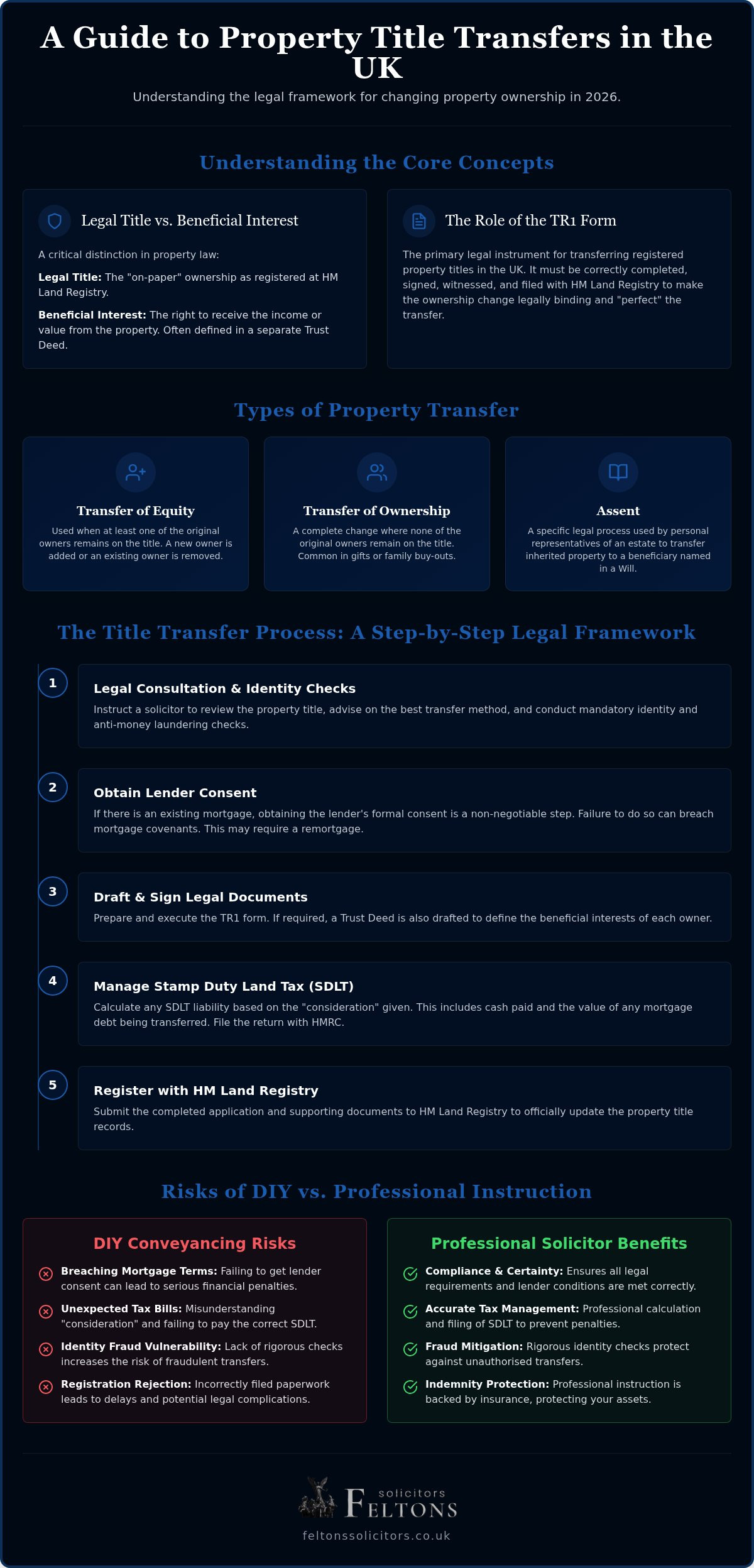
Changing the names on a property deed involves more than a simple clerical update at HM Land Registry; it’s a formal legal transition that requires precision to avoid future disputes. Title transfer is the overarching process of altering the official ownership records, but the specific path you take depends on your circumstances. For instance, a “Transfer of Equity” is used when at least one of the original owners stays on the title, such as when a partner is added after marriage. Conversely, a “Transfer of Ownership” involves a total change where none of the original owners remain, often seen in gifts or family buy-outs.

When dealing with inherited property, a distinct process known as an “Assent” is required. If you’ve been left a home in a Will, the personal representatives of the estate must use an Assent to formally vest the property in your name. This step is vital for making your ownership legally binding, yet it’s frequently misunderstood by those attempting to manage probate without professional guidance. Choosing the correct mechanism is paramount because it dictates your obligations for Stamp Duty Land Tax (SDLT) and your standing with mortgage lenders. Even in transfers where no money is exchanged, the value of a mortgage being transferred can be classed as “consideration”, which can trigger a tax liability.

Legal Title vs. Beneficial Interest

Legal ownership isn’t always as straightforward as the names on the Land Registry might suggest. There is a critical distinction between legal title, which represents the “on paper” ownership, and beneficial interest, which relates to the right to receive the value or income from the property. In many cases, a Trust Deed is drafted alongside the transfer to define these interests clearly. Instructing a residential property law firm ensures these layers of ownership are correctly documented, protecting your investment if circumstances change or relationship dynamics shift.

The Role of the TR1 Form and HM Land Registry

The primary instrument used to facilitate these changes for registered titles is the TR1 form. This document acts as the legal bridge between the current and new owners. Once signed and witnessed, it must be filed with HM Land Registry to make the transfer “perfect”. Without this official registration, the legal title doesn’t technically pass to the new owner. During Conveyancing, it’s also essential to verify that the property’s plan descriptions are accurate, particularly if the transfer involves dividing a plot or changing boundaries. Professional title transfer solicitors uk provide the necessary due diligence to ensure these technical details are handled flawlessly, preventing future boundary disputes or registration delays.

Common Reasons to Organise a Property Title Transfer

Life’s milestones frequently demand a shift in property ownership. Whether you’re blending households or settling an inheritance, the legal title must align with your current intentions. Many homeowners choose to add a spouse or partner to their deeds following marriage or cohabitation. This ensures that both parties have a recognised legal stake in their shared home. However, this isn’t a mere administrative tick-box. It requires formalising the transferring ownership process through the Land Registry to prevent future disputes and ensure clarity for any mortgage lender involved.

Title transfers also facilitate the “buying out” of a co-owner. This is a common scenario amongst siblings who have inherited a property together or joint tenants who have decided to part ways. One party pays a sum to the other to acquire their share, necessitating a formal update to the title deeds. Engaging professional title transfer solicitors uk is critical here to ensure the “consideration” is recorded correctly and that any existing mortgage lender consents to the change. Without this professional oversight, you risk breaching mortgage terms or facing complications when you eventually decide to sell.

Divorce and Financial Settlements

During a relationship breakdown, the home is often the most significant asset to be divided. A divorce and financial arrangements lawyer will structure the property transfer to comply with court orders or separation agreements, ensuring the legal title matches the agreed financial settlement. In some cases, a “Mesher Order” might be used. This defers the sale or transfer of the property until a specific event occurs, such as a child reaching adulthood or completing their education. We understand the emotional weight of these transitions; our role is to provide a calm, steady hand to ensure the legal process remains as smooth and discreet as possible.

Estate Planning and Gifting

Gifting a share of your home to children is a popular strategy for managing future liabilities, but it comes with strict regulatory hurdles that go far beyond simple paperwork. Under the “seven-year rule”, the gift may still be subject to Inheritance Tax if you pass away within seven years of the transfer. Additionally, if you continue to live in the property without paying market rent, HMRC may view it as a “gift with reservation of benefit”, potentially nullifying the tax advantages. You must also be aware of “deliberate deprivation of assets” rules; local authorities often scrutinise property transfers if you later require care funding. Integrating these changes into a wider estate planning strategy is the only way to ensure your legacy is protected. When navigating these complex scenarios, the guidance of title transfer solicitors uk ensures that every legal and tax implication is accounted for. If you are considering a property gift, speaking with a specialist can help clarify your tax position.

The journey begins with a detailed consultation to establish the “consideration” involved in the transaction. In legal terms, consideration isn’t limited to physical cash; it includes the value of any mortgage debt the new owner is taking on. Once this value is determined, the formal drafting of the Transfer Deed, or TR1 form, commences. If you’re sharing ownership in specific proportions, your title transfer solicitors uk will also prepare a Trust Deed to document these beneficial interests clearly. This ensures that the “on paper” ownership matches the financial reality of each party’s contribution.

Executing the deed requires a formal signing in the presence of an independent witness who is not a party to the transfer. Following this, the application is submitted to HM Land Registry along with the necessary filing fees. As of 2026, registration fees are tiered based on property value; for example, a property valued between £200,001 and £500,000 incurs a fee of £330. The process is only “perfected” once the Land Registry updates the digital register, a step that confirms the new ownership status to the world.

Navigating Mortgage Lender Requirements

Lenders maintain a significant interest in who holds the legal title, as any change affects the security of their loan. If a property is mortgaged, you must obtain formal consent before the transfer can proceed. For those leaving the title, a “Release of Covenant” is necessary to ensure they’re no longer liable for the debt. Lenders almost always require a solicitor to act for them during this process to ensure their interests remain protected. This dual representation streamlines the transition whilst satisfying the lender’s rigorous compliance and identity standards.

Stamp Duty Land Tax (SDLT) Implications

A common misconception is that tax only applies when money changes hands. However, SDLT is calculated based on the “chargeable consideration”. If you’re added to a title and take responsibility for a portion of an existing mortgage, that share of the debt is considered payment. In 2026, the standard SDLT threshold begins at £125,000. Even if the consideration falls below this level and no tax is due, you must still file an SDLT return with HMRC within 14 days of completion. Expert title transfer solicitors uk manage these filings on your behalf, preventing the risk of late payment penalties or inquiries from the tax authorities.

Title Transfer Solicitors UK: A Complete Guide to Property Ownership Changes in 2026

The Risks of DIY Conveyancing versus Professional Instruction

The assumption that a property title transfer is merely a matter of filling in forms is a frequent and costly mistake. In reality, the process involves complex legal obligations that, if mismanaged, can leave your most valuable asset vulnerable. Professional title transfer solicitors uk provide a critical layer of security through rigorous Anti-Money Laundering (AML) checks and identity verification. These protocols aren’t just bureaucratic hurdles; they’re essential defences against the rising threat of property fraud. By instructing a professional, you’re also benefiting from Professional Indemnity Insurance. This ensures that if a technical error occurs, your financial interests are fully protected, a safeguard that is entirely absent in a DIY approach.

Most mortgage lenders will simply refuse to engage with unrepresented individuals. They require the assurance that a qualified solicitor is overseeing the transaction to protect their security. Attempting to handle the transfer yourself often leads to a stalemate where the lender won’t release the necessary documents, causing significant delays and potential breaches of contract. These delays can be particularly damaging when a transfer is part of a time-sensitive financial settlement or inheritance plan.

Identity Verification (ID1 and ID3)

For those who choose to proceed without a solicitor, HM Land Registry mandates a strict identity verification process using forms ID1 or ID3. This requires you to find a professional, such as a solicitor or notary, to witness your signature and verify your credentials for a fee. This process is often cumbersome and time-consuming for DIYers, as many firms are reluctant to verify identity for non-clients due to the liability involved. Conversely, when you use a solicitor for the entire transaction, identity verification is integrated seamlessly into the process, providing a higher level of security for all parties involved.

Avoiding Future Litigation

Errors made during a DIY transfer often lie dormant for years, only surfacing during a future sale or upon the death of an owner. Poorly drafted deeds frequently lead to “Contentious Probate” or bitter ownership disputes amongst heirs, which are far more expensive to resolve than the initial legal fees. A solicitor acts as a discreet partner, ensuring that every detail, from the rights of way to the distribution of beneficial interest, is tied up correctly. In the context of property law, indemnity is a financial safeguard that protects you against losses arising from professional errors or omissions. To ensure your property interests are handled with the precision they deserve, you should instruct Feltons Solicitors for your title transfer.

How Feltons Solicitors Facilitates Seamless Title Transfers

Feltons Solicitors understands that property is more than a legal asset; it’s the foundation of your personal and financial security. As a boutique firm, we move away from the high-volume, impersonal processing common in the industry. Instead, we position ourselves as your sophisticated guide, handling the technical complexities of the law whilst maintaining a genuine human connection. Choosing the right title transfer solicitors uk means finding a partner who values your privacy and provides the discreet, high-standard service your situation demands. We don’t just process paperwork; we provide a calm, steady presence during what can often be a stressful period of transition.

Our expertise extends to the most intricate ownership structures. We regularly assist with overseas entity beneficial owner registration, ensuring that international property interests remain compliant with evolving UK regulations. When disputes arise amongst co-owners, we apply a pragmatic, resolution-focused approach to protect your equity and restore stability. This “people-first” philosophy ensures that while the technical legal work is paramount, the human impact of our work is never forgotten.

A Tailored Approach for Private Clients

We recognise that a title transfer is often a single piece of a much larger puzzle. Whether you’re navigating a relationship breakdown or finalising an inheritance, we integrate our property advice into your broader life changes. We’ve discarded archaic legalese in favour of a “plain English” methodology, ensuring you feel informed and empowered at every stage. This boutique level of care prioritises personal rapport, meaning you’ll deal directly with the expert managing your case rather than being passed between anonymous departments. It’s an approach that values modern efficiency without sacrificing traditional professional integrity.

Expertise in Complex and Leasehold Matters

Leasehold properties present unique challenges, particularly regarding extensions and management rights. As leasehold enfranchisement experts, we understand how these nuances impact the transfer of title and the long-term value of your investment. Our team possesses the worldly experience required to handle high-net-worth portfolios and complex international interests with absolute precision. As experienced title transfer solicitors uk, we invite you to a confidential consultation to discuss your specific circumstances and discover how we can facilitate a seamless transition for your property assets. Our goal is to provide the security and comprehensive care you need to move forward with confidence.

Securing Your Property Interests for the Years Ahead

Managing a property ownership change is a significant life event that requires more than just administrative accuracy; it’s about ensuring your legal title reflects your current life circumstances whilst protecting your equity from unforeseen tax or mortgage complications. By navigating the nuances of the TR1 form, satisfying SDLT requirements, and securing lender consent, you establish a solid foundation for your future. These steps are essential for maintaining the integrity of your investment and preventing contentious disputes in years to come.

Instructing expert title transfer solicitors uk provides the professional indemnity and identity security that DIY methods simply cannot offer. Feltons Solicitors, a boutique firm established in 2010, combines specialist expertise in residential and commercial conveyancing with pragmatic, people-first advice. We pride ourselves on being a steady, sophisticated guide through complex legal transitions, ensuring every detail is perfectly aligned with your long-term goals. Contact Feltons Solicitors for expert guidance on your property title transfer today. Taking this proactive step ensures your property remains a secure legacy for you and your family.

Frequently Asked Questions

Do I need a solicitor to transfer property title to my spouse?

While you can legally manage a transfer yourself if there’s no mortgage, instructing title transfer solicitors uk is strongly recommended to ensure the deed is “perfected” at the Land Registry. If a mortgage is involved, lenders almost always insist on professional representation to protect their security. Using a solicitor also provides professional indemnity insurance, which safeguards your home against technical errors that could lead to future ownership disputes or complications whilst you eventually sell.

How much does a title transfer solicitor cost in the UK?

Legal fees for a straightforward transfer of equity typically range between £400 and £900 plus VAT, depending on the complexity of the case. You must also account for disbursements, such as HM Land Registry fees, which are tiered based on the property’s value. For example, a property valued between £200,001 and £500,000 currently incurs a registration fee of £330. We provide transparent, fixed-fee quotes to ensure you have complete certainty over your costs.

Can I transfer property title if there is still a mortgage?

Yes, you can transfer the title, but you must obtain formal consent from your mortgage lender first. The lender will assess the financial stability of the remaining or new owners to ensure they can meet the repayment obligations. This process often involves a “Release of Covenant” for any departing owner. Your solicitor will act for both you and the lender to ensure all regulatory requirements are met and the mortgage deed is updated correctly.

How long does the title transfer process take at the Land Registry?

The legal preparation and signing of deeds usually take between four and eight weeks. Once the application is submitted to HM Land Registry, the time taken to update the digital register can vary significantly. While simple transfers are often processed within a few weeks, more complex cases or those requiring additional queries can take several months. Your solicitor will monitor the progress and provide updates until the new title deed is officially confirmed.

Do I have to pay Stamp Duty on a transfer of equity?

Stamp Duty Land Tax (SDLT) is payable if the “chargeable consideration” exceeds the current threshold of £125,000. Consideration includes any cash payment made for the share plus the proportion of the outstanding mortgage being taken over. If you’re added to a title and take on 50% of a £300,000 mortgage, your consideration is £150,000, which may trigger a tax liability. You must file an SDLT return even if no tax is actually due.

What is the difference between a Transfer of Equity and an Assent?

A Transfer of Equity is used when at least one of the current legal owners remains on the title, such as adding a partner. An Assent is a specific legal process used to transfer property from a deceased person’s estate to a beneficiary named in a Will. Whilst both result in a change at the Land Registry, an Assent requires the involvement of the estate’s personal representatives and follows distinct probate regulations to ensure the transfer is legally binding.

Can a property title be transferred as a gift?

You can transfer a property title as a gift, but this often triggers significant tax implications. If you don’t survive for seven years after the gift, it may be subject to Inheritance Tax. If the property isn’t your primary residence, Capital Gains Tax might also apply based on the market value at the time of the transfer. It’s essential to seek professional advice to understand how gifting impacts your broader estate planning and potential tax exposure.

What documents do I need to provide to my title transfer solicitor?

You’ll need to provide valid photo identification and recent proof of address to satisfy Anti-Money Laundering (AML) regulations. Additionally, your solicitor will require your latest mortgage statement, details of any money changing hands, and a copy of the existing title deeds if the property is unregistered. Providing these documents promptly allows your title transfer solicitors uk to conduct the necessary due diligence and prepare the TR1 form without unnecessary delays to your transaction.

Collective Enfranchisement Solicitors: A How-To Guide for Buying Your Freehold in 2026

Collective Enfranchisement Solicitors: A How-To Guide for Buying Your Freehold in 2026

The building you call home should be your greatest asset, not a source of mounting anxiety. You have likely felt the frustration of rising service charges and the looming worry of a lease dipping toward that 80-year threshold. It is often difficult to organise neighbours, and the fear of hidden legal costs can keep many leaseholders stuck in a cycle of poor maintenance and diminishing property value. Partnering with experienced collective enfranchisement solicitors is the first step toward turning that shared frustration into a valuable, self-managed asset.

We understand that the legal landscape in 2026 feels complex, especially with the phased implementation of the Leasehold and Freehold Reform Act 2024. These reforms provide a significant opportunity to gain total control over your building and eventually secure 990-year leases with zero ground rent. This guide provides a clear blueprint for navigating the enfranchisement process, from understanding the updated 50% non-residential limits to managing group strategy. You will discover how to successfully secure your freehold and increase your property’s market value whilst avoiding the common pitfalls of property litigation. We will explain exactly how to move from leaseholder to freeholder with confidence and professional support.

Key Takeaways

  • Understand how collective enfranchisement empowers you to take full control of your building’s management and eliminate escalating service charges.
  • Learn the updated eligibility criteria for 2026, including the expanded 50% non-residential limit that makes buying the freehold possible for more mixed-use blocks.
  • Discover why instructing specialist collective enfranchisement solicitors is essential for navigating strict statutory deadlines and ensuring a smooth transition of ownership.
  • Identify how a robust Participation Agreement protects your group’s financial interests and ensures the stability of your claim from start to finish.
  • Master the strategic steps required to secure 990-year leases and zero ground rent, significantly increasing the long-term value of your home.

What is Collective Enfranchisement and Why Buy Your Freehold?

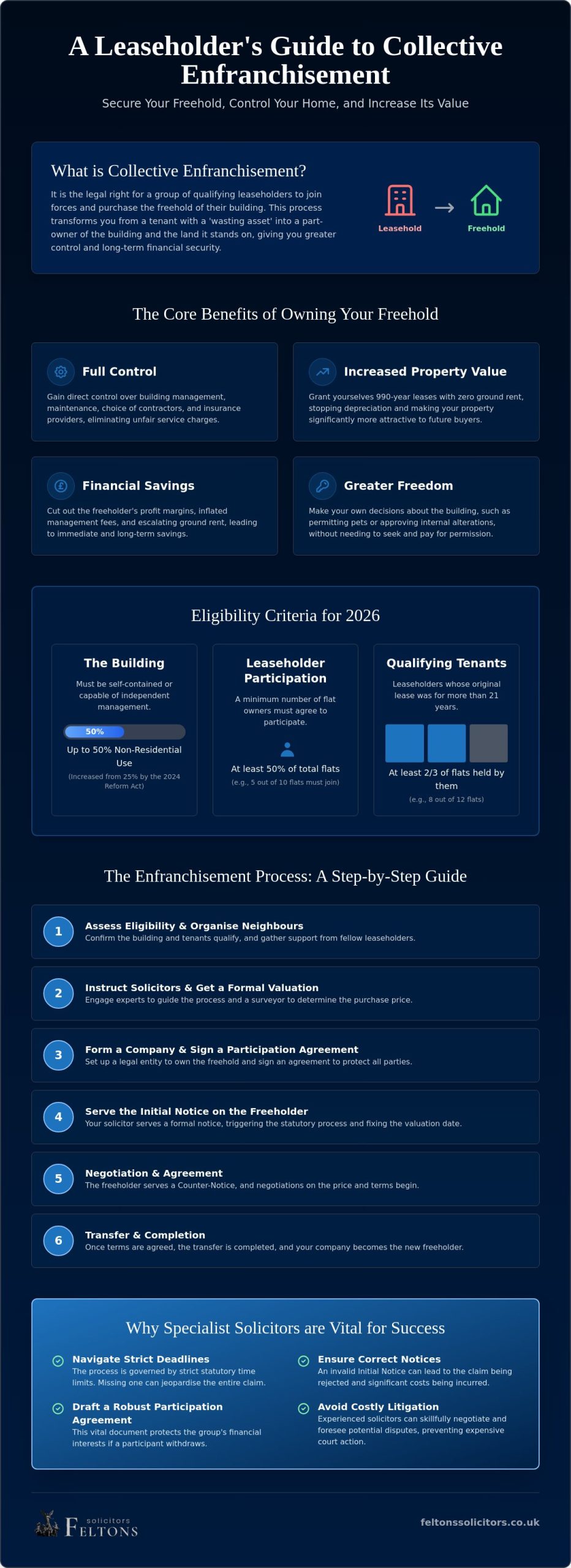
Collective enfranchisement isn’t just a legal procedure; it’s a fundamental shift in how you own your home. Essentially, it’s the right for a group of leaseholders to join forces and purchase the freehold of their building. This process transforms you from a tenant into a part-owner of the land your building sits on. For many, the catalyst is a history of opaque service charges, skyrocketing insurance premiums, or neglected communal areas. When you research What is Collective Enfranchisement, you quickly realise it’s about reclaiming autonomy over your living environment and your long-term financial security.

A lease is often described as a ‘wasting asset’ because its value diminishes as the term gets shorter. By buying the freehold, you and your neighbours can grant yourselves new leases, typically for 999 years, effectively stopping the clock on depreciation. It removes the stress of future extensions and makes your property far more attractive to buyers who might otherwise be wary of a lease dropping towards the 80-year mark. Instructing collective enfranchisement solicitors early in the process ensures the transition of the title is handled with the poise and professional integrity required to protect your investment.

The Core Benefits of Owning the Freehold

Statutory Rights Under the 1993 Act

The legal framework is the Leasehold Reform, Housing and Urban Development Act 1993. This legislation provides a structured route to force a sale, even if the freeholder is reluctant. Engaging collective enfranchisement solicitors ensures every notice is served correctly and that the freeholder cannot use delay tactics. The law is designed to protect your right to ownership, provided the process is followed with precision.

Eligibility Criteria: Does Your Building Qualify in 2026?

Before embarking on the journey toward ownership, it’s essential to confirm that your building meets the specific legal requirements. The process begins with understanding your leasehold property structure. To qualify, the building must be a self-contained block of flats or a part of a building that is capable of independent management. This means it must have its own vertical division and be able to function without relying on services from an adjacent structure. If your block shares communal heating or structural components with another building, the eligibility assessment becomes more nuanced.

One of the most significant shifts in 2026 is the expanded eligibility for mixed-use buildings. Previously, if more than 25% of the internal floor area was used for non-residential purposes, the building was disqualified. However, the Leasehold and Freehold Reform Act 2024 has increased this limit to 50%. This change allows leaseholders in buildings with substantial commercial space, such as shops or offices on the lower floors, to finally take control. Additionally, at least 50% of the total number of flats in the building must agree to participate in the purchase. If you live in a block of ten flats, you need at least five neighbours to commit to the claim.

Another core requirement involves the status of the tenants themselves. At least two-thirds of the flats in the building must be held by ‘qualifying tenants’. These are leaseholders whose original lease term was for more than 21 years. If you are unsure whether your block meets these thresholds, seeking advice from collective enfranchisement solicitors early on can prevent costly missteps. The team at Feltons Solicitors LLP can help you audit your building’s eligibility before you begin formal negotiations.

Defining the ‘Qualifying Tenant’

A qualifying tenant can be an individual or a company. However, if a single person or entity owns more than two flats in the building, they are excluded from being a qualifying tenant for the purposes of the claim. It’s also important to remember that the two-year ownership rule was abolished in early 2025. You can now participate in a collective enfranchisement claim from the day you complete your property purchase, regardless of how long the previous owner held the title. Your current lease length doesn’t affect your right to participate; even those with very short leases can be part of the group.

Common Eligibility Pitfalls to Avoid

Buildings with complex flying freeholds or those owned by specific charitable housing trusts can present unique challenges. In some cases, the freeholder may be exempt from the statutory process if the property is part of a charitable mission. Identifying these exemptions requires a methodical review of the title deeds and the freeholder’s status. Missing these details can lead to a claim being rejected at the first hurdle, which is why collective enfranchisement solicitors conduct thorough initial searches as part of the due diligence process.

The Collective Enfranchisement Process: A Step-by-Step Guide

Successfully purchasing a freehold is as much about group dynamics as it is about legal precision. Whilst the statutory route provides a clear framework, the process requires a methodical approach to ensure every participant remains committed and every deadline is met. Unlike a voluntary negotiation, which relies on the landlord’s whims, the statutory process under the 1993 Act grants you the power to compel a sale. This journey begins with internal organisation and ends with the transfer of the title to a company owned by you and your neighbours.

The first critical step involves organising your group and establishing a formal Participation Agreement. This document is a legally binding contract that governs the behaviour of the participants, securing financial commitments and outlining how decisions will be made. Without this, the claim is vulnerable if a neighbour decides to withdraw at a late stage. Once the group is secure, collective enfranchisement solicitors will help you form a ‘Nominee Purchaser’ company. This entity is specifically designed to hold the freehold title on behalf of the participating leaseholders, ensuring a professional structure for future building management.

Following the company formation, your legal team will serve the Section 13 Notice on the freeholder. This formal document triggers the legal timetable and sets out the proposed price for the freehold. If the freeholder agrees to the terms, the process moves toward completion. However, if an agreement on the premium cannot be reached through negotiation, an application to the First-tier Tribunal may be necessary to determine a fair price. In 2026, the fees for such an application are typically £200, with an additional £300 for a hearing, representing a modest cost for securing a fair valuation.

The Role of the Specialist Valuer

You should never serve a Section 13 Notice without a professional valuation. A specialist valuer provides a realistic estimate of the premium, ensuring your opening offer is neither too high nor so low that it risks being deemed unrealistic. By 2026, the abolition of ‘marriage value’ has significantly simplified these calculations, making the process more transparent for buildings with leases under 80 years. Understanding how these valuations are constructed is just as important for individual leaseholders; a detailed lease extension estimate can help each participant appreciate the financial stakes before the group commits to the collective purchase. Your valuer and collective enfranchisement solicitors work in tandem to counter the freeholder’s opening demands, using market data to protect your financial interests.

Serving the Section 13 Notice

The Section 13 Notice is the most important document in the claim. It must include precise details of the participating flats, the proposed premium, and the details of the Nominee Purchaser. Any technical error can lead to the notice being declared invalid, which may prevent you from starting a new claim for twelve months. The landlord is given a minimum of two months to respond with a Counter-Notice. If they fail to respond by the stated deadline, the group can apply to the court for a Vesting Order, allowing the purchase to proceed on the terms set out in your initial notice.

Collective Enfranchisement Solicitors: A How-To Guide for Buying Your Freehold in 2026

Mitigating Risks: Participation Agreements and Group Management

Whilst the legal framework provides the statutory right to buy, the human element often presents the greatest challenge to a successful claim. Collective enfranchisement requires a group of neighbours to act as a single, disciplined unit for several months. The most significant risk to any claim is a participant dropping out at a late stage. If one person withdraws, the remaining group is often left to cover the financial shortfall, which can jeopardise the entire project. This is why establishing a robust Participation Agreement is the most critical step you can take before serving any formal notice.

A Participation Agreement is a legally binding contract between the leaseholders that governs the group’s behaviour and financial obligations. It provides a safety net, ensuring that everyone is committed to the same goals and understands their share of the costs. Specialist collective enfranchisement solicitors will tell you that a claim’s success often rests on the strength of this internal contract. It prevents stalemates during negotiations by defining exactly how decisions are made, whether by a simple majority or a dedicated committee. Without this structure, a single dissenting voice can halt progress during a critical negotiation window.

What Should Your Participation Agreement Include?

A well-drafted agreement should leave no room for ambiguity. It must clearly outline the following provisions:

  • Defaulting members: Clear consequences for participants who fail to pay their share of the premium or legal fees on time.
  • Lease valuations: The mechanism for granting new 999-year leases to participants at a peppercorn rent, whilst ensuring non-participants remain on their current terms.
  • Future management: How the building will be managed once the freehold is acquired, including the appointment of directors for the Nominee Purchaser company.
  • Cost sharing: A precise breakdown of how the purchase price and the freeholder’s reasonable legal costs will be divided amongst the group.

Managing Apathy and Non-Participants

It’s common to encounter neighbours who want the benefits of a freehold purchase but are unwilling or unable to contribute to the costs. In these cases, the participating group must decide whether to ‘carry’ the cost of the non-participant’s flat to secure the building. For those who cannot join the collective purchase, they still retain their individual tenant lease extension rights, which can be pursued separately. Furthermore, if your freeholder is ‘missing’ or ‘untraceable’, your collective enfranchisement solicitors can apply for a Vesting Order through the county court, allowing the purchase to proceed even in their absence.

Managing a group claim requires a steady, poised hand to ensure all stakeholders remain aligned. If you are ready to formalise your group’s commitment, you should contact our enfranchisement team to draft a Participation Agreement tailored to your building’s specific needs.

Why Specialist Collective Enfranchisement Solicitors are Vital

The legal journey of buying your freehold is paved with rigid statutory deadlines that leave no room for error. If a single notice is served incorrectly or a counter-proposal deadline is missed by just one day, the law can treat the claim as ‘deemed withdrawn’. This doesn’t just stall your progress; it often prevents the group from serving a new notice for another twelve months, during which time property values may rise and leases grow shorter. Instructing specialist collective enfranchisement solicitors is the only way to ensure these procedural traps are avoided. At Feltons Solicitors LLP, we provide the poised, steady guidance required to manage the many moving parts of a group claim, ensuring your interests remain protected from the initial audit to the final transfer of title.

Our approach combines modern efficiency with the traditional professional integrity you expect from a trusted advisor. We understand that behind the legal filings are homeowners seeking peace of mind and financial security. Our methodology is deeply pragmatic; we aim to avoid unnecessary litigation through skilled negotiation, whilst remaining prepared to defend your rights at a tribunal if the freeholder’s demands are unreasonable. We act as the central hub for your claim, coordinating between specialist valuers, dozens of participants, and the freeholder’s legal team to keep the process moving at a reassuring pace.

Avoiding Costly Technical Errors

A common pitfall in these claims is the incorrect structuring of the ‘Nominee Purchaser’ company. This entity must be fit for purpose not just for the purchase, but for the long-term management of the building. We ensure the Articles of Association are drafted to reflect the internal agreements of the group, preventing future disputes amongst the owners. Additionally, we navigate the increasingly complex Land Registry requirements, including the registration of overseas entities where a participant or the freeholder is based abroad. As Leasehold enfranchisement experts, we handle these technical hurdles with a level of precision that general practice firms often lack.

The Feltons Approach: Boutique Care for Complex Claims

The final stage of the process involves complex conveyancing to transfer the freehold title and the simultaneous creation of new, 999-year leases for every participant. This ensures that your ‘wasting asset’ is officially transformed into a secure, long-term investment. Feltons Solicitors LLP provides a boutique level of care that prioritises personal connection, ensuring you aren’t just another file in a high-volume system. If you’re ready to take the first step toward building autonomy, we invite you to contact us for a consultation. We will assess your building’s eligibility and provide a clear, methodical path toward successfully buying your freehold in 2026.

Take Control of Your Building’s Future Today

The transition from a passive leaseholder to an empowered freeholder is one of the most effective ways to protect your long-term investment. By consolidating your group’s interests and leveraging the 2026 reforms, you can finally eliminate the uncertainty of third-party management and the financial drain of ground rents. As we have explored, success requires more than just meeting eligibility criteria; it demands a disciplined approach to group strategy and a thorough understanding of the statutory framework. This shift in ownership doesn’t just lower your annual outgoings; it fundamentally changes the nature of your property from a wasting asset to a permanent, self-governed home, where you can directly appoint specialist contractors like CavClear to manage structural maintenance and damp proofing.

The path to property independence is significantly smoother when guided by specialist collective enfranchisement solicitors who understand the nuances of the current legal landscape. Feltons Solicitors LLP has provided this level of expert guidance since 2010, offering pragmatic and jargon-free advice on a national scale. We take pride in our boutique approach, ensuring that your building’s specific challenges are met with tailored solutions and professional integrity. Our role is to act as your steady advisor, managing the complex coordination between valuers and participants whilst you focus on the future of your community.

Secure your property’s future with Feltons Solicitors LLP to discuss how we can help you achieve full building autonomy. With the right professional partnership, the vision of a self-managed, ground-rent-free building is entirely within your reach.

Frequently Asked Questions

How many tenants do we need to buy the freehold?

You need at least 50% of the total number of flats in your building to participate in the claim. For example, in a block of ten flats, at least five leaseholders must join together to trigger the legal process. It’s also required that at least two-thirds of the total flats in the building are owned by qualifying tenants. This ensures the group has a sufficient collective interest to compel the freeholder to sell.

Can the freeholder refuse to sell the freehold to us?

No, the freeholder cannot refuse the sale if your building and the participating group meet the statutory eligibility criteria. The law grants you a legal right to purchase the freehold under the 1993 Act. Whilst a landlord might challenge the validity of your initial notice or the proposed price, they cannot simply reject the purchase itself. Expert collective enfranchisement solicitors ensure your claim is structurally sound to prevent such challenges from succeeding.

How much does collective enfranchisement cost on average?

The total cost depends on the premium payable for the freehold and the professional fees involved in the claim. You’ll be responsible for your own legal and valuation fees, as well as the freeholder’s reasonable legal and valuation costs. Since the abolition of marriage value in 2024, the premium for buildings with leases under 80 years has become more predictable. A specialist valuer can provide a detailed estimate before you formally commit to the process.

What is a Participation Agreement and do we really need one?

A Participation Agreement is a legally binding contract between the participating leaseholders that governs the group’s financial and procedural commitments. You absolutely need one to protect the group if an individual decides to withdraw or fails to pay their share of the costs. It establishes a clear framework for decision-making and cost-sharing, preventing the claim from collapsing due to internal disputes. It’s the foundation of a secure and professional group strategy.

Does buying the freehold automatically extend my lease?

Buying the freehold doesn’t automatically extend your lease, but it gives your group the power to do so once the purchase completes. Most groups choose to grant themselves new 999-year leases at a peppercorn rent immediately after acquiring the title. This process is handled by your collective enfranchisement solicitors as part of the final conveyancing stage. It effectively removes the ‘wasting asset’ nature of your property and increases its long-term market value.

Can we buy the freehold if some tenants don’t want to join in?

Yes, you can proceed with the purchase as long as at least 50% of the flats in the building participate. Those who don’t join will remain as leaseholders, but their landlord will change from the current freeholder to the new Nominee Purchaser company owned by you and your neighbours. Non-participants won’t benefit from the new 999-year leases or the removal of ground rent unless they negotiate a separate deal with your group later.

What happens if we can’t agree on a price with the freeholder?

If negotiations reach a stalemate, you can apply to the First-tier Tribunal (Property Chamber) to determine the fair premium. As of July 2026, the application fee is £200, with a hearing fee of £300. The Tribunal acts as an independent body that reviews evidence from both sides’ valuers to set a final price. Most cases are settled through negotiation before reaching this stage, but the Tribunal remains a vital safety net for leaseholders.

How long does the collective enfranchisement process take?

The entire process typically takes between nine and twelve months from the service of the initial notice to final completion. This timeline accounts for the statutory response periods, valuation negotiations, and the final conveyancing work. If the case proceeds to a Tribunal, the timeline can extend by several months depending on the court’s availability. Staying organised and responding to your solicitor’s requests promptly is the best way to keep the claim moving efficiently.