

Could a simple administrative oversight really result in a £50,000 fine and the freezing of your UK property portfolio? For many international investors, the Register of Overseas Entities has become a source of significant anxiety. It’s understandable to feel overwhelmed by the shifting expectations of Companies House, especially as they move from a period of initial leniency to one of rigorous enforcement. The potential penalties for non-compliance with the Register of Overseas Entities are no longer just theoretical threats. They are active measures designed to ensure absolute transparency, with daily fines of up to £2,500 and the risk of criminal prosecution for entity officers.
We understand that your priority is protecting your assets whilst maintaining a discreet professional profile. This guide from Feltons Solicitors LLP offers a sophisticated roadmap to help you achieve complete legal compliance without the stress of trial and error. You’ll learn how to identify registrable beneficial owners accurately, secure a valid Overseas Entity ID for seamless transactions, and manage the annual update statement process with precision. We will outline the essential steps to satisfy UK-regulated agents and ensure your property investments remain both liquid and secure throughout 2026.
Key Takeaways
- Understand the mandatory requirements of the Economic Crime Act 2022 to protect the liquidity and legality of your UK property investments.
- Navigate the complexities of identifying registrable beneficial owners through a precise application of the five statutory control tests.
- Protect your assets from severe financial and criminal penalties for non-compliance register of overseas entities by securing a verified Overseas Entity ID.
- Ensure your filings meet strict legal standards by engaging a UK-regulated agent authorised to conduct the mandatory verification process.
- Maintain continuous compliance through the annual update statement to avoid administrative freezes on your property transactions.
Understanding the Register of Overseas Entities and its Legal Necessity
The introduction of the Economic Crime (Transparency and Enforcement) Act 2022 marked a fundamental shift in how international investors hold UK land. It’s no longer enough to operate through an offshore structure without disclosing the individuals who stand behind it. The core purpose of the Register of Overseas Entities is to pull back the curtain, identifying the beneficial owners who ultimately control these vehicles. By creating a public record, the UK government aims to combat illicit finance whilst ensuring the property market remains a transparent environment for legitimate investment.
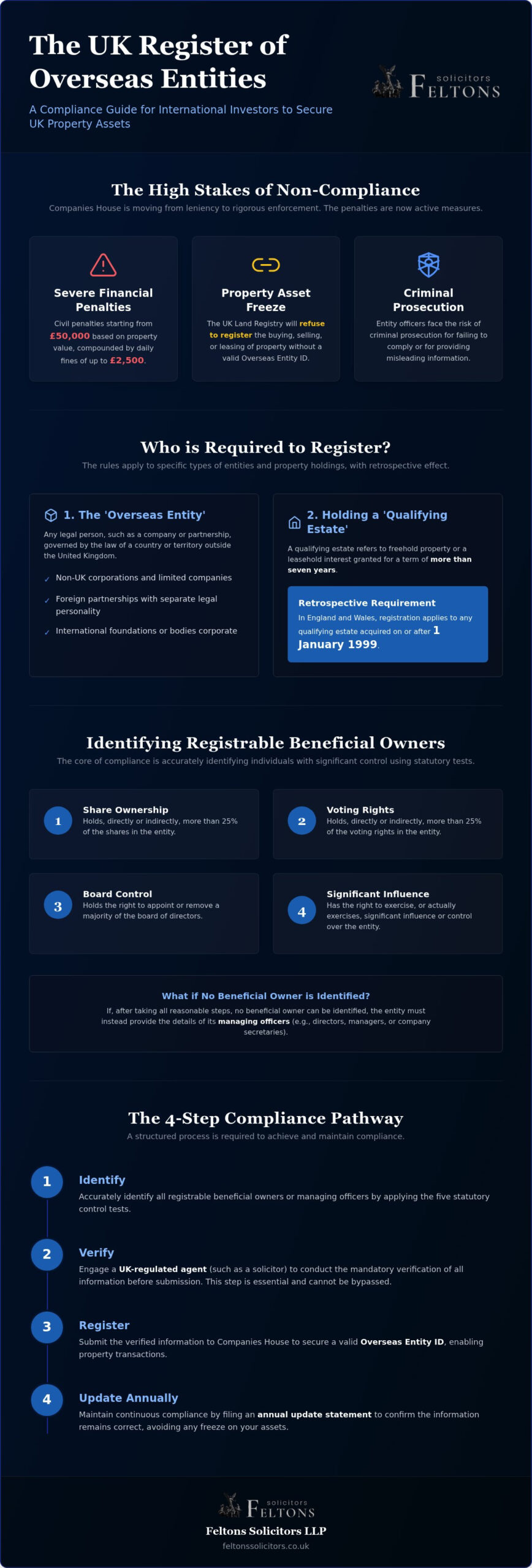
Compliance isn’t optional. To buy, sell, or lease property in the UK, an entity must possess a valid Overseas Entity ID from Companies House. Without this, the Land Registry will simply refuse to process applications, effectively freezing your assets. The penalties for non-compliance register of overseas entities are severe. Companies House now issues civil penalties based on property value, with high-value portfolios facing charges of £50,000 or more per property. These are compounded by daily fines of up to £2,500 and the risk of criminal prosecution for entity officers.
What Qualifies as an Overseas Entity?
The law defines an overseas entity as any legal person, such as a company or partnership, that’s governed by the law of a country or territory outside the United Kingdom. This isn’t limited to traditional offshore tax havens. It applies to any non-UK body with its own legal personality, regardless of where it’s incorporated. Common entities that must register include:
- Non-UK corporations and limited companies
- Foreign partnerships with separate legal personality
- International foundations or bodies corporate governed by foreign law
The Definition of a Qualifying Estate
A qualifying estate refers to freehold property or a leasehold interest granted for more than seven years. Short-term leases often fall outside this requirement, but the rules are strict for long-term holdings. Crucially, the legislation is retrospective. In England and Wales, the registration requirement applies to any qualifying estate acquired on or after 1 January 1999. This historical reach means many long-standing investors must now verify their structures or face the penalties for non-compliance register of overseas entities. Identifying whether your specific holding triggers these duties is the first step in a robust compliance strategy, ensuring your property remains a liquid and transferable asset.
Identifying Registrable Beneficial Owners and Managing Officers
Identifying who truly controls an overseas entity is the pivot point of the registration process. Companies House applies five specific tests to determine beneficial ownership. These tests look beyond the immediate legal title of shares to find the people with the power to direct the entity’s actions. If an individual holds more than 25% of the shares or voting rights, or has the power to appoint the majority of the board, they’re likely a registrable beneficial owner. Precision is paramount here, as misidentifying these individuals can lead to the very penalties for non-compliance register of overseas entities that investors wish to avoid.
In instances where no beneficial owner can be identified after taking all reasonable steps, the entity must instead provide details of its managing officers. This includes directors, managers, or company secretaries. It’s a fail-safe to ensure that someone is always held accountable for the entity’s filings. Providing misleading information here is a criminal offence. It’s one reason why many clients seek professional guidance for registration to ensure every detail is verified. Most information submitted, such as the owner’s name and service address, enters the public domain. However, sensitive data like home addresses and full dates of birth are usually protected from public view, though they remain accessible to law enforcement.
Complex Structures: Trusts and Foundations
Trusts present a unique layer of complexity. Under the Act, disclosure requirements extend to the settlor, trustees, and beneficiaries. Since August 31, 2025, information regarding trusts connected to overseas entities has become publicly accessible. This shift towards transparency means privacy must be balanced with absolute legal accuracy to avoid the heavy penalties for non-compliance register of overseas entities. Our team specialises in unravelling multi-layered corporate hierarchies to ensure every individual in the chain is correctly identified and reported, protecting the integrity of your property structure.
Significant Influence or Control
The fifth test acts as a catch-all for those who exercise control through means other than shareholding. This might include veto rights over key business decisions or the power to direct the entity’s activities. Assessing significant influence is often subjective. It requires a nuanced understanding of corporate governance. The Law Society provides specific guidance for solicitors on verification to ensure these assessments stand up to scrutiny. Accurate reporting is vital. Failing to disclose a person with significant control can lead to a practical freeze on property transactions and substantial daily fines.
The Verification Process: Why a UK-Regulated Agent is Essential
The verification process is the cornerstone of the Register of Overseas Entities. Unlike many other corporate filings, self-registration isn’t an option for international bodies. The law mandates that a UK-regulated agent, such as a solicitor or an accountant, must independently verify the information before it’s submitted to Companies House. This agent essentially “vouches” for the accuracy of the data, assuming a significant degree of professional and criminal liability in the process. It’s this high level of accountability that provides the Land Registry with the confidence to proceed with property transactions.
Timing is critical. Once the agent has completed the verification, there’s a strict 14-day window to submit the application. If this deadline is missed, the verification becomes stale, and the entire process must be repeated. This sense of urgency can be stressful, but it’s a necessary step to avoid the penalties for non-compliance register of overseas entities. As detailed in the UK Government’s Enforcement Approach for Overseas Entities, failing to secure a verified ID can lead to immediate restrictions on your property assets. At Feltons, we act as a sophisticated guide, managing the evidence-gathering phase to ensure all data is robust and ready for submission within the required timeframe.
What Information Needs Verifying?
The verification process is exhaustive. We must confirm the identity of every registrable beneficial owner through high-quality documentation, such as valid passports and recent utility bills for proof of address. For the overseas entity itself, we validate its corporate existence by reviewing constitutional documents, certificates of incorporation, and registers of members. The legislation requires us to take ‘reasonable steps’ to ensure the data is correct. This often involves cross-referencing information across multiple jurisdictions to build a clear, undeniable picture of ownership.
The Risks of Inadequate Verification
Choosing a ‘cheap’ or automated verification service carries substantial risks. If the information is deemed insufficient or inaccurate, Companies House can reject the application or, worse, revoke an existing Overseas Entity ID later. Such a revocation triggers the same penalties for non-compliance register of overseas entities as failing to register in the first place, including heavy daily fines. We maintain the highest professional standards to ensure your application is accepted by the Land Registry the first time. Our methodical approach protects your investment from future legal challenges, providing the security that international property owners require.
Managing the Annual Update Statement and Ongoing Compliance
Compliance is a continuous obligation. Every 12 months, overseas entities must file an update statement with Companies House to confirm that the information held on the register is still accurate. This isn’t merely a tick-box exercise. It’s a strategic requirement to maintain the validity of your Overseas Entity ID. If your status lapses, you’ll find yourself unable to sell, lease, or charge your UK land. We recommend preparing for this statement at least two months in advance. This allows sufficient time to track any changes in beneficial ownership or corporate structure that may have occurred across international borders. Precise record-keeping is the only way to ensure your property transactions remain seamless.
Deadlines and Penalty Structures
Your ‘statement date’ is fixed as the anniversary of your initial registration. Once this date passes, you have exactly 14 days to file the update and pay the £134 statutory fee. The penalties for non-compliance register of overseas entities are designed to be punitive. Daily fines of up to £2,500 can accrue rapidly, and unpaid penalties may attract interest at 8% per annum. Beyond financial loss, the entity’s officers face significant personal risk. Failing to file an update is a criminal offence that can lead to prosecution and a prison sentence of up to five years. It’s a high price to pay for a simple administrative oversight.
Removing an Entity from the Register
If your entity has disposed of all its UK property, you can apply for removal from the register. This process requires a formal application to Companies House, confirming that the entity is no longer a registered owner of any qualifying estate. You must ensure that the Land Registry has updated its records first, as any discrepancy will lead to a rejection. Professional guidance is vital during this exit phase. It ensures that all historical data, including changes in ownership during the transitional period, is fully accounted for. This prevents lingering liabilities and protects the officers from future claims of non-compliance. Even when leaving the UK market, maintaining high standards of integrity is essential.
Register your overseas entity with Feltons Solicitors today to ensure your ongoing compliance is managed with boutique care and precision.
Professional Assistance: How Feltons Solicitors Facilitates Seamless Registration
Securing your UK property portfolio requires a partner who understands the intersection of international corporate structures and domestic property law. At Feltons Solicitors LLP, we provide tailored legal advice that goes far beyond simple administrative filing. By integrating our role as a residential property law firm with our registration services, we offer a holistic solution for international investors. We understand the stress that the Economic Crime Act can cause. Our mission is to provide a calm, steady presence that protects your assets from the penalties for non-compliance register of overseas entities while ensuring your privacy is respected. You deserve a legal partner who prioritises personal connection over high-volume processing.
We take a proactive approach to overseas entity beneficial owner registration. This ensures that when a transaction opportunity arises, your Overseas Entity ID is ready and valid. We handle sensitive information with the utmost discretion, ensuring that your data is only used to satisfy statutory requirements. Our boutique level of care means you aren’t just another number in a high-volume processing system. We manage the complexity so you can focus on your investment goals.
A Boutique Approach to Global Compliance
We move beyond volume processing to offer bespoke legal guidance tailored to your specific needs. This often involves working closely with your international tax and wealth advisors to ensure that your UK property holdings align with your broader global strategy. You’ll benefit from a single point of contact who manages everything from the initial verification to the ongoing annual updates. This methodical approach reflects our commitment to traditional professional integrity whilst embracing modern efficiency. We recognise that the technical legal work is paramount, but the human impact on your family or business is never forgotten.
Securing Your Property Interests for the Future
A robust corporate structure is your best defence against shifting regulations. We help you reduce the administrative burden on your internal teams by taking full responsibility for the compliance cycle. This includes monitoring deadlines and ensuring that every filing meets the strict standards expected by Companies House and the Land Registry. By maintaining a proactive stance, we ensure your property remains a liquid asset that can be traded or leased without delay. If you’re ready to secure your investments and avoid the penalties for non-compliance register of overseas entities, the next step is simple. Contact us today to begin your registration or verification process with a partner you can trust. Your property’s security is our priority.
Securing Your UK Property Portfolio for the Future
The Register of Overseas Entities represents a permanent shift in the landscape of UK property ownership. Compliance is not a one-time event. It’s a continuous commitment to transparency and legal integrity. By correctly identifying beneficial owners and ensuring your data is verified by a regulated agent, you protect the liquidity and value of your investments. Failing to maintain this status exposes your assets to the severe penalties for non-compliance register of overseas entities. These include heavy daily fines and restrictions on your ability to trade land.
As regulated UK legal professionals and specialists in international property law, we provide a discreet, boutique service for high-net-worth clients. We manage the intricacies of the registration process so you don’t have to worry about administrative delays or legal risks. Contact Feltons Solicitors today for expert assistance with registering your overseas entity. We’re here to provide the steady guidance you need to navigate these requirements with total confidence and peace of mind.
Frequently Asked Questions
What happens if I fail to register an overseas entity by the deadline?
Failing to register by the statutory deadline triggers immediate financial and legal sanctions. Companies House issues civil penalties based on your property portfolio’s value, which can reach £50,000 or more per property. Additionally, daily fines of up to £2,500 may accrue. Beyond these fiscal measures, the penalties for non-compliance register of overseas entities include criminal prosecution for the entity’s officers, potentially leading to prison sentences of up to five years.
Can I still sell my UK property if I haven’t received an Overseas Entity ID?
You cannot complete a property sale, lease, or charge without a valid Overseas Entity ID. The Land Registry is legally prohibited from processing applications for non-compliant entities, effectively freezing your assets. This restriction ensures that no legal title can pass to a buyer until you satisfy the registration requirements. To avoid transaction delays, it’s essential to secure your ID well before entering into any formal sale agreements. You don’t want to risk a deal falling through.
Who is considered a ‘registrable beneficial owner’ for a family trust?
For a family trust, the registrable beneficial owners typically include the settlor, the trustees, and any beneficiaries who exercise significant control. If a beneficiary has a right to a specific share of the trust property or can influence the trustees’ decisions, they must be disclosed. Since August 2025, information regarding these trusts has become publicly accessible, making accurate identification vital to ensure your corporate structure remains compliant with the evolving transparency standards.
How often do I need to update my information on the Register of Overseas Entities?
You must file an annual update statement every 12 months, even if no changes have occurred within your corporate structure. This statement is due within 14 days of the anniversary of your initial registration date. Failing to meet this deadline results in the penalties for non-compliance register of overseas entities, including daily fines and a lapsed ID. Maintaining this cycle is crucial for ensuring your property remains liquid and your entity remains in good standing.
Is the information about beneficial owners available to the general public?
Most information provided to the register, such as names and service addresses, is available for public inspection on the Companies House website. However, sensitive data like full dates of birth and residential addresses are generally protected from public view, though they remain accessible to law enforcement agencies. Notably, information regarding trusts connected to overseas entities has also been publicly accessible since August 31, 2025, following recent regulatory updates.
Can any solicitor act as a verification agent for an overseas entity?
Only UK-regulated agents authorised by Companies House can conduct the mandatory verification process. This includes solicitors, accountants, and other professionals subject to the UK’s Anti-Money Laundering (AML) regulations. The agent must be registered as a verification provider and assumes professional liability for the accuracy of the information they vouch for. At Feltons, we provide this specialised service, ensuring your data meets the rigorous standards required for a successful Land Registry application.
How long does the registration process typically take with Companies House?
The timeline for registration depends largely on the complexity of your corporate structure and the time required for verification. Whilst Companies House often processes submitted applications within a few working days, the evidence-gathering and verification phase can take several weeks. We recommend starting the process at least one month before any planned property transaction to allow for thorough document review and to ensure your Overseas Entity ID is issued without delay.
Do I need to register if the property was bought before 1999?
Registration is only required if your overseas entity acquired a qualifying estate in England or Wales on or after January 1, 1999. For properties in Scotland, the retrospective date is December 8, 2014. If your property was purchased before these specific dates and no subsequent registrable transactions have occurred, you may be exempt from the current requirements. However, any new acquisition or long-term leasehold grant will immediately trigger the duty to register and obtain an ID.