

What if the very compensation intended to secure your future actually placed your current financial stability at risk? Receiving a settlement after a life-changing injury should be a moment of relief, yet for many, it brings a fresh wave of anxiety regarding Universal Credit and other means-tested support. You’ve fought hard for this redress, and the fear that it might be depleted by care costs or lead to a total loss of benefits is a heavy burden to carry.
Specialist personal injury trust solicitors provide a sophisticated shield, ensuring your award is legally ring-fenced to protect your eligibility for state assistance whilst securing funds for your long-term rehabilitation. We understand that the transition from litigation to recovery is complex, and our role is to offer a calm, steady hand during this period. This guide explains how a tailored trust structure preserves your capital against the £16,000 threshold, the importance of the initial 52-week disregard period, and how a discreet legal partner simplifies the requirements of the Trust Registration Service to ensure your focus remains entirely on your recovery.
Key Takeaways
- Learn how a personal injury trust functions as a legal shield, ring-fencing your settlement to ensure your compensation is preserved for your specific needs.
- Understand the vital role of personal injury trust solicitors in maintaining your eligibility for means-tested benefits, such as Universal Credit, after receiving an award.
- Discover how to protect your financial future from local authority care assessments, ensuring funds remain available for bespoke rehabilitation and private medical care.
- Recognise why a partner-led, boutique legal service offers the discreet, high-standard expertise required for complex litigation and sensitive asset protection.
- Gain clarity on the essential timing for establishing a trust, particularly the importance of acting before the first interim payment is received.
What is a Personal Injury Trust and Why Do You Need One?
A personal injury trust is a formal legal mechanism designed specifically to hold funds awarded as compensation following an accident or illness. It acts as a protective shield, separating your settlement from your personal capital. This distinction is vital because, without it, the Department for Work and Pensions (DWP) treats those funds as readily available assets. Engaging personal injury trust solicitors ensures this separation is legally robust. Understanding What is a Personal Injury Trust? is the first step toward long-term financial security.
Placing your settlement into a standard current or savings account is a frequent mistake. Once the money enters your personal account, it’s consolidated with your other savings. This can immediately push you over the capital limits required for state support. A trust ensures these funds are ring-fenced, meaning they’re disregarded during financial assessments by government bodies or local authorities. Whilst you remain the beneficiary, the legal title is held by trustees, which creates the necessary barrier to protect your eligibility for support.
Protecting Eligibility for Means-Tested Benefits
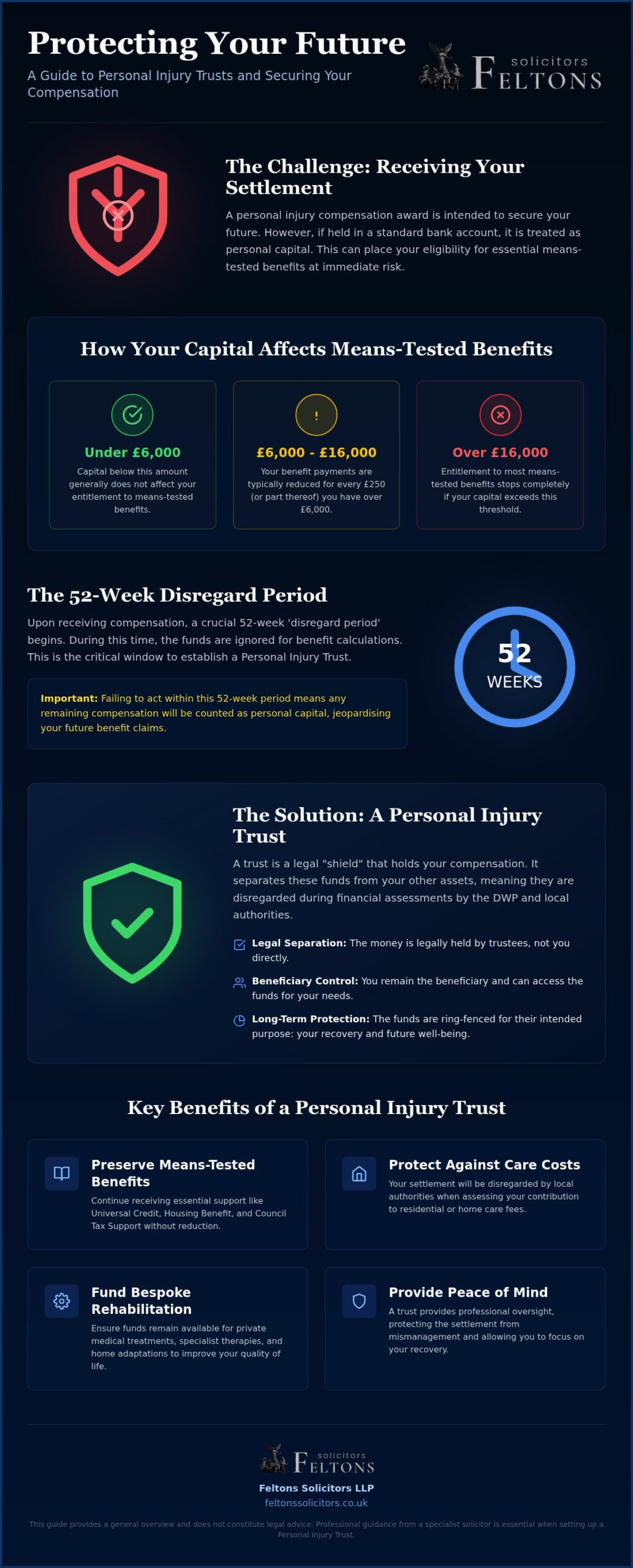
The DWP views personal injury settlements as capital, which can be catastrophic for your household budget. Under current 2026 regulations, capital exceeding £6,000 reduces your entitlement, while assets over £16,000 usually stop means-tested benefits entirely. By using a trust, you preserve access to essential support including:
- Universal Credit
- Housing Benefit
- Council Tax Support
- Income Support
Following the receipt of a personal injury compensation payment, there is a 52-week period where the funds are disregarded for means-tested benefit calculations. This window is a critical time to establish your trust. Failing to act before this period expires means any remaining compensation will be treated as personal capital, potentially ending your right to claim benefits.
The Role of Personal Injury Trust Solicitors
Managing the technical requirements of a Trust Deed requires precision and foresight. This is where specialist personal injury trust solicitors provide essential guidance. We help you decide between a Bare Trust, where you retain absolute control, or more complex structures if the beneficiary lacks the mental capacity to manage their own affairs. Our role is to provide a calm, steady presence during what is often a stressful financial transition. We ensure the trust is established correctly from the outset, allowing you to focus on your recovery while we handle the intricate legal documentation and compliance with the Trust Registration Service. This methodical approach ensures your settlement is managed with the high-standard care it deserves.
The Financial Benefits: Securing Your Long-Term Stability
Securing a compensation award is a significant milestone, yet it’s merely the start of ensuring your financial resilience. A settlement is often intended to last a lifetime, funding ongoing needs that may not be immediately apparent. By engaging personal injury trust solicitors, you create a formal structure that prevents this capital from being treated as personal wealth by local authorities or third parties. It transforms a lump sum into a sustainable resource.
One of the most profound advantages involves social care funding. Without a trust, a local authority can include your compensation in a means-test for residential or home care costs. This could lead to your settlement being rapidly depleted to pay for services that would otherwise be state-funded. The High Court clarified in R (CGT) v West Sussex County Council EWHC 293 (Admin) that damages held in a personal injury trust must be disregarded in these assessments. This legal protection ensures your funds remain available for private medical treatments, bespoke rehabilitation programmes, and home adaptations that enhance your quality of life.
Beyond state assessments, a trust acts as a barrier against financial mismanagement or predatory interests. Life-changing settlements can unfortunately attract unwanted attention from third parties. A trust provides a structured framework where decisions are made by trustees, offering a layer of professional oversight and psychological peace of mind. It allows you to focus on recovery, knowing your capital is ring-fenced for its intended purpose.
Trusts and Future Care Costs
Professional advice is essential to navigate the complexities of “deprivation of capital” rules. If you move funds into a trust incorrectly or after you’ve already been assessed for care, local authorities might challenge the arrangement. Our partner-led approach ensures the trust is established with the necessary precision to avoid these accusations, safeguarding your capital to maintain a higher standard of future living.
Intersections with Family Law and Estate Planning
Financial protection also extends to your domestic life. A trust can help protect your settlement in the event of divorce and financial arrangements, as the funds are clearly identified as compensation for your specific injuries. Additionally, integrating your trust with your wider estate planning ensures that any remaining capital passes to your chosen beneficiaries via a Will. If you’re concerned about how a settlement might affect your existing arrangements, our team can provide the discreet, tailored advice you need to secure your legacy.
Choosing Personal Injury Trust Solicitors: Boutique vs. Claims Factories
Selecting the right personal injury trust solicitors is a decision that carries as much weight as the litigation that secured your award. In the current legal market, many national firms operate as high-volume “claims factories” where the emphasis is on case turnover rather than individual attention. In these environments, your file is often managed by junior staff or paralegals who might lack the depth of experience required to navigate the nuanced financial needs of a life-changing injury. You deserve a partner who views your settlement not as a transaction, but as the foundation of your future security.
Personal rapport is essential when discussing sensitive financial matters and the intimate details of your recovery. A boutique firm offers a calm, steady presence, ensuring you have direct access to a senior solicitor who values privacy and personal connection. This consistency builds a deep level of trust, allowing for a more thorough understanding of your specific long-term goals. We don’t just process paperwork; we provide a methodical, orderly approach that mirrors a professional consultation, making you feel informed and supported throughout the entire process.
The Boutique Advantage for Serious Injury
Direct access to senior legal minds is the hallmark of a high-standard service. We act as sophisticated guides, providing tailored advice that considers your entire private client profile rather than just the immediate settlement. This includes coordinating with your wider estate planning and future care requirements to ensure your trust is perfectly aligned with your life. Our “people-first” philosophy means that whilst the technical legal work is paramount, the human impact of that work is never forgotten. You receive a discreet, high-end service that prioritises your peace of mind over high-volume processing.
Specialist Expertise in Niche Claims
Generalist firms often overlook the specific nuances of occupational lung disease settlements, which can lead to less robust protections. For instance, the meticulous approach required for industrial diseases like silicosis demands a deep understanding of both medical evidence and litigation strategy. Specialist knowledge translates into more effective ring-fencing of your compensation. We ensure that the unique challenges of these niche claims are reflected in how your trust is structured, providing a level of security that a volume-driven firm simply cannot match. This pragmatic, partner-led advice is essential for securing the future of bereaved families and those living with life-changing conditions.
The Process of Setting Up a Personal Injury Trust
Establishing a trust is a methodical process that requires early intervention to be most effective. It’s a common misconception that you should wait until your final settlement is reached. In reality, the most prudent time to engage personal injury trust solicitors is before or during the receipt of your first interim payment. This ensures that compensation never consolidates with your personal capital, maintaining a clear legal boundary from the outset.
The core of this arrangement is the Trust Deed. This formal document must be drafted with absolute precision to satisfy the rigorous standards of both HMRC and the Department for Work and Pensions. It defines the rules of the trust and the powers of those managing it. Once the deed is executed, the next step involves opening a dedicated Trust Bank Account. This account remains entirely separate from your everyday banking, providing a transparent audit trail that confirms the funds are ring-fenced compensation rather than personal savings.
Selecting and Appointing Trustees
Choosing your trustees is a decision that requires sound judgment and a high degree of trust. Trustees hold “fiduciary duties”, which means they’re legally obligated to act in your best interests and manage the funds with care. Whilst many people choose close family members, it’s standard practice to appoint at least two trustees to ensure security and mutual oversight. Many of our clients find significant value in appointing a professional solicitor as a trustee. This provides a neutral, expert presence to handle complex administrative tasks and ensure that the trust’s integrity is never compromised by accidental mismanagement.
Managing the Trust Over Time
A personal injury trust is designed to be a flexible, long-term resource. You can access the funds for specific needs, such as home adaptations, specialised equipment, or private rehabilitation, without those payments being treated as personal income. Maintaining this protection requires ongoing compliance, particularly regarding the Trust Registration Service (TRS). Regular annual reviews with your legal partner ensure the trust continues to meet your evolving needs and remains compliant with current regulations. If your circumstances change, such as a need to replace a trustee or eventually dissolve the trust, your solicitor manages these transitions with the same discreet, high-standard care used during the initial setup.
To ensure your settlement is protected from the moment of your first payment, you should contact our specialist team for a partner-led consultation regarding your trust requirements.
Feltons Solicitors: Your Discreet Partner in Complex Litigation
Feltons Solicitors LLP operates as a boutique firm, providing a calm and steady presence for those facing the aftermath of life-changing injuries. We don’t believe in the high-volume model of national claims factories. Instead, we prioritise a “people-first” philosophy that combines traditional professional integrity with modern, efficient delivery. Our personal injury trust solicitors act as your sophisticated guides, ensuring that the transition from receiving a settlement to securing your future is handled with the highest level of care and precision.
Our commitment to pragmatic, expert advice is rooted in a deep understanding of the human impact behind every legal case. We recognise that behind every complex litigation file is a person or a family seeking to rebuild their lives. By positioning ourselves as a dependable advisor, we offer a level of reliability that ensures your financial interests are protected whilst you focus on your physical and emotional recovery. This methodical approach is designed to provide security in even the most stressful circumstances.
Partner-Led Expertise in Serious Injury
In complex litigation, the quality of your legal partner is paramount. At Feltons, you benefit from direct access to senior legal minds throughout every stage of your claim. We understand that the stress of litigation can be overwhelming, so we position ourselves as a steady hand to reduce that burden. Our reputation is built on handling both national and complex international matters with a level of discretion that larger firms often struggle to maintain. This partner-led approach ensures that no detail is overlooked, from the initial evidence gathering to the final execution of your trust documents.
A Holistic Approach to Private Client Law
We look beyond the immediate success of a claim to secure your entire financial landscape. Our expertise is particularly deep in niche areas such as industrial disease, where we manage complex silicosis litigation with a pragmatic and meticulous mindset. We recognise that a successful settlement is only half the battle; the other half is ensuring that those funds are managed to support your rehabilitation for decades to come. This synergy between our litigation and private client departments is what sets us apart from generalist firms.
By bridging the gap between injury litigation and asset protection, we offer bespoke trust solutions tailored to your unique personal circumstances. We don’t provide generic templates; we create legal structures that reflect your specific health needs and family situation. We invite you to a professional consultation to discuss how our personal injury trust solicitors can protect your compensation and provide the long-term stability you deserve. Our goal is to ensure you feel informed, supported, and in capable hands throughout your recovery journey.
Securing Your Financial Resilience and Peace of Mind
Reaching a settlement is a significant victory, but the work of protecting that legacy begins immediately. By ring-fencing your award within a formal trust, you ensure that your eligibility for means-tested benefits remains intact whilst your capital is preserved for future care and rehabilitation. It’s a strategic move that separates your personal savings from the compensation meant to support your long-term recovery.
Choosing the right personal injury trust solicitors is essential for navigating the complexities of DWP regulations and HMRC compliance. At Feltons Solicitors, we provide a partner-led service that prioritises discreet, high-standard care over the volume-driven approach of national firms. Our specialist expertise in complex litigation and industrial disease ensures that your advice is pragmatic and tailored to your specific financial security. We invite you to contact Feltons Solicitors for a confidential consultation regarding your Personal Injury Trust. Taking this step today ensures that your hard-won compensation remains a source of stability for years to come.
Frequently Asked Questions
What is the “52-week rule” for personal injury compensation?
The 52-week rule is a specific disregard period granted by the DWP following the receipt of your first compensation payment. During this one-year window, any money received from a personal injury claim is ignored when calculating your eligibility for means-tested benefits. It’s a vital grace period that allows you time to seek advice from personal injury trust solicitors and establish a formal trust structure before the funds are treated as personal capital.
Will I lose my Universal Credit if I receive a personal injury settlement?
You won’t necessarily lose your Universal Credit if you receive a settlement, provided you place the funds into a personal injury trust. Without a trust, the DWP treats the award as capital. Under 2026 regulations, assets exceeding £6,000 reduce your monthly entitlement, whilst holdings over £16,000 typically result in a total loss of means-tested support. Ring-fencing the money ensures it remains disregarded during these financial assessments.
Can I be a trustee of my own Personal Injury Trust?
You can certainly be a trustee of your own trust, but you cannot be the sole trustee. Most legal structures require at least two people to manage the funds to ensure transparency and security. Whilst you retain the right to the capital as the beneficiary, having a second person, such as a family member or a professional solicitor, provides the necessary oversight required by banks and government bodies to recognise the trust’s validity.
How much does it cost to set up a Personal Injury Trust in the UK?
The cost of establishing a trust varies depending on the complexity of your settlement and the specific type of trust deed required. Most firms offer a fixed-fee arrangement for standard bare trusts, whilst more intricate discretionary trusts may involve higher professional fees. It’s best to discuss your requirements with personal injury trust solicitors during an initial consultation to receive a tailored quote that reflects the level of senior expertise your specific case demands.
Can I set up a trust after I have already received my compensation?
You can set up a trust after receiving your compensation, but it’s essential to act within the 52-week disregard period. If you wait longer than a year from the date of the first payment, the DWP will likely treat the funds as personal capital, which could immediately impact your benefits. Establishing the trust as soon as the first interim payment arrives is the most effective way to avoid any disruption to your financial support.
Do I need a separate bank account for my Personal Injury Trust?
A dedicated trust bank account is a mandatory requirement for maintaining the legal separation between your compensation and your personal finances. This account must be held in the names of your trustees and should only contain funds derived from your personal injury award. Mixing these funds with your everyday savings can taint the trust, making it difficult to prove to the DWP that the capital should be disregarded during means-testing.
What can I spend my Personal Injury Trust money on?
You have the freedom to spend your trust funds on almost anything that improves your quality of life or aids your recovery. Common uses include purchasing specialised equipment, funding private rehabilitation sessions, or paying for home adaptations. However, it’s important to use the funds directly from the trust account for these purchases. Withdrawing large sums of cash into your personal account can inadvertently push you over the capital limits for benefits.
How many trustees do I need for a Personal Injury Trust?
Standard practice requires a minimum of two trustees to ensure the trust functions correctly and meets the requirements of most UK banks. Having two people provides a system of checks and balances, reducing the risk of financial mismanagement. Many individuals choose a combination of a trusted family member and a professional solicitor. This blend ensures that personal needs are understood whilst the technical and administrative duties are handled with expert precision.