

Could temporary financial support help you meet essential living costs while divorce or dissolution proceedings continue? For people considering maintenance pending suit applications UK, the key is to show how immediate, reasonable needs relate to the other party’s ability to pay. An application doesn’t guarantee an order. Uncertainty about evidence, eligibility or the effect on an already difficult relationship can make the next step feel daunting.
It’s understandable to want clarity before taking formal action. Maintenance pending suit is temporary support during financial proceedings, not a final settlement or a way to fund legal fees. The court considers the circumstances, including each party’s needs and financial position, and the process differs across the UK.
This practical guide explains when an application may be relevant, what financial information and supporting evidence can help present your position, and what to expect from the process. It also explains how to prepare proportionately and why tailored legal advice can help you assess your options before deciding whether to apply.
Key Takeaways
- Maintenance pending suit is interim support during matrimonial proceedings. The terminology and procedure vary across the UK.
- Maintenance pending suit applications UK are assessed on the evidence and circumstances, not a fixed payment formula.
- Set out your income, capital, liabilities and essential expenditure clearly to explain your immediate needs.
- Distinguish interim support from final financial orders and child maintenance, as each serves a different purpose.
- Before taking action, consider affordability and jurisdiction, then get tailored advice on how an application fits the wider financial proceedings.
What are maintenance pending suit applications in the UK?
Maintenance pending suit is temporary financial support that a spouse may ask the court to order whilst certain matrimonial proceedings are under way. In England and Wales, the term is principally used for an application made during divorce, nullity or judicial separation proceedings. A corresponding provision applies to civil partners. The remedy is intended to address financial needs during the case, rather than decide the couple’s final financial settlement.
The phrase describes support during proceedings and is sometimes also called interim maintenance. For general background on spousal support and the term, see Maintenance Pending Suit. The legal test and process depend on the relevant jurisdiction and the facts of the case.
An application isn’t automatic. The court considers the evidence and circumstances, including the applicant’s reasonable needs and the other party’s ability to meet them. Financial hardship may help explain why support is being sought, but it doesn’t guarantee an order. Any interim decision is distinct from a final financial remedy order, which addresses the parties’ financial arrangements as the proceedings progress towards resolution.
When might someone consider applying for interim maintenance?
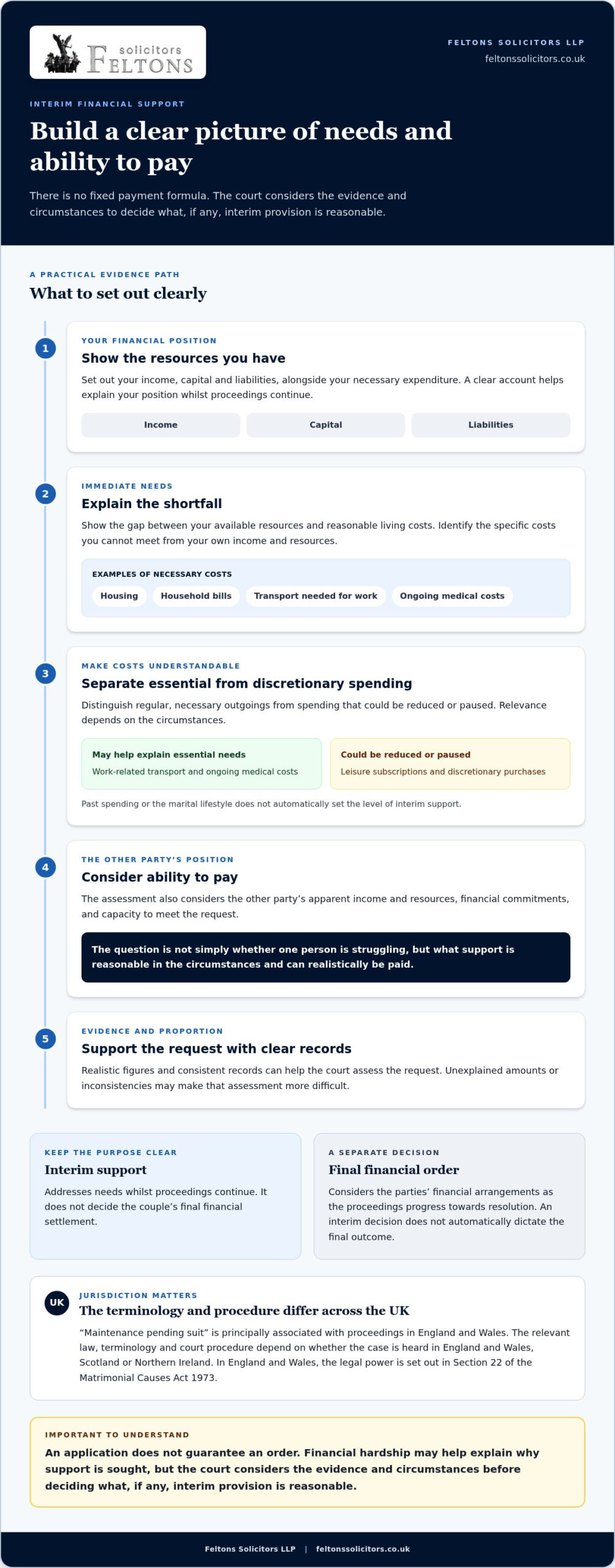
It may be relevant where a person cannot meet reasonable living expenses from their own income and resources whilst the case is ongoing. For example, there may be a shortfall in the money available for housing, household bills and other necessary costs. The court will need a clear picture of those needs, alongside information about the other party’s apparent income and resources. The question is not simply whether one person is struggling, but what support is reasonable in the circumstances and can realistically be paid.
Does maintenance pending suit work the same way across the UK?
No. Family law procedure differs between England and Wales, Scotland, and Northern Ireland. “Maintenance pending suit” is terminology principally associated with proceedings in England and Wales, so it shouldn’t be assumed to describe the same remedy or application process everywhere in the UK. The relevant law, terminology and court procedure depend on the jurisdiction where the case is being heard. Specialist advice can help identify the correct route before an application is prepared.
How does the court assess a maintenance pending suit application?
There is no fixed payment formula. The court looks at the evidence and the parties’ circumstances to decide what, if any, interim provision is reasonable. In England and Wales, the legal power is set out in Section 22 of the Matrimonial Causes Act 1973. The assessment focuses on the applicant’s reasonable needs and the respondent’s ability to meet them, rather than applying a standard figure to every case.
Interim maintenance is assessed against demonstrated needs and available means. A clear, supported account of the shortfall is more useful than an estimate without context. The court may consider the applicant’s income, capital, liabilities and necessary expenditure, as well as the respondent’s income, resources, financial commitments and capacity to pay.
How are needs and affordability considered?
Separate essential and regular costs from spending that could be reduced or paused. For instance, transport needed to get to work or ongoing medical costs may be presented differently from leisure subscriptions or discretionary purchases. This is not a fixed court checklist. Relevance depends on the circumstances, and past spending or the marital lifestyle does not automatically set the level of interim support.
Both financial positions matter. Explain your actual resources and the gap between those resources and reasonable outgoings. The respondent’s position also needs to be understood, including commitments that affect what they can afford. Clear records and realistic figures help the court assess the request fairly. Unexplained or inconsistent amounts may make that assessment more difficult.
What is the difference between interim maintenance and a final settlement?
Interim support is intended to address needs while proceedings continue. It does not resolve all financial claims or determine how assets and other resources should ultimately be divided. A final financial order may take a broader view of the parties’ finances and the issues raised in the case. The court’s interim decision does not automatically dictate the final outcome, although the parties’ circumstances and evidence may continue to develop during proceedings.
For anyone considering maintenance pending suit applications UK, keeping the immediate request proportionate and supported can help clarify the issue for both parties and the court. Tailored advice on divorce and financial arrangements can help organise the relevant financial information and consider an application alongside the wider proceedings.
Maintenance pending suit or another financial option: what should you consider?
The right route depends on what needs to be addressed: immediate support for a spouse, a lasting financial arrangement after separation, or financial provision for a child. These options serve different purposes and may be governed by different rules. Their terminology and availability also depend on the proceedings and jurisdiction. Practical Law guidance on Section 22 provides further context on the maintenance pending suit framework in England and Wales.
| Option | Main purpose | Question it addresses |
|---|---|---|
| Maintenance pending suit | Interim support for a spouse during relevant proceedings. | Is financial help needed whilst the case is ongoing, and what may be reasonable? |
| Final financial orders | Resolve financial claims as part of the longer-term arrangements. | How should the parties’ wider financial position be settled? |
| Child maintenance | Make financial provision for a child. | What arrangements apply to the child’s support? |
The table is a starting point, not a substitute for advice on the applicable law. Maintenance pending suit is not a final settlement, and seeking interim support does not determine the eventual financial outcome.
How does maintenance pending suit differ from child maintenance?
Maintenance pending suit concerns support between spouses during proceedings. Child maintenance concerns a child’s financial support, so it is not simply another name for a spouse’s interim application. The routes, decision-making and relevant rules may differ. Don’t assume that a child maintenance arrangement will meet a spouse’s personal living costs, or that the same eligibility and calculation rules apply throughout the UK.
When might a legal services payment order be relevant?
A legal services payment order raises a separate question: how one party may fund legal representation, rather than how to meet ordinary living expenses. It should not be treated as part of a maintenance request or as a guaranteed source of funding. Whether this type of order is available, and which statutory provisions and procedural test apply, depend on the jurisdiction. A family law solicitor can help distinguish these issues and consider how they fit alongside the wider financial proceedings.
When weighing up maintenance pending suit applications UK, first identify whose needs the application is intended to address and whether the concern is interim living costs, longer-term financial claims, child support or legal representation. Advice on the relevant jurisdiction can help ensure the issue is considered through the appropriate route.
How to prepare for a maintenance pending suit application
Preparation starts with a clear account of what support is needed, why it’s needed now and what resources are available to each party. The correct application procedure depends on the jurisdiction and stage of the proceedings. A well-organised summary can help keep the request focused and make legal advice more useful.
- Confirm the jurisdiction and proceedings. Establish where the case is being heard, what proceedings are under way and which procedure applies. The terminology, forms and court rules aren’t uniform across the UK.
- Set out your immediate needs. Prepare a realistic monthly budget, separating regular essentials from discretionary spending. Note any payment due soon and explain the consequences if it can’t be met.
- Collect current financial evidence. Bring together information about income, bank accounts, savings, regular expenses, debts and other available resources. Support the figures with documents such as payslips, bank statements, bills, loan statements and evidence of other income where relevant.
- Prepare a concise chronology. Record key dates in the proceedings, material changes in either party’s finances and urgent payment needs. Brief context can explain why a particular bill or shortfall needs attention now.
- Check the application before it is made. Compare the figures with the documents, identify missing information and confirm the required form, supporting material and service process for the jurisdiction.
What financial evidence should you organise?
Group evidence by income, expenditure, debts and available resources. Make sure the amounts in your budget correspond with the records, and explain any differences, unusual one-off costs or changes in income. If a bill is urgent, show its amount, due date and relevance to your immediate needs without overstating its impact or leaving out important context. Accurate records are more persuasive than a long, unexplained bundle of paperwork.
What happens after an application is prepared?
Broadly, an application is filed, the other party is notified in accordance with the applicable rules, they may respond, and the court considers the evidence. The court may ask for further information or give directions about how the case should proceed. The precise steps and timing vary, so don’t assume a particular hearing date or outcome. The procedure depends on the relevant jurisdiction.
Interim support also sits within wider financial proceedings. For an overview of that context, read this guide to divorce and financial arrangements. Tailored advice can help organise the evidence and consider whether the proposed application is proportionate. If you’re considering maintenance pending suit applications UK, get advice on your interim maintenance options as part of the wider financial picture.
Getting tailored advice on maintenance pending suit applications
Deciding whether to seek interim support involves more than identifying a shortfall. Consider your immediate and reasonable needs, the evidence available, the other party’s apparent ability to pay and the jurisdiction in which proceedings are taking place. A family law solicitor can assess these factors alongside the wider financial case, so an interim step is considered in context rather than in isolation.
What should tailored legal advice help you clarify?
Advice should help you understand whether an interim application addresses the financial problem you’re facing, or whether another route may be more appropriate. It can also help identify relevant documents, procedural requirements and practical considerations. The outcome can’t be guaranteed: the court’s decision depends on the facts, evidence and applicable law.
Consider asking for guidance on:
- How to explain your immediate expenses and any urgent payment shortfall clearly.
- Which records best support your account of income, resources, liabilities and regular spending.
- How the application may interact with the financial remedy proceedings and longer-term settlement objectives.
- Which terminology and procedure apply in the relevant part of the UK.
This joined-up view matters. An interim request focuses on needs during proceedings, while the wider case may involve financial issues that require separate consideration. Tailored advice on divorce and financial arrangements can help keep those objectives distinct and put the information prepared for one step in the context of the other.
How can you approach the next steps calmly?
Before an initial discussion, organise the key documents you already have and note the questions you most need answered. A short summary can be enough to begin:
- Your essential household expenses and any bills at risk of going unpaid.
- Your current income, accessible funds, debts and other relevant resources.
- Important dates, changes in financial circumstances and the stage of the proceedings.
- The outcome you need in the short term, kept separate from what you hope to resolve in the final settlement.
You don’t need to have every document perfectly arranged before seeking guidance. If essential expenses are at risk, prompt, proportionate advice may help you understand the available options and prepare carefully, without assuming that an application is the only answer. Feltons Solicitors LLP advises on divorce and financial arrangements, with a tailored approach to the issues in each case.
For guidance on your circumstances, discuss your financial arrangements with Feltons.
Take a considered next step
Deciding whether to seek interim support starts with a practical assessment: what essential costs need to be met now, what evidence supports those needs, and what resources may be available? The court considers the circumstances rather than applying a fixed formula, and the correct procedure depends on where the proceedings are taking place. Clear, proportionate preparation can help you understand whether maintenance pending suit applications UK may be relevant to your situation.
Interim maintenance is only one part of a wider financial case. It doesn’t settle all financial claims or guarantee a particular outcome. Tailored legal advice can help you weigh immediate needs against affordability, organise the relevant information and consider the application alongside the wider proceedings. Feltons advises on divorce and financial arrangements, and handles complex litigation and dispute resolution.
If you’re considering your options, discuss your financial arrangements with Feltons. A measured, informed approach can help you move forward with greater clarity.
Frequently Asked Questions
What is maintenance pending suit in the UK?
Maintenance pending suit is interim financial support sought during certain matrimonial proceedings, principally in England and Wales. It is intended to help address a spouse’s needs whilst the case is ongoing, rather than settle all financial claims. The term and legal route aren’t uniform across the UK. Identify the jurisdiction where proceedings are taking place and the rules that apply there before considering an application.
Who can apply for maintenance pending suit?
Eligibility depends on the proceedings and the law that applies in the relevant jurisdiction. In England and Wales, maintenance pending suit is associated with specified matrimonial proceedings, not a general application available to every separated couple. Relationship status, the type and stage of proceedings, and the financial circumstances may all be relevant. A solicitor can help assess whether this interim option fits the facts of your case.
How does a court decide whether to award maintenance pending suit?
The court considers the evidence and circumstances of the case, rather than applying a guaranteed payment formula. Relevant matters may include the applicant’s reasonable needs, income, resources and liabilities, alongside the respondent’s financial position and ability to pay. A clear account of the shortfall, supported by accurate records, can help explain the request. An application doesn’t guarantee an order or a particular amount.
What evidence is needed for a maintenance pending suit application?
Useful evidence may include current income records, bank statements, regular household expenses, debts and documents supporting urgent financial needs. For example, a bill with a due date can help explain why a payment matters now. Keep figures accurate and consistent with the documents, and explain unusual costs or changes. Required forms or further disclosure depend on the proceedings and jurisdiction.
How long does a maintenance pending suit application take?
There isn’t one timetable for every maintenance pending suit application. Timing may depend on the court, procedural route, urgency of the circumstances, completeness of the evidence and whether further information is requested. A general estimate shouldn’t be treated as a promise of a hearing date or decision. The specific circumstances of your case and the applicable procedure will affect expectations.
Is maintenance pending suit the same as child maintenance?
No. Maintenance pending suit generally concerns interim financial support between spouses during certain proceedings, whilst child maintenance is a separate matter with different rules and possible routes for assessment or agreement. A family’s circumstances may involve both, but one shouldn’t be assumed to replace the other. Consider each need separately and establish which process applies to the child’s support and which, if relevant, addresses a spouse’s interim needs.
Can maintenance pending suit be changed or end before the final settlement?
Interim arrangements may be affected by changed circumstances, further court decisions, or the progress and conclusion of proceedings. The effect depends on the wording of any order, the applicable rules and the facts. Don’t assume an arrangement will continue unchanged or determine the final settlement. Before changing payments or relying on an informal variation, get advice on the order and the proper steps in the relevant jurisdiction.