
A life-changing injury often brings a sense of profound isolation, particularly when you’re faced with the daunting task of proving liability in a non-standard accident. You might worry that your case will be processed by a large legal firm where personal connection is sacrificed for volume. Choosing the right complex personal injury claims solicitor is about finding a sophisticated guide who views your recovery as a priority rather than a statistic.
Your future shouldn’t be a gamble. It’s natural to feel anxious about the rising costs of specialist care or the complexities of the 2026 legal landscape, including updated court fees and evolving liability standards. You deserve a partner who provides a calm, steady presence whilst navigating the intricate details of your claim. This guide explains how a specialist solicitor secures essential interim payments for immediate rehabilitation and builds cases for settlements that reflect your true long-term needs. We’ll examine the senior-led strategies required to manage high-value disputes and how a boutique approach ensures you’re never just another file in a system.
Key Takeaways
- Identify the factors that elevate a case to high-value litigation and how forensic experts establish negligence in intricate accident scenarios.
- See how a complex personal injury claims solicitor prioritises your long-term security by navigating disputes involving multiple parties or non-standard liability.
- Gain insight into the resurgence of occupational diseases like silicosis and the critical steps required to hold employers accountable for respiratory protection failures.
- Learn how to accurately quantify both immediate medical bills and lifelong needs, such as home adaptations, to ensure your settlement provides total financial stability.
- Discover the benefits of a senior-led, boutique legal approach that values personal rapport and pragmatic advice over high-volume processing.
What Defines a Complex Personal Injury Claim?
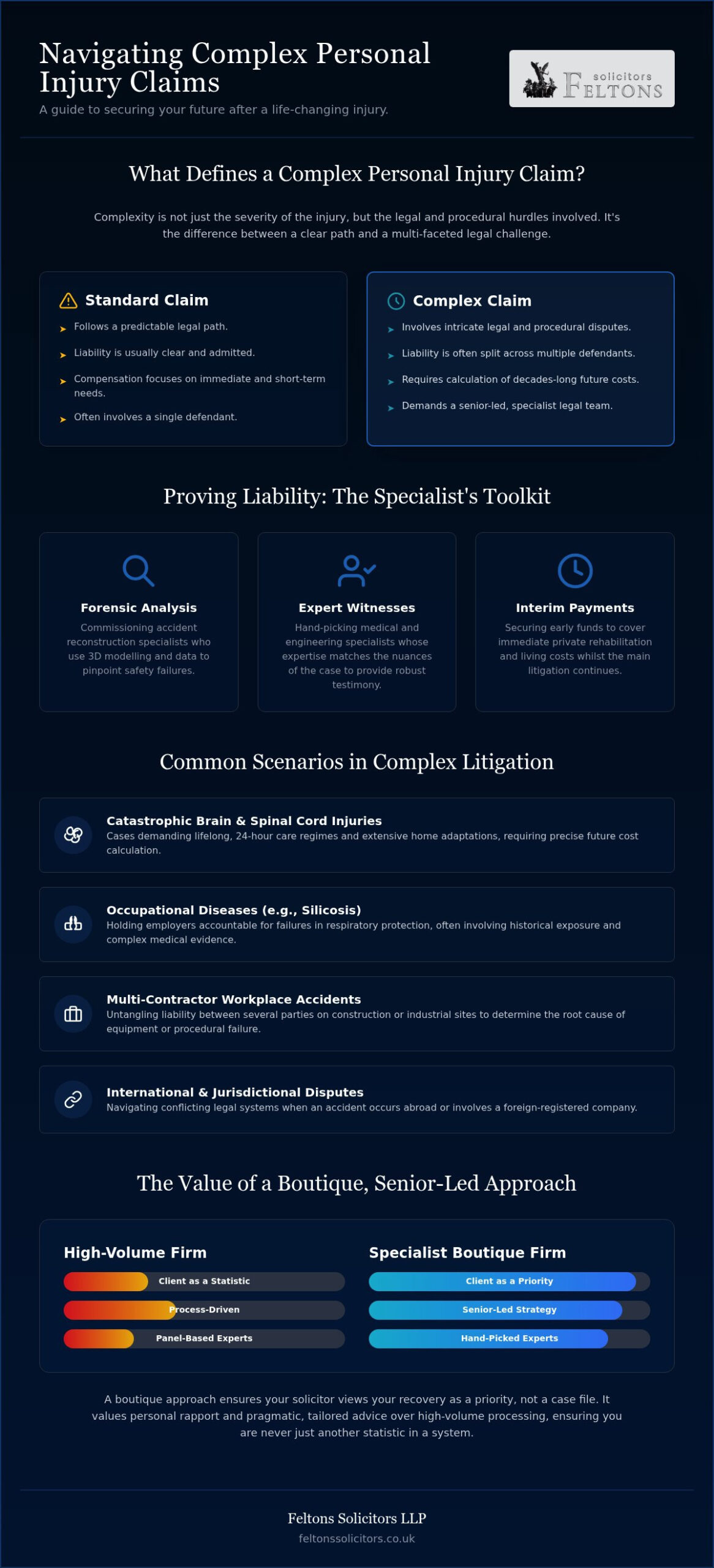
Complexity isn’t just about the scale of the injury. It describes the legal and procedural hurdles that stand between a claimant and their recovery. Whilst a standard claim might follow a predictable path, a complex case involves layers of dispute that require a senior-led approach. It’s the difference between a straightforward admission of fault and a multi-year battle over intricate liability.
A complex personal injury claims solicitor often deals with cases where liability is split across multiple defendants. This is common in large-scale construction accidents or multi-vehicle collisions. In these instances, the difficulty lies in untangling who is responsible for what percentage of the harm. When several parties are involved, each with their own legal team and insurers, the litigation becomes a sophisticated exercise in coordination and forensic evidence gathering.
High-value claims also introduce the challenge of predicting the future. When an injury is life-changing, the legal team must account for decades of lost earnings and care costs. This process of calculating compensation requires a deep understanding of the Personal Injury Discount Rate, which stands at +0.5% as of 2026, and how it affects lump-sum payments for future losses. Without this specialist expertise, there’s a risk that a settlement won’t cover the claimant’s lifelong needs.
The Difference Between Serious and Complex Injuries
A serious injury, such as a compound fracture, is physically devastating but legally straightforward if the cause is clear. Complexity arises when the medical prognosis is unstable or when the injury affects multiple aspects of a person’s life over many years. This is why a complex personal injury claims solicitor looks beyond the immediate diagnosis. They coordinate with multi-disciplinary experts to understand how an injury will evolve, ensuring the claim doesn’t settle prematurely for an inadequate sum. It’s about protecting your interests for the next thirty years, not just the next three.
Common Scenarios Requiring Specialist Complex Litigation
Certain environments naturally produce more intricate legal disputes. These often include catastrophic brain and spinal cord injuries that demand lifelong, 24-hour care regimes. Workplace accidents involving several contractors are equally challenging, as equipment failure must be forensically analysed to determine the root cause of the incident. Fatal accident enquiries also fall into this category, where the solicitor represents bereaved families during inquests and subsequent dependency claims. In modern litigation, international elements add another layer of difficulty. If an accident occurs abroad or involves a foreign-registered entity, jurisdictional challenges require a solicitor with worldly experience to navigate conflicting legal systems.
The Legal Mechanism: Proving Liability in Intricate Cases
Proving liability in a standard slip-and-trip is one thing; establishing negligence in a high-stakes industrial environment or a multi-vehicle pile-up is quite another. In these non-standard settings, the burden of proof rests heavily on the claimant. A complex personal injury claims solicitor must meticulously organise evidence to transform a collection of facts into a robust, undeniable narrative. This often involves commissioning accident reconstruction specialists who use 3D modelling and forensic data to pinpoint the exact moment a safety protocol failed. It isn’t just about what happened; it’s about proving exactly why it was avoidable.
For those facing life-altering injuries, waiting years for a final settlement isn’t an option. Senior solicitors prioritise securing interim payments. These funds provide immediate relief for private rehabilitation, medical equipment, and daily living costs whilst the main litigation continues. It’s a pragmatic approach that ensures your recovery starts now, not when the court process concludes. Securing these payments early provides a sense of financial security that allows you to focus entirely on your physical and emotional wellbeing without the constant pressure of mounting bills.
The Role of Expert Witnesses in Complex Claims
Expert testimony is the bridge between a physical injury and legal compensation. Choosing the right medical or engineering specialists is a nuanced task. Whilst larger firms might rely on high-volume panels, a boutique firm hand-picks advisors whose expertise matches the specific nuances of your case. These party-specific advisors provide detailed reports that withstand intense cross-examination. In some instances, your legal strategy might also consider state-level support like the Industrial Injuries Disablement Benefit, though this is separate from the civil damages pursued by your solicitor. The goal is to create a comprehensive picture of your future needs that the court cannot ignore.
Managing Multi-Party Liability and Contributory Negligence
Complexity often peaks when liability is shared amongst multiple defendants, and a complex personal injury claims solicitor must ensure no party evades their responsibility. This requires a methodical, orderly legal mindset to ensure every potential defendant is correctly identified and served. Defendants frequently attempt to reduce their payout by alleging contributory negligence, arguing that the claimant was partly at fault for their own injuries. Defending against these tactics requires a solicitor who is both a sophisticated guide and a firm advocate. If you’re concerned about the intricacy of your accident, seeking senior-led litigation advice can help clarify the path forward and protect the full value of your claim.
Specialist Focus: Silicosis and Occupational Lung Diseases
The UK stone masonry sector is currently witnessing a troubling resurgence of respiratory conditions, largely driven by the popularity of engineered stone. In May 2026, the Health and Safety Executive (HSE) launched a concentrated programme of over 1,000 inspections to address the unacceptable practice of dry cutting, which puts an estimated 600,000 workers at risk of silica exposure annually. For a complex personal injury claims solicitor, these cases represent a unique intersection of medical science and statutory duty. Silicosis is a preventable but incurable occupational disease caused by silica dust. This condition, along with other Silicosis and Occupational Lung Diseases, often goes undetected for decades due to its long latency period.
Unlike a sudden traumatic accident, the “date of knowledge” for a disease claim might occur years after the initial exposure. This delay creates evidentiary challenges that require a methodical legal mind to overcome. A specialist solicitor must trace historical employment records and safety protocols to prove that the exposure was significant and attributable to a specific workplace environment. It’s about building a bridge between past negligence and current suffering.
Employer Negligence and Statutory Breach
Employers have a clear legal duty to maintain the workplace exposure limit for respirable crystalline silica at or below 0.1 mg/m³. Proving a breach involves demonstrating that an employer failed to implement dust controls that were “as low as reasonably practicable.” This includes providing high-standard respiratory protective equipment and ensuring adequate ventilation. If an original employer has ceased trading, your legal team will work to trace their historical insurers to ensure the claim can still proceed. This persistence is vital for securing the financial security needed to manage a progressive illness.
Legal Support for Bereaved Families
The impact of occupational disease often extends beyond the individual, affecting entire families. Pursuing a claim on behalf of a deceased loved one involves a sensitive but rigorous process of quantifying loss. This includes securing dependency payments for spouses and children who have lost financial support. For those navigating this difficult path, our silicosis claim after death guide provides a detailed roadmap for fatal accident litigation. A complex personal injury claims solicitor acts as a discreet partner during these times, ensuring the human impact of the loss is fully recognised by the court whilst handling the technical complexities of the litigation.
Calculating Compensation: Securing Your Future
General damages compensate you for pain, suffering, and loss of amenity (PSLA). These figures are based on established judicial guidelines, but a complex personal injury claims solicitor ensures that every nuanced impact on your quality of life is professionally documented. Special damages cover your quantifiable financial losses. These include immediate medical bills, travel expenses, and the significant cost of home adaptations required to accommodate a disability. A settlement is not just a payout, but a financial blueprint for the rest of your life.
For younger claimants, calculating the loss of future earnings involves a “multiplier” effect. This process uses the Ogden Tables to estimate what you would have earned had the accident not occurred, accounting for career progression and pension contributions. As of 2026, the personal injury discount rate for England and Wales remains at +0.5%. This rate is used to calculate lump-sum compensation for future losses, and even a small percentage shift can significantly alter the final settlement. It’s a precise, mathematical exercise that requires a solicitor with a methodical and orderly legal mindset.
Future Care and Rehabilitation Needs
Securing your future involves assessing the lifelong costs of private nursing, specialised physiotherapy, and psychological support. In many high-value cases, we may advocate for Periodical Payment Orders (PPOs). These provide a guaranteed, tax-free income for life, which is adjusted annually for inflation. This approach offers a level of security that a single lump sum cannot always match, particularly when care needs are expected to increase as you age. A solicitor who looks beyond the immediate litigation will prioritise these structures to ensure you never run out of funds for essential care.
Personal Injury Trusts and Estate Planning
A successful claim often results in a significant sum that can inadvertently disqualify you from means-tested state benefits. We advise on the creation of Personal Injury Trusts to ring-fence your settlement, ensuring you maintain access to essential support whilst protecting your capital. This synergy between litigation and estate planning ensures your legacy and financial security are protected for the long term. If you are ready to discuss your case with a trusted advisor, you can speak with our senior solicitors to begin building your financial recovery plan.
The Feltons Approach: Boutique Care for Complex Needs
Choosing a complex personal injury claims solicitor is a decision that extends far beyond technical competence. It’s about finding a sophisticated guide who understands that behind every high-value dispute is a life that has been fundamentally altered. Feltons Solicitors LLP was established in 2010 with a commitment to providing discreet, high-standard service that prioritises personal connection over high-volume processing. We don’t believe in the “legal factory” model where cases are passed down to junior staff; instead, we provide senior-led attention for every complex matter we undertake.
Our approach bridges the gap between traditional professional integrity and modern efficiency. We provide pragmatic, plain-English advice that cuts through dense legalese, ensuring you remain fully informed at every stage of the litigation. This methodical flow mirrors a professional consultation, where information is presented in a highly organised manner to provide a sense of security and comprehensive care. By acting as a discreet partner, we value your privacy and personal rapport, ensuring that the human impact of your injury is never forgotten amongst the technical legal work.
A People-First Philosophy in Litigation
We believe that the technical success of a claim is only half the battle. A truly successful outcome is one where the claimant feels supported and empowered throughout the process. Our methodical and orderly approach to resolving high-stakes disputes ensures that every detail is captured, from the forensic evidence of the accident to the long-term psychological impact on the family. We prioritise the human element, recognising that the ultimate goal is your long-term rehabilitation and financial security. If you’re facing the challenges of life-changing litigation, we invite you to a confidential consultation to discuss your unique circumstances and explore how we can support your recovery.
National Expertise with a Personal Touch
Whilst we maintain the worldly experience necessary to handle complex, international-scale matters, we remain deeply rooted in our commitment to personalised care. We handle complex claims for clients across the United Kingdom, providing the strategic depth of a large firm with the tailored attention of a boutique practice. This combination allows us to manage intricate liability disputes and high-value compensation calculations with quiet confidence. Whether you require assistance with a catastrophic injury or a specialist silicosis claim, our team acts as a trusted advisor to secure the settlement you deserve. If you’re seeking a partner who values your future as much as you do, contact our senior solicitors to begin your journey toward financial stability and peace of mind.
Securing Your Financial Recovery in an Evolving Legal Landscape
Navigating the aftermath of a catastrophic injury requires more than just legal representation; it demands a partnership with a trusted advisor who understands the lifelong implications of your claim. We’ve explored how identifying the nuances of liability and precisely calculating future care costs are essential steps in protecting your long-term wellbeing. Whether you are managing the challenges of a specialist occupational disease or a life-changing accident, the right complex personal injury claims solicitor provides the steady, methodical guidance necessary to build a robust case.
Feltons Solicitors LLP offers senior-led expertise with a national reach, ensuring you receive boutique levels of care without sacrificing the worldly experience required for high-value litigation. We prioritise personal connection and traditional professional integrity to help you move forward with confidence. If you are ready to protect your future, speak with a specialist complex personal injury solicitor at Feltons Solicitors today. You don’t have to navigate these intricate challenges alone.
Frequently Asked Questions
What makes a personal injury claim “complex” in the eyes of the law?
Complexity is defined by legal, medical, or procedural hurdles rather than physical severity alone. It typically involves cases with multiple defendants, international jurisdictional issues, or intricate liability disputes where fault is contested. High-value claims requiring decades of future loss calculations also fall into this category. A complex personal injury claims solicitor manages these layers of difficulty to ensure that the litigation narrative is forensically sound and addresses all multi-disciplinary hurdles.
How long do I have to start a complex personal injury claim in the UK?
You generally have three years from the date of the accident or the “date of knowledge” of the injury to begin legal proceedings. This limit is governed by the Limitation Act 1980. For occupational diseases like silicosis, the three-year clock starts when you reasonably knew your illness was significant and caused by your work. It’s vital to seek senior-led advice early to ensure evidence is preserved and court deadlines are met.
Can I change my solicitor if I am unhappy with how my complex claim is being handled?
Yes, you have the right to transfer your case to a different firm at any stage of the litigation. Many claimants move from high-volume “legal factories” to a boutique complex personal injury claims solicitor to receive more personal, senior-led attention. Your new solicitor will coordinate the transfer of your file and handle the lien on your costs, ensuring the transition is smooth and your case remains on track for success.
What are interim payments, and can I receive them before my case is settled?
Interim payments are advance sums paid out of the final settlement to cover immediate needs like private rehabilitation, medical equipment, or lost earnings. You can receive them once the defendant has admitted liability or if the court is satisfied you will win. These payments are crucial for maintaining financial security during long-running disputes. They ensure you don’t have to wait years to access the care and home adaptations you need right now.
Will my complex personal injury claim have to go to court?
Most claims are settled through negotiation, with approximately 97% of personal injury cases in England and Wales concluding without a full trial. Whilst your solicitor will prepare every case as if it’s going to court to maintain a position of strength, a settlement is often reached during mediation. If a trial is necessary, your senior solicitor will provide a steady, calm presence to guide you through the process and represent your interests.
How is compensation calculated for life-changing injuries?
Compensation is split into general damages for pain and suffering and special damages for quantifiable financial losses. For life-changing injuries, we use the Personal Injury Discount Rate, currently +0.5%, to calculate lump-sum payments for future care and lost earnings. We also consider the “multiplier” effect for younger claimants. This methodical approach ensures your settlement acts as a comprehensive financial blueprint for your lifelong needs and provides long-term security.
What is a Personal Injury Trust, and do I need one?
A Personal Injury Trust is a legal arrangement that holds your compensation separately from your personal finances. This is often necessary to ensure your settlement isn’t “means-tested,” allowing you to remain eligible for certain state benefits. By ring-fencing these funds, you protect your capital for its intended purpose: your long-term care and rehabilitation. Your solicitor can advise on the synergy between litigation and estate planning to protect your legacy and future support.
Can I claim for silicosis if I was exposed to silica dust many years ago?
Yes, you can claim for silicosis even if exposure occurred decades ago, provided you are within three years of your “date of knowledge.” Because occupational lung diseases have long latency periods, the law allows for claims to proceed once symptoms are diagnosed. We trace historical insurers for companies that may have ceased trading, ensuring that the human impact of past negligence is addressed through contemporary legal action and financial support.