

Could your global legacy be dismantled by the very borders you crossed to build it? In 2026, the transition to a residence-based Inheritance Tax system means that simply living in the UK can now expose your worldwide assets to HMRC, regardless of where they’re physically located. Managing these complexities requires the steady hand of experienced international probate solicitors uk. The intersection of foreign succession laws and British tax requirements has never been more intricate, making professional oversight essential for protecting family wealth and ensuring your intentions are honoured.
It’s natural to feel overwhelmed by the conflicting demands of different legal systems or the fear that significant delays will stall the distribution of assets to your beneficiaries. With probate application fees now at £526 and tax thresholds frozen until 2031, the margin for error has vanished. This guide provides a clear, comprehensive roadmap for managing complex cross-border estates, ensuring every foreign asset is legally secured whilst maintaining strict compliance with current 2026 regulations. We’ll examine how to navigate the new residence-based tax landscape, mitigate your total tax liability through expert planning, and streamline the probate process across multiple jurisdictions to provide your family with much-needed stability.
Key Takeaways
- Grasp how the 2026 shift to a residence-based tax system impacts your global estate and the specific reporting obligations now required by HMRC.
- Navigate the complexities of foreign property ownership, including the essential steps for the Registration of Overseas Entities to protect your real estate assets.
- Benefit from the bespoke guidance of international probate solicitors uk to manage the nuances of cross-border administration and ensure seamless asset distribution.
- Utilise a methodical executor roadmap to accurately secure worldwide assets while identifying the most favourable tax treatments available under current laws.
- Reduce the likelihood of international legal disputes and contentious probate through discreet, forward-thinking estate management strategies.
What is International Probate? Understanding Cross-Border Estate Administration
International probate is the legal procedure required to manage and distribute an estate when the deceased held assets in more than one country. Unlike a standard domestic probate, which follows a single set of rules, cross-border administration involves a complex conflict of laws between different legal systems. This often occurs in two primary scenarios: a UK resident dies leaving property or bank accounts abroad, or a foreign national passes away leaving assets within the UK. In either case, the process requires international probate solicitors uk to act as a central coordinator, managing various legal threads to ensure a cohesive distribution of the estate.
The role of the UK solicitor is to bridge the gap between jurisdictions. They don’t just handle the UK side; they liaise with foreign legal professionals to ensure that the grant of probate is recognised and that assets are released without unnecessary friction. This coordination is what prevents a cross-border estate from becoming a decades-long administrative burden for the family.
The Legal Complexity of Multiple Jurisdictions
The primary challenge in these cases is the concept of “Situs,” which refers to the legal location of an asset. For example, immovable property like a holiday home is governed by the laws of the country where it stands, whilst movable assets like shares or cash might follow the laws of the deceased’s last residence. Identifying every jurisdiction early is vital. Failing to account for a single foreign bank account can stall the entire process. Experienced international probate solicitors uk must navigate different definitions of “ownership” and “validity” across borders, which significantly increases the administrative burden compared to a UK-only estate.
Why Specialist Expertise is Essential for Cross-Border Estates
Many civil law countries, such as France or Spain, operate under “forced heirship” rules. These regulations dictate that a specific portion of an estate must go to certain relatives, potentially overriding the instructions in a UK Will. Without specialist guidance, executors risk foreign assets being frozen or facing unexpected legal challenges from disgruntled heirs abroad. A dedicated solicitor ensures that the estate remains compliant with international treaties and local requirements, preventing costly delays. At Feltons Solicitors LLP, we provide that boutique level of care, acting as a discreet, trusted advisor to navigate these global complexities whilst protecting the integrity of the deceased’s final wishes.
Key Legal Frameworks: Domicile, Residence, and Resealing a Grant
The distinction between domicile and residence is often the most significant hurdle in cross-border estate administration. Whilst residence describes where you live, domicile is a deeper legal concept reflecting where you truly belong or intend to remain permanently. Since April 2025, the UK has moved to a residence-based system for Inheritance Tax. This means individuals who’ve been UK tax residents for at least 10 out of the previous 20 tax years are now subject to UK IHT on their worldwide assets. For executors, this shift makes the guidance of international probate solicitors uk essential to avoid double taxation or compliance failures with HMRC.
Determining Domicile and Its Impact on Probate
HMRC’s assessment of domicile remains the foundation of any international probate strategy. You typically have a domicile of origin, which is usually the country of your father’s domicile at your birth. However, you can acquire a domicile of choice by moving to a new country with the clear intention of living there permanently. Even if you’ve lived abroad for years, HMRC may still consider you “deemed domiciled” in the UK for tax purposes if you haven’t sufficiently severed those legal ties. This determination dictates whether the 40% Inheritance Tax rate applies only to your UK assets or your entire global estate. Our team at Feltons Solicitors LLP acts as a discreet advisor for complex wealth, ensuring these technical legal frameworks are navigated with precision.
Resealing a Grant vs. Applying for a New Grant
A common point of confusion for foreign executors is whether they need to start the probate process from scratch in the UK. If the deceased was from a country covered by the Colonial Probates Act 1892, the existing foreign grant can often be “resealed”. This process is available for several jurisdictions, including Australia, Canada, New Zealand, and Hong Kong. Resealing is a streamlined administrative procedure where the UK court places its own seal on the foreign document, giving it full legal force here. It’s significantly faster and more cost-effective than a fresh application.
However, for countries not covered by this Act, such as the USA or most of mainland Europe, a full UK Grant of Representation is required. This involves a more rigorous application process, including a detailed account of UK-based assets and liabilities. Experienced international probate solicitors uk can determine which path is necessary, preventing the freezing of assets and reducing distribution delays. Whether your situation requires a simple reseal or a complex new application, a methodical approach ensures that the estate is administered whilst maintaining strict compliance with international treaties.
Managing Foreign Property and the Register of Overseas Entities
Real estate often forms the cornerstone of a cross-border estate, yet it presents unique challenges that differ from liquid assets like cash or shares. When a property is involved, executors must navigate the specific Residential Property Law of the country where the land is situated. This is particularly complex when UK land is held by a foreign company or trust. In such cases, the mandatory Registration of Overseas Entities becomes a critical compliance hurdle. If the deceased was a beneficial owner of an overseas entity that owns UK property, the executor has a legal duty to update the register at Companies House. Failure to do so can freeze the property’s title, preventing any sale or transfer to beneficiaries.
Compliance with the Economic Crime Act
Under the Economic Crime (Transparency and Enforcement) Act 2022, any foreign entity owning UK land must identify its beneficial owners. Probate acts as a trigger for these requirements. Executors must verify the identity of the new beneficial owners or confirm that the deceased’s interest has ceased. This isn’t a task for the layperson. It requires a UK-regulated verification agent to submit the data to Companies House. Professional international probate solicitors uk provide this essential service, ensuring that the estate doesn’t face daily fines or criminal prosecution for non-compliance. These regulations are designed to prevent money laundering, but for an executor, they represent a significant administrative trap that can stall asset distribution for months.
Valuing and Transferring Foreign Real Estate
Securing an accurate valuation of foreign property is the first step in determining the estate’s total value for HMRC. You can’t simply rely on local estate agent estimates. HMRC requires professional valuations that meet their specific criteria, which often means coordinating with surveyors in the country where the property is located. Beyond the valuation, executors must account for local transfer taxes and potential Capital Gains Tax. Each jurisdiction has its own rules for how property passes to heirs. Some countries require a local notary to oversee the transfer, whilst others may have specific “exit taxes” for non-resident beneficiaries. By engaging international probate solicitors uk, you gain a partner who can manage these local professionals, ensuring that the property is either sold or transferred efficiently whilst minimising the tax impact on the final inheritance.
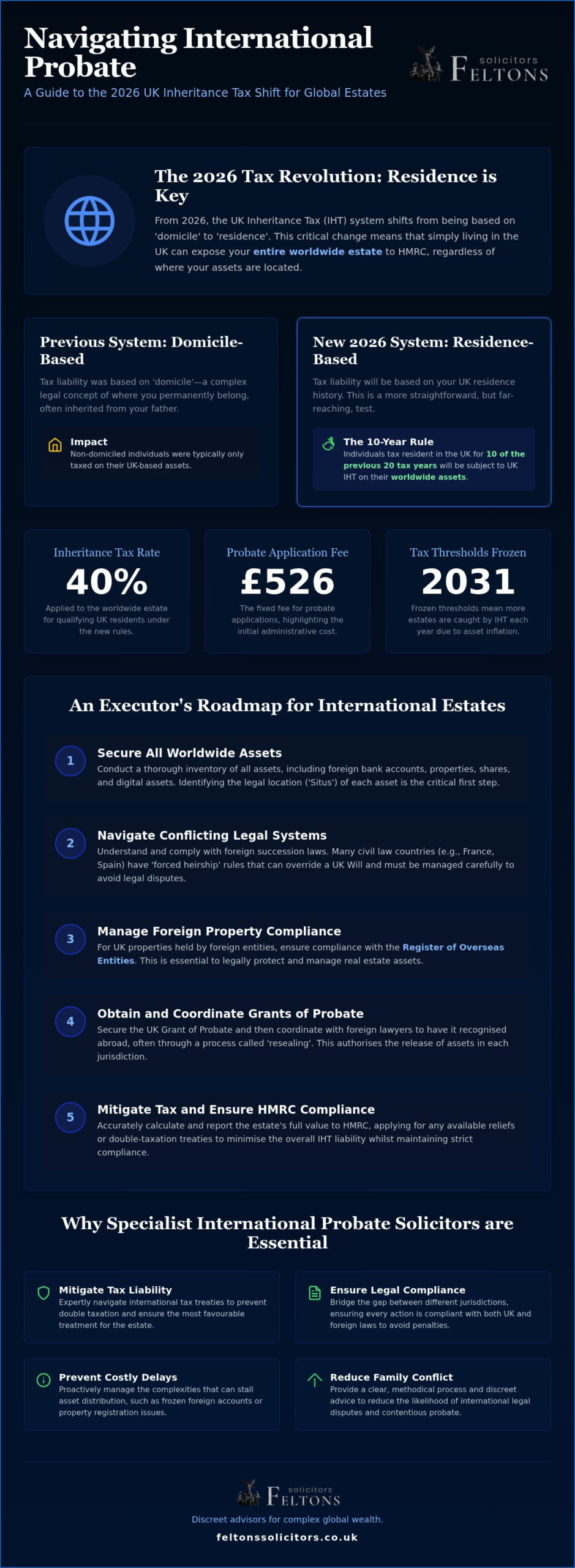
An Executor Roadmap: Steps for Handling International Assets
Managing an estate with global reach requires a disciplined, step-by-step approach to avoid administrative gridlock. The first priority is to conduct a thorough search for all worldwide assets and liabilities. This isn’t always straightforward, as digital accounts, offshore holdings, and foreign life policies can be easily overlooked. Once the inventory is complete, you must determine the deceased’s domicile and the applicable tax regime. This step is critical; it dictates whether HMRC expects a slice of the global pie or just the UK-based assets. Working with international probate solicitors uk ensures this assessment is accurate, preventing costly overpayments or future investigations.
Gathering International Documentation
The paperwork for cross-border estates is significantly more demanding than domestic probate. You’ll often need multiple copies of the death certificate, each verified with an Apostille to prove its authenticity to foreign banks and land registries. If the deceased left a Will in a foreign language, it must be translated by a certified professional before the UK Probate Registry will accept it. Organising a comprehensive inventory of global shareholdings is equally vital. Each jurisdiction has its own requirements for transferring securities; missing a single document can stall the distribution process for months. A methodical approach to documentation is the only way to maintain the momentum of the estate administration.
Navigating International Inheritance Tax
Tax is often the greatest source of anxiety for executors. Fortunately, the UK has established Double Taxation Treaties with many countries to ensure you don’t pay tax twice on the same asset. However, claiming this relief isn’t automatic. You must report all foreign assets on the IHT400 form and provide evidence of any tax already paid abroad. This is where professional Estate Planning advice becomes invaluable. It helps you understand the nuances of these treaties and ensures the estate remains compliant whilst protecting the maximum amount of wealth for the beneficiaries. If you’re struggling to manage the complexities of a multi-jurisdictional estate, our team of international probate solicitors uk can provide the steady, expert guidance you need. For tailored support with your cross-border legal matters, contact Feltons Solicitors LLP today.
Why Specialist International Probate Solicitors are Essential
Cross-border estates aren’t just legal puzzles; they’re human stories spanning continents. Managing these requires more than a standard probate application. By engaging international probate solicitors uk, you secure a single point of contact who understands the friction between different legal systems. This central coordination is vital for preventing the misunderstandings that lead to Contentious Probate. When beneficiaries are spread across jurisdictions, the risk of disputes over asset valuation or distribution increases. A specialist firm mitigates this by providing clear, authoritative guidance that respects the laws of every country involved.
Feltons Solicitors LLP brings a unique advantage to this process. We specialise in both Private Client and Property Law, a combination that’s essential when an estate includes high-value UK real estate or complex overseas entities. Many firms treat probate and property as separate silos. We integrate them, ensuring that the registration of overseas entities or the transfer of leasehold property happens alongside the probate application. This prevents the administrative gaps that often cause significant delays for executors.
Discreet Handling of High-Value Estates
Privacy is paramount when dealing with high-value international wealth. Our boutique approach prioritises personal connection over high-volume processing. We understand the sensitive family dynamics that arise when assets are distributed amongst relatives in different tax regimes. By acting as a discreet, trusted advisor, we protect the privacy of your beneficiaries. We ensure that the technical legal work remains invisible to the family, allowing them to focus on their own transition whilst we handle the global complexities with quiet confidence.
Pragmatic Advice for Global Clients
Efficiency is the hallmark of our service. We focus on pragmatic outcomes that avoid protracted legal battles. During what is often a stressful period, we provide a calm, steady presence, guiding you through every HMRC requirement and foreign legal hurdle. Our goal is to secure your assets and distribute them with minimal tax liability. If you’re ready to secure your global legacy, you can instruct us for a comprehensive Probate and Estate Planning review. This ensures your current estate is handled correctly whilst preparing your own affairs for the future. As experienced international probate solicitors uk, we’re here to provide the sophisticated oversight your estate deserves.
Securing Your Global Legacy with Confidence
Managing a cross-border estate in 2026 requires a meticulous balance of legal precision and strategic foresight. As the UK moves towards a residence-based tax system, the importance of accurately determining domicile whilst ensuring compliance with the Registration of Overseas Entities cannot be overstated. These complexities often feel overwhelming. They don’t have to be. By understanding the intersection of private client law and international property requirements, you can protect family wealth and ensure a seamless transition of assets across jurisdictions.
The guidance of international probate solicitors uk provides the steady, professional oversight needed to navigate these global challenges. Feltons Solicitors LLP offers a sophisticated boutique service tailored to the needs of complex global wealth. Our expertise in multi-jurisdictional property and probate ensures that every detail, from foreign tax clearances to beneficial owner registrations, is handled with the utmost discretion and care. We’re here to act as your trusted advisor, providing pragmatic solutions that respect both the law and your family’s privacy. Contact Feltons Solicitors LLP for expert international probate advice today and take the first step towards securing your legacy with peace of mind.
Frequently Asked Questions
Do I need a UK solicitor if the deceased lived abroad but had UK assets?
Yes, if the deceased owned UK property, bank accounts, or shares, you’ll generally need a UK Grant of Probate to release them. UK financial institutions won’t accept foreign grants without a local seal or a fresh application. Engaging international probate solicitors uk ensures that these assets are identified and secured whilst maintaining compliance with local inheritance tax requirements. It’s the most efficient way to prevent assets from being frozen indefinitely.
How long does international probate typically take to complete?
International probate usually takes between 6 and 18 months, depending on the complexity of the jurisdictions involved. Whilst a domestic estate might be settled faster, cross-border cases require coordination with foreign legal professionals and tax authorities. Delays often occur during the valuation of foreign property or when waiting for tax clearances from multiple countries. A methodical approach and early documentation gathering help to keep the process within a predictable and manageable timeframe for the family.
Can I reseal a Grant of Probate from any country in the UK?
No, you can only reseal a Grant of Probate if it was issued in a country covered by the Colonial Probates Act 1892. This includes many Commonwealth jurisdictions such as Australia, New Zealand, Canada, and South Africa. If the deceased lived in a country outside this list, such as the USA or France, you must apply for a fresh UK Grant of Representation. This technical distinction is vital for planning your administrative timeline and overall estate budget.
What happens if there are two different wills in two different countries?
Having multiple wills is a common strategy to handle assets in different jurisdictions, provided they’re drafted correctly. The primary challenge is ensuring that a newer will doesn’t accidentally revoke an older one in another country. Solicitors must carefully review the revocation clauses in each document. If conflicts arise, legal experts must determine which law takes precedence, often based on the deceased’s domicile or the location of the specific assets being distributed amongst the heirs.
Will I have to pay inheritance tax in both the UK and the foreign country?
You might be liable for tax in both countries, but Double Taxation Treaties usually prevent you from paying twice on the same asset. These treaties allow you to offset tax paid in one jurisdiction against the liability in another. Since the UK moved to a residence-based system in 2025, your worldwide assets may be subject to HMRC’s 40% rate if the deceased met the 10-out-of-20-year residency rule. Professional planning is essential to manage these complex liabilities.
What is an Apostille and why is it needed for international probate?
An Apostille is a certificate that authenticates the signature or seal on a public document, such as a death certificate or a power of attorney. It’s a requirement under the Hague Convention to ensure that documents from one country are legally recognised in another. Without this verification, foreign banks and land registries often won’t accept your UK legal papers. This causes significant administrative hurdles and can indefinitely stall the distribution of the estate to its beneficiaries.
How does the Register of Overseas Entities affect inheriting UK property?
If you’re inheriting UK property held through a foreign company, you must comply with the Register of Overseas Entities. Executors are required to update Companies House regarding any changes in beneficial ownership. Failure to maintain this registration can result in daily fines and prevent the property from being sold or transferred. Specialist international probate solicitors uk can act as verification agents to ensure the estate remains compliant with the Economic Crime Act whilst protecting the property’s legal title.
Can an executor be held personally liable for international tax errors?
Yes, executors carry a heavy burden of personal liability for the accuracy of tax returns submitted to HMRC and foreign authorities. If you fail to report worldwide assets or miscalculate the tax due, you could be held responsible for penalties or unpaid interest out of your own pocket. This financial risk is why many executors seek professional guidance from a boutique firm like Feltons Solicitors LLP to ensure every valuation and tax claim is precise and fully compliant.