

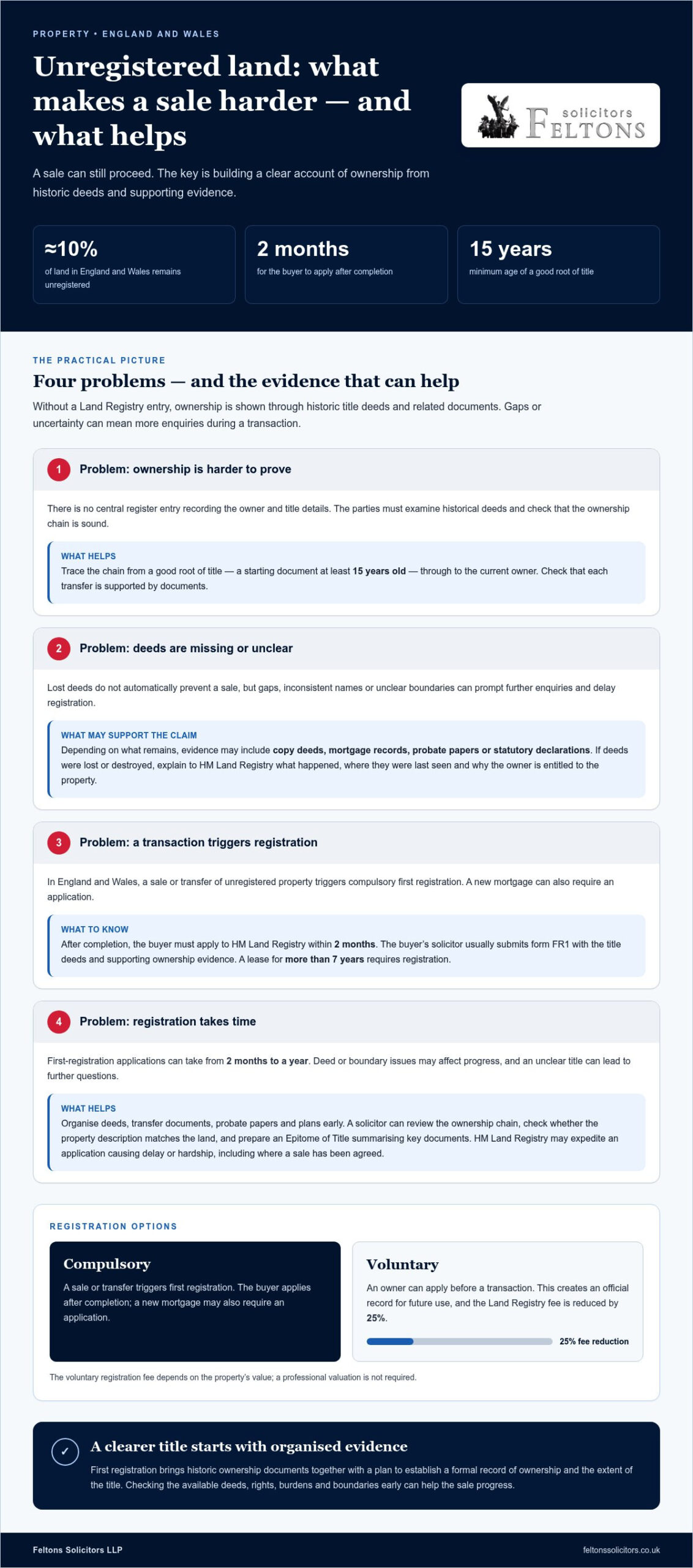
Approximately 10% of land in England and Wales remains unregistered, but a sale or transfer triggers compulsory first registration. After completion, the buyer must apply to HM Land Registry within two months. Unregistered land conveyancing solicitors assess the title deeds and ownership history that support the application.
It’s understandable to wonder whether an unregistered title makes a property harder to sell, or whether registration can wait. The answer depends on whether a sale, transfer or other registrable event has triggered the requirement, and on the evidence available to establish ownership.
This article explains when first registration is compulsory, the practical risks of leaving a title unregistered and how a sale can proceed. It also covers why some land remains unregistered, what to do when deeds are missing and how first registration turns historic ownership documents into a registered title.
Key Takeaways
- A sale or other registrable transaction can trigger first registration; after buying unregistered property, the buyer must apply within two months of completion.
- Historic deeds and ownership records help establish the chain of title, so organising the available documents can support a smoother sale.
- An unregistered property can still be sold, but missing or unclear title evidence may complicate the transaction and delay registration.
- Some land remains unregistered because no transaction requiring registration has occurred; voluntary registration can help make ownership easier to evidence in future.
- First registration brings the property onto the register for the first time, creating a formal record of ownership and the extent of the title.
Is it compulsory to register land?
In England and Wales, registration becomes compulsory when unregistered property is sold or transferred. The buyer generally applies for first registration after completion, although an owner can register voluntarily before a transaction.
The Land Registration Act 1925 introduced compulsory registration, initially for specified transactions, including the grant of a new lease of 21 years or more, according to UK legislation. Today, a sale or transfer of unregistered property triggers registration, and a new mortgage can also require an application. HM Land Registry says granting a lease for more than seven years requires registration.
Checking the Registration Status
To check registration status, find out whether HM Land Registry holds an official record for the property. This matters before a sale, transfer or mortgage because the title information determines which documents and registration steps are needed. Anyone can request an official copy of the register for registered land. Check the registered owner, property details, rights and restrictions rather than relying only on old deeds.
First Registration Applications
First registration is the process of creating a Land Registry record for a property that has never been registered. After a purchase, the buyer’s solicitor submits the application, usually using form FR1, with the title deeds and supporting ownership evidence. The application brings earlier conveyances and dealings together with a plan to establish the registered title. A clear, complete application helps address questions about the property boundaries, ownership and rights.
An owner can also apply voluntarily when no transaction has triggered compulsory registration. This can establish an official record before a future sale or mortgage, giving the parties a registered title to work from. A reduced fee applies to voluntary first registration, with the Land Registry fee reduced by 25 per cent. The fee depends on the property’s value, and a professional valuation is not required.
Timing matters if a transaction is under way. The buyer must apply within two months of completion after purchasing unregistered land. First-registration applications can take from 2 months to a year, so unresolved deed or boundary issues may affect progress. HM Land Registry may expedite an application where it is causing delay or hardship, including when a sale has been agreed.
Solicitors’ charges depend on the work involved, such as reviewing historic deeds, resolving title issues and preparing a registration application. The price depends on the case and is given after a quote request.
To find a solicitor experienced in unregistered land conveyancing near you, look for someone who handles first registration, examines historic ownership evidence and can explain the steps for your transaction. A local search for unregistered land conveyancing solicitors can help identify firms offering this specialist conveyancing work.
What are the consequences of not registering an unregistered title?
Without a Land Registry entry, ownership must be established through historical title deeds and related documents. This can make selling, buying or mortgaging more involved, because the parties need to examine the evidence and confirm that the ownership chain is sound. In England and Wales, a good root of title should be at least 15 years old. If that starting document is missing or later transfers are unclear, the investigation may take longer.
The buyer’s solicitor reviews original deeds and conveyances to trace ownership from the good root of title to the current owner. They check that each transfer is supported by documents and that the property described matches the land being sold. The solicitor may also prepare an Epitome of Title, a summary of the ownership chain and the key documents supporting it. Gaps, inconsistent names or unclear boundaries can lead to further enquiries and delays.
Missing deeds don’t automatically prevent a sale, but alternative evidence may be needed to support the ownership claim. Depending on what remains, this could include copy deeds, mortgage records, probate papers or statutory declarations. If deeds have been lost or destroyed, the owner may need to explain to HM Land Registry what happened, where the documents were last seen and why they are entitled to the property. A specialist review can identify gaps before they become obstacles during a transaction.
Leaving a title unregistered means there is no central register entry recording the owner and title details. This can make ownership harder to prove and increase the potential for disputes. It may also complicate a sale or mortgage, as the buyer or lender relies on the deeds and ownership investigation rather than an official register. Registration can help protect an owner’s interests against fraudulent dealings by someone falsely claiming to own the property, and guard against adverse possession claims.
For an unregistered purchase, the solicitor’s investigation does more than collect paperwork. It checks whether the documents form a coherent account of ownership and whether the evidence shows relevant rights or burdens. A land charges search against previous owners can help identify interests affecting the property. If the chain has a gap, the next step is to locate supporting records or assemble other evidence before the application proceeds.
Early document review can reduce avoidable questions once a sale is agreed. Keep deeds, transfer documents, probate papers and plans together, and note any known loss or damage. For support with a property transaction involving historic title documents, residential and commercial conveyancing can provide a relevant next step.
How do I sell an Unregistered Property?
You can sell an unregistered property using its title deeds as evidence of ownership. The seller prepares the deeds and property information, the buyer investigates the title and, after completion, applies for first registration within two months.
Confirming the Seller’s Right to Transfer
To confirm the seller’s right to transfer the property, ownership is traced through the title deeds and supporting documents. The buyer needs evidence that the seller can pass on the title. A conveyancer reviews the chain of transfers, checks names and dates, and identifies gaps that need explanation. The seller’s solicitor can start gathering and organising these documents before a buyer is found, helping to identify issues early.
Property Details, Boundaries and Restrictions
The sale documents must describe the property accurately, including its boundaries and relevant rights or restrictions. Compare the deeds and plans with the land being sold, particularly where the plot includes shared access, a field or an extension. A mismatch can prompt enquiries or complicate the registration application. The buyer’s conveyancer examines the documents to understand which land and rights pass with the transfer.
Conveyancing Timescales
Unregistered title evidence can affect the pace of conveyancing because historic documents need examination before the buyer can be satisfied. First registration can take from 2 months to a year, while creating a new registered title usually takes between 6 and 9 months. These periods concern registration, not the entire sale. Missing deeds, unclear boundaries or incomplete ownership evidence can require further investigation and cause delays.
Steps in an Unregistered Conveyancing Transaction
The transaction usually moves from collecting title deeds, to checking the ownership chain, answering the buyer’s enquiries, completing the sale and applying for first registration. The seller’s solicitor prepares title evidence and can start before marketing. After completion, the buyer’s solicitor submits the application to HM Land Registry, normally using form FR1 with supporting documents. This order matters because the buyer needs evidence to register the transferred title.
Some properties remain unregistered because no sale or other registrable transfer has triggered first registration. Approximately 10% of land in England and Wales remains unregistered. An owner may choose voluntary first registration before selling, but can also proceed with a sale using the deeds. The right approach depends on the available documents, any title concerns and the transaction’s timing.
For practical support with the title investigation and transfer, conveyancing for property transactions can help organise the work involved in an unregistered sale.
Land that remains unregistered
Land can remain unregistered because no sale or other registrable dealing has triggered first registration. This does not, by itself, mean the owner lacks legal title. In England and Wales, title may still be evidenced by deeds and earlier conveyances. The practical difference is that buyers and lenders must rely on those documents rather than a current Land Registry record.
For an unregistered residential property, the deeds may show how ownership passed between successive owners. A conveyancer examines the documents and checks that the property description, boundaries and ownership chain fit together. This investigation matters before a sale or mortgage because gaps or conflicting details can lead to enquiries, disputes or delays. A straightforward application depends on coherent evidence, not simply the age of the property.
Some registrable dealings make registration compulsory. For example, taking out a mortgage on unregistered commercial property triggers registration as part of the mortgage process. A sale or transfer can also trigger first registration. Owners without an immediate transaction can choose voluntary registration, creating an official record before buyers or lenders need to rely on historic deeds.
Before an application, searches help identify interests that may affect the land. A land charges search should cover previous owners since 1925, and form K15 is used to apply for that search. The search is made against owner names, so accurate details from the title documents matter. An index map search can also help establish whether the land, or part of it, is already recorded on the register.
Where someone occupies land without the owner’s consent and claims it as their own, adverse possession may become relevant. The stated period for a claim involving unregistered land is 12 years. An application may be appropriate where land has been occupied and used as one’s own for the prescribed period, but clear ownership evidence is lacking. Occupation alone does not settle who owns the land; the history and supporting evidence matter.
Leaving land unregistered can make ownership harder to demonstrate and a later sale more document-heavy. Missing deeds may require secondary evidence, such as copy deeds, mortgage records or probate papers. If boundaries are unclear, plans and historical documents can help explain which land the title covers. A solicitor can review the available evidence, arrange relevant searches and prepare an application for first registration where appropriate.
Some owners choose to register before a sale or mortgage, while others wait until a transaction triggers the requirement. The decision depends on the quality of the title evidence, the intended transaction and whether a clear record would assist future buyers. Voluntary first registration can establish the title in advance.
What is unregistered land in England and Wales
Unregistered land is property without a title entry at HM Land Registry. Ownership is evidenced by deeds and documents recording earlier dealings, rather than a current register. The absence of a register entry does not, by itself, mean the land has no owner. It means the title must be understood through its documentary history.
That distinction reflects how registration developed. The Land Registration Act 1925 introduced compulsory registration for specified transactions, and registration became compulsory nationwide for most land transactions in England and Wales in 1990. The Land Registration Act 2002 replaced the 1925 Act. Land that has not undergone a registrable dealing may therefore remain outside the register.
For an unregistered title, conveyancers examine the deeds to establish how ownership passed from one person to another. A conveyance may describe the property, record a transfer and refer to rights affecting access or use. Historical plans can help identify boundaries, while mortgages, probate papers and other documents may explain later changes. Each item contributes evidence, and the chain must make sense as a whole.
Registered ownership works differently. HM Land Registry records the owner and title details, including relevant rights and restrictions, under a unique title number. An official copy of the register can be requested for registered land. For unregistered land, there is no equivalent title entry to inspect, so the buyer’s investigation depends on the documents available and whether they establish a consistent chain.
First registration creates a Land Registry title for land that has never been registered. The application brings together evidence from earlier conveyances and dealings, along with a plan showing the property outline. This turns a documentary history into an official record that can be inspected in future transactions. Registration does not remove the need to understand the property’s boundaries or recorded rights.
Unregistered status can also matter when ownership changes through inheritance. A personal representative dealing with property may need to establish the deceased’s title from the deeds before the transfer can be registered. Keeping property documents with estate records can help make that investigation more manageable. Where property forms part of a wider succession plan, discuss your estate planning needs and how ownership should be documented.
Feltons Solicitors LLP: Divorce and Financial Arrangements
Feltons Solicitors LLP provides residential and commercial conveyancing for property transactions, including matters involving unregistered titles. If you’re preparing to sell or buy unregistered property, the firm can assess the title documents, trace the ownership chain and manage the conveyancing process. This can be particularly useful where deeds are incomplete, boundaries need clarifying or first registration follows a transfer.
The firm also assists with wills, probate and estate planning where property ownership forms part of a wider family or estate matter. The right support depends on the legal issue: a property sale calls for conveyancing, while questions about distributing property after death may involve estate planning or probate.
Contact Feltons Solicitors LLP to discuss your property matter.
Prepare your next property decision with confidence
Before taking your next step, gather the available deeds, plans and correspondence. A clear set of documents makes it easier to identify what needs attention and raise the right questions about a proposed sale, purchase or registration. Note any missing deeds or boundary descriptions that are difficult to interpret. These details give a conveyancer a practical starting point.
The right unregistered land conveyancing solicitors can explain the work involved in your transaction and how historic title evidence fits into it. Feltons Solicitors LLP handles residential and commercial conveyancing, including property matters that need careful title review. Taking advice before agreeing a transaction can help you plan around the documents and decisions ahead.
If you’re ready to discuss your property matter, contact Feltons Solicitors LLP. A considered next step can make a complex title easier to approach, and help you move forward with greater clarity.
Frequently Asked Questions
Who should register the property?
After buying unregistered property, the buyer is responsible for applying for first registration. The buyer’s conveyancer usually prepares and submits the application as part of the post-completion work. A seller may register voluntarily before a sale, giving the buyer an established title to work from. For example, an owner preparing to market a property can consider registration before finding a buyer.
Should You Consider Voluntary First Registration?
Voluntary first registration may suit an owner who wants to establish a registered title before a sale, transfer or mortgage requires an application. Consider the condition of the deeds, whether the property description is clear and whether a transaction is planned. The Land Registry fee depends on the property’s value, and a professional valuation is not required. The timing can depend on whether the title evidence is ready.
What are the risks of buying and selling unregistered land?
The main risks include difficulty evidencing ownership, extra title enquiries and possible delays if the deeds don’t clearly match the land being transferred. For instance, a deed plan might not show clearly whether a garage or access strip forms part of the property. Buyers may also need to understand rights affecting the land before proceeding. Sellers can reduce uncertainty by gathering relevant deeds and plans early.
What details should be included in the application for first registration?
An application should identify the property’s address and boundaries, the current owner, and relevant rights or restrictions. Form FR1 is used for first registration. Supporting evidence includes the title deeds and documents showing ownership history. Include a scale drawing if the deeds don’t contain a suitable plan. Accurate information helps the application describe the land and title being registered, rather than leaving key details unclear.
When is first registration of unregistered land compulsory?
In England and Wales, a purchase or transfer of unregistered property triggers compulsory first registration. A new mortgage on unregistered property can also trigger it. Certain other dealings matter too: gifts of land and assents by personal representatives require a change of ownership to be registered, and granting a lease for more than seven years requires registration. Following a purchase, the buyer must apply within two months of completion.
What documents are needed to convey unregistered land?
Gather the original title deeds, earlier conveyances and transfer documents that evidence the ownership chain. Plans help identify the land, while probate papers may explain how an owner inherited it. The conveyancer can prepare an Epitome of Title summarising the relevant ownership documents. Searches can also form part of the investigation, including land charges and an index map search. If original deeds are missing, secondary evidence may help support the title.
How long does unregistered land conveyancing take compared with registered land?
Unregistered transactions can take longer because the conveyancer must investigate historical deeds and establish the ownership chain. First registration may take from 2 months to a year, and creating a new registered title usually takes between 6 and 9 months. These are registration timeframes, not a guaranteed completion date for the sale. The work required depends on the title evidence, searches and any questions raised about the property.
How do solicitors investigate title to unregistered land?
Solicitors examine the deeds to trace ownership from a good root of title to the current owner. In England and Wales, a good root should be at least 15 years old. They compare names, dates, property descriptions and plans, then investigate gaps using supporting material such as probate records or copy deeds. Searches against previous owners can identify land charges, while an index map search helps check the land’s registration position.