
International Divorce Solicitors UK: Navigating Cross-Border Family Law in 2026

International Divorce Solicitors UK: Navigating Cross-Border Family Law in 2026

Since 2022, divorce cases involving non-British nationals in the UK have risen by 20%, reflecting a world where families and assets are increasingly spread across borders. If you are an expat or part of an international couple, you likely feel a profound sense of anxiety regarding how conflicting legal systems might impact your future. It’s natural to worry about the security of global assets or the complexities of international child relocation whilst facing the end of a marriage. You deserve a steady, professional hand to guide you through these high-stakes decisions.

By partnering with experienced international divorce solicitors uk, you can move from uncertainty to a position of informed control. This article provides expert guidance on securing the most favourable jurisdiction under 2026 regulations and protecting your global interests through meticulous asset disclosure. We will also explore how to establish legally binding child arrangements that remain robust across different territories, ensuring your family’s transition is handled with the discreet, high-standard care it requires.

Key Takeaways

  • Identify the fundamental criteria for initiating divorce in England and Wales, specifically focusing on the nuanced distinctions between domicile and habitual residence.
  • Discover the strategic importance of the “race to issue” and how choosing the correct legal system can secure a more favourable financial outcome.
  • Learn how to manage the disclosure of worldwide assets, including foreign property and trusts, to ensure your global wealth remains protected.
  • Understand how to establish child arrangement orders that respect a child’s habitual residence whilst facilitating seamless international travel and holiday contact.
  • Recognise how expert international divorce solicitors uk offer the tailored, boutique guidance required to navigate the complexities of cross-border family law with confidence.

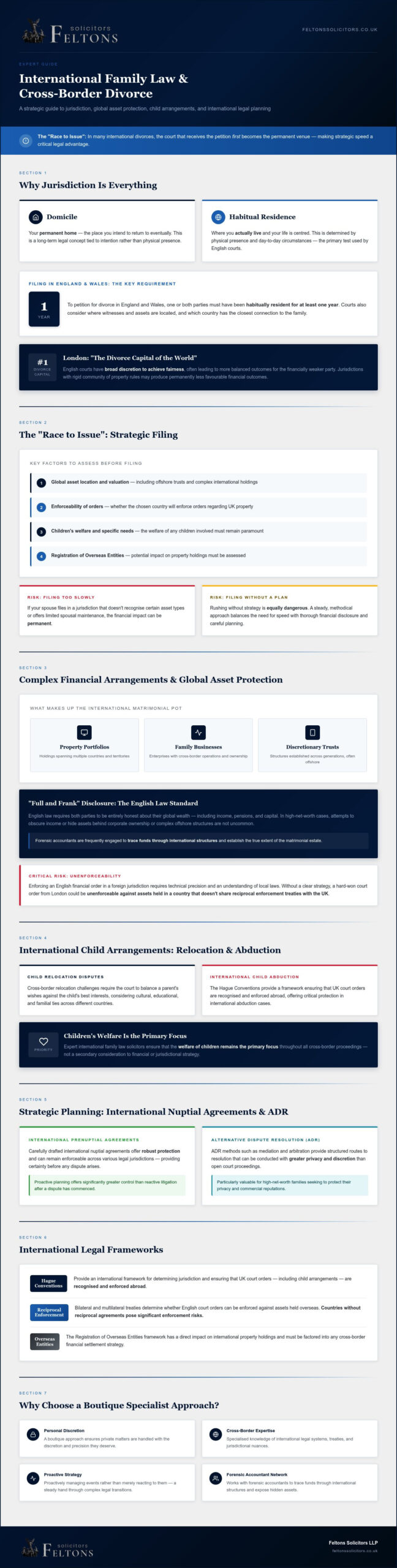
Establishing Jurisdiction for an International Divorce in the UK

Jurisdiction is far more than a procedural box to tick; it is the most critical strategic decision you will make at the start of your case. For expats and global families, the ability to issue proceedings in England and Wales can fundamentally change the trajectory of a financial settlement. Our team of international divorce solicitors uk understands that establishing a legal connection to this jurisdiction requires a methodical approach, particularly when a couple has resided outside the British Isles for many years. Choosing the right forum ensures that your interests are protected by a system known for its sophisticated handling of complex wealth.

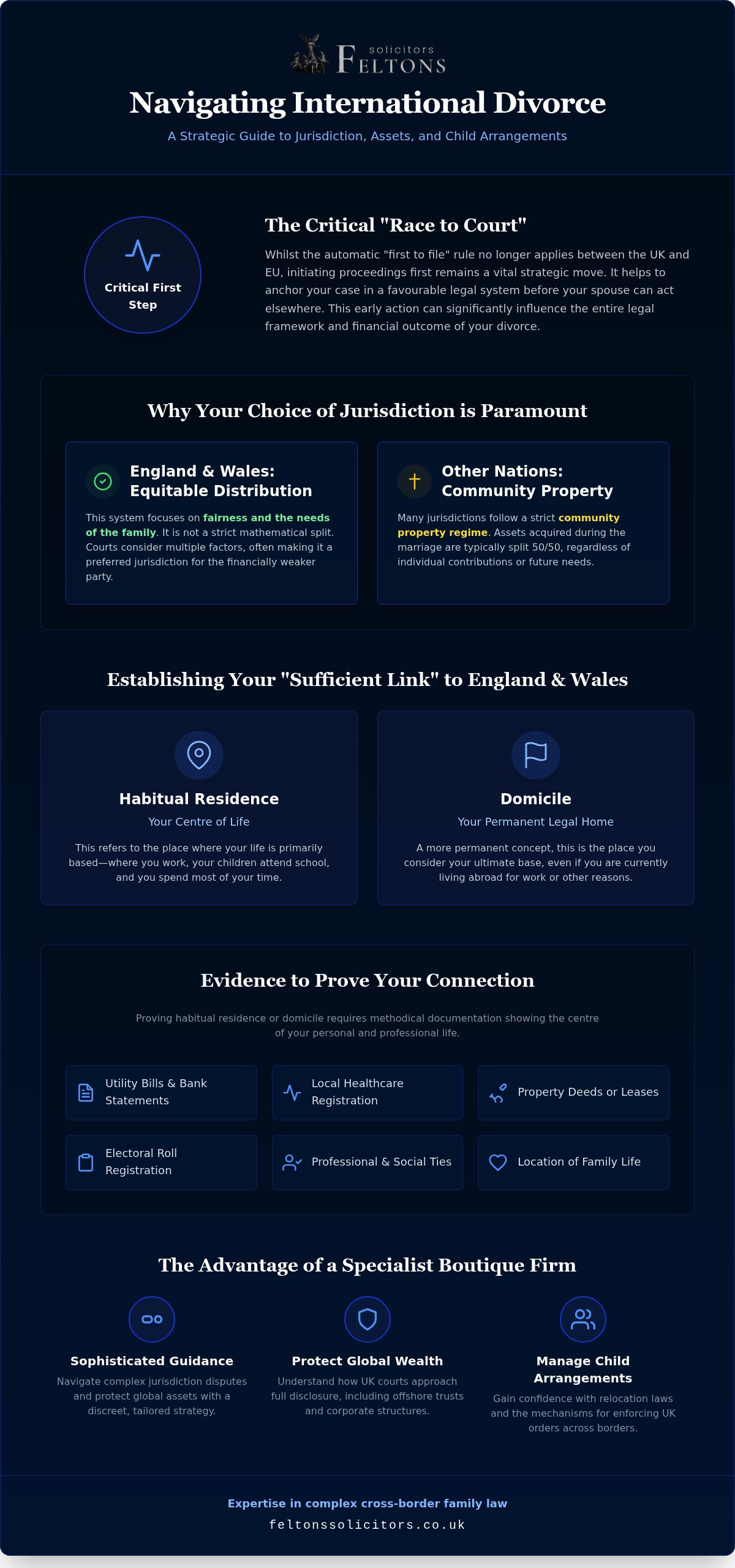
England and Wales is often perceived as a “generous” jurisdiction, particularly for the financially weaker spouse. Unlike many civil law systems that strictly adhere to rigid matrimonial property regimes, English courts possess wide discretion to ensure a fair outcome based on the needs of both parties. This includes the power to share future earnings or offshore pensions that might be shielded in other countries. Even if you have lived abroad for a significant period, you may still be able to establish a sufficient link to the UK through your domicile or a period of habitual residence.

The Domicile and Habitual Residence Tests

Determining where you can legally divorce depends on two primary concepts: domicile and habitual residence. Your domicile of origin is typically assigned at birth, whereas a domicile of choice is only established when you settle in a new country with the clear, proven intention of making it your permanent home. Habitual residence is a more fluid, fact-based assessment of where the “centre of your interests” actually lies. Under the 2026 legal standard, habitual residence is defined as the place where a person has established, on a fixed basis, the permanent or habitual centre of their interests, taking into account all relevant professional and personal ties. For expats, the “six-month rule” often applies, allowing you to file in the UK if you have been habitually resident here for at least six months prior to the application, provided you are also domiciled here.

England and Wales versus Other Jurisdictions

It’s vital to remember that England and Wales operate as a separate legal entity from Scotland or Northern Ireland. Each has distinct rules regarding how assets like business interests or inherited wealth are treated. Because jurisdiction dictates which laws apply to the division of your global estate, the stakes of international matrimonial law are exceptionally high. A international divorce solicitors uk expert can help you evaluate whether the English courts offer a more favourable environment for your specific assets compared to a foreign court. Feltons provides a divorce and financial arrangements lawyer to navigate these initial hurdles, ensuring you don’t lose the opportunity to secure a settlement in the jurisdiction that best serves your long-term security.

Managing Global Assets and Financial Settlements Whilst Abroad

Securing a fair financial settlement requires absolute transparency, yet the complexity of global wealth often makes this a challenge. In the English court system, both parties are bound by the duty of “full and frank” disclosure. This means every asset, regardless of where it is held in the world, must be declared. For high-net-worth expats, this process involves more than just listing bank accounts; it requires a deep dive into offshore trusts, commercial interests, and property portfolios. Enlisting international divorce solicitors uk ensures that your disclosure is robust and that your spouse’s worldwide interests are accurately scrutinised.

A unique challenge in 2026 involves the intersection of family law and property transparency. If your matrimonial estate includes UK property held through foreign companies, the registration of overseas entities becomes a critical factor. UK courts now have greater visibility into the beneficial ownership of these assets, making it harder for parties to shield wealth behind complex corporate veils. We focus on protecting your favourite assets, such as a family home or a long-held business, by ensuring they are valued correctly and treated fairly within the context of the overall global pot.

Financial Disclosure and Overseas Property

Identifying beneficial ownership in international structures is a meticulous task. The UK court looks past the legal title to determine who truly controls and benefits from an asset. This is particularly relevant for properties or businesses located in jurisdictions with less stringent reporting requirements. To avoid common mistakes, such as underestimating the value of foreign commercial interests or failing to account for tax liabilities on offshore investments, we utilise expert valuations. These professional assessments ensure that the “fair value” presented to the court is accurate, preventing your global estate from being undervalued during the settlement process.

Enforcing UK Financial Orders Internationally

Obtaining a court order in London is only the first step; enforcing it in a foreign jurisdiction is where the real complexity lies. Whilst the UK is a signatory to various reciprocal enforcement agreements and the Hague Convention, the ease of enforcement varies significantly between countries. If a spouse refuses to comply with a settlement, you need a clear strategy for pursuing assets abroad. Navigating these broader legal landscapes requires an understanding of how different territories interact. For those managing the wider pressures of cross-border disputes, organisations like the Reunite International Child Abduction Centre provide essential context for the high-stakes nature of international family law. If you are concerned about the security of your global interests, a discreet consultation can help you build a plan for enforcement that spans multiple borders.

Strategic Considerations: The ‘Race to Issue’ and Forum Shopping

In the context of cross-border family law, the decision of where to file for divorce is rarely a matter of mere convenience. It is a calculated choice known as forum shopping. For many expats, the jurisdiction in which proceedings are initiated can determine whether they face a restrictive division of assets or a more equitable, needs-based settlement. Expert international divorce solicitors uk provide the necessary foresight to evaluate these competing legal systems before your spouse takes the initiative. Securing the right forum is about ensuring your future is governed by a system that recognises the true extent of your global contributions.

The “Race to Issue” remains a vital consideration. Whilst the post-Brexit landscape has shifted away from the strict “first to file” rule previously seen within the EU, the timing of your application still carries significant weight. Establishing jurisdiction early in England and Wales can prevent a case from being moved to a foreign court where the legal standards for asset division or spousal maintenance might be considerably less favourable. Acting decisively allows you to set the procedural tone for the entire dispute.

Why the Choice of Country Impacts Your Settlement

Legal systems vary dramatically in their approach to matrimonial wealth. The English courts generally follow a needs-based approach, which allows for a high degree of discretion to ensure both parties can maintain a reasonable standard of living. In contrast, many jurisdictions in mainland Europe or the Middle East operate under a “community of property” regime. These systems often strictly divide only the assets acquired during the marriage, potentially ignoring significant pre-marital wealth or trust interests that an English court might otherwise consider. Maintenance orders also differ significantly; whilst some countries limit spousal alimony to a fixed, short-term duration, the UK retains the ability to award more substantial support if the circumstances demand it. In contested jurisdictions, issuing your application first is a tactical necessity to ensure your financial future is governed by the most protective legal framework available to you.

Preventing Asset Dissipation Across Borders

When a divorce becomes international, the risk of one party attempting to move or hide wealth increases. Protecting the matrimonial pot requires more than just local knowledge; it requires a coordinated global strategy. We often utilise freezing orders to prevent the dissipation of assets whilst proceedings are pending, ensuring that property, shares, and bank accounts remain within the court’s reach. Effective protection involves a high degree of coordination amongst legal professionals. Your international divorce solicitors uk will often work alongside foreign legal teams to mirror orders in other countries, creating a multi-layered shield around your assets. This process relies on discreet, rapid action to maintain the financial status quo and ensure that no assets are undervalued or removed from the equation before a final settlement is reached.

International Child Arrangements and Relocation Matters

Whilst financial disputes are often settled through meticulous accounting, child arrangements require a more nuanced understanding of a child’s integration into their social and family environment. The foundation of any cross-border parenting dispute is the concept of habitual residence. This isn’t merely a matter of where a child is physically present; it’s an assessment of their “degree of integration” in a particular country. For international families, this can become complex when a child spends significant time in multiple jurisdictions. Expert international divorce solicitors uk help parents establish where a child’s legal home lies, ensuring that the correct court makes decisions regarding their future.

The UK courts prioritise the child’s welfare as the paramount consideration, often overriding the personal preferences of either parent. This is particularly evident in “Leave to Remove” cases, where one parent seeks court permission to relocate a child to a foreign country. Research indicates that approximately 70% of such relocation applications are made by non-British nationals wishing to return to their home country. These cases are notoriously difficult, as the court must balance the parent’s desire to move against the child’s right to maintain a meaningful relationship with the parent left behind. Given that the median duration for private law child arrangement cases in England and Wales is approximately 43 weeks, early strategic planning is essential.

Child Arrangements Orders with a Global Element

A robust international child arrangements order must go beyond the basics of residence and contact. We focus on drafting specific clauses that address the realities of a mobile lifestyle, including allocated times for international video calls, the division of travel costs, and agreements on schooling across borders. To ensure these arrangements are respected worldwide, we often advise on “mirror orders.” These are secondary orders obtained in the foreign jurisdiction that replicate the terms of the UK order, making it legally enforceable in both countries. This proactive approach helps resolve potential disputes over healthcare or religious upbringing before they escalate into international litigation.

Preventing International Parental Child Abduction

The fear of a child being removed from the UK without consent is a significant source of anxiety for many parents. If you suspect your spouse may be planning to relocate a child without your permission, you must act swiftly. Proactive steps include applying for a Prohibited Steps Order or seeking to secure the child’s passports with the court. The Hague Convention provides a mechanism for the return of children taken across borders, but prevention is always the more stable path. Warning signs often include the sudden liquidation of assets, the closing of bank accounts, or a parent’s increased interest in their home country’s legal system. If you are concerned about your family’s security, our specialist child arrangement lawyers can help you implement the necessary legal safeguards to protect your children’s stability.

In the high-stakes environment of cross-border family law, your choice of representation shouldn’t be based on volume, but on the depth of personal attention your case receives. Unlike larger, high-volume firms that may treat cases as procedural sequences, Feltons Solicitors LLP operates on a boutique model that prioritises discreet, high-standard care. Our philosophy blends traditional professional integrity with modern efficiency, ensuring that every client feels supported by a calm, steady presence. As international divorce solicitors uk, we understand that a sophisticated guide is essential when your future involves multiple legal systems and significant global assets.

Managing a complex international case requires more than just legal knowledge; it demands a coordinated approach to property and tax implications. We leverage a trusted network of global experts to provide comprehensive advice on everything from offshore trusts to foreign commercial interests. This synergy between family law and property expertise is particularly vital for clients dealing with the registration of overseas entities, ensuring that every facet of your wealth is protected. Privacy and discretion remain our hallmarks, providing high-net-worth individuals with the security they need during a sensitive life transition.

A Tailored Approach to Cross-Border Family Law

We organise every case with a focus on reducing the significant stress that accompanies international disputes. You’ll have direct access to senior solicitors who possess the worldly experience necessary to handle nuanced, multi-jurisdictional matters. Our approach is inherently pragmatic; whilst we are prepared for complex litigation, we always favour out-of-court settlements where possible. This focus on mediation and negotiation saves valuable time and protects your family’s privacy from the public nature of court proceedings. By tailoring our strategy to your specific lifestyle, we ensure that the technical legal work never loses sight of the human impact.

How Feltons Solicitors LLP Supports International Clients

Distance shouldn’t be a barrier to high-quality legal support. We utilise modern technology to manage cases seamlessly for clients based anywhere in the world, from Dubai to New York. Our commitment to providing a reassuring, expert perspective allows you to focus on your future whilst we handle the intricate details of your cross-border divorce. If you require a partner who values personal rapport as much as technical competence, we invite you to take the next step. Contact Feltons Solicitors LLP for a discreet consultation to discuss how our team of international divorce solicitors uk can secure your interests and provide the steady guidance you deserve.

Securing Your Future Across Borders in 2026

Navigating the end of a marriage is a significant challenge; doing so across international lines requires a level of precision that only a specialist can provide. We’ve explored how establishing the correct jurisdiction through domicile or habitual residence serves as the foundation for your financial security. You’ve also seen how the synergy between family law and property expertise, particularly regarding the registration of overseas entities, ensures that global assets remain visible and protected. Whether you’re managing complex commercial interests or seeking stable arrangements for your children, the strategic decisions you make now will define your future standard of living.

Choosing the right international divorce solicitors uk means opting for a boutique service that prioritises your privacy whilst delivering pragmatic, expert advice on global litigation. At Feltons Solicitors LLP, we provide the calm, steady guidance needed to resolve high-stakes disputes with professional integrity. It’s time to move forward with confidence and clarity. Secure your global assets with a discreet consultation at Feltons Solicitors LLP. You don’t have to face these complexities alone; help is available to ensure your interests are protected every step of the way.

Frequently Asked Questions

Can I divorce in the UK if neither I nor my spouse currently live there?

Yes, it’s possible to divorce in England and Wales even if both parties reside abroad, provided that at least one spouse remains domiciled here. Domicile is a distinct legal concept from residency; it refers to the country you consider your permanent home. If you were born in the UK or have maintained strong legal and financial ties to the country, you may still meet the criteria to issue proceedings through international divorce solicitors uk.

How long does an international divorce take compared to a domestic one?

International divorces typically take longer than domestic cases due to the logistical challenges of serving papers across borders and translating legal documents. Whilst the standard “no-fault” divorce in England and Wales has a minimum timeframe of 26 weeks, cross-border cases often extend beyond this. Coordinating with foreign legal teams and managing the disclosure of global assets adds layers of complexity that require a methodical, patient approach.

What is ‘forum shopping’ and is it legal in the UK?

Forum shopping is the strategic process of choosing the legal system most likely to produce a favourable financial or child-related outcome. It is entirely legal, provided you can establish a genuine legal link to the jurisdiction, such as habitual residence or domicile. However, UK courts will scrutinise these links closely to ensure that the choice of forum isn’t purely manipulative or without a substantive connection to the parties involved.

Will a UK court order be valid in my home country?

The validity of a UK court order in your home country depends on whether that nation has a reciprocal enforcement agreement with the UK. Many countries recognise English orders under the Hague Convention, but others may require a “mirror order” to be issued by their own local courts. It’s essential to verify these enforcement mechanisms early in the process to ensure your settlement is robust and recognised globally.

How are international pensions divided during a UK divorce?

International pensions are treated as part of the total matrimonial assets, though the UK court’s power to divide them directly is limited. Whilst an English court can issue a Pension Sharing Order for a UK-based scheme, it cannot usually compel a foreign pension provider to comply. In these instances, we often utilise “offsetting,” where one party receives a larger share of other assets, such as property, to compensate for the pension value held abroad.

What happens if my spouse has already started divorce proceedings in another country?

If your spouse has initiated proceedings elsewhere, a jurisdictional dispute arises that must be resolved before the divorce can progress. The court will apply the principle of forum non conveniens to determine which country is the most appropriate and convenient forum to hear the case. This is a highly technical area of law where acting quickly is vital to ensure your case is heard in the jurisdiction that best protects your interests.

Can I move back to the UK with my children after a divorce abroad?

Relocating to the UK with your children after a divorce abroad requires either the written consent of the other parent or a court order from the jurisdiction where the children currently live. Moving without this permission can be classified as international parental child abduction, even if you are returning to your home country. You must follow the specific relocation laws of the country where the children are habitually resident to ensure the move is legal.

How much does an international divorce cost in the UK?

The cost of an international divorce in the UK is influenced by the complexity of the assets involved and whether the jurisdiction is contested. As of July 13, 2026, the standard court fee for filing a divorce application is £628. Beyond this, legal fees will vary based on the level of cross-border coordination required. Engaging international divorce solicitors uk ensures that your costs are managed through a pragmatic, boutique service that focuses on efficiency and high-standard care.

Financial Disclosure in Divorce UK: A Complete Guide for 2026

Financial Disclosure in Divorce UK: A Complete Guide for 2026

What if the most significant threat to your future financial security isn’t the divorce itself, but a single missing detail in your paperwork? It’s a common fear amongst those separating in 2026, especially when the legal landscape now includes complex digital assets and shifting pension regulations. Undertaking the financial disclosure divorce UK process often feels like an overwhelming administrative hurdle, particularly when you’re already managing the emotional weight of a relationship ending.

You’ve worked hard for your assets. The anxiety that they might be unfairly divided, or the worry that your spouse isn’t being entirely transparent about their own holdings, is a heavy burden to carry. This guide provides the calm, expert clarity you need to master these complexities, ensuring your settlement is fair, legally binding, and robust enough to withstand any future challenges. We’ll examine the latest 2026 valuation standards for pensions and cryptocurrency, the strict requirements of the current Form E, and the vital steps to achieving a final settlement with total peace of mind.

Key Takeaways

  • Understand the “full and frank” legal standard required for financial disclosure divorce UK to ensure your final settlement is protected against future legal challenges.
  • Navigate the complexities of Form E by learning the specific 2026 requirements for valuing modern assets, including digital holdings and complex pension schemes.
  • Identify exactly which assets must be declared, from the family home to individual savings accounts, to avoid the risk of court-imposed penalties.
  • Learn how the court handles non-disclosure and why being transparent is the most effective way to safeguard your long-term financial interests.
  • Discover how a tailored, people-first legal approach can transform an intrusive process into a structured path toward a fair and final resolution.

What is Financial Disclosure in a UK Divorce?

The process of financial disclosure divorce UK is often the most significant phase of a legal separation. It represents a formal exchange of information where both parties provide a comprehensive overview of their financial positions. Transparency is not merely a courtesy; it is a fundamental legal obligation. Without a clear and honest account of every asset, debt, and income stream, it is impossible to reach a settlement that the court considers fair or equitable.

This requirement exists to protect both individuals. By ensuring all cards are on the table, the law prevents one party from being disadvantaged by a lack of information. This transparency is governed primarily by the Matrimonial Causes Act 1973, which provides the framework for how the court distributes assets. Whether you are negotiating through mediation or proceeding via a court application, the standards for honesty remain identical. A final agreement only becomes legally binding when it is drafted into a Consent Order and approved by a judge, who must be satisfied that the disclosure was complete before granting the order.

Failing to be transparent carries long term risks. If a spouse discovers later that assets were hidden or undervalued, they can apply to have the original agreement “set aside.” This means the entire settlement could be reopened years after the divorce is finalised, leading to significant legal costs and emotional distress. Accurate disclosure is your primary defence against future litigation.

The Duty of Full and Frank Disclosure

Full and Frank Disclosure is the absolute legal requirement to reveal all financial interests. This duty is expansive and ongoing. It begins the moment financial negotiations start and continues until the final order is sealed by the court. You must disclose everything, including assets you might believe are “non-matrimonial,” such as an inheritance or a business you owned before the marriage. Whilst you may argue that these specific assets should not be shared, you don’t have the right to hide them from the process. The court, not the individual, determines which assets are relevant to the final division.

Voluntary vs. Court-Mandated Disclosure

Many couples choose to exchange information voluntarily at the start of their separation. This approach often saves time and reduces legal fees, as it avoids the rigid timetable of court proceedings. However, even in a voluntary exchange, most solicitors recommend using the standard Form E to ensure no details are overlooked. If one party is reluctant to share information or if there are concerns about hidden wealth, the court will intervene. In these instances, the court mandates a strict timetable for financial disclosure divorce UK, and failing to comply can result in serious penalties, including cost orders or the court making assumptions about your wealth that may not be in your favour.

The Form E Process: Navigating the Standard Financial Statement

Form E is the primary mechanism for financial disclosure divorce UK, serving as the “gold standard” for transparency in England and Wales. This document is far more than a simple list of assets; it’s a comprehensive 27-page statement that requires you to account for your entire financial life. The current version, dated 23 January 2023, is designed to leave no stone unturned, covering everything from basic income to complex business interests and digital holdings. By providing a structured framework, it ensures that both parties and the court have a clear, identical dataset from which to negotiate a fair split.

The timeline for this process is usually strict. In court proceedings, the judge sets a deadline for the simultaneous exchange of these forms, typically several weeks before the first hearing. Even in voluntary negotiations, sticking to a clear schedule prevents the process from drifting. Perhaps the most critical element of the form is the Statement of Truth. When you sign this, you’re confirming that you’ve made full and frank disclosure. Providing false information or omitting an asset isn’t just a mistake; it’s a serious legal breach that can lead to your settlement being overturned or, in extreme cases, proceedings for contempt of court.

Many people find the sheer volume of data required to be the most daunting aspect of sorting out your finances in a divorce. It’s easy to feel overwhelmed by the level of detail, but approaching the task methodically is the best way to maintain control. If you find the complexity of these requirements stressful, seeking specialist legal support can provide the steady, professional presence needed to ensure your submission is accurate and robust.

Evidence and Supporting Documentation

A Form E is only as strong as the evidence supporting it. You’re required to provide a full 12 months of statements for every bank account, building society, and ISA in your name. This “12-month rule” allows solicitors to track patterns of spending and identify any unusual transfers that might suggest assets are being moved. You’ll also need formal valuations for properties, recent mortgage statements, and up-to-date CETV (Cash Equivalent Transfer Value) figures for all pensions. Organising these documents into a clear, indexed bundle from the outset is the most effective way to minimise legal fees and avoid frustrating delays.

Questionnaires and Clarification

The exchange of Form E is rarely the end of the inquiry. Once both parties have reviewed each other’s statements, they have the right to serve a “Questionnaire.” This is a formal list of questions designed to fill gaps or clarify inconsistencies. For example, if a bank statement shows a large unexplained withdrawal, the questionnaire will ask for its destination. Whilst this back-and-forth can feel intrusive, it’s a vital part of the financial disclosure divorce UK process. It ensures that any “grey areas” are resolved before a final order is drafted, protecting the integrity of your eventual settlement.

What Must Be Disclosed? A Comprehensive Checklist for 2026

The identification of assets is the next logical step once you understand the Form E framework. In 2026, the scope of what constitutes wealth has expanded significantly. It’s no longer enough to simply list the family home and a joint savings account. The court requires a granular look at your entire financial footprint to ensure the financial disclosure divorce UK process is complete. This includes everything from traditional property to modern virtual holdings.

You must declare all matrimonial and non-matrimonial property. This encompasses the primary family home, any buy-to-let investments, and overseas holiday homes. Beyond physical bricks and mortar, every bank account, ISA, and premium bond must be listed. Business interests require particular attention; you’ll need to disclose shareholdings, directorships, and any interest in partnerships. Even if you believe a business asset is entirely separate from the marriage, it must be declared so its status can be professionally assessed. For those navigating a complex financial settlement divorce, having a clear strategic checklist in place before disclosure begins can be invaluable in ensuring no asset category is overlooked.

Pensions often represent a couple’s most valuable asset, sometimes exceeding the value of the family home. Following the Pension Advisory Group’s second report (PAG2) published in January 2024, the court’s approach to dividing occupational, private, and state pensions has become more refined. You’ll also need to account for the digital landscape. In 2026, this means providing valuations for cryptocurrency portfolios, NFTs, and even monetised online platforms like Substack or YouTube channels, which are now recognised as legitimate income streams.

Handling Complex Assets and Trusts

Assets held within a family trust must be disclosed, even if you’re only one of several beneficiaries. The court needs to understand the nature of your interest and the likelihood of you receiving future capital or income. Similarly, inheritances received before, during, or even after the separation must be documented. Whilst these are often treated differently from assets built up together, they remain part of the overall financial picture. High-value personal items also fall under the disclosure umbrella. If you own jewellery, art, or classic cars with a resale value exceeding £500, these should be professionally valued and included in your statement.

Liabilities and Financial Obligations

A fair settlement isn’t just about sharing wealth; it’s about managing debt. You must provide a full declaration of all personal loans, credit card balances, and mortgages. These liabilities are subtracted from your total assets to reach a “net” figure. The court also considers your future needs and financial obligations, such as school fees or the cost of rehousing. Whilst “conduct” or bad behaviour rarely impacts the financial split, it can become relevant during financial disclosure divorce UK if one party has deliberately squandered assets or “dissipated” funds to reduce the pot available for sharing. Understanding how spousal support obligations interact with these liabilities is essential; working with spousal maintenance solicitors UK can help you navigate these complexities and secure a financially sound Clean Break order.

Financial Disclosure in Divorce UK: A Complete Guide for 2026

The Consequences of Non-Disclosure: Protecting the Integrity of the Settlement

Attempting to circumvent the financial disclosure divorce UK process is a high-risk strategy that rarely succeeds. When a spouse is caught hiding assets or providing misleading information on Form E, the legal repercussions are severe. The court possesses the power to draw “adverse inferences,” which essentially means a judge can assume you have significantly more wealth than you’ve declared. They can then award your spouse a larger share of the known assets to compensate for this suspected hidden wealth, often leaving the non-disclosing party in a worse position than if they’d been honest.

Dishonesty also triggers significant financial penalties regarding legal costs. Usually, each party pays their own costs in financial remedy cases, but if one person behaves obstructively or dishonestly, the court can order them to pay the other party’s legal fees. This often results in a situation where the cost of the litigation far exceeds the value of the asset they were trying to hide. The landmark case of Sharland v Sharland remains the definitive authority on this matter, cementing the principle that “fraud unravels all.” In this case, the Supreme Court ruled that because a settlement was reached based on fraudulent information, it could not stand. This ensures that no person can profit from their own dishonesty during a divorce settlement.

Reopening a Divorce Settlement Years Later

A Consent Order is only as strong as the disclosure it is built upon. If a failure to disclose is discovered years later, the entire settlement can be “set aside,” effectively reopening the case. This forces both parties to restart legal proceedings from scratch, often a decade or more after the original divorce was finalised. The emotional and financial toll of restarting these negotiations is immense. Without full transparency, your settlement remains under a permanent cloud of uncertainty, leaving you vulnerable to future claims that could’ve been avoided with an honest Form E.

What to Do if You Suspect Hidden Assets

If you suspect your spouse is being untruthful, there are robust mechanisms available to uncover the truth. Forensic accountants play a vital role in these investigations, using sophisticated data analysis to identify hidden patterns in spending or undisclosed income streams. They look beyond the standard bank statements already discussed to find where money might’ve been diverted into trusts or offshore holdings. These experts provide the concrete evidence needed to request court-ordered Search Orders or Freezing Injunctions, which prevent the further movement of funds whilst the investigation continues. Feltons Solicitors LLP supports clients in protecting assets during divorce.

If you have concerns about the transparency of your partner’s finances, contact Feltons Solicitors LLP for a confidential discussion about how we can safeguard your financial future.

Expert Guidance: How Feltons Solicitors LLP Organise Your Disclosure

Managing the intricacies of financial disclosure divorce UK is a journey that requires both technical precision and emotional intelligence. At Feltons Solicitors LLP, we adopt a boutique, people-first approach that recognises the individual behind the financial data. We understand that whilst the law demands cold facts and figures, the experience of revealing your private financial life can feel intrusive and stressful. Our role is to act as a calm, steady presence, guiding you through the complexities of the 2026 legal environment with quiet confidence and professional authority.

Our team provides tailored advice for high net worth divorce, where settlements often involve international asset structures, offshore holdings, and sophisticated investment vehicles. We ensure that every aspect of your disclosure is bulletproof. By meticulously organising your financial evidence from the outset, we build a foundation for a settlement that is not only fair but also unchallengeable. This methodical preparation is the most effective way to secure a final order that protects your interests for the long term. Our worldly experience allows us to handle matters of an international scale whilst maintaining the personal rapport of a trusted advisor.

Discreet and Sophisticated Legal Support

Privacy is a cornerstone of our service. We handle sensitive financial data with the utmost discretion, ensuring your personal affairs remain protected throughout the financial disclosure divorce UK process. Our commitment to pragmatic advice means we always seek the most efficient path to a resolution, avoiding unnecessary court escalation whenever possible. We bridge the gap between traditional professional integrity and modern efficiency, using streamlined methodologies to manage complex documentation whilst maintaining the high-standard, personal service our clients expect. This approach ensures that the human impact of our work is never forgotten, even when dealing with the most technical legal requirements.

Taking the Next Step

Securing early legal advice is crucial before you start the disclosure process. This initial stage sets the tone for the entire negotiation. To prepare for your first consultation, it’s helpful to create a rough outline of your assets, liabilities, and any specific concerns you have regarding pensions or business interests. This allows us to provide immediate, focused guidance on your position. It’s often beneficial to gather your most recent bank statements and any known pension valuations to facilitate a more thorough initial discussion.

If you’re ready to move forward, we invite you to contact Feltons Solicitors LLP for a discreet discussion regarding your financial arrangements. Our solicitors are here to provide the sophisticated guidance you need to navigate this transition with security and peace of mind. You don’t have to manage the complexities of disclosure alone; we’re here to ensure you’re in capable hands from the very first step.

Securing Your Financial Independence

Navigating the intricacies of financial disclosure divorce UK is more than a procedural requirement; it’s the foundation of your future independence. By approaching the Form E process with transparency and precision, you ensure that your settlement is both fair and final. As explored throughout this guide, modern assets like digital holdings and complex pension schemes require meticulous valuation to withstand legal scrutiny. A settlement built on full and frank disclosure is the only way to achieve a clean break that remains protected for years to come, avoiding the risk of being set aside in the future.

Since 2010, Paula Felton has led Feltons Solicitors LLP in providing sophisticated, boutique legal support for those managing high net worth and complex financial arrangements. We combine national reach with international expertise to offer a calm, steady presence during life’s most challenging transitions. Secure your financial future with expert guidance from Feltons Solicitors LLP. You deserve the peace of mind that comes from knowing your affairs are in the hands of dedicated specialists who prioritise your long-term well-being and security.

Frequently Asked Questions

Do I have to disclose assets I owned before we were married?

Yes, you must disclose every asset you own, including those acquired long before the marriage took place. Whilst you might argue that these are “non-matrimonial” assets and should be excluded from the final division, they must still be visible to the court. Transparency is the only way to ensure your final settlement is legally robust and protected from future challenges.

What is the “Statement of Truth” on Form E and why does it matter?

The Statement of Truth is a formal declaration at the end of Form E confirming that the information provided is full, accurate, and complete. It carries significant legal weight. If you deliberately omit assets or provide false data, you could face proceedings for contempt of court, which may result in fines or, in extreme cases, imprisonment.

Can my ex-partner see my bank statements during financial disclosure?

Yes, your ex-partner and their legal team have a right to review all documentation provided during the financial disclosure divorce UK process. This includes the mandatory 12 months of bank statements for every account held in your name. This mutual exchange ensures that both parties are negotiating from a position of equal knowledge and transparency.

What happens if I accidentally forget to include an asset in my disclosure?

You must notify your solicitor immediately to rectify any genuine errors or omissions in your paperwork. If an asset is discovered later, it can cast doubt on the integrity of your entire disclosure. The court may choose to “set aside” the final agreement or impose cost penalties, even if the initial omission was entirely accidental.

How much does the financial disclosure process typically cost in the UK?

The cost of disclosure depends on the complexity of your financial arrangements and the level of professional support required. Whilst the court fee for a financial order application is currently £313, total costs will fluctuate if you require specialist business valuations or forensic accounting. Investing in thorough disclosure early on often prevents far more expensive legal challenges in the future.

Do I need to disclose my business accounts if I am the sole director?

Yes, you must disclose all business interests, including accounts for companies where you are the sole director. The court needs to understand the value of the business and any income or capital you could potentially draw from it. This usually involves providing the last two years of accounts and any recent business valuations.

Is financial disclosure required if we have already agreed on how to split everything?

Yes, full disclosure is still necessary even if you’ve reached an informal agreement. To turn your private arrangement into a legally binding Consent Order, a judge must review a summary of your financial positions. This ensures the financial disclosure divorce UK standards have been met and the agreement is fair to both parties.

How far back do I need to go when providing bank statements for divorce?

You are generally required to provide 12 months of statements for every bank account, building society, and ISA held in your name. This “12-month rule” is the standard for Form E. However, if there are specific concerns about unusual transactions or hidden money, the court may order you to provide statements going back much further.

Divorce and Financial Arrangements Lawyer: A Guide to Protecting Your Assets in 2026

Standing alone

What if your financial settlement wasn’t merely a division of assets, but a strategic blueprint for your post-divorce life? It’s natural to feel a sense of trepidation when considering the future of your family home or the pension you’ve worked decades to build. The requirement for full and frank disclosure via Form E often adds a layer of stress to an already emotional period. You likely want a clean break that respects your non-matrimonial property whilst ensuring your long-term stability is never compromised. Partnering with a specialist divorce and financial arrangements lawyer ensures that these complexities are handled with precision and quiet confidence.

We’ll guide you through the intricacies of matrimonial finance to help you secure your future and protect your hard-earned wealth. This guide explores how to achieve a fair settlement under the current 2026 regulations, covering everything from the importance of court-approved Consent Orders to the tax-efficient transfer of assets. We’ll also demystify the mandatory reflection periods and the latest procedural requirements, providing the clarity you need to move forward with certainty.

Key Takeaways

  • Understand why a formal Consent Order is essential to prevent future claims, moving beyond risky informal agreements to secure a legally binding clean break.
  • Learn how to navigate the mandatory Form E process to ensure full financial transparency whilst protecting your long-term interests and wealth.
  • Discover the specific criteria UK courts use to determine a fair settlement, with the welfare of any children remaining the primary consideration in every arrangement.
  • Explore how a specialist divorce and financial arrangements lawyer can help you choose the most efficient resolution pathway, from mediation to strategic litigation.
  • Identify the strategic steps required to protect non-matrimonial assets and create a robust financial blueprint for your post-divorce life.

The Essential Role of a Divorce and Financial Arrangements Lawyer

Many couples attempt to resolve their finances over the kitchen table, hoping to save time and expense. Whilst this spirit of cooperation is commendable, informal deals carry significant risk. Without the oversight of a specialist divorce and financial arrangements lawyer, you may inadvertently overlook complex assets or fail to account for the true value of a pension. A verbal agreement, or even a written one signed privately, isn’t legally binding. To achieve a clean break, you need a Consent Order. This document transforms your agreement into a court order, effectively ending your ex-spouse’s ability to make financial claims against you in the future.

Understanding what is a divorce settlement? involves more than just splitting bank accounts. It requires a forensic eye to identify hidden assets or ensure business interests are valued accurately. During periods of intense emotional stress, it’s difficult to remain objective. An experienced advocate acts as your steady presence, protecting your wealth whilst you focus on your family’s transition. Partnering with a divorce and financial arrangements lawyer provides the technical scrutiny needed to uncover undervalued assets that might otherwise be missed during a casual negotiation.

Moving Beyond a Simple Split

The common assumption that assets are always split 50/50 is often just the starting point of the conversation. English law prioritises fairness and the future needs of both parties, which frequently results in an unequal division. Your solicitor ensures every matrimonial asset, from the family home to complex share schemes, is correctly identified and valued. They provide the methodical approach required to prevent future financial claims. Without a legally sealed order, an ex-spouse could potentially claim against your future inheritance or business success years after the divorce is finalised.

Discreet Support for Complex Estates

For high-net-worth individuals, the stakes are considerably higher. Handling international property, offshore trusts, or private company shares requires professional poise and technical depth. A boutique firm offers a tailored experience, prioritising personal connection over high-volume processing. This approach balances modern efficiency with traditional legal values, ensuring your privacy is maintained throughout. Whether dealing with national interests or complex international matters, engaging high net worth divorce solicitors with the worldly experience necessary to protect your global wealth is essential.

Financial disclosure is the bedrock of any fair settlement. It isn’t merely a suggestion; it’s a strict legal obligation for “full and frank” transparency. Both parties must provide a comprehensive overview of their financial position, ensuring nothing remains hidden. This process centres on Form E (01.23), a detailed financial statement required in most financial remedy proceedings. Accuracy is paramount. Providing misleading information or attempting to conceal assets can have severe consequences, including the court setting aside a final order or imposing cost penalties against the dishonest party. For a comprehensive understanding of your obligations under the latest regulations, our guide to financial disclosure in divorce UK covers the 2026 valuation standards for pensions, cryptocurrency, and all key procedural requirements in detail.

A divorce and financial arrangements lawyer acts as a methodical guide through this exhaustive requirement. They don’t just help you fill in boxes; they strategically organise your data to present the most robust case possible. This involves scrutinising the other party’s disclosure for inconsistencies or suspicious omissions. If your situation involves complex corporate structures or international interests, your solicitor may engage forensic accountants to trace funds or value private shares. This level of diligence is essential for making the most of your divorce settlement and ensuring your future is built on a stable foundation.

The Disclosure Process Step-by-Step

The journey begins with meticulous evidence gathering. You’ll need to compile at least twelve months of bank statements, recent pay slips, and P60s. For those with significant wealth, property appraisals and detailed pension valuations are vital. Your divorce and financial arrangements lawyer will review these documents to identify potential vulnerabilities or strengths in your position. This methodical approach ensures that when you reach the negotiation stage, you’re operating from a position of total clarity. If you’re feeling overwhelmed by the volume of paperwork required, seeking bespoke legal advice can help streamline the process.

Valuing Pensions and Property

Pensions are often the most undervalued asset in a marriage. Obtaining an accurate Cash Equivalent Transfer Value (CETV) is the first step, but it rarely tells the whole story. Expert analysis is often needed to understand the true income-producing potential of a scheme. Property valuations must also be current, reflecting the 2026 market conditions. It’s also vital to consider the tax implications of any transfer. Under current UK regulations, separating couples have up to three tax years after the end of the tax year in which they separate to transfer assets under the “no gain, no loss” rule. If the transfer is part of a formal court-approved agreement, this rule can often be applied without a specific time limit, potentially saving thousands in Capital Gains Tax. Once your settlement is finalised, reviewing your estate planning strategy is an essential next step to ensure your newly structured assets are protected and passed on according to your wishes.

Achieving a Fair Settlement: Understanding Section 25 Factors

Fairness in a legal context isn’t a simple mathematical split of 50/50. Instead, the court relies on a specific statutory framework to determine how assets should be divided. This framework is found in Section 25 of the Matrimonial Causes Act 1973. It provides a list of criteria that judges must consider when deciding what constitutes a fair outcome. The court’s primary concern is always the welfare of any children under the age of eighteen. Beyond this, the judge evaluates the income, earning capacity, and financial resources each party has or is likely to have in the foreseeable future. A divorce and financial arrangements lawyer ensures that these factors are interpreted in a way that supports your specific needs and long-term security.

The court also examines the standard of living enjoyed by the family before the breakdown of the marriage. This isn’t about maintaining a lavish lifestyle indefinitely, but rather ensuring that the transition to independent living is as equitable as possible. Age and the duration of the marriage play significant roles; a twenty-year marriage will be viewed differently from a two-year union. Additionally, any physical or mental disabilities that affect a party’s ability to earn a living are taken into account. Your divorce and financial arrangements lawyer will use these details to build a compelling narrative for your settlement.

Financial Needs vs. Contributions

The court’s first objective is to meet the “needs” of both parties, particularly regarding housing and future income. If the matrimonial pot is limited, needs will almost always trump other considerations. However, the law also recognises contributions. These aren’t limited to financial input. Caring for the home or looking after children is given equal weight to the role of the primary breadwinner. It’s a common misconception that “conduct” or bad behaviour during the marriage affects the split. In reality, the court only considers conduct if it is so “gasp-inducing” that it would be inequitable to ignore it, which is exceptionally rare in English law.

Non-Matrimonial Assets

One of the most complex areas of matrimonial finance involves non-matrimonial assets. These are typically assets acquired before the marriage or received as an inheritance or gift during the union. Whilst the court has the discretion to “ring-fence” this wealth, that protection isn’t absolute. If the matrimonial assets aren’t sufficient to meet the needs of both parties, the court may dip into non-matrimonial property. Strategic arguments are essential here, especially when protecting a family business or a significant pre-marital investment. Demonstrating that these assets have been kept separate from the joint family finances is often the key to keeping them out of the final settlement pot. For estates where this distinction is particularly critical, specialist high net worth divorce solicitors can provide the strategic depth needed to navigate the evolving legal landscape following recent Supreme Court decisions.

Divorce and Financial Arrangements Lawyer: A Guide to Protecting Your Assets in 2026

Resolution Pathways: Negotiation, Mediation, and Court

Resolving financial matters doesn’t always require a courtroom battle. Most couples prefer to reach an agreement through private negotiation, finding that out-of-court settlements offer a level of privacy and speed that litigation simply cannot match. Mediation is a popular starting point; it’s a process where an independent third party helps you reach a compromise. However, mediation isn’t always suitable. If there’s a significant power imbalance or a lack of financial transparency, it may prove ineffective. A divorce and financial arrangements lawyer provides the necessary support during these negotiations, ensuring you don’t agree to a settlement that undervalues your long-term needs.

When negotiations stall, the “Financial Remedy” court process becomes the necessary framework for resolution. This structured timeline involves three main stages: the First Appointment, the Financial Dispute Resolution (FDR) hearing, and, if required, a Final Hearing. Most cases settle at the FDR stage, where a judge provides an early indication of the likely outcome. This stage is designed to encourage settlement by giving both parties a realistic view of their position. The entire process is managed by an experienced divorce and financial arrangements lawyer who manages the transition with professional poise, using the court’s structure to encourage a fair settlement whilst preparing a robust case for litigation if a compromise remains elusive.

The Power of a Consent Order

Even when an agreement is reached amicably, it remains vulnerable until it’s formalised. A Consent Order is the only mechanism to achieve a “Clean Break”, legally severing financial ties and preventing future claims. Judicial oversight provides security. A judge reviews the arrangement to ensure it’s fair and meets the requirements of both parties. This process transforms a private deal into a binding court order, offering the finality needed to move forward with confidence.

Litigation as a Pragmatic Tool

Court proceedings shouldn’t be viewed solely as a last resort. Sometimes, the discipline of a court timetable is the only way to force a reluctant spouse to engage in honest negotiations. Litigation also allows for interim maintenance orders, ensuring you have the financial resources to meet your immediate needs whilst the final settlement is being determined. The finality of a court-imposed Financial Order provides a definitive end to the process, allowing you to move forward with certainty. If you require a strategic approach to your settlement, you can contact our team for expert guidance.

Why Feltons Solicitors LLP is Your Trusted Partner for Financial Settlements

Choosing a divorce and financial arrangements lawyer involves more than just selecting a legal representative; it is about finding a dedicated partner who understands the high stakes involved. Feltons Solicitors LLP operates as a boutique firm, which means we prioritise personal connection over high-volume processing. We recognise that behind every asset schedule is a future that requires protection. Our approach is defined by a quiet confidence and a commitment to bespoke strategy, ensuring that your unique circumstances are met with the tailored attention they deserve. You aren’t merely a case number here. We provide the calm, steady presence needed to navigate the complexities of wealth preservation during an emotional transition.

Our firm possesses the worldly experience required to handle national and international-scale matters with professional poise. For clients with complex global interests, Feltons Solicitors LLP offers the discreet, high-standard service usually found in much larger firms, but with the personal rapport of a trusted advisor. We bridge the gap between established heritage and forward-thinking methodology, ensuring your wealth is managed with both modern efficiency and traditional professional integrity. This people-first philosophy means that while the technical legal work is paramount, the human impact of our strategy is never forgotten. We provide plain English advice that empowers you to make informed decisions without the confusion of dense, archaic legalese.

Modern Delivery with Traditional Values

We believe that high-end reliability should be paired with modern efficiency. Feltons Solicitors LLP utilises streamlined digital processes to manage your case effectively, yet we maintain the core values of a partner-led service. This ensures that a senior expert is always at the helm of your financial arrangements, providing the sound judgment and practical advice you require. Our reputation for being poised and dependable makes us a calm port in the storm of litigation. We value the privacy and personal rapport that a boutique firm provides, ensuring your discreet matters remain exactly that.

Taking the Next Step

Your journey toward a secure future begins with a clear, methodical roadmap. During an initial consultation at Feltons Solicitors LLP, we’ll listen to your goals and identify the specific areas where your assets require the most protection. We move from a broad statement of capability to a specific, actionable strategy designed for your post-divorce life. This rhythm mirrors a professional consultation: it’s direct enough to respect your time but thorough enough to provide a sense of security. If you are ready to secure your wealth with an expert divorce and financial arrangements lawyer, contact our team to arrange a confidential discussion.

Securing Your Financial Independence and Peace of Mind

A fair financial settlement is more than a division of property; it’s the foundation for your next chapter. Ensuring your agreement is formalised through a Consent Order is the only way to achieve a true clean break and protect your future wealth. By addressing the Section 25 factors and navigating the Form E disclosure process with precision, you can move forward with the confidence that your long-term interests are secure. You’ve seen how these steps form a vital shield for your assets, ensuring that no stone is left unturned in the pursuit of an equitable outcome.

Partnering with an experienced divorce and financial arrangements lawyer ensures that your interests are handled with the highest level of professional integrity. Established in 2010, Feltons Solicitors LLP offers a boutique, partner-led service designed for individuals with complex national and international requirements. Our expertise in high-value litigation allows us to manage even the most intricate disputes with a calm and poised approach, prioritising your privacy and personal rapport throughout the process.

You don’t have to face these complexities alone. Secure your financial future with a consultation at Feltons Solicitors LLP and take the first step toward a stable and certain future. We’re here to help you manage this transition with clarity, dignity, and confidence.

Frequently Asked Questions

How much does a divorce and financial arrangements lawyer cost?

Total costs depend entirely on the complexity of your financial situation and whether an agreement can be reached amicably. Every case is unique, with fees reflecting the time required to investigate assets, negotiate terms, and draft the necessary legal documents. Whilst there are fixed court fees for the divorce application itself, the cost of resolving financial arrangements is determined by the depth of professional expertise required to secure a fair outcome.

Is it possible to have a clean break order without a lawyer?

You can apply for a clean break order yourself, but it’s rarely advisable due to the technical precision required. A divorce and financial arrangements lawyer ensures the document is drafted correctly to prevent any future claims. Without professional oversight, you might leave yourself vulnerable to a claim on your future inheritance or business growth years after the final order is granted by the court.

What happens to my pension in a divorce settlement?

Pensions are treated as matrimonial assets and are often the most valuable part of the settlement. They can be handled through pension sharing, where a percentage is transferred to the other spouse, or pension offsetting, where one party keeps the pension in exchange for a larger share of other assets. Obtaining an accurate Cash Equivalent Transfer Value (CETV) is the essential first step in this methodical calculation.

Can my ex-spouse claim money after our divorce is finalised?

Yes, an ex-spouse can potentially claim money even after the divorce is finalised if you haven’t obtained a court-approved Consent Order. The Decree Absolute, now called the Final Order, only ends the marriage itself; it doesn’t end the financial relationship. Only a legally binding order providing a “clean break” can permanently bar your ex-spouse from making future claims against your income, property, or future assets. Alongside securing a clean break order, reviewing your estate planning arrangements to protect your legacy is a prudent step to take once your financial settlement is in place.

How long does it take to reach a financial settlement in the UK?

A financial settlement typically takes a minimum of six to eight months to finalise in the UK. This timeline is largely dictated by the mandatory 20-week reflection period built into the no-fault divorce process. If your finances are complex or if you cannot reach an agreement through mediation, the process can take twelve months or longer to resolve through the structured court system. During this period of transition, managing short-term costs is vital, and Pixie Loans offers a transparent way to access fast borrowing options should you need to bridge any financial gaps.

Do I have to go to court to sort out my finances after divorce?

You don’t have to attend court if you can reach an agreement through negotiation or mediation. Most couples resolve their finances privately and then submit a Consent Order to the court for a judge’s approval. Court hearings are generally reserved for cases where there is a lack of financial transparency or where parties are fundamentally disagreed on what constitutes a fair and equitable division of assets.

What is the “starting point” for dividing assets in a marriage?

The starting point for dividing matrimonial assets is a 50/50 split, but this is rarely the final outcome. The court’s primary focus is fairness and meeting the future needs of both parties, particularly when children are involved. Factors such as earning capacity, age, and the length of the marriage often justify a departure from an equal split to ensure both parties have adequate housing and income.

How are business interests handled during financial negotiations?

Business interests are valued as matrimonial assets and are subject to the same disclosure requirements as bank accounts or property. A divorce and financial arrangements lawyer will often work with forensic accountants to determine the true value of a company. Depending on the circumstances, the court may allow one party to keep the business whilst offsetting its value with other matrimonial assets like the family home.