
Land Registry Overseas Entity ID Requirements: A 2026 Checklist

Land Registry Overseas Entity ID Requirements: A 2026 Checklist

An Overseas Entity ID is a registration reference, not a green light for a UK property transaction. The land registry overseas entity ID requirements involve registering the entity with Companies House and checking that its details support the Land Registry application. An ID alone does not resolve inconsistencies or fill gaps in the information needed for a transaction.

To assess whether the rules apply, look at the entity’s legal status, its UK land interests and the activity proposed. Companies House registration and a Land Registry application are separate steps, so check that the relevant details align before documents are prepared. Doing this early can help identify issues before they affect an application.

This 2026 checklist explains when an Overseas Entity ID may be needed, what information to prepare and what to review before an application is made. It also covers how to check registration details and where legal support can help. Feltons Solicitors LLP advises on overseas entity registration and complex property transactions, helping clients coordinate registration information and conveyancing documents.

Key Takeaways

  • Start by reviewing the entity’s UK land interests and proposed transaction to establish which requirements may apply.
  • Use the land registry overseas entity ID requirements checklist to organise the registration and transaction details before applying.
  • Compare the entity’s legal name, form and identifying information across Companies House records and transaction documents.
  • Check that registration details are current, then review the property title restriction and transaction type before preparing the Land Registry application.
  • A solicitor can help coordinate ownership information, entity records and conveyancing documents when the transaction or ownership structure is complex.

What does a Land Registry overseas entity ID prove?

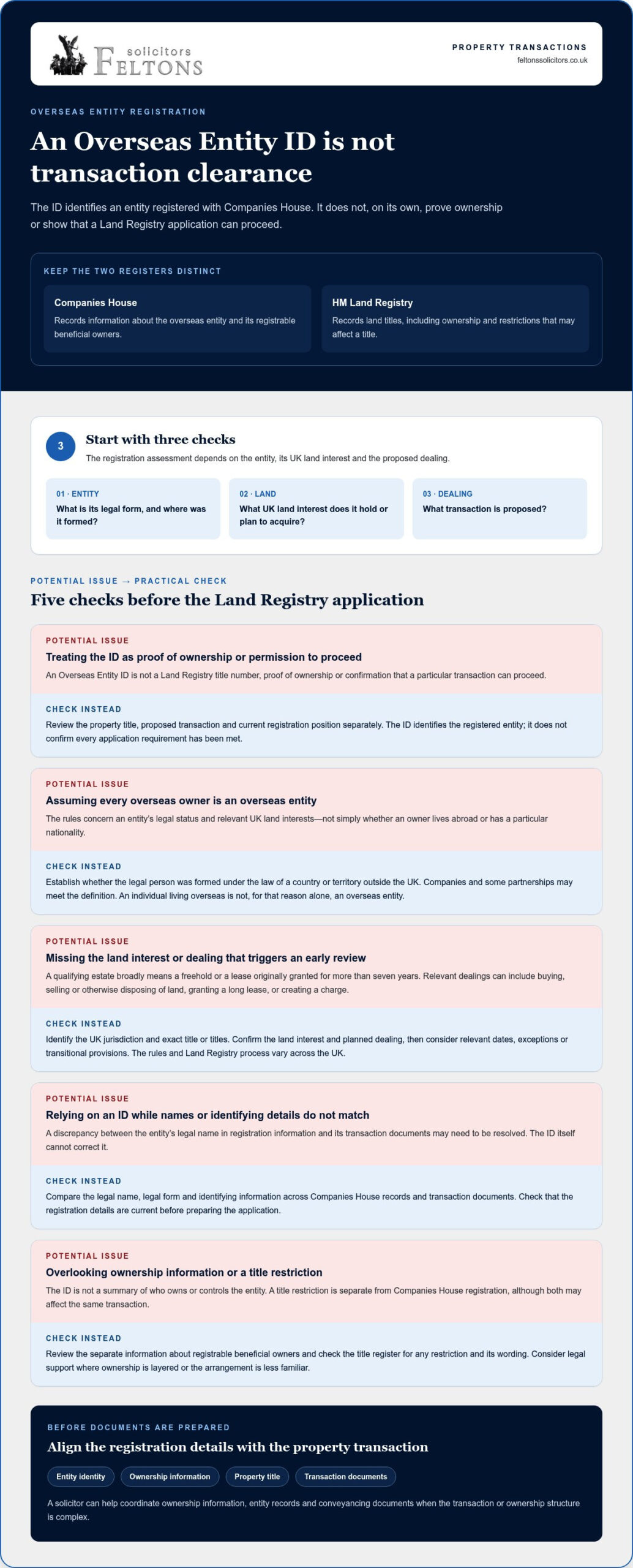
An Overseas Entity ID is the reference issued by Companies House when an overseas entity is entered on the Register of Overseas Entities. It identifies the registered entity. It is not a Land Registry title number, proof of ownership or confirmation that a particular property transaction can proceed.

The two registers serve different purposes. Companies House records information about the overseas entity and its registrable beneficial owners. HM Land Registry records land titles, including ownership and restrictions that may affect a title. An ID may be necessary for a property transaction, but it does not show that every registration or application requirement has been met. Check the title, proposed transaction and current registration position separately.

Which overseas entities are within the registration rules?

An overseas entity is a legal person formed under the law of a country or territory outside the UK. Companies and some partnerships may meet this definition. The rules concern the entity’s legal status and relevant UK land interests, not simply whether an owner lives abroad or has a particular nationality.

An individual who lives overseas is not, for that reason alone, an overseas entity. However, an individual may be a beneficial owner of an entity, which is a separate part of the registration analysis. The entity’s legal form and the law under which it was formed can affect whether the rules apply. Less familiar arrangements and layered ownership structures may need case-specific legal analysis before a transaction proceeds.

What is the difference between an entity ID and an owner’s details?

The ID is a reference for the registered entity. It is not a summary of the people who own or control it, and it does not replace the information required about registrable beneficial owners. Those details are assessed separately as part of the registration process.

Beneficial ownership analysis looks at relevant information about people or legal entities that own or exercise control over the overseas entity. The assessment depends on the structure and applicable rules. An ID alone does not establish that ownership information is complete, current or suitable for the transaction.

  • Entity identity: the overseas entity’s legal name and form.
  • Entity reference: the Overseas Entity ID issued after registration.
  • Ownership and control: the separate information required about registrable beneficial owners.

When checking the land registry overseas entity ID requirements, keep these elements distinct. A mismatch between the entity’s legal name in registration information and its transaction documents may need to be resolved. The ID itself cannot correct that discrepancy. Feltons Solicitors advises on overseas entity registration and complex property transactions, helping clients align ownership information with conveyancing documents.

Who needs an overseas entity ID for a UK property transaction?

Start with three questions: what kind of entity is involved, what interest in UK land does it hold or plan to acquire, and what transaction is proposed? Under the overseas entities regime, a legal entity governed by the law of a country or territory outside the UK may need to register if it owns or seeks to acquire a qualifying estate. Broadly, this means a freehold or a lease originally granted for more than seven years. The rules and Land Registry process vary across the UK, so identify the relevant jurisdiction before assessing the transaction.

This is a starting point, not a universal answer. The land registry overseas entity ID requirements can depend on the property interest, transaction date, title and applicable exemptions or transitional provisions. The regime also covers certain earlier acquisitions, with relevant dates varying across the UK. Review the transaction and title rather than relying on a general summary.

Which property dealings should prompt an early eligibility check?

Check the position early if an overseas entity is buying a qualifying estate, selling or otherwise disposing of relevant land, granting a long lease, or creating a charge over it. The effect of the rules depends on the dealing and circumstances. Having an ID does not automatically satisfy every Land Registry requirement.

Review the property title alongside the Companies House registration. A restriction on a title is a Land Registry entry that can limit registration of specified dispositions unless its stated condition is met. It is separate from registration on the Register of Overseas Entities, although both may affect the same transaction.

  • Identify the relevant UK jurisdiction and exact title or titles.
  • Confirm whether the entity owns or proposes to acquire a freehold or qualifying lease.
  • Describe the planned dealing, such as a transfer, lease or charge.
  • Review the title register for a restriction and note its wording.
  • Check relevant dates and whether an exception or transitional provision may apply.

How can ownership structures change the assessment?

Look beyond the name shown on the title. An overseas entity may be owned through several companies, or control may be exercised through arrangements that are not obvious from a simple ownership chart. Registration analysis must identify any registrable beneficial owners under the applicable tests. Shareholders and directors are not automatically decisive in every case.

Trust arrangements need particular care. Depending on the facts and rules, trustees and other people connected with a trust may be relevant to the ownership or control assessment. The treatment differs between structures. Record the chain of ownership and control, and flag trusts, intermediate entities or disputed control for legal analysis before preparing documents.

Where the structure or title raises questions, overseas entity registration and conveyancing support can help align the ownership analysis with the proposed property dealing and its Land Registry requirements.

What information should you check before relying on an overseas entity ID?

Review the details before relying on the ID in a property transaction. A valid-looking reference could be linked to the wrong entity, or the records may no longer reflect its legal name or ownership structure. The land registry overseas entity ID requirements are one part of the check: compare the Companies House record with the title and transaction documents.

Consistent records make it easier to show that the registered entity, property title and application documents refer to the same legal person. Differences in spelling, legal form or identifying details may need an explanation or correction. Deal with discrepancies early rather than waiting until the application is being prepared.

How should the entity’s registration details be checked?

Start with the Companies House Register of Overseas Entities. Find the entity and compare its record with the proposed transfer, lease or charge. Check the exact legal name and form, then confirm that the Overseas Entity ID belongs to that entity, not another group company with a similar name. Review the registration details for changes since the ID was issued.

Check the entity’s current position as well as its original registration. Overseas entities must file an annual update statement within 14 days of each registration anniversary, even if there have been no changes. Review the Companies House record for the latest filing and the next update date. Confirm the evidence and checking process required for the particular application against current Companies House and HM Land Registry guidance.

What owner and control information may need attention?

Compare the ownership and control information on the register with the entity’s current structure. Trace intermediate companies and consider whether changes in ownership, control or relevant personal details have been reflected in the required filings. Investigate missing or inconsistent entries rather than assuming they are immaterial. Trust arrangements may also require careful analysis. The people and information relevant to the disclosure depend on the circumstances and applicable rules.

  1. Match the entity: compare the exact legal name, legal form and identifying details across the Companies House record and transaction documents.
  2. Check the ID: confirm it is recorded against the entity that will be party to the transaction.
  3. Review current status: check registration details, the latest update statement and its next due date.
  4. Compare ownership: review beneficial owner and control information against the current structure, noting changes or uncertainties.
  5. Check the property records: examine the relevant HM Land Registry title information and ensure the application documents address any restriction.
  6. Organise supporting material: keep relevant records together and submit sensitive information only through the appropriate official process.

For complex structures, a solicitor can help reconcile entity records, beneficial ownership information and conveyancing documents before an application is lodged. This review can identify inconsistencies early and clarify which points need further attention under the current rules. In addition, individuals managing cross-border assets should keep abreast of broader statutory obligations, taking note of any recent hmrc tax warning regarding financial compliance and reporting.
Land Registry Overseas Entity ID Requirements: A 2026 Checklist

How do overseas entity ID requirements affect a Land Registry application?

Companies House registration and a Land Registry application are separate steps. Companies House records the overseas entity and issues its Overseas Entity ID. HM Land Registry deals with the property title and applications to register transactions. Having an ID does not, by itself, establish that an application meets the requirements for the title or the particular dealing.

The land registry overseas entity ID requirements need to be considered alongside the title register, transaction and supporting documents. A restriction on the title may specify conditions that must be satisfied before a disposition can be registered. Its wording matters. Do not assume that the same evidence or process applies to every sale, lease, charge or other dealing.

What should be checked on the title and application?

Begin with the current title information and identify any restriction referring to an overseas entity. Compare the registered proprietor and transaction parties with the Companies House details. A group may have several overseas companies with similar names, so confirm that the ID belongs to the legal entity named in the transaction and title records.

Next, establish which Land Registry application and evidence are appropriate for the transaction. Requirements can depend on the title, restriction and nature of the disposition. Check the current HM Land Registry guidance, forms and evidence standards rather than reusing documents from a different matter. The September 2026 version of Practice Guide 78 may require evidence that an overseas entity has existed continuously since it was first registered as proprietor. Assess whether that point is relevant to the title and application.

  • Read the restriction on the title and note the condition it sets.
  • Match the entity named on the title and in transaction documents to its Companies House record and ID.
  • Identify the transaction type and the application being made.
  • Check current Land Registry guidance for the applicable evidence and filing requirements.

What can happen if the ID or application details do not match?

An inconsistency may prompt HM Land Registry to raise questions or requisitions, or delay consideration of the application. The outcome depends on the issue and relevant rules. An administrative difference is not necessarily the same as a substantive eligibility or compliance problem, but it should be explained or corrected through the appropriate process.

For example, if a transfer names “Northstar Holdings Ltd” but the title or Companies House record uses a different legal name, the application may need clarification or supporting evidence. The mismatch could be a naming discrepancy, or it could indicate that the ID for a different entity has been supplied. These situations require different responses, so investigate the cause rather than making assumptions.

Where a restriction, ownership structure or supporting evidence raises questions, get legal support with your Land Registry application to coordinate registration details and conveyancing documents before submission.

A checklist helps organise the facts, but it cannot replace advice on the specific entity, title and transaction. The land registry overseas entity ID requirements involve separate Companies House and Land Registry processes. A solicitor can bring the records together, identify gaps in ownership information and assess how a title restriction applies to the proposed dealing.

Coordination is especially useful when registration details and conveyancing documents were prepared at different times or by different parties. For example, a change to an entity’s legal name or control structure may need to be reflected in relevant records and considered alongside the transaction documents. Legal review can identify what needs attention and which steps apply, without assuming a particular outcome or timetable.

When is tailored legal advice particularly useful?

Consider transaction-specific advice if ownership runs through several entities, a trust is involved, the entity’s details have changed, or the transaction is time-sensitive. These circumstances can raise questions that a general checklist cannot resolve by itself.

A solicitor can review the entity and ownership information alongside the title restriction and planned dealing. This joined-up assessment can help distinguish a record discrepancy from a wider eligibility or compliance issue, and clarify what to address before an application is prepared. Feltons Solicitors advises on overseas entity registration and complex property transactions, bringing registration and conveyancing considerations into the same discussion.

What should you have ready for an initial discussion?

You do not need to resolve every issue before seeking advice. A concise set of core details helps focus the discussion and identify what further information may be needed.

  • Entity details: the exact legal name, legal form and jurisdiction in which the entity is formed.
  • Registration reference: the Companies House Overseas Entity ID, if one has been issued, and any known update or record changes.
  • Property information: the relevant title number or title details, together with a copy of the title register if available.
  • Transaction outline: a short description of the proposed purchase, sale, lease, charge or other dealing, including any key dates.
  • Ownership and control: a simple outline of the ownership chain, any trusts, changes in control and unresolved questions.

Keep supporting documents organised, but avoid sending sensitive ownership material through informal or insecure channels. Appropriate handling depends on the information and why it is being provided.

For broader background on identifying the people connected with an overseas entity, the Overseas Entity Beneficial Owner Registration guide can help explain the ownership side of the checklist. For a UK property transaction, Feltons Solicitors can discuss how the registration position, title details and conveyancing documents fit together.

Put the next property step on a clear footing

Before the transaction moves further, turn your checklist into a working file. Record unanswered questions, identify who can provide the missing information and keep relevant documents together. This gives everyone involved a clearer basis for addressing registration and application issues as they arise.

The land registry overseas entity ID requirements can intersect with ownership structures and conveyancing documents in ways that call for a transaction-specific review. That assessment can help you identify what needs attention next, rather than relying on assumptions about how a previous matter was handled.

Feltons assists with overseas entity registration, residential and commercial conveyancing, and complex property transactions. Discuss your overseas entity and property registration requirements with Feltons to consider the appropriate next steps for your matter.

With the relevant details organised and issues identified, you can move forward with greater clarity about the registration and application requirements.

Frequently Asked Questions

What is a Land Registry overseas entity ID?

It is the reference Companies House issues after registering an overseas entity on its Register of Overseas Entities. The ID identifies the entity in that register. It is not a property title number or confirmation that every requirement for a particular transaction has been met. For example, an entity’s ID does not explain whether a restriction on a title affects a proposed transfer. Check the current rules and application requirements for the specific property and transaction.

Does an overseas entity need an ID to buy UK property?

An overseas entity may need to register and obtain an ID before a relevant property transaction can proceed, depending on its circumstances and the applicable rules. The land registry overseas entity ID requirements are not a single test that applies identically to every buyer. Establish the entity’s legal status, the property interest being acquired and whether an exception may be relevant. The title and current Companies House guidance can help identify the checks needed.

Can an overseas entity sell UK property without an ID?

That depends on the title, proposed sale and rules that apply to the entity. A restriction on the title may affect whether HM Land Registry can register a disposition, but its wording and any relevant exception need to be considered in context. Review the title register and current Land Registry guidance before progressing. A conveyancing solicitor can assess whether the entity’s registration position and sale documents address the relevant requirements.

What information is needed to apply for an overseas entity ID?

Registration generally requires information about the overseas entity and, where applicable, its registrable beneficial owners or managing officers. The details depend on the entity’s legal form and ownership arrangements. For example, a structure involving intermediate companies may require tracing ownership and control rather than considering only the immediate shareholder. Check the latest Companies House guidance before preparing the application, particularly if trusts or unusual control arrangements are involved.

Is an overseas entity ID the same as a Companies House number?

No. An Overseas Entity ID relates specifically to registration on the Register of Overseas Entities. It is distinct from other Companies House identifiers and from a Land Registry title number, which relates to a property title. For a transaction, use the precise reference requested and compare it with the entity’s official register entry. Similar names or numbers within a corporate group make this check particularly important. Do not assume one identifier can replace another.

What happens if the overseas entity ID is incorrect on a Land Registry application?

An incorrect or inconsistent ID may lead HM Land Registry to ask for clarification or raise a requisition, and could delay registration depending on the circumstances. Compare the application against the entity’s Companies House record to establish whether the error is a typing mistake or relates to a different entity. If the application has already been submitted, establish the appropriate correction process promptly. Where completion arrangements are time-sensitive, seek advice on the specific application.

Do beneficial owners need their own overseas entity ID?

No. The Overseas Entity ID identifies the registered entity, not each beneficial owner. However, registration may require information about registrable beneficial owners and other relevant people, depending on the ownership structure and applicable tests. For example, an individual who controls an entity through another organisation may need to be considered as part of the ownership analysis. Keep the entity’s reference separate from disclosure information and review complex arrangements carefully.

How long does it take to get an overseas entity ID?

There is no fixed timeframe that applies to every application. Processing can vary, and the completeness of the submission, verification requirements and complexity of the ownership structure may affect progress. Check current Companies House service information when planning, and allow time to address questions or correct information before a property transaction reaches a critical stage. If timing could affect contractual or completion arrangements, seek advice based on the transaction’s circumstances.

Removing Overseas Entities: UK Land Registry Guide 2026

Removing Overseas Entities: UK Land Registry Guide 2026

A property sale doesn’t, by itself, remove an overseas entity from the relevant land register or from Companies House. If you’re searching for “removing overseas entity from land registry”, first identify which record needs changing: the property title records ownership, while Companies House maintains the Register of Overseas Entities.

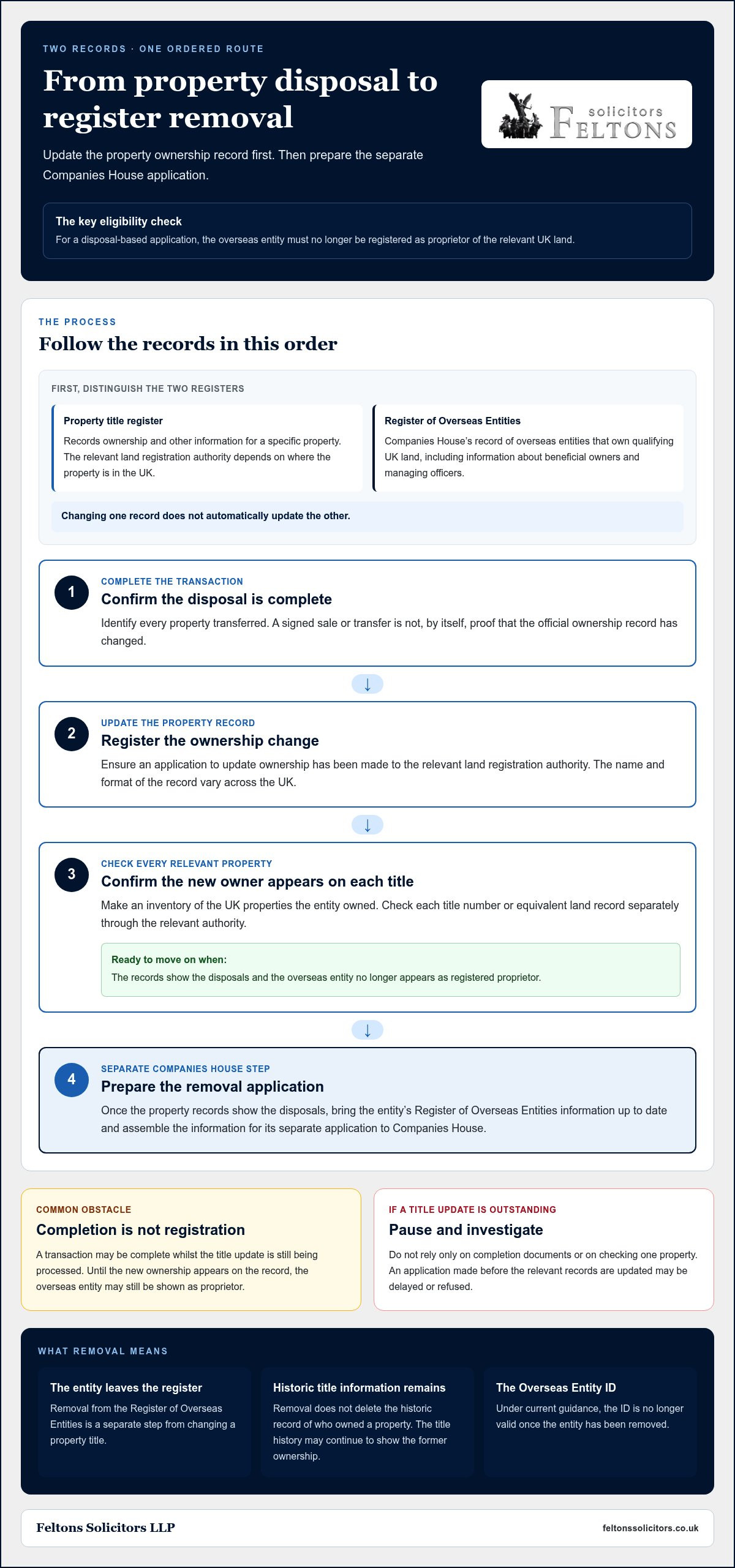
It’s easy to assume one removal application will update both records. In practice, the order matters. The overseas entity must have disposed of its UK property, and the relevant land register must show the new ownership before the entity can apply to leave the Register of Overseas Entities. If a title update is still pending or the entity’s information is out of date, the application may be delayed or rejected.

This guide explains how the two processes fit together, which eligibility checks to complete and what information and verification may be needed before applying. It also covers common filing issues and how to prepare for them. Where ownership records or international details add complexity, legal support can help coordinate the property and Companies House requirements.

Key Takeaways

  • “Land Registry removal” can mean changing a property title or leaving the Register of Overseas Entities. Identify which record needs updating.
  • For removing overseas entity from land registry records, complete the disposal and ensure the relevant title shows the new ownership before applying to Companies House.
  • Check all relevant property titles and bring the entity’s Register of Overseas Entities information up to date before preparing the removal application.
  • Resolve outstanding title registrations, inconsistent details, incomplete updates and missing verification to help avoid preventable delays.
  • Coordinated legal advice can help align conveyancing and Companies House steps, particularly where multiple titles or jurisdictions are involved.

Removing an overseas entity from the Land Registry: which register do you mean?

“Land Registry removal” can refer to two different processes: changing the ownership details recorded for a property, or removing an overseas entity from a Companies House register. The processes are connected, but changing one record doesn’t automatically update the other.

Two registers, two purposes

  • Property title register: records the registered ownership and other information for a specific property. The relevant land registration authority maintains it, and the responsible authority depends on where the property is in the UK.
  • Register of Overseas Entities: Companies House’s record of overseas entities that own qualifying UK land, including information about their beneficial owners and managing officers. Companies House is the UK’s registrar of companies; you can find further background on Companies House.

A completed transfer followed by an updated property title changes the ownership record for that property. It does not remove the former owner from the Register of Overseas Entities. That requires a separate application to Companies House, once the eligibility conditions are met. Keeping the two records distinct helps you complete the steps in the right order.

What does removing an overseas entity from the register mean?

Removal means taking the entity off the Register of Overseas Entities, not deleting the historic record of who owned a property. The title history may continue to show the entity’s previous ownership, and information on the public register may remain viewable after removal. Removal also affects the entity’s Overseas Entity ID: under current guidance, the ID is no longer valid once the entity has been removed. Don’t assume the entity can rely on that ID for a future UK land transaction.

When may an overseas entity apply for removal?

For a disposal-based application, the central eligibility test is that the entity is no longer registered as proprietor of relevant UK land. It isn’t enough for a sale or transfer to be signed, or for the parties to consider the transaction complete. The ownership records for the relevant land must reflect the disposal before the entity applies to leave the Companies House register.

This distinction matters when a transaction has completed but the title update is still being processed. Until the register shows the new owner, the public record may still identify the overseas entity as proprietor, creating an obstacle to removal. Check each relevant title rather than relying only on completion documents.

The entity’s registration history also helps explain its reporting obligations and the information held on the register. Feltons’ overseas entity registration guide explains the registration framework for UK property owners. Before preparing a separate Companies House removal application, confirm that each relevant title has been updated.

Before applying to remove an overseas entity, update the property title records

Start with the property records, not the Companies House removal form. Confirm that the completed disposal has been recorded for every relevant property where the overseas entity was registered as proprietor. A signed transfer or sale agreement is evidence of the transaction, but it doesn’t show, by itself, that the public ownership record has changed.

Use this sequence to prepare:

  1. Complete the disposal. Confirm that the transaction has completed and identify each property transferred.
  2. Register the ownership change. Ensure an application to update ownership has been made to the relevant land registration authority. The name and format of the record vary across the UK.
  3. Check every relevant title. Review each title or equivalent land record separately, including properties held under different title numbers.
  4. Prepare for removal. Once the records show the disposals, assemble the information for the separate Companies House application.

The order matters. If an overseas entity applies before the relevant ownership records have been updated, Companies House may be unable to confirm that it meets the removal conditions. The application could be delayed or refused. Resolve the title position first rather than relying on a signed transfer or the parties’ understanding that the sale has completed.

How do you confirm the new owner is recorded?

Make an inventory of the UK properties the entity owned, then identify the title number or equivalent land record for each one. Check the current record through the relevant land registration authority for the property’s jurisdiction. Confirm that the overseas entity no longer appears as the registered proprietor. Checking one property doesn’t confirm the position for the others.

Keep the stages distinct: conveyancing completion concerns the transaction between the parties, while registration updates the official ownership record. The application to register a transfer may still be outstanding after completion. Check the current record before moving to the next stage.

What if a property transfer has not appeared on the register?

Pause the removal application and investigate the outstanding registration. Review the transfer and completion documents, the registration application and any correspondence about requisitions or missing information. This can help establish whether the application is still being processed or whether something needs attention before the title can be updated.

For wider context on ownership records and conveyancing, Feltons’ residential property law guide explains key aspects of residential property transactions. Where several titles or jurisdictions are involved, Feltons’ conveyancing and overseas entity legal support can help coordinate the property records and Companies House steps.

Applying to Companies House After Title Updates

Once the relevant property records reflect the disposals, make the next application to Companies House, not to the land registration authority. These are separate stages: the title update records who owns the property, while Companies House considers whether the overseas entity can be removed from the Register of Overseas Entities.

Before filing, use current Companies House guidance to check the online application route, who is eligible to submit it and what authentication is required. Procedures can change, so don’t rely on an old form or instructions from an earlier filing. Confirm that the entity’s register information is accurate and up to date.

What information should be ready before filing?

Prepare the entity’s identifying details and Overseas Entity ID, then compare the information held by Companies House with the entity’s current records. Check the names and details of beneficial owners and managing officers, including whether any changes need to be reported. The current form and guidance specify what information to supply.

Where information has changed, verification is a key preparation step. Under current requirements, changes to an entity’s information, including new beneficial owners or managing officers, must be verified by a UK-regulated agent no more than three months before the removal application is made. Allow time to organise the evidence and confirm that it relates to the information being filed.

Establish who will submit the application and what evidence of authority to act is required under the current process. A clear file can bring together the entity’s details, relevant ownership information, verification evidence and confirmation that property records have been updated. This helps identify gaps between the conveyancing position and the Companies House filing before submission.

What happens after Companies House receives the application?

Companies House reviews the application against its requirements. It may seek clarification or further information if details are incomplete, inconsistent or need supporting evidence. Respond carefully to any request, and don’t assume that submitting the form means removal has already taken effect.

Removal doesn’t necessarily make information already available on the public register disappear. Treat the application as a change in the entity’s registration status, not as a request to erase its history. Consider what information remains accessible and make sure the entity understands the practical consequences before proceeding.

The Overseas Entity ID is no longer valid after removal. The entity should consider this consequence before applying, especially if it may need to undertake a later transaction involving UK land. For anyone removing overseas entity from land registry records, careful preparation means checking the title position, information and verification together, then following the current Companies House application guidance.

Removing Overseas Entities: UK Land Registry Guide 2026

Common delays when removing an overseas entity from property records

A removal application can be held up when the entity’s property records don’t align with the information filed with Companies House. Use this issue-and-response check to identify what needs attention before submitting.

  • A transfer is still awaiting registration. Check the application status and any correspondence about outstanding requirements. Resolve the registration issue and confirm the current title position before relying on the disposal for a removal application.
  • One property still shows the entity as proprietor. The eligibility test applies across the relevant UK land held by the entity, not just the property most recently sold. Review every property and title, including properties in different parts of the UK. A private sale agreement does not override a public record that still names the entity as registered proprietor.
  • Entity details do not match across records. Compare the entity’s name and identifying details in the property records with its Companies House information and supporting documents. Resolve discrepancies before filing so the application can be assessed against consistent information.
  • Beneficial owner or managing officer details are out of date. Compare the register information with current details and identify any required update. Check Companies House guidance for the applicable verification rules and deadlines. Under current requirements, changes to entity information must be verified by a UK-regulated agent no more than three months before a removal application.
  • An update statement or verification evidence is missing. Establish whether required updates are complete and gather the relevant evidence before applying. An incomplete compliance record or insufficient verification may mean more work is needed before the removal application is ready.

Can an overseas entity be removed if one property is still registered to it?

Generally, no. If a relevant UK property record still lists the entity as proprietor, the entity may not meet the removal eligibility test, even if it has sold its other properties. Resolve the remaining ownership position first, either by completing a disposal or addressing an outstanding title registration. The public proprietor record is central; a contract or private agreement alone does not change it.

What if the entity’s details or verification information have changed?

Check the information held for the entity and relevant people against current records before submission. Changes to beneficial owners or managing officers can affect what needs updating and verifying. Use the latest Companies House guidance to confirm the requirements at the time of filing, rather than relying on old verification documents or a previous application.

There is an additional coordination point if the entity owns or has owned land in more than one UK jurisdiction. England and Wales, Scotland, and Northern Ireland have distinct land registration systems, so the record and process for checking each title may differ. Keep a property-by-property schedule showing the jurisdiction, title reference and current registered proprietor. This helps prevent an overlooked title from undermining an otherwise complete application.

Where multiple titles, inconsistent records or international ownership details make the checks difficult to coordinate, Feltons can assist with overseas entity and property transaction advice to help clarify the next steps.

Coordinating a property disposal with a separate Companies House application can become more involved when the entity has several UK properties, multiple titles or land in different jurisdictions. Legal support can help bring the transaction documents, title position and entity information together, so unresolved issues can be identified before an application is submitted.

Feltons Solicitors advises on overseas entity registration, complex property transactions, and residential and commercial conveyancing. This combination is relevant when work involves both property records and the Register of Overseas Entities. Advice can be tailored to the ownership arrangements and records involved, including where the property history or jurisdiction adds complexity.

What can a solicitor help you coordinate?

A solicitor can review the disposal documents alongside the status of the related title registration, helping establish whether the public record reflects the transaction. They can also help organise entity information and identify inconsistencies or outstanding matters that may need resolution before filing. For multiple properties, this means considering the relevant titles together rather than treating one completed sale as the whole picture.

Where ownership arrangements or jurisdictional requirements are complex, tailored advice can clarify which records and transaction details need attention. This is practical coordination, not a promise that Companies House will accept an application or that a particular result or timescale can be achieved.

What should you prepare for an initial discussion?

A concise file helps make the circumstances easier to assess. Gather the core identification details and documents available, even if you’re unsure which items will be most relevant. The following information provides a useful starting point:

  • Entity details: the overseas entity’s registered name and Overseas Entity ID.
  • Property information: addresses and title references for relevant UK properties, with the jurisdiction of each property noted.
  • Disposal records: signed transfer or sale documents, completion information and correspondence about registration of the ownership change.
  • Title evidence: current title records, equivalent land records or correspondence showing the status of any outstanding registration.
  • Register changes: details of beneficial owners or managing officers who have changed since the entity’s latest filing, alongside any related update or verification information.

You don’t need to resolve every uncertainty before seeking advice. A clear account of what has been sold, what still appears in the property records and what information has changed can focus the discussion on the next steps. This is particularly useful where the entity’s portfolio spans England and Wales, Scotland or Northern Ireland, as each has its own land registration system.

If you’re considering removing overseas entity from land registry records and need to coordinate the property and Companies House aspects, discuss your property records and proposed application with Feltons. Bring the disposal history and available title information so the position can be considered in context.

Make your next step a coordinated one

The point where a disposal, a title update and a register filing meet is often where a tailored legal review can be useful. If you’re considering removing overseas entity from land registry records, bring the property history and the entity’s current position together before deciding how to proceed. A clear view of the matter can help identify outstanding questions and prepare for the next stage.

Feltons advises on overseas entity registration, complex property transactions, and residential and commercial conveyancing. The firm provides pragmatic guidance to domestic and international clients, shaped around the records and ownership arrangements involved.

For advice on your circumstances, discuss your overseas entity and property records with Feltons’ solicitors. A focused conversation can help you establish a practical way forward.

Frequently Asked Questions

Can I remove an overseas entity from the Land Registry after selling a UK property?

You may be able to apply for removal from the Register of Overseas Entities after a sale, once the entity is no longer registered as proprietor of any relevant UK land. A completed sale doesn’t necessarily mean the ownership record has changed. For example, if the buyer’s registration is still pending, the public title may continue to show the seller. Check the relevant records before making a separate Companies House application.

Is the Register of Overseas Entities the same as the Land Registry?

No. The Register of Overseas Entities is maintained by Companies House and records overseas entities that own qualifying UK land, along with relevant ownership information. A property title register records ownership and other details for an individual property. The registers serve different purposes and are updated through separate processes. Changing a property title does not itself change the entity’s status on the Companies House register.

How do I apply to remove an overseas entity from the register?

Apply to Companies House using its current removal process, once the entity meets the eligibility requirements. Before starting, gather its name and Overseas Entity ID, confirm the position of all relevant property records, and review entity and beneficial ownership details for accuracy. Check the latest Companies House instructions for the application route, who may submit it, authentication and any verification evidence required. Requirements should be checked at the time of filing.

What happens if an overseas entity applies before the property title is updated?

If the title still identifies the overseas entity as proprietor, Companies House may be unable to confirm that the entity is eligible for removal. The application could be delayed or refused, leaving the entity to resolve the registration issue and consider what further filing is needed. Check for outstanding correspondence about the title application, such as a request for additional information, before submitting the removal application.

Does removal from the Register of Overseas Entities erase the entity’s public information?

No. Removal changes the entity’s status on the register; it does not necessarily erase information already available about its registration or history. The entity should also consider the effect on its Overseas Entity ID: current guidance says the ID is no longer valid after removal. This matters if the entity may later be involved in a UK land transaction, so consider the consequences before applying.

Can an overseas entity apply for removal if it still owns another UK property?

Generally, no, if it remains registered as proprietor of relevant UK land. Selling one property does not meet the eligibility test if another qualifying property is still registered to the entity. This can be easy to overlook where property is held across different jurisdictions or under separate titles. Check the entity’s full UK property portfolio and resolve any remaining ownership position before applying to Companies House.

Do Scotland and Northern Ireland use the same property register as England and Wales?

No. The UK does not have one single property title register covering all four nations. England and Wales, Scotland, and Northern Ireland have distinct land registration systems, so the relevant authority, record and process depend on where each property is situated. If an entity has held land in more than one jurisdiction, identify and check the corresponding record for every property rather than relying on a search in one system.

Register of Overseas Entities Guidance: A Comprehensive Legal Framework for 2026

Register of Overseas Entities Guidance: A Comprehensive Legal Framework for 2026

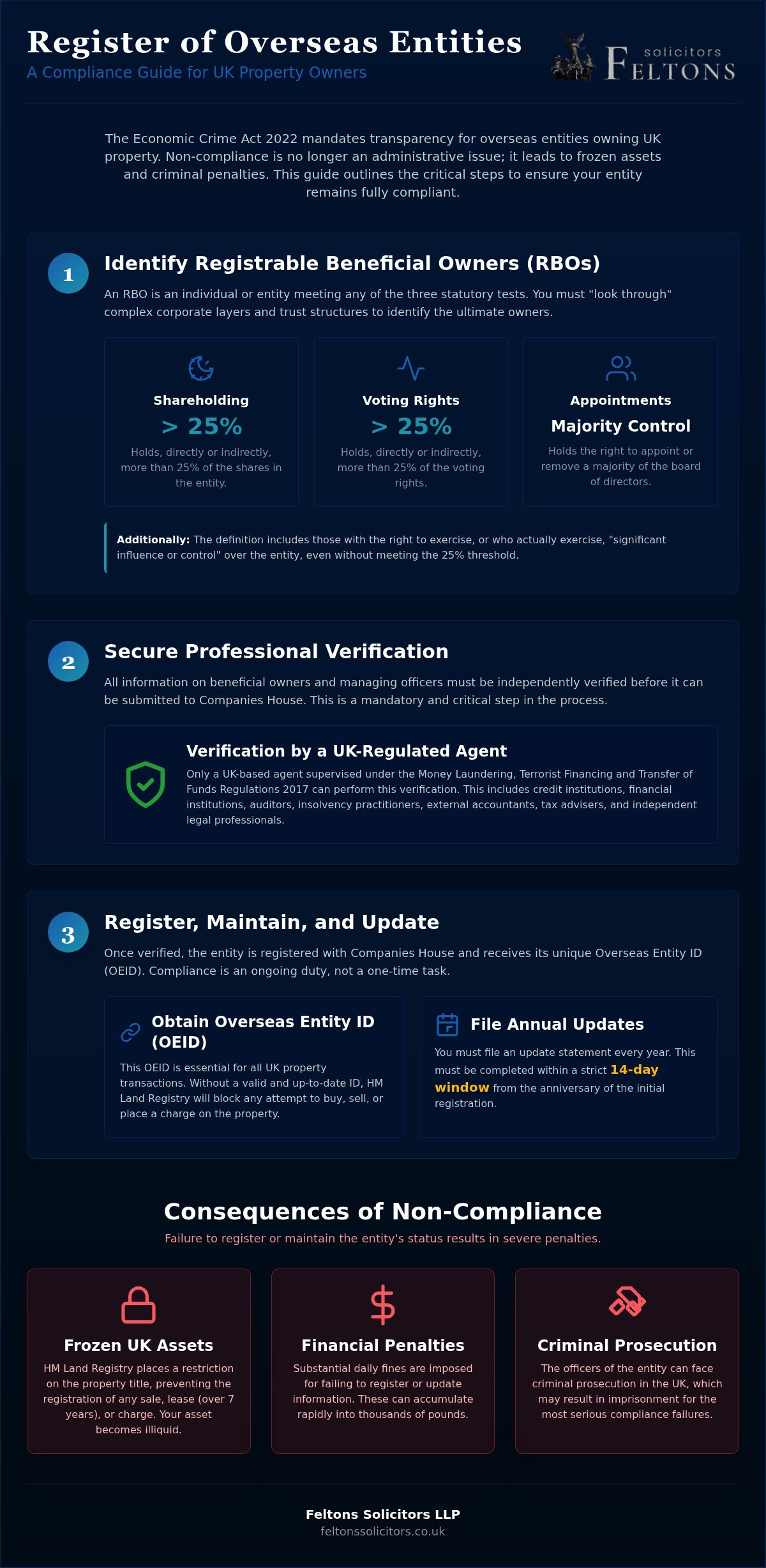
A simple filing error on the Register of Overseas Entities is no longer just an administrative oversight; in 2026, it’s a direct path to a frozen property portfolio and potential criminal prosecution. This register of overseas entities guidance serves as your definitive roadmap through the increasingly stringent requirements of the Economic Crime Act 2022. Companies House has shifted its focus from encouraging transparency to robust enforcement, making precision more critical than ever before.

We recognise that identifying beneficial owners within multi-layered corporate structures often feels like solving a complex puzzle where the rules are constantly shifting. It’s natural to feel a sense of unease regarding the threat of heavy fines or the difficulty of securing a regulated UK verification agent whilst managing international interests. You deserve a legal partner who provides calm, expert clarity instead of added pressure.

By following this framework, you’ll master the intricacies of the new trust disclosure rules and ensure your property transactions remain seamless and secure. We will examine the registration process, the necessity of professional verification, and the strict 14-day window for your mandatory annual updates. This guide ensures you remain in full compliance, protecting both your reputation and your UK assets.

Key Takeaways

  • Identify registrable beneficial owners with precision by applying the three primary tests and the 25% control threshold.
  • Secure your property interests by obtaining expert register of overseas entities guidance to navigate mandatory verification through a regulated UK professional.
  • Protect your assets from Land Registry blocks and criminal penalties by mastering the strict 14-day filing window for annual update statements.
  • Recognise how a tailored legal approach integrates compliance into your broader property strategy to ensure seamless long-term management.

Understanding the Register of Overseas Entities (ROE) Requirements

The Register of Overseas Entities (ROE) serves as a critical transparency tool within the UK’s legal system. Its primary purpose is to reveal the true owners of UK land held through foreign structures, curbing the use of anonymous offshore vehicles for illicit gains. This requirement was formalised under the Economic Crime (Transparency and Enforcement) Act 2022, which fundamentally altered the compliance obligations for international investors. By creating a public record of beneficial ownership, the government aims to foster a more accountable and secure property market.

An “overseas entity” is broadly defined as any legal person, such as a corporation or partnership, that is governed by the law of a country or territory outside the United Kingdom. If your entity owns, or intends to acquire, qualifying UK property, registration with Companies House is mandatory. Failing to adhere to this register of overseas entities guidance can lead to severe repercussions. Beyond the daily fines that can reach thousands of pounds, officers of the entity face potential imprisonment. We understand how daunting these criminal sanctions appear, yet they are avoidable with a methodical approach to your legal duties.

The Scope of the Legislation in 2026

The current framework is comprehensive, covering various legal structures including foreign companies and limited partnerships. One of the most significant aspects is its retrospective nature. In England and Wales, the rules apply to all land purchased on or after 1 January 1999. Once registered, the entity receives a unique Overseas Entity ID (OEID). This number is the “golden ticket” for any modern property transaction. Without a valid OEID, you cannot complete a purchase, sale, or lease of more than seven years. It’s a simple identifier that carries immense weight in the eyes of the law.

The Interplay with HM Land Registry

Compliance is enforced through a symbiotic relationship between Companies House and HM Land Registry. The Land Registry places a restriction on the title of any property owned by an overseas entity. This restriction effectively freezes the asset. You won’t be able to register a transfer of title, a lease, or a legal charge unless the entity is fully compliant and its registration is up to date. Proactive management is vital. Waiting until a disposal is underway to seek register of overseas entities guidance often leads to costly delays and broken chains in the conveyancing process. A clear status at the Land Registry ensures your property remains a liquid asset rather than a legal burden.

Identifying and Disclosing Registrable Beneficial Owners (RBOs)

Determining who truly holds the reins of a foreign company requires more than a glance at a share certificate. This register of overseas entities guidance prioritises the accurate identification of Registrable Beneficial Owners (RBOs), a process that involves three rigorous statutory tests. An individual or legal entity is typically registrable if they meet any of the following criteria:

  • Holding, directly or indirectly, more than 25% of the shares in the entity.
  • Holding, directly or indirectly, more than 25% of the voting rights.
  • Holding the right, directly or indirectly, to appoint or remove a majority of the board of directors.

Some individuals exert power through “significant influence or control” without holding a formal majority. This often occurs amongst family offices or private equity arrangements where veto rights or bespoke articles of association exist. If your exhaustive search yields no RBOs, you must instead provide details for every “managing officer” of the entity. Following official Companies House guidance is essential to ensure these declarations are legally sound and prevent future disputes with the registrar.

Complex Ownership and Trust Structures

Navigating chains of ownership that span multiple offshore jurisdictions is a common hurdle. You must “look through” each layer until a registrable individual or a “legal entity subject to its own disclosure requirements” is found. When trusts are part of this chain, the level of detail required increases significantly. Trustees, settlors, and even certain beneficiaries must be disclosed. If you find yourself managing a web of international interests, seeking professional legal support can clarify these opaque structures whilst ensuring your privacy is protected where the law permits.

New Rules for Trust Transparency in 2026

The landscape for trust privacy changed fundamentally on 31 August 2025, when the UK government enabled public access to trust information held on the register. Whilst this data isn’t visible on the public search by default, third parties can now apply to Companies House to view specific trust details. The Register of Overseas Entities (Protection and Trusts) Regulations 2026, which came into force in July 2026, further refined how this information is handled and protected. Under these rules, a registrable beneficial owner in the context of a trust is any person who serves as a trustee, settlor, or beneficiary, or who otherwise exercises significant control over the trust’s assets and administration.

The Critical Role of UK-Regulated Verification Agents

The integrity of the UK’s property market depends on the accuracy of the data submitted to Companies House. For this reason, the legislation strictly prohibits self-verification by the overseas entity itself. This register of overseas entities guidance emphasises that an independent, regulated professional must scrutinise every piece of information before it’s submitted. This requirement acts as a safeguard, ensuring that the transparency intended by the Economic Crime Act is actually achieved in practice.

Only “relevant persons” as defined by the Money Laundering Regulations can act as verification agents. This group primarily includes solicitors, accountants, and financial institutions regulated in the UK. Choosing the right partner is a decision that shouldn’t be taken lightly. Verification agents carry significant legal liability; providing false or misleading information is a criminal offence that can lead to unlimited fines or imprisonment. Whilst some high-volume service providers offer basic checks, a boutique law firm provides a superior level of due diligence that protects your corporate reputation and ensures absolute precision.

The Verification Process Step-by-Step

The verification journey follows a methodical three-stage path to ensure compliance. First, your agent gathers original corporate documentation, including certificates of incorporation and registers of members, to trace the ownership chain. Second, the agent conducts comprehensive “know your client” (KYC) and anti-money laundering checks on all identified beneficial owners. Finally, once satisfied, the agent issues a formal verification statement to Companies House using their unique agent assurance code. This structured approach, supported by official UK government guidance, ensures your entity receives its Overseas Entity ID without delay.

Maintaining the Integrity of the Register

Compliance is a recurring commitment rather than a one-off task. You must re-verify your information during every annual update to confirm that the beneficial ownership details remain accurate. If changes occur between filing dates, such as the transfer of shares or a change in trustees, these must be recorded and verified during the next update statement. A methodical approach prevents issues with your agent assurance code, which Companies House can revoke if they suspect negligent or fraudulent verification practices. Staying organised ensures your property assets remain liquid and your legal standing remains beyond reproach.

Register of Overseas Entities Guidance: A Comprehensive Legal Framework for 2026

Managing Annual Update Statements and Removal Procedures

Registration is the initial hurdle, but the legal race continues every year. The statutory duty to file an update statement remains one of the most overlooked aspects of the regime. This register of overseas entities guidance confirms that every entity must submit a statement once every 12 months. The filing window is surprisingly tight. You have exactly 14 days from the anniversary of your initial registration to complete the submission. Missing this deadline is a criminal offence. It can also lead to a daily fine, which accumulates rapidly and creates unnecessary financial strain.

Calculating your filing period is straightforward but requires diligence. Your “update period” is the 12 months following registration or your last update. Even if your ownership structure hasn’t changed a single percentage point, you still have a legal obligation to confirm this fact with Companies House. Staying ahead of this calendar is the only way to ensure your property interests remain protected and your corporate standing remains clear. We often find that clients feel a sense of relief once a reliable tracking system is in place, as it removes the fear of accidental non-compliance.

The Annual Update Checklist

A methodical review is the best defence against compliance failures. Before filing, you should verify that your current list of beneficial owners and managing officers is exhaustive and accurate. Ensure that all personal details, including names and residential addresses, are current. If significant changes in ownership occurred during the year, you must secure fresh verification from a UK-regulated agent before the update can be accepted. This prevents the administrative blocks that can derail future transactions. For expert assistance in managing these recurring duties, you can instruct Feltons Solicitors LLP to handle your annual compliance.

Removal from the Register of Overseas Entities

Many owners wonder what happens when they no longer hold UK property. If your entity has disposed of all qualifying land interests, you may be eligible for removal from the register. This is not an automatic process. You must submit a formal application for removal, which includes a declaration that the entity is no longer a registered owner of any relevant land. Once the application is submitted, Companies House enters a processing period to verify the claim with the Land Registry. Maintaining thorough records of your property disposals is vital during this stage. Even after removal, you should retain your compliance documentation for at least seven years to satisfy any future regulatory enquiries.

For high-net-worth property owners, the Register of Overseas Entities isn’t just an administrative hurdle; it’s a critical component of a broader wealth management and risk mitigation strategy. Large corporate firms often treat these registrations as high-volume, impersonal data entries. In contrast, a boutique firm like Feltons Solicitors LLP offers the discreet, high-standard service that complex international matters require. We provide a calm, steady presence, ensuring that your privacy is respected whilst every regulatory box is ticked with absolute precision. This register of overseas entities guidance is designed to help you move from confusion to complete confidence.

Compliance shouldn’t exist in a vacuum. By aligning your registration with broader residential property law strategies, you ensure that your assets remain liquid and ready for any future transaction. Our team specialises in the intricate details of overseas entity beneficial owner registration, allowing you to focus on your investment goals rather than administrative burdens. This integrated approach prevents the Land Registry blocks and criminal liabilities discussed earlier, providing a seamless experience from the moment of acquisition to the point of disposal.

A Tailored Approach to International Clients

We understand that our international clients operate across different time zones and diverse corporate cultures. Providing effective register of overseas entities guidance requires more than technical knowledge; it demands an appreciation for the human impact of legal work. For South African entrepreneurs, you can learn more about Express Shelf Company to ensure your domestic compliance is managed alongside your UK obligations. We act as a sophisticated guide, handling cross-border communications with the poise and dependability you expect from a trusted advisor. This people-first philosophy ensures that even the most complex or stressful property transactions feel manageable and secure under our care.

Next Steps for Your Overseas Entity

The best time to address your compliance status is before a deadline looms or a property sale is agreed. An initial consultation allows us to identify potential hurdles in your ownership structure, such as missing documentation from a foreign jurisdiction or complex trust arrangements. Whether you need to begin a new registration or submit an urgent annual update statement, our methodical process provides the security you need. Ensure your UK property assets remain secure with expert oversight by contacting our team today to discuss your specific requirements and safeguard your interests for 2026 and beyond.

Securing Your UK Property Interests for 2026

Navigating the UK property market as an international investor requires more than just capital; it demands rigorous adherence to transparency laws that are only becoming more stringent. By prioritising the accurate identification of beneficial owners and respecting the critical role of UK-regulated verification agents, you protect your assets from unnecessary freezes or legal complications. This register of overseas entities guidance provides the foundation for a compliant future, yet the practical application of these rules often requires a more personalised touch to navigate the nuances of international corporate structures.

Feltons Solicitors LLP offers the discreet, high-standard service needed to manage these complex requirements alongside your broader residential and commercial property interests. As regulated legal professionals, we provide the reassurance of absolute precision whilst maintaining the boutique level of care that high-net-worth individuals deserve. You don’t have to face these regulatory shifts alone. Instruct Feltons Solicitors LLP for your Overseas Entity Registration today to ensure your portfolio remains liquid and your reputation remains beyond reproach. We look forward to acting as your trusted advisor in these sensitive matters.

Frequently Asked Questions

What is the Register of Overseas Entities (ROE)?

The Register of Overseas Entities is a public database managed by Companies House to identify the true owners of foreign organisations holding UK property. Established under the Economic Crime Act 2022, it serves as a transparency tool to combat financial crime. Every foreign entity must register to receive a unique ID number. Without this identifier, you’ll find it impossible to buy, sell, or lease land in the United Kingdom.

Which overseas entities are required to register with Companies House?

Any legal person, such as a corporation or partnership, governed by laws outside the UK is considered an overseas entity. If your organisation owns or plans to acquire UK land, registration is a statutory requirement. This applies retrospectively to land purchased in England and Wales since January 1999. Identifying your entity type correctly is the first step in ensuring your property portfolio remains compliant with current transparency regulations.

What happens if an overseas entity fails to register its beneficial owners?

Failure to register results in a complete freeze on your property assets at HM Land Registry. You won’t be able to sell, lease, or charge the land until the entity is compliant. Beyond these civil restrictions, non-compliance is a criminal offence. The entity and its officers may face unlimited fines or prison sentences. These penalties are designed to ensure that transparency is not treated as an optional administrative task.

How often does an overseas entity need to update its registration?

Overseas entities must submit an update statement to Companies House every 12 months. This is mandatory even if your beneficial ownership structure has remained entirely unchanged since the last filing. You have a narrow 14-day window from the anniversary of your registration to complete this duty. This register of overseas entities guidance stresses the importance of punctuality, as missing this deadline can lead to immediate criminal prosecution and significant daily fines.

Can I sell my UK property if my overseas entity is not registered?

You cannot complete a property sale if your entity is not correctly registered. The Land Registry will block the transfer of title, meaning the buyer cannot become the legal owner. This often results in breached contracts and significant financial loss. It’s vital to verify your status well before a sale is agreed. Ensuring your registration is active avoids the stress of a last-minute scramble that could jeopardise your entire transaction.

Who can act as a verification agent for the Register of Overseas Entities?

Only UK-regulated professionals, such as solicitors, accountants, or financial institutions, can act as verification agents. These individuals must have a valid assurance code from Companies House to submit your data. Choosing a law firm provides a higher level of security, as solicitors are bound by strict professional standards. This ensures your data is verified with the precision required to satisfy the registrar and protect you from the consequences of inaccurate submissions.

Is information on the Register of Overseas Entities available to the public?

Most details on the register, including names and the nature of control, are visible to the public via Companies House. However, sensitive data like residential addresses and full dates of birth are kept private. Recent changes in 2025 mean that trust information is now accessible to the public upon application. If an individual faces a serious risk of harm, they can apply for their information to be protected from public disclosure entirely.

What is a “registrable beneficial owner” in the context of UK land?

A registrable beneficial owner is anyone who meets the 25% threshold for shares or voting rights in an entity. It also includes those who can appoint or remove the majority of the board of directors. This register of overseas entities guidance also covers individuals who exercise significant influence or control through other means. Correctly identifying these individuals is essential for a valid registration and requires a thorough analysis of your entity’s corporate governance.