

What looks like a clear lease breach may not be one. A missed payment, unauthorised alteration or failure to meet a repair obligation can raise urgent concerns, but the answer depends on the lease wording, the facts and any notice already served. If you’re seeking breach of commercial lease legal advice, it can be difficult to know whether to negotiate, remedy the issue or take formal action, especially when a deadline is approaching.
This guide explains what may count as a breach and how to respond. It covers how to check the relevant lease terms, organise correspondence and evidence, and consider the potential consequences before acting. A notice or missed payment should not be ignored, but neither does an allegation mean court action is inevitable. Reviewing the documents can help clarify your position and identify a practical next step.
Key Takeaways
- The signed lease is the starting point. Check the specific obligation and any relevant variations before deciding that a breach has occurred.
- Keep the lease, notices, correspondence and relevant payment records together so the facts can be assessed clearly.
- A suspected breach doesn’t automatically mean court action. Possible next steps may include putting matters right or seeking a negotiated resolution.
- Breach of commercial lease legal advice can help clarify potential risks, remedies and proportionate options based on the documents and circumstances.
- Before taking formal action or responding to a notice, consider having an adviser review your commercial property dispute and the applicable legal context.
What counts as a breach of a commercial lease?
It is not always clear whether a problem is a lease breach or a disagreement about what the lease requires. Start with the signed lease. A breach occurs when a landlord or tenant fails to meet an obligation in that agreement. Examples may include unpaid rent, alterations made without required consent, using the premises for a prohibited purpose or failing to meet a repair obligation.
An allegation is not proof that a breach has occurred. The relevant clause, the surrounding facts and any agreed changes to the lease all matter. Similar conduct can have different consequences under leases with different wording. This guide provides general information, not advice on your particular documents or circumstances.
Which lease obligations are commonly disputed?
Disputes may concern payment obligations, permitted use, repairs and maintenance, alterations, or restrictions on assigning the lease. For example, a disagreement about who must carry out particular repairs may turn on the wording of the repairing covenant and any related schedule.
Either party may be accused of breaching the agreement. A tenant might allege that a landlord has failed to meet an obligation, just as a landlord might raise concerns about rent or how the property is used. A delay or disagreement alone does not necessarily establish a breach. Check what the lease requires and whether the circumstances meet that requirement.
Why the exact lease wording matters
Read the clause said to have been breached alongside relevant definitions, schedules and any formal variations. These may qualify or explain the obligation. Check whether the lease sets out how a notice must be given or allows time to remedy a particular problem. Requirements can be specific to the agreement, so do not assume that a deadline or process in another lease applies to yours.
The legal response may also depend on the relevant UK jurisdiction and the rules in force there. Seek advice based on the documents and current law before taking action. For a general explanation of the contract concept, see What counts as a breach of a commercial lease? The phrase “breach of contract” covers a broad area. Whether a particular lease obligation has been broken requires closer assessment.
If you are unsure how the wording applies, breach of commercial lease legal advice can help you assess the lease, correspondence and available options before responding. Let the documents and facts guide your next step, rather than assumption.
What can happen after a commercial lease breach?
The consequences depend on the lease terms, the nature of the alleged breach, the parties’ actions and the law that applies. A problem may be resolved by putting matters right or agreeing a practical way forward. In other cases, a landlord or tenant may consider formal dispute resolution or court proceedings. None of these outcomes follows automatically from an allegation.
A landlord may record the concern, review the relevant lease provisions and consider any contractual remedies. A tenant may investigate the allegation, gather records, remedy the issue where appropriate or explain why they dispute it. Either party should take care before acting unilaterally: a step that seems straightforward could affect their position under the lease.
Possible remedies are not automatic
Termination or forfeiture can have serious consequences, including disruption to a tenant’s business, staff and customers. Check the lease and legal requirements before treating these as available options. In England and Wales, forfeiture for a breach other than non-payment of rent generally requires a landlord to serve a notice under section 146 of the Law of Property Act 1925, identifying the breach and allowing a reasonable time to remedy it. Different rules may apply to rent arrears, and the lease must be checked.
Commercial Rent Arrears Recovery (CRAR) is a separate route for qualifying rent arrears in England and Wales. It has procedural requirements, including notice before enforcement. Check the relevant rules and the lease before relying on it. These remedies do not replace consideration of negotiation or other proportionate ways to resolve the dispute.
Respond promptly to formal notices
Keep the original correspondence and note when and how each notice arrived. Save emails, delivery records, payment documents, photographs and other relevant evidence. Do not alter or discard material that may help establish what happened. Notice wording, delivery methods and response periods can vary, and legal requirements differ by jurisdiction. If a notice specifies a deadline, do not ignore it or assume there is more time. Have the document and applicable rules checked promptly.
Ignoring formal correspondence can narrow the options available and allow a dispute to escalate. A rushed admission, payment decision or attempt to end the lease could also have consequences. Breach of commercial lease legal advice can help clarify the documents, risks and possible next steps before you act. Feltons Solicitors LLP provides commercial conveyancing and litigation and dispute resolution. You can enquire about its dispute resolution services to check whether it can assist with your particular commercial property dispute.
Does a commercial lease breach always mean court action?
No. An alleged breach does not automatically require a court claim. The right response depends on the lease, the evidence, the urgency of the issue and its effect on the business. A discussion or agreed remedy may be proportionate in some disputes; others may need structured dispute resolution or formal proceedings. Negotiation cannot guarantee agreement, and proceedings cannot always be avoided.
Where a practical conversation is appropriate, the parties can set out what they believe happened, refer to the relevant lease terms and consider a workable remedy and timescale. Put any agreement in writing, including what each party will do and by when. Keep discussions separate from any formal deadline: negotiation does not necessarily change a notice period or other time limit.
Compare the possible routes
| Route | Purpose | Considerations and when advice may help |
|---|---|---|
| Informal discussion | Clarify concerns and explore a practical solution directly. | May suit a straightforward disagreement, but record any agreed steps and check that deadlines are protected. |
| Solicitor-led negotiation | Set out a party’s position and seek a resolution through legal representatives. | Advice may help assess the lease, evidence and wording of a proposal before it is sent or accepted. |
| Other dispute resolution | Use a structured process to help the parties address the dispute without immediately asking a court to decide it. | Suitability depends on the issues, the parties’ willingness to engage and any applicable requirements. |
| Litigation | Ask a court to determine a dispute where other steps have not resolved it or a formal decision is needed. | Consider the evidence, business impact, available remedies and current procedural rules with a legal adviser. |
When escalation needs careful thought
Seek advice if key facts are disputed, similar issues keep arising, or the dispute is affecting access to or use of the premises, trading or important business decisions. A threatened termination or other urgent action also calls for prompt assessment. Do not assume a particular remedy is available, or that withholding payment is safe, without checking the lease and legal position.
Court routes and procedure depend on the circumstances and jurisdiction, so confirm current requirements before acting. Breach of commercial lease legal advice can help you weigh a proportionate response against the practical risks. Feltons Solicitors LLP provides litigation and dispute resolution. You can enquire about dispute resolution to check whether the firm can assist with your particular commercial property dispute.
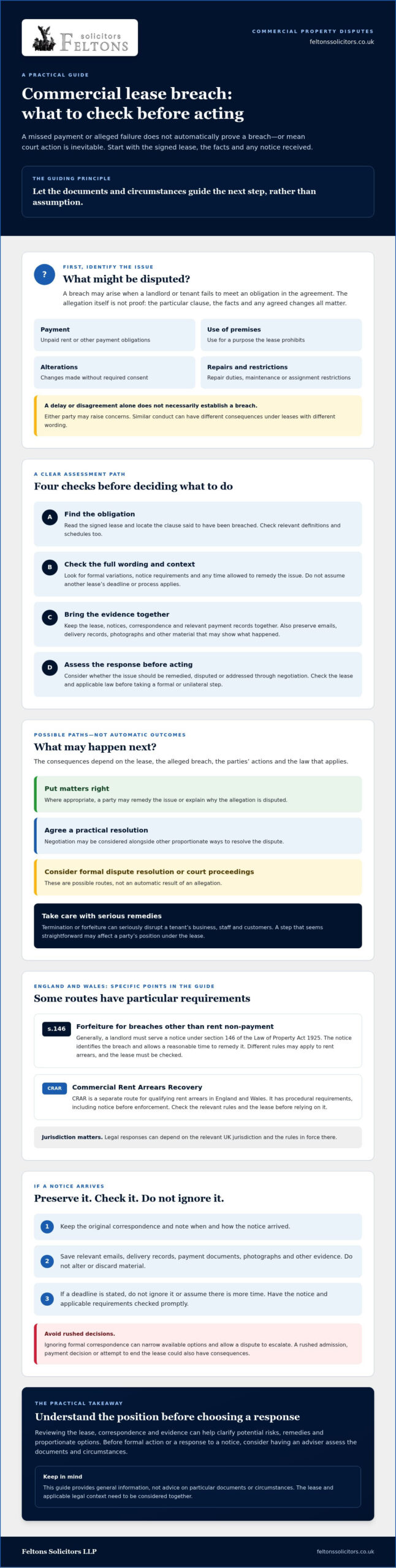
What should you do if you suspect a commercial lease breach?
A measured response starts with a clear record of what has happened and what the lease requires. Before replying to an allegation or taking action, work through these steps:
- 1. Identify the concern. Write down what happened, when it happened and who was involved. Separate confirmed facts from assumptions or points that still need checking.
- 2. Locate the relevant clause. Find the obligation in the signed lease, then check related definitions, schedules and any later variations or side letters. Note any notice procedure or deadline that may apply.
- 3. Gather and preserve records. Keep the lease and related documents alongside notices, correspondence and relevant payment records. Make a dated chronology so the sequence is easy to follow.
- 4. Seek tailored advice before deciding what to do. A review of the documents and evidence can help clarify your position and inform a proportionate response.
Do not ignore a formal notice, make an admission just to end a difficult exchange, or take an irreversible step without understanding its possible effect. If a deadline is stated, flag it promptly when seeking advice.
Documents and evidence to prepare
Gather the signed lease, side letters, licences, variations and relevant schedules. Add emails, messages, photographs, invoices and payment records where they relate to the issue. Keep original files and documents where possible. For important communications, record the date, sender or recipient, how they were delivered and when they arrived. An organised file helps an adviser assess both the lease wording and the events surrounding the dispute.
Questions to ask before choosing legal advice
Ask whether the adviser can assess the specific lease and alleged breach, and whether the firm can assist with your type of commercial property dispute. Clarify which documents they need, which deadlines require attention, and what risks and resolution options may be relevant. Advice should be based on your circumstances, not on the assumption that one remedy fits every dispute.
Feltons Solicitors LLP provides commercial conveyancing and litigation and dispute resolution, with a pragmatic approach to complex matters. To discuss your circumstances and ask whether the firm can assist, discuss your commercial property dispute with Feltons. Tailored breach of commercial lease legal advice can help you understand the documents and make an informed decision about what to do next.
How can breach of commercial lease legal advice help?
Tailored legal advice can turn a worrying allegation into a clearer assessment of your position. A solicitor may review the lease and any variations alongside relevant correspondence, notices and evidence, then consider the legal context that applies. This can help identify what is agreed, what remains contested and which parts of the lease need closer interpretation.
That review may clarify the strengths and risks of each party’s position, possible remedies and practical ways forward. Depending on the circumstances, options could include addressing an issue, negotiating or considering formal dispute resolution. Advice should explain the choices and their implications, without assuming that litigation is inevitable or promising a particular result.
What a first discussion may need to cover
Be ready to explain who the parties are, which premises are involved and which lease clause is at the centre of the concern. Outline what has happened so far, including any notices received, response dates and steps either party has taken. Mention immediate business concerns, such as the effect of the dispute on operating from the premises.
An initial discussion can help establish what information is needed and whether the matter may fit the firm’s services. It cannot determine the outcome without an appropriate review of the documents, evidence and relevant circumstances. If a notice gives a deadline, make that clear at the outset.
Choosing a proportionate way forward
Before committing to a response, ask what options are available, what risks each may carry and whether any time limits need attention. A measured approach may focus on resolving the underlying issue where practical, while preserving your position if the dispute continues. The right course depends on the lease, evidence, urgency and business impact.
Feltons Solicitors LLP provides property law and commercial conveyancing services, alongside litigation and dispute resolution. Its stated approach is pragmatic and tailored to complex matters, but whether it can assist will depend on the nature of your dispute. An enquiry can help establish whether your circumstances fit the firm’s services; it does not guarantee an outcome.
If you’re considering breach of commercial lease legal advice, you can contact Feltons Solicitors to discuss your situation and ask whether the firm can assist. A clear explanation of the documents, options and next steps can help you make an informed decision before taking action.
Take a considered next step
A suspected lease breach needs a document-led response. Check the relevant terms, keep a clear record of events and pay close attention to formal notices and deadlines. An allegation does not automatically mean court action, but acting without understanding the lease could create further risk.
Tailored breach of commercial lease legal advice can help you assess the evidence, understand potential options and choose a proportionate way forward. Feltons Solicitors LLP provides property law and conveyancing services, including commercial conveyancing, as well as litigation and dispute resolution for domestic and international clients. The firm describes its approach as pragmatic advice for complex matters. Whether it can assist will depend on your specific circumstances.
To discuss your commercial property dispute and ask whether Feltons can help, contact Feltons Solicitors LLP. With a clearer understanding of your position, you can decide on your next step with greater confidence.
Frequently Asked Questions
What is considered a breach of a commercial lease?
A breach occurs when a landlord or tenant fails to meet an obligation set out in the lease. Examples may include unpaid rent, using the premises outside the permitted use, carrying out unauthorised alterations or failing to meet a repair obligation. Whether conduct amounts to a breach depends on the precise wording, any variations and the circumstances. A disagreement or delay alone does not necessarily prove that a contractual obligation has been broken.
What should I do if I receive a commercial lease breach notice?
Read the notice carefully, note when and how it arrived, and identify any stated deadline. Keep it with the lease, related correspondence and documents that may help explain the issue. Check which clause is said to have been breached, but do not assume the allegation is correct or ignore it. Before admitting liability, agreeing to a remedy or taking action, consider getting advice based on the documents and applicable law.
Can a landlord end a commercial lease because of a breach?
A landlord may have remedies for a breach, but ending the lease is not automatic. Check the lease for relevant rights, and consider any legal requirements that apply to the steps a landlord must take. For example, in England and Wales, forfeiture for some breaches requires a notice and an opportunity to remedy the breach; different rules may apply to rent arrears. The position depends on the facts and jurisdiction, so seek tailored advice before acting.
Can a tenant challenge an alleged breach of a commercial lease?
Yes. A tenant may dispute whether the lease imposes the obligation alleged, whether the facts establish a breach, or whether the landlord has followed the required process. Review the relevant clause, variations, notices and supporting evidence, then keep a clear record of events and communications. Breach of commercial lease legal advice can help assess the tenant’s position and consider a proportionate response without assuming that either party’s account is established.
How quickly should I respond to a commercial lease breach notice?
Check the notice immediately and seek advice promptly, especially if it states a response date or refers to formal action. There is no single response period for every notice: time limits and service requirements can depend on the lease, the type of alleged breach and the applicable law. Record the date and method of delivery, and do not assume that informal discussions pause or extend a formal deadline.
Can a commercial lease dispute be resolved without going to court?
Yes, some disputes may be resolved through direct discussion, solicitor-led negotiation or another suitable dispute resolution process. The parties might clarify what happened, discuss a possible remedy and record any agreement in writing. These approaches are not guaranteed to succeed, and court proceedings may still be considered if the dispute remains unresolved or a formal decision is needed. The evidence, urgency, lease terms and business impact can all inform which route is appropriate.
What documents should I take to a commercial lease solicitor?
Take the signed lease, relevant schedules, side letters, licences and any variations, along with notices and related correspondence. Emails, messages, photographs, invoices and payment records may also help, depending on the issue. Keep original documents and note important dates, recipients and delivery details. A short chronology can help explain what happened and distinguish confirmed facts from assumptions. The solicitor may identify other documents needed after reviewing the material.