

The most successful legal outcome isn’t the one won in a courtroom; it’s the one that never reaches it. When a conflict arises, whether it’s a commercial disagreement or a sensitive private matter, the immediate instinct is often one of dread. You’re likely worried about escalating legal fees, the exhausting stress of formal proceedings, and the uncertainty of where you’ll stand when the dust settles. It’s a heavy burden to carry. Engaging experienced dispute resolution solicitors is the first step toward reclaiming control and finding a path forward that prioritises your interests over unnecessary litigation.
We understand that you’re seeking a way to resolve your situation with as little friction as possible. This guide provides a clear understanding of the UK dispute resolution process in 2026, showing you how to protect your legal position whilst avoiding the drain of a protracted court battle. We’ll explore the latest updates to the Civil Procedure Rules and the strategic use of alternative methods to help you reach a swift, cost-effective resolution. By the end, you’ll have the clarity needed to make informed decisions and ensure minimal disruption to your life or business.
Key Takeaways
- Understand why prioritising interests over ego is the key to avoiding unnecessary court battles and achieving a swifter resolution.
- Discover the distinct advantages of Alternative Dispute Resolution (ADR) pathways compared to the formal litigation process.
- Learn how to recognise the critical point when instructing dispute resolution solicitors becomes essential to protect your legal and financial position.
- Gain a clear overview of Pre-Action Protocols and strategic cost management to ensure your case remains focused and efficient.
- Explore the benefits of a discreet, partner-led approach for navigating complex legal conflicts with poise and professional integrity.
What is Dispute Resolution and Why Does it Matter?
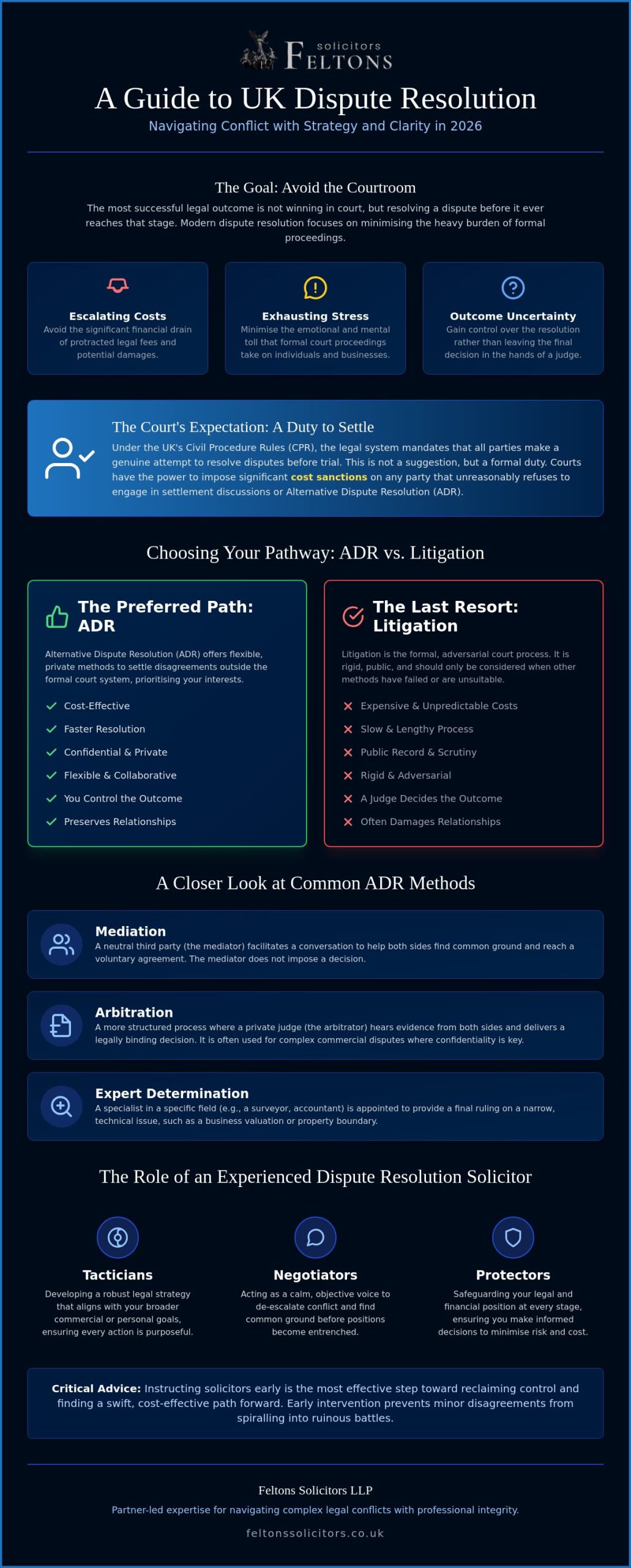
At its heart, dispute resolution is the structured process of resolving a legal disagreement between two or more parties. It’s a field that encompasses everything from informal negotiations to high-stakes international arbitration. For most, the term “legal conflict” evokes images of a crowded courtroom and a judge’s gavel. However, in the modern legal environment, the courtroom is often the last place any party wants to be. Avoiding court has become the primary objective for both individuals and businesses, as they seek to preserve resources and maintain control over the outcome.
Experienced dispute resolution solicitors act as much more than just litigators. They are negotiators, tacticians, and calm voices in the middle of a storm. They look beyond the immediate legal technicalities to understand the human and commercial realities behind a conflict. This is why early intervention is so critical. A minor disagreement over a contract or a boundary can quickly spiral into a ruinous battle if left unchecked. By instructing dispute resolution solicitors at the outset, you can often de-escalate the situation before positions become entrenched and costs become prohibitive.
The Core Objectives of Modern Conflict Resolution
Civil Procedure Rules and the Duty to Settle
The UK legal system has undergone significant shifts, and by 2026, the emphasis on cooperation is stronger than ever. The Civil Procedure Rules (CPR) explicitly expect parties to attempt to resolve their issues before a trial. This isn’t just a suggestion; it’s a formal duty. The courts now have robust powers to penalise parties who unreasonably refuse to engage in settlement discussions or Alternative Dispute Resolution (ADR). If you ignore an invitation to mediate without a valid reason, you may find yourself facing severe cost sanctions, even if you eventually win your case. The 2026 framework prioritises efficiency, ensuring that the court’s limited resources are reserved only for those disputes that truly cannot be resolved through dialogue.
Exploring the Pathways: ADR vs Litigation
Selecting the most appropriate route for your conflict is a pivotal decision. It’s not merely a choice between court and no court; it’s about matching the process to your desired outcome. Alternative Dispute Resolution (ADR) serves as a broad umbrella for various methods designed to settle disagreements outside the traditional judicial system. In contrast, litigation is the formal, adversarial process where a judge decides the case. While the court system remains the backbone of Civil justice in England and Wales, ADR offers a level of flexibility that courtrooms simply cannot match. It allows parties to set their own pace, choose their adjudicators, and keep proceedings entirely private.
The choice of pathway depends heavily on the nature of the dispute and the parties involved. Some conflicts require the rigid, predictable structure of a court schedule to ensure progress. Others benefit from the creative, interest-based solutions that only ADR can provide. Experienced dispute resolution solicitors assess these variables at the outset to recommend a strategy that balances speed, cost, and the likelihood of a favourable result.
Common ADR Methods: Mediation, Arbitration, and Negotiation
Mediation is perhaps the most recognisable form of ADR. Here, a neutral third party helps both sides find common ground. It’s a voluntary process, and the mediator doesn’t impose a decision; they facilitate a conversation. Arbitration, however, is more structured. It involves a private judge who delivers a binding decision, often used in complex commercial contracts where privacy is essential. Expert Determination is a refined tool for technical or financial disputes. In this scenario, a specialist in a specific field, such as a surveyor or accountant, provides a final ruling on a narrow, technical issue.
When Litigation Becomes Necessary
Despite the myriad benefits of ADR, litigation remains an essential tool in any legal arsenal. Sometimes, you need the weight of a court order to protect your position immediately. If a party is hiding assets or refusing to stop a damaging behaviour, an injunction may be the only viable solution. Litigation is also necessary when the other side refuses to engage in good faith or ignores invitations to settle. In these instances, top commercial litigation firms UK provide the robust representation needed to advance your position through the courts. Our role as dispute resolution solicitors is to ensure that if court becomes unavoidable, your case is prepared with meticulous detail. If you are facing a deadlock, reaching out for a professional assessment of your options at Feltons Solicitors is a sensible first step toward resolution.
Identifying When to Instruct Dispute Resolution Solicitors
Determining the exact moment to involve legal counsel is a strategic decision that can alter the entire trajectory of a conflict. Often, parties wait until a formal claim arrives or a relationship has completely fractured before seeking help. However, the “point of no return” usually occurs much earlier, typically when direct dialogue ceases to be productive and positions begin to entrench. Recognising this shift allows you to engage dispute resolution solicitors before a manageable disagreement evolves into a costly, high-stakes battle. Early instruction provides the opportunity to set the tone of the interaction, ensuring your rights are asserted with clarity and poise from the outset.
Attempting to resolve complex legal issues without professional guidance carries significant risks. In the current legal environment, procedural missteps can be difficult to rectify. Missing a specific deadline in a Pre-Action Protocol or failing to disclose a relevant document can weaken your position before you even reach a mediator’s table. Beyond the technicalities, dispute resolution solicitors provide a vital layer of objectivity. Conflict is inherently emotional; it clouds judgment and often leads to decisions based on frustration rather than logic. A solicitor acts as a steady, rational guide, removing emotional bias to focus on the most pragmatic and beneficial outcome. This specialist perspective is particularly vital for sensitive family matters, such as when you require the expertise of contentious probate solicitors to navigate estate disagreements with discreet authority.
Complexity and High-Value Disagreements
When the financial or legal risks are substantial, the margin for error disappears. High-value disputes often involve intricate contractual layers or multi-jurisdictional elements that require a sophisticated understanding of international law. For these matters, the personalised care of a boutique firm is invaluable. Unlike high-volume practices, a boutique firm provides a tailored, high-standard service where your matter receives the concentrated attention of experienced partners. This ensures that every detail of a complex claim is scrutinised, protecting you from unforeseen liabilities that could arise in large-scale litigation.
Protecting Assets and Reputation
Maintaining privacy is often as important as the financial settlement itself. One of the most significant advantages of early legal involvement is the protection of legal professional privilege, which ensures that sensitive discussions remain confidential. This is essential for preventing private details from entering the public court record, where they could damage a personal brand or a corporate reputation. Whether you are dealing with a business breach or need a divorce and financial arrangements lawyer to secure your future, the goal is to resolve the matter quietly and efficiently, allowing you to move forward with your reputation intact.
Strategy and Costs: Navigating the Process whilst Protecting Your Interests
A successful resolution begins with a defined roadmap. Without a clear strategy from the outset, legal matters often suffer from “mission creep,” where the scope of the disagreement expands and costs spiral out of control. Your dispute resolution solicitors should work with you to identify core objectives early on. This involves a rigorous risk assessment to weigh the potential costs of legal representation against the value of the claim. If the legal fees are likely to eclipse the eventual settlement, a different, more conciliatory approach is required. Efficiency is the hallmark of a sophisticated legal partner.
Understanding Pre-Action Protocols is a fundamental part of this strategy. These are the mandatory steps you must take before issuing a formal claim in the UK courts. They’re designed to encourage the exchange of information and facilitate settlement without the need for litigation. In 2026, the courts expect strict adherence to these protocols. Failing to follow them leads to significant cost penalties, even if your underlying legal argument is sound. You must also organise your evidence meticulously. Well-ordered documentation, from emails to contracts, allows your legal team to build a robust case quickly, reducing the billable hours required to sort through chaotic records.
Funding Options and Cost Management
Managing the financial aspect of a dispute requires transparency and planning. Most dispute resolution solicitors offer a range of fee structures to suit different needs. Hourly rates are standard for complex, unpredictable matters, whilst fixed fees may be available for specific stages of a case. In certain circumstances, conditional fee agreements might be appropriate. You should also check your existing insurance policies; many business and home insurance products include legal expenses insurance that covers a significant portion of your costs. Budgeting for the long term whilst seeking a swift resolution ensures you don’t feel forced to settle prematurely due to financial pressure.
The Importance of Pragmatic Advice
Adopting a “win at all costs” mentality is often the most expensive strategy a party can pursue. It leads to entrenched positions and protracted battles that benefit no one. Pragmatic advice focuses on finding a middle ground that satisfies your core objectives without the unnecessary drain of a trial. In the context of UK law in 2026, pragmatic advice is the application of legal expertise to achieve a commercially or personally viable result that prioritises the client’s long-term stability over a symbolic courtroom victory. If you’re looking for a strategy that protects your capital and your peace of mind, consider instructing Feltons Solicitors to handle your matter with discreet authority.
Professional Support for Complex Disputes
Feltons Solicitors LLP stands as a calm, steady presence for those facing the intricate complexities of modern litigation. We combine the efficiency of modern delivery with the traditional professional integrity that has defined the legal sector for generations. Our dispute resolution solicitors understand that every conflict is unique, requiring a bespoke strategy rather than a one-size-fits-all approach. By prioritising a “people-first” philosophy, we ensure that the human impact of legal work is never overlooked. Whether we are handling a domestic boundary disagreement or a multi-jurisdictional commercial claim, our focus remains on providing a sophisticated guide through complex legal waters.
Our boutique structure allows for a dedicated, partner-led approach, fostering a level of personal rapport and trust that larger, high-volume firms often struggle to maintain. You won’t be passed between junior associates; instead, you’ll benefit from the direct expertise of senior practitioners who have been resolving complex matters since Feltons was established in 2010. This ensures that your case is handled with discreet authority and the worldly experience necessary to manage international-scale disputes with poise. We believe that high-end reliability shouldn’t come at the cost of accessibility.
Tailored Solutions for Individuals and Businesses
A Discreet Partner for Your Legal Journey
Privacy is a cornerstone of our service. In high-stakes resolution, the value of keeping sensitive information out of the public domain cannot be overstated. Professional dispute resolution isn’t just about winning a case; it’s an investment in your future security and peace of mind. To begin assessing your situation with a trusted advisor, you can contact Feltons Solicitors LLP for a confidential discussion. Taking this step allows us to review your options and develop a pragmatic path forward that protects your interests whilst minimising disruption to your life or business.
Securing Your Future Through Strategic Resolution
Navigating a legal conflict requires more than just a firm grasp of the law; it demands a clear strategy that prioritises your long-term stability over the exhaustion of a courtroom battle. By understanding the pathways of Alternative Dispute Resolution and the importance of early, pragmatic intervention, you can protect your assets and your reputation whilst avoiding unnecessary costs. The transition from conflict to resolution is often found in the middle ground, where professional guidance removes emotional bias and focuses on a commercially or personally viable path forward.
Since being established in 2010, Feltons Solicitors LLP has acted as a sophisticated guide for clients facing complex national and international litigation. Our boutique approach ensures you receive partner-led expertise and a personal level of care that high-volume firms simply cannot match. If you are ready to move past a disagreement with confidence and poise, you can instruct Feltons Solicitors LLP for expert dispute resolution support. Choosing the right dispute resolution solicitors is a vital investment in your future security, allowing you to focus on what matters most whilst we handle the complexities of your case with discreet authority. You don’t have to face these challenges alone.
Frequently Asked Questions
How long does the dispute resolution process typically take in the UK?
The duration of a dispute depends heavily on the chosen method and the complexity of the issues involved. Whilst mediation can often be concluded in a single day, formal litigation in the UK courts may take anywhere from 12 to 18 months to reach a final hearing. Adhering to Pre-Action Protocols is essential, as these structured steps are designed to encourage early settlement and reduce the overall timeframe.
Do I have to go to court if I hire a dispute resolution solicitor?
Hiring dispute resolution solicitors does not mean you will end up in court; in fact, the opposite is often true. The vast majority of legal conflicts are resolved through negotiation or Alternative Dispute Resolution (ADR) before they ever reach a judge. A solicitor’s primary role is to act as a strategist and negotiator, finding the most efficient way to settle the matter whilst protecting your legal position.
What is the difference between mediation and arbitration?
The fundamental difference lies in who makes the final decision. In mediation, a neutral third party helps the disputing parties reach their own mutually agreeable solution. In arbitration, the parties appoint a private judge, known as an arbitrator, who hears the evidence and makes a binding decision that both sides must follow. Mediation is facilitative and voluntary, whilst arbitration is adjudicative and formal.
How much will it cost to resolve my legal dispute?
The total cost is determined by the complexity of the dispute and the time required to reach a resolution. Most firms offer varied fee structures, including hourly rates for ongoing matters or fixed fees for specific stages of a case. It is important to conduct a cost-benefit analysis early on to ensure that the pursuit of a claim remains commercially viable relative to the potential settlement value.
Can I resolve a dispute myself without a solicitor?
Whilst you can represent yourself in straightforward small claims, instructing dispute resolution solicitors is highly recommended for complex or high-value matters. The UK legal system involves strict procedural rules and Pre-Action Protocols that can be difficult for a layperson to navigate. A professional ensures that your evidence is presented effectively and that you don’t inadvertently weaken your position through procedural errors or missed deadlines.
What happens if the other party refuses to negotiate or use ADR?
If the other party refuses to engage in good faith, you may be left with no choice but to initiate formal litigation. However, the UK courts take a dim view of parties who unreasonably refuse to attempt ADR. Under the Civil Procedure Rules, a judge has the power to impose significant cost sanctions on a party who has blocked settlement discussions, even if that party eventually wins the case.
Is a settlement reached in mediation legally binding?
A settlement reached during a mediation session is not automatically binding until it is formalised in writing. Once the parties have agreed on the terms, a “Settlement Agreement” is drafted and signed by all involved. At this point, the document becomes a legally binding contract that can be enforced through the courts if one side fails to uphold their obligations or attempts to reopen the dispute.
What should I bring to my first meeting with a dispute resolution solicitor?
To make the most of your initial consultation, you should prepare a clear chronology of events and gather all relevant documentation. This includes signed contracts, key emails, and any formal letters of claim you have received. Bringing these materials allows your solicitor to assess the strength of your position quickly and provide pragmatic advice on the best route forward, ensuring your time is used efficiently.