

Probate Administration Services London: A Comprehensive Guide to Estate Management in 2026

Probate Administration Services London: A Comprehensive Guide to Estate Management in 2026

What if the most significant act of stewardship you ever perform for a loved one is the one that takes place after they have passed? Managing a legacy is a profound responsibility, yet the emotional weight of bereavement often makes the technical demands of estate management feel insurmountable. You likely feel the pressure to get everything right, from settling debts to ensuring the correct distribution of assets, all whilst fearing a costly mistake with HMRC or becoming lost in complex legal jargon. It’s a difficult balance to strike when you are simply trying to find the space to grieve.

When you require professional probate administration services london offers various options, but finding a partner who combines technical precision with genuine empathy is essential. We understand that you want legal peace of mind and the assurance that Inheritance Tax liabilities are kept to a minimum. This guide provides a clear roadmap for estate administration in 2026. We will outline the steps to securing a Grant of Probate, explain how to handle complex property matters, and show you how a methodical, people-first approach can protect your family’s future.

Key Takeaways

  • Understand the vital legal distinction between probate with a Will and Letters of Administration when no Will exists.
  • Gain clarity on the essential stages of estate management, from initial asset valuation to the final distribution to beneficiaries.
  • Evaluate the benefits of professional probate administration services london against the potential risks and 9–12 month time commitment of a DIY approach.
  • Identify strategies to manage complex Inheritance Tax liabilities and property transfers whilst ensuring full compliance with HMRC.
  • Discover how a boutique, solicitor-led service provides the personalised support needed to handle intricate or international estate matters.

Understanding Probate Administration Services in London and Across the UK

Probate is often described as the key that unlocks a deceased person’s estate. Technically, it is the formal legal recognition of a person’s authority to manage, sell, or distribute the assets of someone who has passed away. Without this court-authorised document, banks, land registries, and financial institutions cannot release funds or transfer property ownership. It is the final act of stewardship, ensuring that a loved one’s legacy is handled with the respect and precision it deserves.

The path to obtaining this authority depends entirely on whether a Will exists. If the deceased left a valid Will, the court issues a Grant of Probate to the individuals named as Executors. If no Will was left, the estate is governed by the rules of intestacy. In these cases, the court issues Letters of Administration to a suitable person, usually a close relative, who then becomes the Administrator. Both roles carry identical legal weight and responsibilities. Professional probate administration services london families rely on ensure that these distinctions are managed correctly from the outset, preventing costly delays or disputes amongst beneficiaries.

Choosing a professional partner provides a layer of security that is difficult to achieve alone. It transforms a daunting administrative burden into a structured, manageable process. This methodical approach is particularly vital when dealing with the high-value property and diverse asset portfolios often found in the capital.

When is Probate Required?

Not every death requires a formal grant, but most significant estates do. Probate is typically necessary when the deceased owned property in their sole name or held significant savings, often exceeding the specific thresholds set by individual banks. Conversely, assets held in joint names, such as a family home or a shared bank account, usually pass automatically to the surviving owner through the principle of survivorship. Small estates with minimal liquid assets may also be exempt. However, the first step is always verifying the validity of the most recent Will. Even a small error in the document’s execution can invalidate it, changing the entire trajectory of the estate’s distribution.

The Emotional and Legal Burden of Executorship

Acting as an Executor is a profound responsibility, yet it carries substantial personal liability. If a mistake is made in tax calculations for HMRC or if assets are distributed to the wrong parties, the Executor can be held personally and financially responsible. This legal pressure is often overwhelming whilst you are navigating the initial stages of bereavement. Many families choose to delegate these tasks to a law firm to ensure every detail is handled with “plain English” clarity and professional rigour. A steady legal presence provides a necessary buffer, allowing you to focus on the personal impact of your loss whilst we manage the technical complexities. High-quality probate administration services london offer this essential peace of mind, acting as a discreet partner through every stage of the journey.

The transition from mourning to administration is often abrupt. Whilst the emotional impact of a loss remains, the legal timeline begins almost immediately. The process is a structured sequence of events designed to ensure the deceased’s wishes are honoured and all financial obligations are met. It begins with registering the death and locating the original Will, which dictates who has the authority to act. From there, the focus shifts to asset discovery. You must identify everything from property and bank accounts to specific personal effects and outstanding debts.

Once the estate is mapped, the next hurdle is HMRC. You are required to file Inheritance Tax returns regardless of whether the estate exceeds the tax-free threshold. Only after the tax position is clarified can you apply for the Grant of Probate. Once issued, this document allows you to close accounts, sell property, and settle any remaining liabilities. The final stage is the distribution of the remaining funds to the beneficiaries. By utilising the probate administration services london firms provide, you ensure that every liability is accounted for before a single penny is distributed, protecting yourself from future claims.

Valuing the Estate and Asset Identification

Accuracy is paramount during valuation. You must organise formal valuations for all property and high-value items to satisfy HMRC’s strict reporting standards. Estimates are rarely sufficient and can lead to investigations if they appear undervalued. Beyond physical assets, you must also investigate digital holdings. This includes online investment platforms, cryptocurrency, and even social media accounts that may hold sentimental or financial value. Life insurance policies and private pensions often sit outside the Will, but they must still be identified for tax purposes. If you are unsure where to begin with asset discovery, our specialists in probate and estate planning can provide the necessary structure to ensure nothing is overlooked.

Applying for the Grant of Representation

The application for a Grant of Probate (where there is a Will) or Letters of Administration (where there is not) is the formal request for legal authority. As we move through 2026, the Probate Registry continues to prioritise digital applications to streamline the process. Whilst timelines can fluctuate based on the complexity of the estate, most straightforward applications currently take approximately 16 weeks to process. During this waiting period, you cannot sell property or distribute funds, but you can use the time to prepare the estate accounts. Maintaining a methodical approach during this phase ensures that once the grant arrives, the final distribution can proceed without further delay. High-quality probate administration services london keep you informed at every stage, providing a calm presence whilst the Registry completes its work.

Evaluating Your Options: Professional Services vs DIY Administration

Deciding how to manage an estate is a significant choice that requires a pragmatic look at your available time and expertise. Whilst a DIY approach might seem like a way to reduce costs, it often requires a commitment of 9 to 12 months of intensive administrative work. This involves balancing hundreds of hours of communication with banks, utility companies, and HMRC, often during a time when you should be focusing on your family. Engaging professional probate administration services london provides a structured alternative, shifting the burden of paperwork to experts who understand the intricate legal requirements of 2026.

Professional fees are not a personal cost for the Executor. They are instead considered a legitimate expense of the estate. This means the cost is deducted from the estate’s assets before final distribution to beneficiaries. Choosing a boutique firm over a high-volume, automated service ensures that you receive tailored support rather than being processed through a generic system. This level of individual attention is vital for complex estates involving high-value London property or international assets where a “one size fits all” approach simply won’t suffice.

The Risks of Personal Liability for Executors

Executors are often surprised to learn they are personally and financially liable for any errors made during administration. If you inadvertently settle the wrong debts or fail to identify all legal beneficiaries, you could be held responsible for the shortfall. A professional solicitor provides essential indemnity insurance, protecting you from personal financial loss if a claim is made against the estate later. This is particularly important in cases of ‘contentious probate’ where family disagreements can escalate quickly. If family tensions rise, our specialists in dispute resolution services can step in to manage these conflicts, ensuring that legal disputes don’t derail the administration process.

Cost-Benefit Analysis of Professional Probate

A simple cost-benefit analysis reveals that the “cheapest” option isn’t always the most efficient. Missed tax-saving opportunities or delays in filing can lead to HMRC penalties that far outweigh professional fees. We prioritise transparent fee structures that reflect the actual complexity of the work, providing you with a clear roadmap of costs from the outset. This methodical approach ensures that assets are distributed efficiently, often concluding the process faster than a DIY attempt. This speed and precision provide the security needed to manage even the most complex estate with quiet confidence.

Complex estates demand a higher level of scrutiny and technical precision. In the capital, property values frequently push estates beyond the standard tax thresholds, making the role of expert probate administration services london firms indispensable. Managing these cases requires more than just administrative diligence; it necessitates a sophisticated understanding of how tax law, property rights, and international regulations intersect. It’s not simply about identifying what a loved one owned, but about how those assets are structured and protected for the next generation.

The challenge often lies in the timing. HMRC typically requires Inheritance Tax (IHT) to be paid within six months of the end of the month in which the person died. This often creates a liquidity gap, as banks usually won’t release significant funds until the Grant of Probate is issued. Strategic planning is required to bridge this gap, perhaps by utilising the Direct Payment Scheme or taking out specialised probate loans. Professional oversight ensures these financial hurdles don’t stall the entire administration process.

Inheritance Tax Planning and HMRC Compliance

The ‘nil-rate band’ is the foundation of IHT planning, but it’s the nuances that often save an estate from excessive taxation. We focus on utilising the Residence Nil-Rate Band (RNRB), which provides an additional allowance when a main residence is passed to direct descendants. This can be vital in protecting the family home’s value from being eroded by tax. Meticulous record-keeping is essential during this phase. You should retain all estate documentation, valuations, and correspondence for at least 10 years after the administration concludes. This creates a robust audit trail that protects the Executor if HMRC decides to open an enquiry in the future.

Probate Involving Property and Overseas Assets

When an estate includes a home, the probate process merges with conveyancing. Working with an experienced residential property law firm ensures that the sale or transfer of the property is handled seamlessly alongside the legal application. This is particularly important when Capital Gains Tax considerations arise if the property’s value increases between the date of death and the date of sale. International assets add another layer of difficulty. Foreign property or beneficiaries residing outside the UK may trigger different tax jurisdictions or require the ‘resealing’ of a grant in another country. Additionally, some estates include unique claims, such as silicosis claims after death or other personal injury settlements, which must be valued and integrated into the final accounts with expert care.

For expert guidance on managing these intricate details and ensuring full compliance, contact our team for Wills, Probate, and Estate Planning services.

Why Choose Feltons Solicitors for Probate Administration

Selecting the right legal partner is the most critical decision an Executor will make. Whilst many firms offer probate administration services london wide, the experience of navigating an estate often feels transactional rather than personal. We believe that probate is more than a series of filings; it’s a human experience that requires a delicate balance of technical expertise and genuine compassion. Our boutique structure ensures that you aren’t just another case number in a high-volume system. Instead, you deal directly with experienced solicitors who provide pragmatic, plain English advice tailored to your specific circumstances.

Our expertise extends beyond the borders of the capital. We handle national and international estate complexities with a calm, steady presence, ensuring that diverse asset portfolios are managed with modern efficiency. By integrating the immediate needs of probate with forward-thinking estate planning, we help you look beyond the current administration to protect the long-term interests of all beneficiaries. This holistic view is often the difference between a simple distribution and a lasting legacy.

A Trusted Advisor for Bereaved Families

Established in 2010 by Paula Felton, our firm was built on the principle that high-end legal reliability should be accessible and supportive. We combine traditional professional integrity with the forward-thinking methodology required in 2026. This people-first philosophy is at the heart of everything we do. We understand the sensitivities of family dynamics during bereavement and act as a discreet partner in even the most complex litigation. Our goal is to provide a sense of security, allowing you to move through the legal process with the confidence that every detail is being handled by a dedicated expert.

Securing the Future for Beneficiaries

Probate provides a unique opportunity to review and strengthen the financial security of those left behind. As part of the administration process, we often assist families in setting up trusts to protect assets for future generations. This proactive approach helps to minimise potential family disputes and ensures a smooth transition of wealth. We don’t just close the chapter on an estate; we help you write the next one. Contact Feltons Solicitors today for a professional consultation on your probate needs and discover how our tailored, solicitor-led probate administration services london can support your family.

Protecting Your Family’s Legacy with Confidence

Managing an estate is a final, vital act of care for a loved one. It requires a meticulous approach to HMRC compliance and a clear understanding of property law to ensure assets are protected for the next generation. By moving away from the risks of personal liability and the time-intensive nature of DIY administration, you can find the space needed to focus on your family. Our role is to provide that steady, legal foundation, ensuring every technical detail is handled with precision and professional rigour.

When you choose the probate administration services london families have trusted since 2010, you gain more than just legal advice. You partner with a boutique firm that specialises in both complex domestic and international probate matters. At Feltons Solicitors LLP, we pride ourselves on delivering an empathetic, tailored service that prioritises your family’s unique needs. We invite you to Speak with a specialist probate solicitor at Feltons Solicitors LLP to discuss how we can assist you. You don’t have to face these legal complexities alone; we are here to guide you every step of the way toward a secure future.

Frequently Asked Questions

How much do probate administration services cost in London?

Professional fees vary depending on the complexity of the estate and the specific level of support you require. These costs are typically considered a legitimate expense of the estate and are deducted from the assets before final distribution to beneficiaries. Boutique firms often provide transparent fee structures based on hourly rates or fixed quotes, ensuring you only pay for the expertise your specific situation demands.

How long does the probate process typically take in 2026?

A straightforward application currently takes approximately 16 weeks for the Probate Registry to process. Whilst the legal grant is a significant milestone, the entire administration journey usually spans 9 to 12 months. This timeline allows for thorough asset valuation, debt settlement, and the final distribution of funds, though complex or international estates may require additional time to conclude properly.

Can I apply for probate myself without a solicitor?

You can choose to manage the application yourself, but you’ll be personally and financially liable for any mistakes made during the process. DIY administration involves hundreds of hours of paperwork and direct negotiation with HMRC and financial institutions. Many families find that professional probate administration services london specialists provide the security and expert oversight needed to avoid costly tax or legal errors.

What happens if someone dies without a Will (Intestacy)?

The estate is governed by the rules of intestacy if no valid Will is found. In these circumstances, the court issues Letters of Administration to a suitable person, usually a close relative, who then manages the estate. The law dictates how assets are shared amongst surviving family members, which may not always align with what the deceased would have personally chosen.

Is Inheritance Tax always payable during probate?

Inheritance Tax is only due if the value of the estate exceeds the current tax-free thresholds set by the government. Even if the estate is below these limits, you’re still required to file a return with HMRC to confirm the tax position. Strategic use of available allowances, such as the Residence Nil-Rate Band, can often help to minimise the overall liability for your family.

What are the first steps an executor should take after a death?

Registering the death and locating the original Will are the most immediate priorities for any executor. Once you’ve secured the Will, you should notify banks, building societies, and insurance companies to protect the deceased’s assets. Gathering a comprehensive list of all assets and outstanding debts is also vital to ensure the estate is valued accurately for the probate application.

Can a solicitor help if there is a dispute over the Will?

Specialist solicitors provide essential guidance and mediation if family disagreements or legal challenges arise. Contentious probate requires a calm, objective approach to resolve conflicts whilst protecting the interests of the beneficiaries. Professional support helps to manage these sensitive situations discreetly, often preventing the need for expensive and stressful court proceedings.

Do I need probate if the deceased only had a joint bank account?

Probate is usually unnecessary for assets held in joint names, as these typically pass to the surviving owner through the principle of survivorship. This rule applies to most shared bank accounts and properties held as joint tenants. However, you’ll still need a grant if the deceased held other significant assets, such as property or shares, in their sole name.

How to Find a Will: A Comprehensive Guide to Locating a Deceased Person’s Last Wishes

How to Find a Will: A Comprehensive Guide to Locating a Deceased Person’s Last Wishes

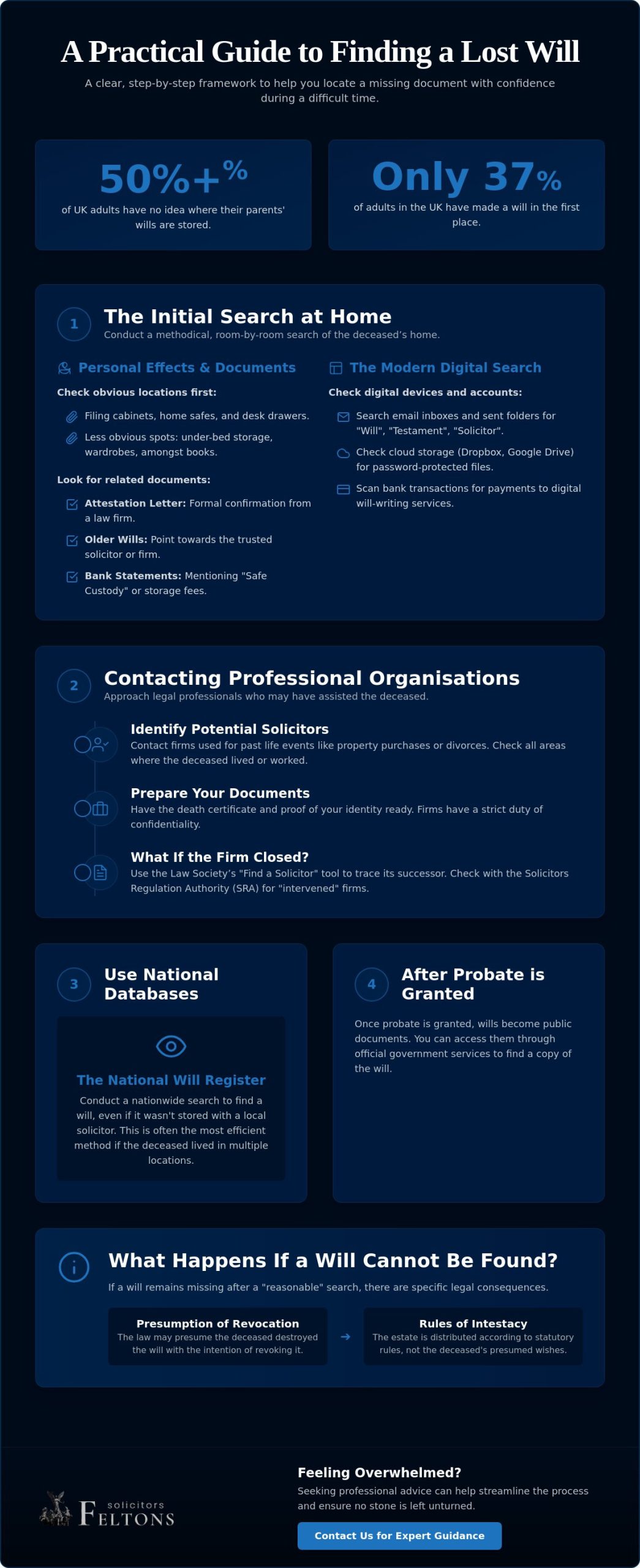
Did you know that over half of UK adults have no idea where their parents’ wills are stored? It’s a startling figure, especially when you consider that only 37% of adults in the UK have actually made a will in the first place. If you’re currently struggling to find a will for a loved one, you’re likely feeling a heavy mix of anxiety and confusion. The fear of distributing assets incorrectly or triggering a family dispute is a significant burden to carry whilst you’re also grieving.

We understand that this process requires a delicate balance of sensitivity and professional rigour. This guide provides a clear, step-by-step framework to help you locate a missing document with confidence. You’ll learn how to conduct a thorough search of personal effects, how to access official national registries, and how to navigate probate records. We’ll also clarify the legal hierarchy of documents so you can distinguish a final will from a mere draft, and identify the exact moment it’s time to conclude your search and proceed under the rules of intestacy.

Key Takeaways

  • Conduct a methodical, room-by-room search of the deceased’s home, prioritising filing cabinets, safes, and less obvious storage areas.
  • Identify and contact solicitors who handled previous life events, such as property purchases or divorces, to locate documents held in professional storage.
  • Use the National Will Register to conduct a nationwide search, which can help you find a will even if it wasn’t stored with a local solicitor.
  • Learn how to access wills as public documents through official government services once probate has been granted.
  • Understand when a search is legally considered “reasonable” and the implications of the legal presumption of revocation if a document remains missing.

The search should commence in the room where the deceased managed their personal affairs. You aren’t simply looking for a formal legal document; you’re looking for the breadcrumbs that lead to it. This initial phase requires a calm, systematic approach. Whilst the urge to find a will quickly is understandable, rushing can lead to overlooking small but vital clues. Clearing one room entirely before moving to the next ensures your search is as thorough as it is methodical.

Check the obvious locations first. Filing cabinets, home safes, and desk drawers are the most common repositories for a Last Will and Testament. However, don’t overlook less conventional “safe” spots. People often tuck important papers into under-bed storage, the back of wardrobes, or even amongst books on a shelf. If the physical document isn’t immediately visible, shift your focus to finding evidence of its location. Look for business cards from solicitors or bank statements that list “Safe Custody” or “Annual Storage” fees. These small details often provide the breakthrough needed to find a will held by a professional firm.

Key documents to look for

Keep an eye out for an “Attestation” letter. This is a formal confirmation from a law firm that they’ve witnessed the signing of a document. Even if the letter is dated several years ago, it identifies the legal professionals who likely hold the original. Similarly, older versions of a will are invaluable. Whilst they are no longer legally binding, they point towards the firm that the deceased trusted with their estate planning. You should also look for bank correspondence mentioning “Safe Custody” services, as many older individuals preferred storing their documents in a bank vault rather than at home.

Digital search tips for the modern estate

In our increasingly paperless world, the search often moves from the desk to the desktop. Start by checking the deceased’s email inbox for keywords like “Will”, “Testament”, or “Solicitor”. Don’t just look at the inbox; the “sent” items folder can reveal correspondence with legal advisors that the recipient might have otherwise deleted. If you encounter password-protected folders on a laptop or cloud storage like Dropbox or Google Drive, look for a written record of passwords in a physical address book or a “master” document. You should also scan bank transactions for subscriptions to digital will-writing services. These platforms often store the final document in a secure cloud portal rather than sending a physical copy.

Contacting solicitors and professional organisations

If your physical search at home proves unsuccessful, your next step is to approach the legal professionals who may have assisted the deceased. It’s common practice for solicitors to retain the original document whilst providing the client with a copy for their records. Start by identifying firms used for significant life events, such as property purchases or divorce proceedings. These files often contain clues or the document itself, making them a logical place to find a will that has been professionally stored.

Don’t limit your enquiries to just one firm. Contact solicitors in every area where the deceased lived or worked throughout their life. If you aren’t sure where to start, you can Search for a will on the National Will Register to see if a professional registration exists. It’s often the most efficient way to find a will when the deceased lived in multiple locations. You should also verify if a dedicated will-writing service was used. These businesses operate differently from traditional law firms but are equally likely to hold the final wishes of their clients.

Before making these calls, ensure you have a copy of the death certificate and proof of your own identity. Solicitors have a strict duty of confidentiality; they won’t release information or confirm they hold a document until they’re certain the person has passed away and you have a legitimate right to the information. If you find yourself overwhelmed by this administrative burden, seeking professional Wills, Probate, and Estate Planning advice can help streamline the communication with third-party firms and ensure no stone is left unturned.

What if the law firm has closed down?

Law firms frequently merge or change names, which can make them difficult to track. If a firm no longer exists, use the Law Society’s “Find a Solicitor” tool to trace its successor. When a firm closes without a successor, the Solicitors Regulation Authority (SRA) often intervenes to protect client files. They maintain a database of “intervened” firms, allowing you to locate documents that might otherwise seem lost to history. Your local Law Society branch can also provide records of firm successions in the area.

Requesting a search from banks and high-street lenders

In decades past, banks were the primary choice for storing “deeds and documents.” Whilst many high-street lenders have phased out these “Safe Custody” services, many older wills remain in their central vaults. You can request a search for a fee, though you must provide a death certificate first. Be aware that as banks modernised, many returned these documents to the owners or transferred them to third-party storage facilities, so a negative result at a bank doesn’t mean the document doesn’t exist.

Using the National Will Register and official databases

When local enquiries and physical searches fail to produce results, the focus must shift to broader, nationwide databases. The National Will Register is the primary resource for this stage of the journey. It’s a central hub that helps executors find a will by connecting them with the legal professionals who hold the original document. You must remember that will registration is not a legal requirement in the UK. A negative result doesn’t confirm that a will doesn’t exist; it simply means it hasn’t been recorded on this specific system.

There are different levels of investigation available through this registry. A “Register-only” search checks the database’s ten million records for a direct match. If that proves fruitless, a “REACH” search expands the enquiry to include law firms and professional will writers in the geographic areas where the deceased lived or worked. This wider net is often the only way to find a will that was drafted by a firm the family was unaware of. The costs for these searches are typically considered a legitimate estate expense, meaning the executors can often reclaim the fee from the deceased’s assets during the probate process.

If the register identifies a match, you won’t receive the document immediately. Instead, the system notifies the firm holding the will, who then contacts you to verify your identity and entitlement. This layer of security ensures that the testator’s privacy is protected even after death. If you need to obtain a copy of a will that has already been through a court process elsewhere, the procedure differs significantly from these private registry searches.

How the National Will Register works

The register operates as a private database rather than a government archive. Many solicitors automatically register the wills they draft to provide their clients with an extra layer of security. This “Certainty” search system is designed to prevent estates from being distributed under the rules of intestacy when a valid will actually exists. It acts as a digital safety net, connecting a solicitor’s private files with the public’s need to locate them whilst maintaining strict confidentiality protocols.

Searching for a will amongst professional will writers

Not all wills are drafted by solicitors. Many individuals choose professional will writers who are members of bodies like the Institute of Professional Willwriters (IPW) or the Society of Will Writers (SWW). These organisations maintain their own internal records and can be contacted directly to see if a member holds a specific document. Be cautious if the deceased used an unregulated provider. If such a firm has ceased trading, their archives can be difficult to trace, often requiring more intensive detective work through local business records or former partners.

How to Find a Will: A Comprehensive Guide to Locating a Deceased Person’s Last Wishes

Finding a will after probate has been granted

Once a Grant of Probate has been issued by the court, a will ceases to be a private document. It enters the public domain, meaning anyone can request a copy for a fee. This is a significant shift in the search process. If your earlier efforts to find a will through solicitors or the National Will Register were unsuccessful, the government’s probate records provide a definitive answer. For any death that occurred after 1858 in England or Wales, the GOV.UK “Find a Will” service is the primary tool for your search.

Timing is a crucial factor when using this database. It’s common for there to be a delay between a person’s passing and their records appearing online. Usually, you must wait at least six months after the death to perform a search. This allows time for the executors to locate the document, apply for probate, and for the registry to process the grant. If you search too early, you’ll likely receive a “No Record Found” result, which can be misleading if the application is simply still in progress.

When you find a will through this service, you are actually ordering two distinct items: the Grant of Probate and the will itself. The grant is the court’s confirmation that the executors have the legal authority to manage the estate. The will is the document that outlines the deceased’s wishes. If you are struggling with the administrative burden of this search or need assistance managing an estate, our team offers professional Wills, Probate, and Estate Planning services to provide the clarity you need during a difficult time.

Ordering copies of a probate record

The online portal is the most efficient way to secure these documents. You’ll need the deceased’s full name and year of death to begin. If probate hasn’t been granted yet, but you expect it will be soon, you can request a “standing search” for a fee of £3. This ensures you’re notified if a grant is issued within the next six months. For records that are found, obtaining an official copy of the grant and the will costs £16 per copy, a fee that reflects the current cost-recovery model implemented in May 2024.

Searching older records (Pre-1996)

Historical searches require a slightly different approach. Whilst many modern records are digitised, older files may require a search of the National Probate Calendar. If the record you need isn’t available through the online portal, you can order copies by post using form PA1S. This postal search also carries a £16 fee. These older archives are maintained by District Probate Registries, which preserve the integrity of the UK’s testamentary history and ensure that even decades-old wishes remain accessible to those with a legitimate interest.

What happens if you cannot find a will?

Sometimes, despite your most diligent efforts, you simply cannot find a will. At this stage, you must determine whether you’ve conducted a “reasonable search” to satisfy the legal requirements of the Probate Registry. This isn’t merely about personal closure. It’s a formal necessity. You must be able to demonstrate that you’ve exhausted all logical avenues, from searching floorboards to querying national databases, before the estate can be declared intestate. If you’ve followed the methodical steps outlined in this guide, you’ve likely met that threshold.

There’s a specific legal concept you should understand: the presumption of revocation. If a document was last known to be in the testator’s possession but cannot be located after their death, the law often presumes they destroyed it with the intention of revoking it. Overcoming this presumption is notoriously difficult. It requires clear, persuasive evidence that the document was lost or destroyed accidentally, such as in a fire or during a house move. Without such proof, the court will likely treat the deceased as having died without a valid testamentary document.

For executors, the risk of a document appearing after the estate has been distributed is a significant concern. This is where “Missing Will Insurance” becomes a vital tool. This indemnity policy protects executors and beneficiaries if a valid will is discovered years later, ensuring that those who distributed the assets in good faith aren’t held personally liable for a misplaced inheritance. It provides a final layer of security when you’ve done everything possible to find a will but come up empty-handed.

Applying the Rules of Intestacy

When no valid document is found, the Rules of Intestacy dictate how the estate is carved up. These rules follow a strict hierarchy, prioritising spouses, civil partners, and children. It’s a rigid system that doesn’t account for modern family dynamics or the specific wishes the deceased might have expressed verbally. Crucially, “common law” partners have no automatic rights under these rules, regardless of how long they lived together. This often leads to distressing situations where a surviving partner is left without financial support or a right to the family home, making professional legal guidance essential before you proceed with an intestate distribution. To avoid placing your own family in this position, a proactive approach to estate planning can ensure your wishes are clearly documented and legally binding. For families with significant assets, understanding what is a family trust and how it can protect wealth across generations is an equally important consideration.

How Feltons Solicitors LLP can assist with the search

We provide a calm, steady hand for families navigating the complexities of a missing will. The team at Feltons Solicitors LLP conducts thorough, professional searches that go beyond basic enquiries, utilising our industry connections to trace documents that might seem lost. Whether you’re dealing with a contested estate or need to satisfy the court that a reasonable search has been completed, we offer the sophisticated expertise required to resolve these matters with minimal friction. To ensure your own family never faces this uncertainty, we invite you to read our Guide to Estate Planning and Wills, which offers practical advice on future-proofing your estate and protecting your loved ones.

Resolving the search with confidence

Locating a loved one’s final wishes is a journey that moves from the private intimacy of the home to the public rigour of the court system. By following a structured approach, from inspecting personal effects to engaging with national registries, you ensure that every reasonable effort has been made to honour the deceased’s intentions. Whether you successfully find a will or ultimately proceed under the rules of intestacy, the clarity gained from a thorough search provides the peace of mind necessary to move forward with the administration of the estate.

When the complexities of missing documents or historical records feel overwhelming, a steady professional hand can make all the difference. Our specialist Probate and Estate Planning team offers the pragmatic, empathetic support required for sensitive family matters, maintaining the high standards of private client care we have provided since 2010. Please contact Feltons Solicitors LLP for expert assistance with Wills and Probate. We are here to act as your trusted guide, ensuring that every legal requirement is met with precision and care.

Frequently Asked Questions

Can I find out if I am named in a will before the person dies?

You cannot legally compel someone to reveal the contents of their will whilst they are still alive. A will is a private document, and the testator has no obligation to share its contents with anyone, including family members or potential beneficiaries. If they choose to keep their wishes confidential, the document only becomes accessible to executors after their passing. Privacy and autonomy are paramount during the testator’s lifetime.

How much does it cost to find a will in the UK?

The cost depends on the search method used. Obtaining an official copy of a will from the probate registry costs £16 per copy, whilst a standard search on the National Will Register typically costs £30. If you need to stay informed about future probate applications, a standing search can be requested for a £3 fee. These costs ensure you can find a will through official channels with legal certainty.

What should I do if I find multiple versions of a will?

You should prioritise the version with the most recent execution date. Most modern wills include a revocation clause that automatically cancels all previous testamentary documents. If the versions are undated or their validity is unclear, you must seek legal advice immediately to avoid distributing assets incorrectly. The court will ultimately determine which document represents the final, intended wishes of the deceased.

Are wills public records in the UK?

Wills only become public records in England and Wales once a Grant of Probate has been issued. Before this point, the document remains private and is usually held by the executors or a solicitor. Once probate is granted, the will is filed with the court and anyone can order a copy for a small administrative fee through the government’s online portal. This ensures transparency in the estate distribution process.

How long does a solicitor keep a will for?

Solicitors typically store original wills indefinitely or until they are notified of the testator’s death and the document is required for probate. Many firms maintain these records for several decades to ensure they are available when needed. If a firm closes or merges, the documents are transferred to a successor firm or the Solicitors Regulation Authority to maintain the chain of custody and protect the testator’s wishes.

Can I see a will if I am not an executor?

You don’t have an automatic right to see a will before probate is granted unless you are a named executor. The executors hold the legal authority and may choose to share the contents with beneficiaries, but they aren’t legally required to do so at the early stages. However, once the document enters the public domain following the grant of probate, anyone can pay the required fee to view it.

What happens if a will is found after the estate has been distributed?

If a valid will is discovered after distribution, the entire probate process may need to be revisited. Beneficiaries who received assets under an earlier document or the rules of intestacy might be required to return them to the estate. This is a complex legal situation, which is why many executors take out “Missing Will Insurance” to protect themselves against such unforeseen discoveries and potential personal liability.

Is a copy of a will legally valid if the original is lost?

A copy is not automatically valid, as the law often presumes a missing original was intentionally destroyed by the testator. To use a copy to find a will’s legal weight, you must apply to the Probate Registry and provide evidence that the original was lost accidentally. This process requires proving the document was correctly executed and that the testator didn’t intend to revoke their wishes before they passed away.