

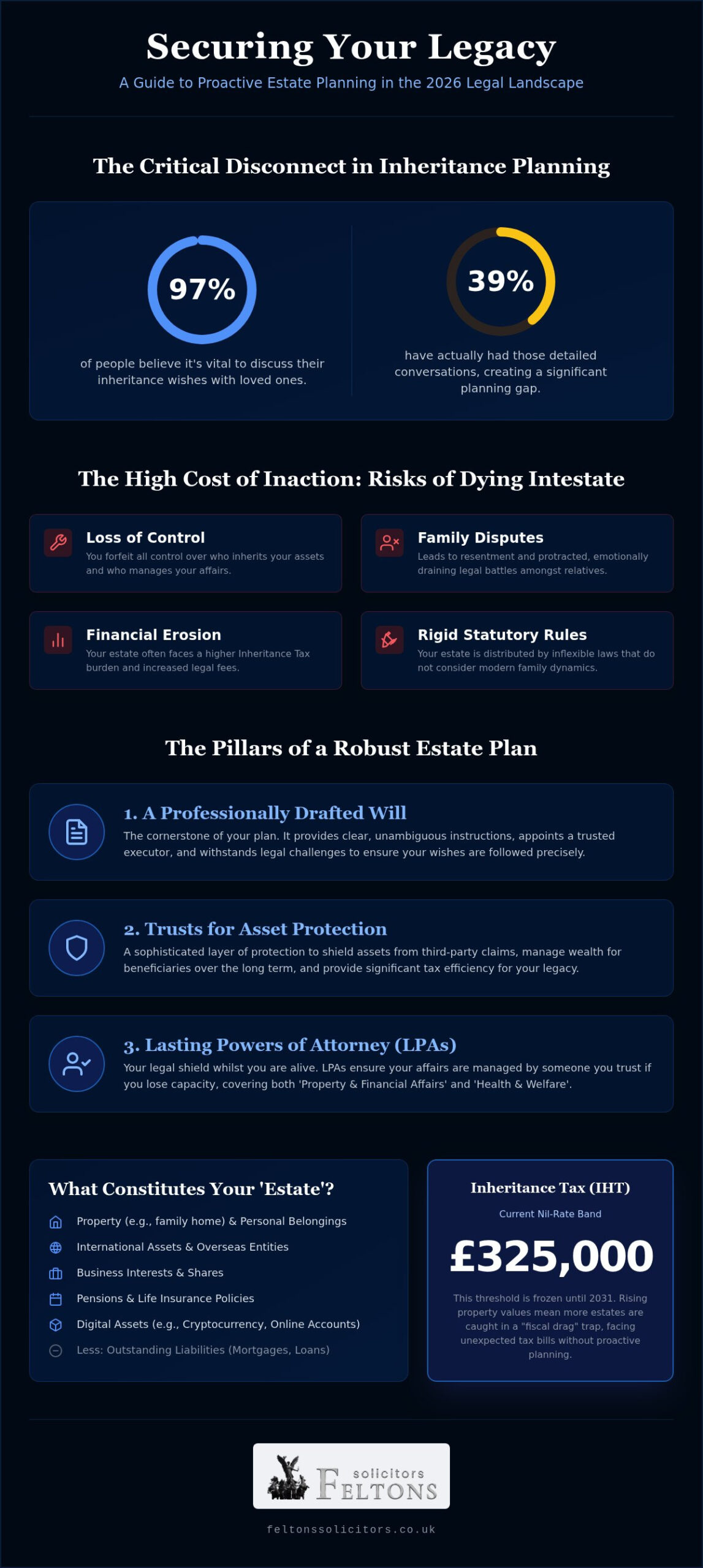
Whilst 97% of people believe it’s vital to discuss inheritance with their loved ones, only 39% have actually had those detailed conversations. It’s a striking disconnect that often stems from a deep-seated anxiety about the future. Effective estate planning is more than just a financial task; it’s a pragmatic legal shield designed to protect your family from the twin threats of Inheritance Tax and avoidable disputes. You likely want the peace of mind that comes with knowing your hard-earned assets will reach the right hands without being unnecessarily eroded by the state.
This guide will show you exactly how to secure that certainty by addressing the complexities of the 2026 legal landscape. We’ll explore how to minimise your tax liabilities, ensure your will is legally robust, and provide a clear roadmap for your executors. From understanding the current £325,000 nil-rate band to the nuances of property protection, you’ll gain the expert insight needed to secure your legacy with confidence and poise. By the end of this article, you’ll have a clear understanding of the steps required to protect your beneficiaries and ensure your final wishes are followed to the letter.
Key Takeaways
- Establish a robust legal foundation by combining a professionally drafted will with Lasting Powers of Attorney for comprehensive protection.
- Navigate the complexities of the 2026 Inheritance Tax landscape to effectively use the residence nil-rate band and shield your family home.
- Master the intricacies of estate planning to ensure your wishes are followed precisely whilst minimising the tax burden on your beneficiaries.
- Secure international assets and business interests by understanding the latest requirements for the registration of overseas entities.
- Discover how a tailored, boutique approach provides the clarity and discretion necessary to manage high-value or complex multi-jurisdictional estates.
What is Estate Planning and Why is it Essential in 2026?
Estate planning is the methodical legal process of arranging the management and disposal of your assets during your life and after death. It’s far more than a simple document; it’s a strategic framework designed to protect your family’s future. For a comprehensive overview of estate planning, one must look beyond the distribution of money and consider the long-term preservation of legacy. In 2026, this has become critical. With Inheritance Tax thresholds frozen until 2031 whilst property values continue to rise, many families are finding themselves caught in a “fiscal drag” trap. Without proactive steps, a larger portion of your wealth may end up with the Treasury rather than your children.
A simple will is often the starting point, but it rarely suffices for complex modern lives. A comprehensive estate plan integrates trusts to protect assets from third-party claims and Lasting Powers of Attorney to ensure your affairs are managed if you lose capacity. It provides a level of legal certainty that a DIY will simply cannot match. The primary goal is clarity. You’re creating a roadmap that prevents confusion and ensures your executors can act with authority and confidence.
The Legal Definition of Your ‘Estate’
Your estate encompasses everything you own at the time of your passing. This includes tangible property like your home and personal belongings, but also increasingly complex digital assets, such as cryptocurrency or online business accounts. Pensions and life insurance policies also form a significant part of the total value. It’s vital to account for liabilities, including mortgages, outstanding loans, and funeral expenses, as these are deducted to determine the net value of your legacy. We also consider “beneficial ownership,” which distinguishes between the person who holds the legal title and the person entitled to the benefits of the asset. This distinction is crucial for tax efficiency and asset protection.
Risks of Dying Intestate
Dying without a valid will, or “intestate,” leaves your estate at the mercy of rigid statutory rules. These laws don’t account for modern family dynamics or your personal preferences. You lose all control over who inherits your favourite possessions or who manages your affairs. Amongst family members, this often leads to resentment and protracted legal disputes that can take years to resolve. Beyond the emotional toll, the financial impact is significant. Intestacy frequently results in a higher tax burden and increased legal fees for your survivors, effectively shrinking the inheritance you intended for them to receive.
The Pillars of a Robust Estate Plan: Wills, Trusts, and LPAs
A robust estate plan relies on three fundamental components: the will, trusts, and Lasting Powers of Attorney (LPAs). These aren’t isolated documents. They function as an integrated safety net to ensure your legacy remains intact regardless of what the future holds. Understanding the legal framework of estate planning is the first step toward effective asset preservation. Whilst a will dictates where assets go after death, an LPA protects you whilst you’re still alive. In 2026, registering an LPA with the Office of the Public Guardian costs £92 per document. This covers both “Property & Financial Affairs” and “Health & Welfare,” providing a comprehensive shield for your autonomy and financial security.
These pillars work in tandem to prevent the erosion of your estate. Without this coordinated approach, your assets could be vulnerable to mismanagement, excessive taxation, or legal challenges. By aligning these legal tools, you create a seamless transition of wealth that respects your wishes and provides for your beneficiaries with minimal friction.
Drafting a Will That Withstands Challenge
Generic or DIY wills are frequently vulnerable to “contentious probate” disputes, where family members challenge the validity of the document. To prevent this, professional drafting is essential. Clear, unambiguous language removes the room for interpretation that often fuels legal battles amongst survivors. Choosing the right executor is equally vital. This person must be someone you trust to handle complex administrative tasks with impartiality and diligence. For a deeper look at these requirements, see our A Complete Guide to Estate Planning.
Using Trusts for Long-Term Protection
Trusts offer a sophisticated layer of protection against mismanagement or external claims. A discretionary trust, for instance, allows trustees to decide how and when beneficiaries receive assets. This is particularly useful for protecting vulnerable relatives or children who aren’t yet ready for financial responsibility. Alternatively, a life interest trust can ensure a spouse has the right to live in a property whilst the ultimate ownership is preserved for children. We take a boutique approach to these structures, ensuring every trust is tailored to your specific family dynamics. If you’re managing complex assets, seeking bespoke estate planning advice ensures your strategy is both legally sound and tax-efficient.
Navigating Inheritance Tax and Asset Protection Strategies
Navigating the complexities of Inheritance Tax (IHT) requires a blend of technical precision and personal foresight. For many, an authoritative definition of estate planning involves the strategic use of thresholds to protect wealth from the standard 40% tax rate. In the 2026/27 tax year, the nil-rate band is held at £325,000 per individual. When you include the £175,000 residence nil-rate band, a married couple can potentially pass on up to £1 million tax-free. However, these figures are frozen until 2031, making proactive management essential as property values rise.
Gifting remains a cornerstone of asset protection. You’re permitted an annual gift allowance of £3,000, along with small gifts of £250 to any number of individuals. For larger sums, the ‘seven-year rule’ applies. These transfers only exit your estate for tax purposes if you survive for seven years after the gift is made. This is particularly relevant for blended families or individuals with existing financial obligations from a previous marriage. Failing to account for these can lead to claims against the estate that erode the intended inheritance. If your situation involves prior settlements, our Guide to Divorce and Financial Arrangements provides the necessary legal context.
IHT Exemptions and Reliefs
Specific exemptions can significantly reduce the taxable value of your legacy. Most transfers between spouses or civil partners are exempt, provided they are UK-domiciled. Additionally, leaving at least 10% of your net estate to charity can reduce your overall IHT rate from 40% to 36%. For those with commercial interests, the following reliefs are vital:
- Business Relief (BR): This can provide up to 100% relief on the transfer of a business or its assets, ensuring the enterprise can continue without a heavy tax burden.
- Agricultural Relief (AR): This protects working farms by providing relief on the agricultural value of the land and associated buildings.
Protecting the Family Home
The legal structure of your property ownership is a critical element of estate planning. Deciding whether to hold your home as ‘joint tenants’ or ‘tenants in common’ determines if your share passes automatically to a survivor or according to your will. This choice is particularly important for those wanting to ring-fence assets for children from a first marriage or protect a share of the home from future care costs. Structuring this correctly requires a deep understanding of property law. For more detailed guidance on managing your home’s legal status, explore our article on Navigating Residential Property Law.
Managing Complex Estates: International Assets and Business Interests
Managing high-value estates often involves assets that cross national borders. When you own property abroad or hold international investments, your estate planning strategy must account for the conflicting legal systems of multiple jurisdictions. Some countries operate under “forced heirship” rules, which can override the intentions set out in a standard UK will. To prevent these conflicts, we often recommend cross-border wills that are specifically drafted to be enforceable in each relevant territory. This ensures your international legacy is protected from local legal challenges that could otherwise delay probate for years.
The integration of commercial interests requires a similar level of precision. Leaseholds, for example, are not just property; they are contracts with specific expiry dates and conditions. These must be reviewed to ensure they remain valuable assets for your beneficiaries rather than becoming legal liabilities. Integrating these into a wider strategy ensures that your commercial and personal legacies don’t conflict, providing a seamless transition for your heirs.
The Register of Overseas Entities and UK Property
If you hold UK land through a foreign company, you face a strict legal obligation under the Economic Crime (Transparency and Enforcement) Act. The Overseas Entity Beneficial Owner Registration is now a mandatory requirement for any overseas entity buying, selling, or transferring UK property. Non-compliance is a serious matter. It can lead to significant daily fines and, more critically, restrictions on your ability to deal with the property. You may find yourself unable to sell, charge, or lease the land until the registration is fully up to date and verified by a regulated professional.
Succession Planning for Business Owners
For business owners, personal legacy and commercial continuity are inextricably linked. A smooth transition of ownership requires more than just a will; it necessitates a review of shareholder agreements and articles of association. These documents often contain pre-emption rights that dictate what happens to shares when a director passes away. Without aligning these with your personal wishes, your family could be forced to sell their stake at an undervalued rate or lose control of the enterprise entirely. We provide the pragmatic advice needed to navigate this intersection of commercial and personal law. If your estate includes complex corporate structures, seeking professional guidance on the registration of overseas entities and business succession is the most secure way to protect your interests.
The Feltons Approach: Bespoke Legal Guidance for Your Legacy
Choosing a boutique firm ensures your legacy is handled with a level of care that high-volume providers simply cannot replicate. We believe that estate planning is not a transactional process; it’s a long-term commitment to your family’s security. By combining modern efficiency with traditional professional integrity, we provide a steady presence in complex situations. Our approach is characterised by quiet confidence and an unwavering focus on personal connection. We prioritise your specific needs, ensuring that every legal instrument we draft reflects your unique values and circumstances.
Our consultations are designed to be discreet and thorough, mirroring the high standards of a private professional partnership. We don’t just process documents. We act as your sophisticated guide, helping you navigate the nuances of asset protection and tax mitigation whilst ensuring the human impact of your decisions is never forgotten. This methodical flow ensures you feel supported and in capable hands from the very first meeting.
Why a Specialist Solicitor Matters
In an era of automated templates and DIY kits, the value of a specialist solicitor has never been higher. These generic services often fail to account for the legal subtleties of property law or the risks of contentious probate. At Feltons, we translate complex legalese into a “plain English” strategy that you can actually understand. Our expertise extends beyond drafting; we possess the depth of experience required to handle complex litigation and dispute resolution should your estate ever be challenged. This “people-first” philosophy ensures that whilst the technical work is paramount, the emotional reality of your situation is always respected.
Next Steps: Organising Your Consultation
Preparing for your initial advisory meeting is the first step toward legal certainty. To ensure our consultation is as productive as possible, it’s helpful to gather a clear summary of your affairs. We recommend organising the following information before we meet:
- A comprehensive list of assets, including property deeds and digital investments.
- Details of any existing trusts or previous divorce financial arrangements.
- A list of potential executors and guardians for minor children.
- Information regarding any international assets or overseas entities.
During our initial meeting, we’ll review your objectives and provide a clear, methodical roadmap for your future. We invite you to contact Feltons Solicitors LLP to begin your estate planning today and secure the peace of mind your family deserves.
Protecting Your Legacy for the Years Ahead
Securing your assets in 2026 requires more than just a simple document; it demands a coordinated legal strategy that addresses the realities of frozen tax thresholds and complex family dynamics. By aligning professionally drafted wills with robust trusts and Lasting Powers of Attorney, you create a definitive roadmap for your executors whilst shielding your beneficiaries from unnecessary Inheritance Tax. Whether you’re managing domestic property or complex international holdings, the right estate planning provides the certainty that your final wishes will be followed precisely.
At Feltons Solicitors LLP, we offer a sophisticated blend of professional authority and empathetic care. We specialise in navigating the intricacies of international property and the registration of overseas entities, providing pragmatic legal advice tailored to your individual circumstances. Our boutique approach ensures your legacy is handled with the discretion and high-standard service it deserves. Secure your family’s future with bespoke estate planning from Feltons Solicitors LLP. Taking this step today ensures that your hard-earned assets remain a source of security for the generations to come.
Frequently Asked Questions
What is the difference between a will and estate planning?
A will is a single legal document that dictates asset distribution after death, whereas estate planning is a comprehensive strategy for managing your affairs during your life and beyond. It encompasses wills, trusts, and Lasting Powers of Attorney to provide a total safety net. Whilst a will is a vital component, effective estate planning ensures your assets are protected from tax erosion and that your health and financial decisions are managed if you lose capacity.
How much is the Inheritance Tax threshold in the UK for 2026?
For the 2026/27 tax year, the standard Inheritance Tax nil-rate band is £325,000 per individual. This threshold is currently frozen until April 2031. Additionally, the residence nil-rate band provides a further £175,000 when passing a main residence to direct descendants. This allows individuals to potentially pass on up to £500,000 tax-free, or up to £1 million for married couples and civil partners who combine their allowances and transfer unused bands.
Can I draft my own estate plan without a solicitor?
Whilst you can technically draft your own documents, DIY estate planning carries significant legal risks. Inaccurate language can lead to “contentious probate” disputes amongst survivors or result in a will being declared invalid. A specialist solicitor provides the professional authority needed to navigate complex tax laws and ensure your documents are legally robust. Choosing a boutique firm ensures your plan is tailored to your specific circumstances rather than relying on generic, automated templates.
What happens to my digital assets, such as social media and cryptocurrency?
Digital assets must be specifically accounted for to ensure they aren’t lost or inaccessible to your executors. This includes social media accounts, which often require a designated “legacy contact,” and high-value assets like cryptocurrency. For crypto, you must provide clear instructions on how to access private keys or hardware wallets without compromising security whilst you’re alive. Including these in your estate planning strategy prevents significant administrative hurdles and ensures your digital legacy is managed correctly.
How often should I review and update my estate plan?
You should ideally review your estate plan every three to five years to ensure it remains aligned with current legislation. However, major life events should trigger an immediate update. These include marriage, which automatically revokes an existing will, divorce, the birth of children, or a significant change in your financial position. Regular reviews ensure your strategy accounts for property value increases and changes in tax thresholds, such as the nil-rate bands frozen until 2031.
Is a Lasting Power of Attorney really necessary if I have a will?
A Lasting Power of Attorney (LPA) is essential because a will only takes effect after you pass away. If you lose mental capacity due to illness or injury whilst you’re still alive, your will cannot help manage your affairs. An LPA allows you to appoint trusted individuals to make decisions regarding your health, welfare, and finances. Without one, your family may have to undergo a costly and lengthy court process to gain the authority to help you.
How can I protect my children’s inheritance if I remarry?
Remarriage can unintentionally disinherit children from a previous relationship because it typically cancels any existing will. To protect their inheritance, you can use a life interest trust. This allows a new spouse to live in the family home or receive income from assets whilst ensuring the underlying capital eventually passes to your children. This pragmatic approach balances the needs of your current partner with the long-term security of your descendants from a previous marriage.
What are the legal risks of not registering an overseas entity holding UK property?
Failing to comply with the Register of Overseas Entities creates severe legal and financial barriers. Under the Economic Crime Act, beneficial owners of overseas entities holding UK land must register with Companies House. Non-compliance can result in significant daily fines and prevents you from selling, leasing, or charging the property. These restrictions essentially freeze the asset, making it impossible to manage or transfer as part of your wider estate planning strategy.