

Silicosis Compensation Claims UK: A Specialist Guide to Legal Redress in 2026

Silicosis Compensation Claims UK: A Specialist Guide to Legal Redress in 2026

Could a diagnosis that feels like an ending actually be the starting point for securing your family’s future? For many workers, the discovery of an occupational lung disease brings immediate concerns about physical health and long-term financial stability. Understanding the landscape of silicosis compensation claims uk is essential for anyone facing this reality in 2026, as the legal framework provides a clear pathway to both accountability and essential care.

It’s understandable to feel overwhelmed by the complexities of litigation, especially when you are managing symptoms whilst trying to decipher the strict three-year “date of knowledge” rule. We believe that you deserve a discreet, professional partner to handle the legal burden so you can focus on your wellbeing. This guide offers expert clarity on the 18th Edition Judicial College Guidelines, updated Industrial Injuries Disablement Benefit rates, and the precise steps required to hold negligent parties responsible. You will learn how to navigate the claims process with confidence; ensuring your family’s financial security is protected through tailored legal redress and specialist support.

Key Takeaways

  • Identify how employer breaches of the Health and Safety at Work Act 1974 and COSHH regulations form the legal foundation of a successful claim.
  • Understand the complexities of silicosis compensation claims uk by identifying the strict three-year limitation period and the “date of knowledge” rule.
  • Explore how the 18th Edition Judicial College Guidelines are used to assess general damages for pain, suffering, and loss of amenity in 2026.
  • Learn the vital difference between general and special damages to ensure every aspect of your future care and financial loss is recovered.
  • Discover the benefits of a bespoke, partner-led legal service that prioritises personal rapport and expert guidance throughout the litigation process.

Silicosis is a debilitating condition characterised by irreversible lung scarring. It occurs when respirable crystalline silica (RCS) is inhaled, leading to inflammation and permanent tissue damage. Crucially, the UK legal system views this as an avoidable occupational illness. If you’ve been diagnosed, understanding What is Silicosis? from a legal perspective is the first step toward justice. Every worker has a fundamental right to a safe environment where dust exposure is strictly controlled. When employers fail to provide adequate ventilation or protective equipment, they may be liable for silicosis compensation claims uk.

Legal redress often depends on the clinical presentation of the disease. Chronic silicosis typically develops after decades of low-level exposure, whilst accelerated silicosis appears within five to ten years of more intense work. Acute silicosis is the most severe, often manifesting within months of extreme exposure. Courts recognise that each form requires a different approach to evidence, but all stem from the same failure to manage workplace hazards. The UK legal system treats silica dust as a significant health hazard, and the Health and Safety Executive (HSE) maintains strict workplace exposure limits to protect workers from these life-altering outcomes.

The Emerging Crisis: Engineered Stone and Modern Exposure

The rise of artificial stone kitchen worktops has created a modern “front line” for silicosis cases. These products can contain up to 95% silica, far exceeding the levels found in natural granite or marble. In August 2024, the first UK cases linked to this industry were identified in young men, highlighting a systemic failure in dust suppression during the cutting and polishing phases. If you work in fabrication or fitting, you may have been exposed to lethal dust levels without proper warning. The legal implications for this sector are profound, as many manufacturers have failed to adapt their safety protocols to the high silica content of modern materials.

Traditional Industries at Risk amongst UK Workers

Whilst engineered stone dominates recent headlines, traditional sectors continue to see high rates of illness. Construction, demolition, and stone masonry remain high-risk environments. Workers in pottery, ceramics, and sandblasting are also frequently exposed. Even historical exposure in mining and quarrying leads to silicosis compensation claims uk in 2026. The long latency period of chronic silicosis means symptoms often appear years after a worker has left the industry. This makes early legal advice essential to ensure that evidence from past workplaces is preserved and historical negligence is correctly identified.

Establishing Employer Negligence and the Duty of Care

Proving negligence is the cornerstone of any successful legal redress. Under the Health and Safety at Work etc. Act 1974, your employer carries a statutory duty to ensure your health and safety “so far as is reasonably practicable.” This is not a mere suggestion; it’s a legal mandate. For those pursuing silicosis compensation claims uk, this duty means providing a workplace where the risk of inhaling crystalline silica is managed with forensic precision. When a company fails to maintain these standards, they’re not just being negligent; they’re breaking the law.

The Control of Substances Hazardous to Health (COSHH) Regulations 2002 provide the specific technical framework for this duty. Employers must prevent exposure or, where that’s impossible, adequately control it. This usually requires the installation of “local exhaust ventilation” (LEV) to capture dust at the source. If an employer relies solely on basic masks without addressing the environment itself, they’ve likely breached their duty. The current Workplace Exposure Limit (WEL) for respirable crystalline silica is 0.1 mg/m³ over an eight-hour period. Exceeding this limit is a clear indicator of systemic failure and provides strong grounds for a claim.

Breach of Duty: What Constitutes Negligence?

Negligence often manifests through a lack of proper equipment or oversight. In many silicosis compensation claims uk, we see a recurring pattern of failure in three specific areas:

  • Respiratory Protective Equipment (RPE): Failing to provide high-specification masks that are face-fit tested for the individual worker.
  • Inadequate Training: Not educating staff on the “invisible” dangers of silica dust or the correct way to use suppression systems.
  • Health Surveillance: Ignoring the legal requirement under COSHH to provide regular lung function tests for at-risk employees.

The Role of the HSE and Regulatory Standards

HSE guidance documents, particularly the L5 Approved Code of Practice, are frequently used as benchmarks in court to establish what a “reasonable” employer should have done. In January 2025, the HSE published updated guidance specifically for those working with stone, clarifying the rigorous steps required to control exposure in modern fabrication shops. Proving that an employer “knew or ought to have known” about these risks is simpler in 2026, as the medical evidence and NHS guidance on silicosis have made the dangers common knowledge in industrial sectors. If you’re concerned about how these regulations apply to your specific work history, consulting a specialist in industrial disease litigation can provide the clarity you need to proceed.

Assessing Claim Value: General vs Special Damages

Determining the financial value of a claim is a methodical process that balances your immediate suffering with your future requirements. In the UK legal system, compensation is divided into two distinct categories: General and Special Damages. General Damages are awarded for pain, suffering, and loss of amenity (PSLA). This figure compensates you for the physical and psychological impact of the disease itself. According to the 18th Edition of the Judicial College Guidelines published in April 2026, a younger person experiencing severe disability and a heightened chance of premature death may receive between £123,000 and £166,000. For significant decline in lung function and impaired breathing, the brackets typically range from £67,000 to £86,000.

These figures reflect the clinical reality of the condition. The irreversible nature of lung scarring, as detailed in NHS information on silicosis, means that courts must account for a permanent reduction in quality of life. Whilst General Damages address the injury, they’re often only one part of silicosis compensation claims uk. To truly secure your family’s future, we must look closely at the financial losses that stem directly from your diagnosis.

Quantifying Special Damages and Future Losses

Special Damages aim to reimburse you for every penny lost due to your illness. This calculation is often complex and requires expert forensic accounting. We prioritise the recovery of lost earnings, including future wages and the impact on your pension contributions. Beyond income, we secure funding for essential medical interventions that go beyond standard care. This includes private pulmonary rehabilitation, oxygen therapy, and the cost of professional caregivers. As the disease progresses, we also account for necessary home adaptations, such as the installation of stairlifts or specialised bathroom equipment, ensuring you can maintain your independence and dignity at home.

Claims on Behalf of Families and Dependants

When a diagnosis results in a fatal outcome, the legal focus shifts to protecting the dependants left behind. The law allows for the recovery of a Statutory Bereavement Award and the reimbursement of funeral expenses. More importantly, we can claim for the “loss of dependency,” which covers the financial support the deceased would have provided to their spouse or children. Securing this accountability provides a vital safety net for families during an exceptionally difficult time. If you are handling the affairs of a loved one, our specialised guide on silicosis claim after death provides a compassionate and detailed overview of the legal steps available to you.

The Claims Process: A Step-by-Step Path to Justice

Timing is often the most critical factor in successful silicosis compensation claims uk. The law dictates a strict three-year limitation period for starting a claim. This clock begins ticking on the “date of knowledge,” which is typically the day you received a formal diagnosis or the moment you reasonably suspected your respiratory issues were work-related. Because the symptoms of chronic silicosis can take decades to manifest, this rule ensures that the path to justice remains open long after the initial exposure occurred. However, waiting until the final months of this period can make evidence gathering more difficult, so early intervention is always advisable.

A robust case relies on the testimony of independent medical experts. We work closely with leading pulmonologists who specialise in occupational lung diseases to provide a definitive link between your workplace conditions and your clinical health. These experts use advanced CT imaging and specialist lung function tests to quantify the extent of your impairment. This medical evidence serves as the foundation for your claim, ensuring that your compensation reflects the true severity of your condition rather than a generic estimate.

Many claimants worry about what happens if their former employer has ceased trading or cannot be traced. This is a common scenario in industrial disease litigation. If the original company is gone, we can often trace their historical insurers who remain liable for the claim. In cases where no insurer can be found, you may still be eligible for a lump-sum payment under the Pneumoconiosis etc. (Workers’ Compensation) Act 1979. As of April 2026, these government-backed payments have been increased to ensure workers aren’t left without support simply because a business has closed its doors.

Gathering Evidence to Support Your Claim

Success in court requires a meticulous reconstruction of your working life. We begin by obtaining your full employment history from HMRC to identify every period of potential exposure. Witness statements from former colleagues are equally vital; they provide first-hand accounts of the dust levels, the lack of ventilation, or the absence of protective equipment. Combined with your medical records and CT imaging, this creates a comprehensive evidence trail that is difficult for defendants to dispute.

Navigating the Pre-Action Protocol

The formal legal journey begins with a Letter of Claim sent to the defendant or their insurer. They have a set period to investigate and provide a response regarding liability. Our personal injury solicitors manage this entire dialogue, aiming for a fair settlement through negotiation whilst remaining fully prepared to issue court proceedings if a defendant is uncooperative. We prioritise a smooth, discreet process that protects your privacy whilst pursuing the maximum redress. If you’re ready to begin this process, you can contact our specialist team for a confidential consultation to discuss your options.

Why Choose Feltons Solicitors for Silicosis Litigation?

Selecting the right legal representation is the most consequential decision you’ll make following a diagnosis. At Feltons Solicitors, we understand that you aren’t just looking for a lawyer; you’re seeking a discreet partner to guide you through a period of profound uncertainty. We specialise in silicosis compensation claims uk by combining high-level professional authority with a genuine, empathetic reassurance. Our firm intentionally avoids the high-volume approach of larger practices, opting instead for a boutique service where your case receives the individualised attention it requires. We prioritise your peace of mind, ensuring that the legal process remains a supportive experience rather than an additional burden on your health.

Our expertise in complex litigation allows us to maintain a national reach whilst preserving the personal rapport of a trusted advisor. We believe in pragmatic, expert advice delivered in plain English. You won’t find dense, archaic legalese here; we prefer transparent communication that keeps you informed and empowered. Our people-first philosophy means that whilst the technical legal work is paramount, we never lose sight of the human impact of your condition. We’re committed to securing the financial security you need for long-term care and family stability, managing every detail with the quiet confidence that comes from years of specialist experience.

A Discreet and Supportive Legal Partnership

We position ourselves as a calm, steady presence in the face of stressful situations. Our partner-led approach ensures that your claim is managed by a senior expert from start to finish, providing a level of reliability that high-volume firms simply cannot match. We focus on minimising the burden on you by handling all negotiations and evidence gathering with methodical precision. This allows you to focus on your wellbeing whilst we work discreetly to secure the maximum redress for your suffering and future needs.

Securing Your Future with Feltons

Our firm provides access to a hand-picked network of the UK’s leading medical experts and pulmonary rehabilitation specialists. This ensures your clinical evidence is beyond reproach. Beyond industrial disease, our team possesses the worldly experience necessary to handle complex matters involving significant assets. You can explore our expertise in divorce and financial arrangements to see how our broader commitment to asset protection and bespoke legal care benefits all our clients. Whether you’re seeking accountability from a negligent employer or looking to protect your family’s financial future, we’re here to provide a sophisticated, high-standard service tailored to your unique circumstances.

Securing Your Future and Restoring Your Peace of Mind

Navigating a diagnosis of occupational lung disease is an immense challenge, but you don’t have to face it alone. We’ve explored how identifying employer negligence through COSHH breaches and understanding the 2026 Judicial College Guidelines are essential steps toward justice. Success in silicosis compensation claims uk hinges on early action and the meticulous gathering of medical evidence from specialist pulmonologists. By respecting the strict three-year limitation period and focusing on both general and special damages, you can ensure your family’s financial security is preserved whilst you focus on your health.

Feltons Solicitors provides the calm, steady guidance needed to manage these complex litigation matters. Our boutique, partner-led service ensures you receive individualised attention whilst benefiting from our national reach across the United Kingdom. We’re committed to transparent, plain English communication and a people-first philosophy that prioritises your wellbeing at every stage. We invite you to Arrange a discreet consultation with our specialist silicosis solicitors today. Taking this first step is the most effective way to hold negligent parties accountable and secure the specialist care you deserve. Your future stability is our primary concern.

Frequently Asked Questions

What is the time limit for making a silicosis compensation claim in the UK?

You must generally start your claim within three years of the date you first became aware you had the condition. This is known as the “date of knowledge,” which is often the day you received a formal clinical diagnosis from a specialist. Because the symptoms of chronic silicosis can take decades to appear, the court focuses on when you reasonably should have known about the illness rather than when the original dust exposure occurred.

Can I still claim if the company I worked for no longer exists?

Yes, you can still pursue legal redress even if your former employer has ceased trading or been dissolved. We specialise in tracing historical liability insurers who remain responsible for industrial disease claims many years after a business closes. If an insurer cannot be located, you may still be eligible for a lump-sum payment from the government under the Pneumoconiosis etc. (Workers’ Compensation) Act 1979, which provides a vital safety net for workers.

How much compensation am I likely to receive for a silicosis diagnosis?

The value of silicosis compensation claims uk depends on the severity of your symptoms and the financial impact on your future. Under the 18th Edition Judicial College Guidelines (2026), general damages for pain and suffering can range from £39,000 for moderate breathing difficulties to over £166,000 for severe disability. Special damages for lost earnings, private medical care, and home adaptations are calculated separately and often form a significant portion of the final settlement.

Do I need to go to court to secure silicosis compensation?

Most silicosis cases are settled through detailed negotiation without the need for a full court hearing. Our approach is to build such a robust evidence base that the defendant’s insurers recognise the necessity of a fair settlement. Whilst we prepare every case with the diligence required for a trial, a formal court appearance is rare. We prioritise a discreet process that achieves the maximum redress whilst minimising the stress on you and your family.

Can I make a claim on behalf of a family member who has passed away?

You can make a claim for a loved one who has died as a result of occupational silica exposure. The three-year limitation period usually begins from the date of death or the date a post-mortem confirms the condition. These claims are designed to provide financial security for dependants, covering the loss of the deceased’s income and pension, alongside a Statutory Bereavement Award and the recovery of funeral expenses.

What evidence do I need to prove my employer was negligent?

Proving negligence requires a combination of medical records and occupational history. We obtain your HMRC employment records to verify your work history and secure witness statements from former colleagues to describe the working conditions. Specialist medical reports from independent pulmonologists are also essential to link your lung damage to the specific dust levels at your workplace. This evidence proves that the employer failed to implement necessary controls like local exhaust ventilation.

Will making a claim affect my current employment or benefits?

It’s illegal for an employer to dismiss you or treat you unfavourably because you’ve started a compensation claim. Pursuing silicosis compensation claims uk is a protected legal right. Furthermore, a civil claim is distinct from state benefits like the Industrial Injuries Disablement Benefit (IIDB). Whilst some state benefits may be recovered by the DWP from the final settlement to avoid “double recovery,” the primary goal of your claim is to secure the long-term financial support the state cannot provide.

How long does a typical silicosis compensation case take to resolve?

A typical claim usually takes between 12 and 24 months to reach a conclusion, depending on how quickly the defendant admits liability. Cases involving companies that have ceased trading can take slightly longer as we must trace the historical insurance providers. We work at a steady, deliberate pace to ensure that every aspect of your future care needs is quantified, ensuring you don’t settle for less than you’re entitled to.

Extending a Lease on a Flat London: A Complete Guide to Protecting Your Property Value in 2026

Extending a Lease on a Flat London: A Complete Guide to Protecting Your Property Value in 2026

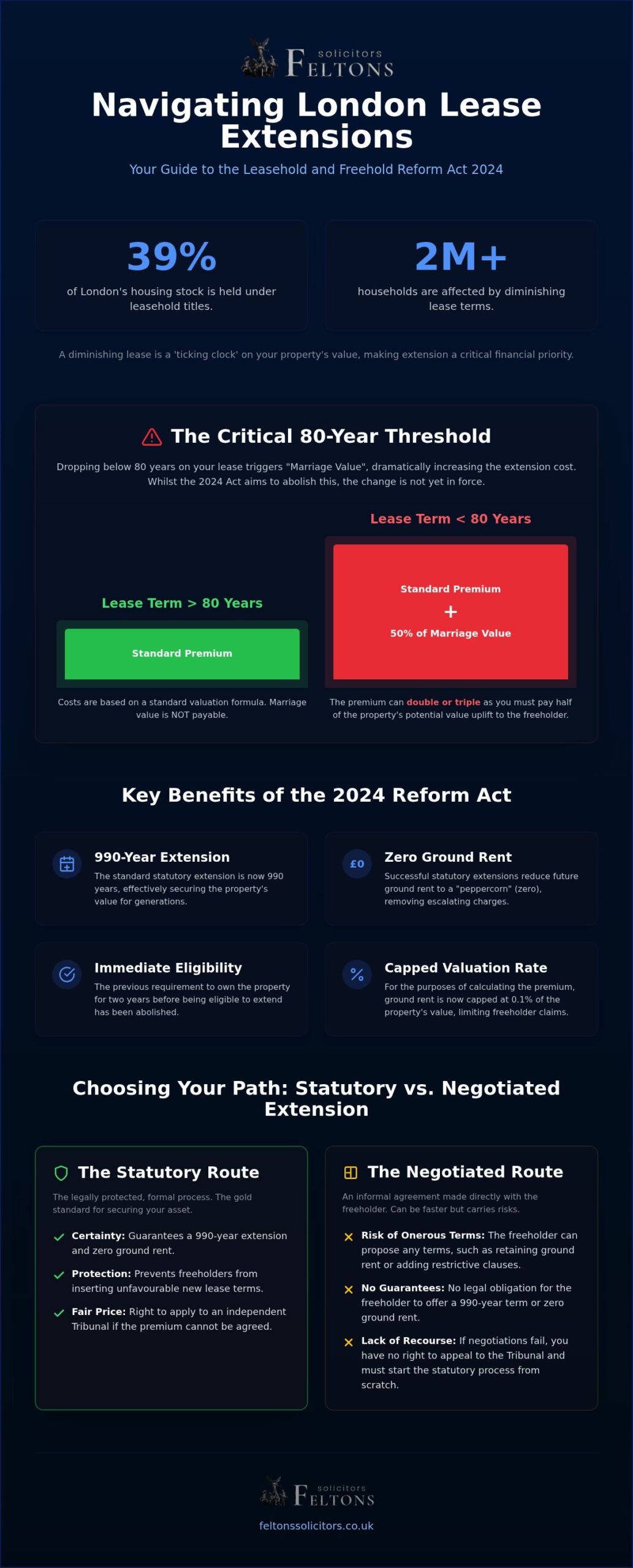
With 39% of London’s housing stock held under leasehold titles, the ticking clock of a diminishing term is a reality for over two million households. You likely feel the weight of the 80-year cliff edge or the frustration of ground rents that complicate your financial future. We understand that extending a lease on a flat london can feel like navigating a legal labyrinth, especially whilst the legislative landscape continues to shift following recent reforms.

This guide provides a sophisticated roadmap through the Leasehold and Freehold Reform Act 2024 to ensure your property remains a secure, saleable asset. You’ll learn how to leverage the new 990-year statutory extension and the abolition of the two-year ownership rule to your advantage. We’ll also clarify why marriage value still impacts premiums in 2026 and how the current ground rent caps function, giving you the quiet confidence to protect your investment with precision and poise.

Key Takeaways

  • Understand why extending a lease on a flat london is a critical financial priority before the term drops below 80 years to avoid costly marriage value premiums.
  • Learn how the 2024 legislative reforms allow you to secure a 990-year extension and eliminate the previous two-year ownership requirement.
  • Compare the security of the statutory route against the speed of private negotiations to determine the most advantageous path for your specific circumstances.
  • Gain clarity on premium calculations, including how ground rent is now capped at 0.1% of the property value for valuation purposes.
  • Discover the benefits of a boutique legal approach that prioritises personal rapport and expert guidance over high-volume processing.

Why Extending a Lease on a Flat London is a Critical Financial Decision

Leasehold ownership in the capital is essentially a long-term tenancy that decreases in value as time passes. Extending a lease on a flat london is the primary mechanism for reversing this decline and securing your financial future. It’s a strategic legal process that adds a significant number of years to your interest, typically 990 years under the latest reforms. This isn’t merely a paperwork exercise; it’s an essential step in protecting your equity and ensuring your home remains a viable asset.

Beyond simply adding time, the process provides a vital opportunity to modernise your lease terms. By formalising an extension, you effectively reset the clock on your property’s marketability. This proactive approach prevents your investment from becoming a “wasting asset,” where the value drops more sharply as the remaining term diminishes. For many owners, the peace of mind that comes with a secure, long-term title is just as valuable as the financial gain.

This newfound security often encourages leaseholders to invest further in their property’s aesthetic and functional value; for those looking to enhance their interiors, the bespoke craftsmanship at Finest Furniture Studio offers a way to perfectly tailor a London flat to a modern lifestyle.

The Impact of a Short Lease on Property Value

Historical property structures, such as the traditional 99-year lease, were designed for a different era. Amongst modern UK property types, leaseholds are unique because their value is inextricably linked to the time remaining on the contract. In the current market, lenders view leases with 70 to 85 years remaining with increasing caution. Many high-street banks tighten their lending criteria as the term drops, sometimes refusing mortgages entirely once a lease reaches the 70-year mark. This creates a psychological and financial barrier for potential buyers, often forcing sellers to accept significantly lower offers to compensate for the upcoming extension costs.

Why the ’80-Year Rule’ Still Matters in 2026

The 80-year threshold remains the most significant financial milestone for any leaseholder. Once a lease falls below this point, “marriage value” becomes payable to the freeholder. This is a calculation of the potential increase in the property’s value following the extension; current law requires you to share 50% of that uplift with the landlord. This creates a financial “cliff edge” where the premium for extending a lease on a flat london can double or triple overnight once the term hits 79 years. Whilst the 2024 reforms aim to eventually abolish marriage value, these specific changes aren’t yet in force in July 2026. Acting before you hit the 80-year mark remains the most effective way to save thousands of pounds in premiums.

Another essential benefit of a statutory extension is the elimination of ground rent. Under the current framework, your ground rent is reduced to a “peppercorn,” which effectively means zero. This removes the risk of escalating ground rent clauses that can make a flat difficult to sell or unmortgageable. By addressing the lease length and ground rent simultaneously, you’re not just adding years; you’re removing future obstacles to a smooth sale.

Statutory vs Negotiated Extensions: Selecting the Most Advantageous Path

When extending a lease on a flat london, you face a pivotal choice between the formal statutory process and an informal negotiated agreement. This decision dictates not just the immediate premium you pay, but the long-term saleability of your asset. While the government guidance on extending your lease outlines both options, the tactical nuances are often overlooked by high-volume providers. Your choice should reflect a balance between legal security and your specific timeline for the property.

Selecting the right path requires a clear understanding of the trade-offs involved. The statutory route offers a degree of protection that a private deal cannot match, yet there are specific scenarios where a direct negotiation might serve a short-term objective. Regardless of the route, professional legal oversight remains essential to prevent the inclusion of restrictive clauses that could hinder future transactions.

The Statutory Route: Security and Certainty

The statutory path relies on the Leasehold Reform, Housing and Urban Development Act 1993, as modernised by recent legislation. In July 2026, this route grants you the right to a 990-year extension and reduces your ground rent to a peppercorn. It acts as a shield against freeholders who might otherwise attempt to insert unfavourable terms. If negotiations over the premium stall, you have the right to apply to the First-tier Tribunal. This ensures an independent body determines a fair price based on finalised valuation rates, providing a level of certainty that is the gold standard for asset protection.

The Negotiated Route: Speed and Flexibility

An informal deal might appeal if you are in the middle of a sale and need to resolve a lease issue within weeks. It allows for a direct conversation with your freeholder, potentially bypassing the rigid timelines of the formal process. However, this flexibility comes with significant risks. Freeholders often offer what appears to be a lower premium in exchange for retaining ground rent or introducing new, modernised restrictive covenants. These “quick fixes” frequently lead to complications during future remortgaging. We recommend a cautious approach to any private offer, as the lack of statutory protection can leave you vulnerable to onerous terms.

The right choice depends on your appetite for risk and your long-term plans. A negotiated deal might save time, but it lacks the statutory protections that cap ground rent for premium calculations at 0.1% of the property’s value. Without a specialist to review the new lease, you might inadvertently sign away rights you are entitled to under the 2024 Act. If you are weighing up these options, seeking advice on leasehold enfranchisement and extensions can provide the clarity needed to make a sound, enduring investment decision.

Assessing the Costs: Premiums, Valuations, and the 2024 Reform Act

Budgeting for extending a lease on a flat london requires a clear-eyed view of three main financial pillars. These include the premium paid to the freeholder, the professional fees for your own advisors, and the evolving impact of the latest legislation. Understanding how these elements interact is the first step in ensuring you don’t overpay for your extension. Since the financial stakes are high, a methodical approach to your valuation is the best way to safeguard your equity.

The premium itself is the most significant cost, calculated by a specialist surveyor such as Winfields Surveyors London, who assesses the property’s current market value against the remaining lease term and ground rent. Under current rules, ground rent is capped at 0.1% of the property’s value for the purpose of these calculations. This provides a more predictable baseline for leaseholders, although the final figure remains subject to negotiation or tribunal determination.

How the Leasehold Reform Act 2024 Changes the Landscape

The Leasehold and Freehold Reform Act 2024 is designed to make the process more affordable by moving towards a standard 990-year extension. While the Act is now law, the implementation of certain cost-saving measures is phased. For instance, the abolition of marriage value is realistically expected to commence in 2027 or 2028. This creates a “wait or act” dilemma for many owners in the capital. If your lease is well above 80 years, waiting for the finalised valuation rates might yield savings. However, if your lease is approaching the 80-year mark, acting now is often safer; the risk of crossing the 80-year threshold and triggering marriage value under current law usually outweighs the potential benefits of waiting for secondary legislation.

Budgeting for Your Lease Extension

A comprehensive budget must account for several moving parts. In addition to the premium, you should prepare for your own professional fees, which typically include a valuation surveyor and a specialist solicitor. One of the most significant changes in 2026 is that leaseholders are no longer required to pay their freeholder’s legal and valuation costs for a statutory lease extension. This shift represents a substantial saving compared to the previous system, where leaseholders were burdened with the costs for both sides of the transaction.

  • The Premium: The core cost paid to the freeholder to purchase the additional years.
  • Valuation Fees: Payment for a specialist surveyor to provide an accurate premium estimate.
  • Legal Disbursements: Costs for Land Registry searches and the final registration of the new lease.

Marriage value represents the increase in the property’s value following the extension, and under current rules, leaseholders must pay 50% of this “profit” to the freeholder if the remaining term is less than 80 years. By addressing these costs with a trusted advisor, you can ensure your budget is both realistic and protective of your long-term interests.

Extending a Lease on a Flat London: A Complete Guide to Protecting Your Property Value in 2026

The Statutory Procedure: A Step-by-Step Guide to Your Extension

The formal path to extending a lease on a flat london is a structured legal journey that demands precision at every milestone. Following the Leasehold and Freehold Reform Act 2024, the process has become more accessible for many owners. One of the most significant changes is the abolition of the two-year ownership rule on 31 January 2025. You no longer need to wait for two years after purchasing your home to start the extension process; you can begin protecting your asset value from day one. This removal of the “waiting period” allows new owners to immediately address a short lease before it impacts their equity or remortgaging options.

Before you trigger the formal procedure, you must appoint a specialist solicitor and an expert valuer. These advisors work in tandem to ensure your opening offer is realistic yet favourable. Your valuer provides the “best-case” and “worst-case” premium figures, whilst your solicitor prepares the technical documentation required to serve notice on your freeholder. This preparation is the foundation of a successful negotiation.

Serving the Section 42 Notice

The process formally begins when your solicitor serves a Tenant’s Notice, commonly known as a Section 42 Notice, on the freeholder. This document is tactically vital because it fixes the “valuation date.” Once this notice is served, the premium you pay is based on the property’s value and the lease length at that specific moment. If property prices in the capital rise during the following months of negotiation, your premium remains protected against those increases. It essentially “freezes” the financial landscape in your favour.

Accuracy in this notice is non-negotiable. Any technical error can allow a freeholder to invalidate the claim, potentially forcing you to wait six months before serving a new notice. Your solicitor must also identify the “Competent Landlord.” In many London blocks, there are multiple layers of head-leases between you and the ultimate freeholder. Identifying the correct party with the legal authority to grant a 990-year extension is a complex task that requires a methodical legal mindset.

Completion and Registration at HM Land Registry

After the freeholder responds with a Section 45 Counter-Notice, a period of negotiation follows. Once the premium and lease terms are agreed upon, the process moves to completion. This involves signing the new lease deed and transferring the premium and any outstanding service charges. For a deeper understanding of how these steps fit into your wider responsibilities as a homeowner, you can explore our guide on Navigating Residential Property Law.

The final step is the registration of the new lease at HM Land Registry. This is a critical administrative task that updates your title deeds to reflect the new 990-year term and the elimination of ground rent. Without this registration, the extension is not legally complete, and your property value remains at risk. If you are ready to begin this process, our team provides the expert oversight needed for Leasehold Enfranchisement and Extensions to ensure your application is handled with discreet, professional care.

Choosing the right legal partner is the most consequential decision you will make when extending a lease on a flat london. At Feltons Solicitors LLP, we consciously distance ourselves from the high-volume, “conveyancing factory” models that often prioritise speed over substance. We believe that complex property matters require a bespoke approach, combining technical precision with a high-end level of reliability. Our firm provides a calm, steady presence for leaseholders, ensuring that every detail of your extension is handled with the discreet care your asset deserves.

Our “people-first” philosophy means we value personal rapport and clear communication. We understand that legal jargon can be alienating; therefore, we provide pragmatic advice in plain English without sacrificing formal professional integrity. Whether you are a domestic homeowner or an international investor with a London portfolio, our team acts as a sophisticated guide through the intricacies of the UK’s evolving property laws. We take pride in being a dependable partner, protecting your privacy whilst securing your property’s future value.

Expertise in Leasehold Enfranchisement

The implementation of the Leasehold and Freehold Reform Act 2024 has introduced layers of complexity that require a specialist’s eye. Our team possesses deep expertise in both the legal requirements and the valuation nuances that define this transitional period. We simplify the reform process for you, managing the phased roll-out of new rights whilst protecting you from the financial risks that still exist in 2026. As Leasehold Enfranchisement Experts, we ensure that your extension is not just a standard transaction, but a strategic asset management exercise designed to eliminate ground rent and maximise saleability.

Starting Your Lease Extension Journey

The first step in extending a lease on a flat london is a comprehensive assessment of your current lease terms. We provide an initial consultation to identify potential obstacles, such as upcoming marriage value thresholds or restrictive covenants. Following this review, we coordinate closely with expert valuation surveyors to ensure your Section 42 Notice offer is robust and defensible. This methodical preparation prevents unnecessary delays and positions you for a successful negotiation with your freeholder.

Securing a 990-year lease extension requires a partner who understands the human impact of technical legal work. We invite you to contact Feltons Solicitors for a professional discussion regarding your property. Our approach is steady and reassuring, designed to make you feel informed and supported from the first instruction to the final registration at HM Land Registry. Let us provide the expert oversight needed to maintain the value and security of your London home.

Securing Your Property’s Future with Confidence

The 2026 property market offers significant advantages for leaseholders who act with foresight. By leveraging the 990-year extension rights and the removal of the two-year ownership rule, you can transform a diminishing asset into a secure, long-term investment. While the legislative landscape continues to evolve, the core principle remains the same: proactive management is the most effective way to eliminate ground rent and maintain your home’s marketability.

Successfully extending a lease on a flat london requires a partner who balances technical legal mastery with a supportive, people-first philosophy. As specialists in leasehold enfranchisement, our pragmatic and approachable experts are trusted by both national and international property owners to handle complex property matters with absolute discretion. We ensure that the nuances of the 2024 reforms are navigated precisely to achieve the best financial outcome for you.

We invite you to contact Feltons Solicitors for expert guidance on your lease extension. Our team is ready to provide the calm, authoritative support you need to protect your equity. Take the first step today towards a more secure financial future for your London property.

Frequently Asked Questions

How much does it cost to extend a lease on a flat in 2026?

The total cost of extending a lease on a flat london in 2026 is comprised of the premium paid to the freeholder and your own professional fees for valuation and legal advice. A significant change this year is that leaseholders are no longer responsible for paying the freeholder’s legal or valuation costs in statutory claims. The premium itself is calculated based on your property’s market value, the remaining lease term, and the current ground rent, with the latter now capped at 0.1% of the property value for calculation purposes.

Does the Leasehold and Freehold Reform Act 2024 make lease extensions cheaper now?

The 2024 Act has made extensions cheaper by removing the requirement to pay the freeholder’s professional costs, but some financial reforms are still being phased in. While the 0.1% ground rent cap for premium calculations is active, the abolition of “marriage value” for leases under 80 years is not yet in force in July 2026. This means that while some savings are immediate, the most substantial cost reductions for shorter leases are expected to arrive with secondary legislation in 2027 or 2028.

Can I extend my lease if it has already fallen below 80 years?

You can still extend your lease if it has dropped below 80 years, although the premium will be higher due to the inclusion of marriage value. Under the current legal framework, you must pay the freeholder 50% of the uplift in the property’s value that results from the extension. It’s vital to seek expert valuation advice in these circumstances to ensure the marriage value calculation is fair and based on accurate market data.

How long does the statutory lease extension process typically take?

The formal statutory route generally takes between six and twelve months to reach completion and registration at HM Land Registry. This timeline includes the two-month period allowed for the freeholder to serve their counter-notice and a subsequent period for premium negotiations. While a negotiated informal deal might be faster, the statutory route provides a structured legal timetable that protects you from unnecessary delays by the landlord.

What is the difference between a 90-year and a 990-year lease extension?

The 990-year extension is the new statutory standard introduced by the 2024 reforms, replacing the previous 90-year entitlement. This significant increase effectively grants you a “virtual freehold,” ensuring that the lease will never need to be extended again. Extending a lease on a flat london for 990 years provides far greater long-term security and asset protection than the older 90-year model, making the property much more attractive to future buyers and lenders.

Do I still need to pay ground rent after I extend my lease?

No, once you complete a statutory lease extension, your ground rent is legally reduced to a “peppercorn,” which effectively means zero. This reduction is a mandatory part of the formal process and applies for the entire duration of the new 990-year term. This elimination of ground rent is a key benefit, as it removes the risk of onerous rent review clauses that can complicate future sales or remortgaging applications.

What happens if my freeholder is missing or unresponsive?

If your freeholder cannot be found, you can still secure an extension by applying for a “Vesting Order” through the County Court. This process allows the court to act in the place of the missing landlord to grant the new lease, provided you can demonstrate that reasonable efforts were made to locate them. The premium is then paid into court to be held for the freeholder should they ever come forward in the future.

Can I sell my flat whilst the lease extension process is ongoing?

You can sell your property during the process by “assigning the benefit” of the Section 42 notice to the incoming buyer. This legal transfer allows the buyer to take over the ongoing extension claim immediately upon completion of the sale, rather than waiting to start a new application. This is a common and effective strategy in the London market to ensure that a short lease does not prevent a successful and timely property sale.

High Net Worth Divorce Solicitors London: Protecting Complex Assets

High Net Worth Divorce Solicitors London: Protecting Complex Assets

Did you know that London’s “Financially Complex Divorce Index” is currently 56.37, which is significantly higher than the national average of 34.37? For individuals with substantial assets, the end of a marriage brings a unique set of anxieties that go far beyond standard emotional distress. You are likely concerned about maintaining business continuity, protecting pre-marital wealth, and keeping your private financial affairs away from the public eye. Finding the right high net worth divorce solicitors london is the first step in ensuring these complex elements are handled with the discretion they deserve.

We understand that a high-value divorce is a strategic exercise in wealth preservation rather than a standard legal template. This guide provides a clear path through the intricacies of high-value settlements, focusing on strategic asset protection and bespoke legal solutions. We will explore how to value non-liquid assets, navigate international jurisdictions, and utilise recent case law like Standish v Standish to protect your financial legacy whilst ensuring a fair resolution. By the end of this article, you will have a comprehensive understanding of how to manage your divorce with minimal disruption to your professional and personal life.

Key Takeaways

  • Understand what constitutes a high net worth divorce in 2026 and why these cases demand a specialised approach to protect your future.
  • Learn how high net worth divorce solicitors london employ strategic methods to ring-fence pre-marital wealth, trusts, and commercial interests.
  • Discover the advantages of private justice through arbitration and Financial Dispute Resolution to ensure your financial arrangements remain entirely confidential.
  • Master the essential steps for financial disclosure, including the critical role of Form E and the coordination of expert valuations for non-liquid assets.
  • Explore the benefits of a boutique legal partnership that prioritises personal rapport and senior-level expertise for international matrimonial matters.

A high net worth divorce is a process involving complex financial structures, business interests, and international assets. Whilst the core principles of divorce law in England and Wales have been simplified by no-fault legislation, the financial remedy stage has grown increasingly sophisticated. In 2026, the Family Court is tasked with unpicking intricate wealth structures whilst maintaining a commitment to fairness and the “sharing principle.” This requires a level of forensic detail that standard proceedings simply don’t demand. For those with significant estates, partnering with high net worth divorce solicitors london is essential to ensure that wealth is not just divided, but protected through intelligent legal architecture.

The role of the court has evolved to recognise that wealth preservation is a legitimate concern, particularly when assets were acquired long before the marriage began. However, without a bespoke strategy, the risk of “asset dissipation” or unfair valuation is high. These cases require a departure from the “one-size-fits-all” approach, moving instead towards a model of private justice and expert-led negotiation.

The Threshold of Complexity

Complexity in a high-value divorce rarely stems from the size of a bank balance alone. Instead, it arises from the nature of the assets involved. Standard online divorce calculators fail to account for the nuances of a diversified portfolio. We often see disputes centred on assets such as:

  • Private equity holdings and carried interest.
  • Valuable collections of fine art, classic cars, or rare wine.
  • Intellectual property rights and future royalty streams.
  • Inherited wealth and pre-acquired property.

Recent judicial trends, including the application of the Standish v Standish principles, have reinforced the need to distinguish between matrimonial and non-matrimonial property. Identifying which assets should be “ring-fenced” is a critical first step in any high-value settlement.

The Importance of Jurisdiction

London remains a global hub for matrimonial finance, often referred to as the “divorce capital of the world” due to the court’s broad powers to award maintenance and share assets. For international couples, the choice of where to file—often called “forum shopping”—can result in vastly different financial outcomes. If you hold property in multiple countries or have an international business presence, the jurisdiction you choose will dictate the tax implications and the enforceability of any final order. High net worth divorce solicitors london provide the worldly experience necessary to navigate these cross-border challenges, ensuring your interests are protected regardless of where your assets are physically located.

Protecting Complex Assets: Trusts, Business Interests, and Property

Protecting a lifetime of wealth accumulation requires more than just a standard financial disclosure. It demands a forensic understanding of how different asset classes interact with current law. High-value matrimonial disputes often hinge on the distinction between “matrimonial” assets, which are shared, and “non-matrimonial” wealth, such as inheritances or pre-existing business stakes. Experienced high net worth divorce solicitors london work to ring-fence these assets, ensuring the settlement reflects the unique origins of your wealth. Understanding these high-net-worth divorce complexities is essential for anyone looking to preserve their financial legacy whilst navigating a separation.

Business Interests and Shareholdings

Your business is often your most significant asset, but it is also the most vulnerable during a divorce. The court’s primary objective is to achieve a fair division without killing the “Golden Goose.” This means valuations must be precise. We utilise forensic accountants to unwrap complex corporate structures, looking beyond the balance sheet to assess liquidity and latent tax liabilities. Whether you hold a minority shareholding or lead a family-owned enterprise, maintaining business continuity is paramount. A structured approach ensures that a settlement doesn’t force a sale or disrupt daily operations.

Trusts and Offshore Structures

Trusts are frequently at the centre of high-value disputes. The court distinguishes between “nuptial settlements,” which can be varied by a judge, and third-party trusts that remain outside the matrimonial pot. Transparency is now a legal requirement, particularly with the introduction of the overseas entity beneficial owner registration. Failing to account for these disclosure standards can lead to severe penalties or adverse inferences from the court. If your wealth is held via offshore entities, you need a partner who understands the intersection of property law and family finance.

Pensions and Retirement Provision

High-value pensions, including SIPPs and SSAS structures, require specialised handling. Whilst many couples look at pension sharing orders, high net worth individuals often prefer “offsetting,” where one party keeps the pension in exchange for other assets like the family home. With the 2026 tax landscape and previous changes to lifetime allowances, accurate actuarial valuations are non-negotiable. Our team can help you structure these financial arrangements to ensure long-term security without sacrificing current liquidity. Partnering with high net worth divorce solicitors london ensures that every element of your retirement portfolio is weighed correctly against your immediate needs.

Strategic Pathways: Litigation vs. Alternative Dispute Resolution

Choosing the right forum for a high-value separation is as much a commercial decision as it is a legal one. Whilst the default route often involves the court system, the inherent lack of privacy in public hearings can be a significant deterrent for those with sensitive business interests or public profiles. In the current legal environment, high net worth divorce solicitors london are increasingly steering clients towards “private justice” models. These pathways offer a level of discretion and control that the traditional court process simply cannot match, allowing for a resolution that remains entirely amongst the parties involved.

The rise of Private Financial Dispute Resolution (FDR) hearings has transformed how wealthy couples settle their affairs. Instead of waiting months for a court date, parties can hire a specialist judge—usually a senior barrister or retired member of the judiciary—to provide a non-binding indication of the likely outcome. This focused, one-day event often facilitates a settlement that avoids the adversarial nature of a final trial. For those seeking to minimise disruption to their professional lives, this bespoke approach is often the most efficient route to a clean break.

The Court Process and Financial Disclosure

If your case proceeds through the courts, the duty of “full and frank disclosure” is absolute. Every asset, from offshore holdings to minority shareholdings, must be declared on a Form E. Failing to comply can lead to severe penalties, including cost orders or the court drawing “adverse inferences” about your wealth. It is vital to work with a divorce and financial arrangements lawyer who can meticulously prepare this documentation. You can expect the process to begin with a First Appointment to define the issues, followed by an FDR where the court encourages a settlement based on a judge’s preliminary view.

Private Arbitration and Mediation

Arbitration has become the preferred choice for many high net worth individuals because it is binding, confidential, and significantly faster than the court system. You select the arbitrator and the venue, ensuring the process fits your schedule rather than the court’s calendar. Equally, mediation offers a space for creative financial arrangements that a judge might not have the jurisdiction to order. When legal points are particularly contentious, obtaining a formal counsel’s opinion can provide the clarity needed to break a deadlock without stepping foot in a courtroom. By engaging high net worth divorce solicitors london who are experienced in these alternative pathways, you can protect your reputation whilst securing a fair financial future.

High Net Worth Divorce Solicitors London: Protecting Complex Assets

Preparing for a High-Value Settlement: A Professional Checklist

Preparation is the foundation of any successful high-value settlement. It’s not just about compliance; it’s about building a strategic framework that protects your long-term interests. Whilst the court mandates the exchange of Form E, the complexity of a high-net-worth estate often requires additional documentation that goes far beyond the standard requirements. Engaging high net worth divorce solicitors london early in the process allows for a meticulous review of your financial position before any formal disclosure is made. You should organise a comprehensive schedule of all global assets, including those held in trusts or via overseas entities.

Managing your behaviour during this period is equally critical. Whilst the emotional toll of a separation is significant, the financial decisions you make now will define your lifestyle for decades to come. We act as a steady, professional presence, helping you separate emotional impulses from logical financial objectives. This methodical approach ensures that no stone is left unturned and no asset is undervalued. If you are beginning this process, you can book a confidential consultation with our senior team to discuss your specific requirements.

The Role of Forensic Experts

In cases involving diversified wealth, we frequently instruct third-party experts to provide clarity. Forensic accountants are essential for tracing assets that may have been diverted or hidden amongst complex corporate layers. Their expertise is also vital for valuing unique holdings, such as cryptocurrency portfolios or vast tracts of agricultural land, which standard valuers might overlook. Beyond simple valuation, these experts help us design tax-efficient settlement structures. This ensures that the division of assets doesn’t trigger unnecessary Capital Gains Tax liabilities, which can be as high as 24% for residential property gains in the 2026/27 tax year.

Securing Interim Financial Support

A divorce can sometimes lead to immediate liquidity issues, especially if one party controls the primary income streams. We can apply for “Maintenance Pending Suit” to ensure your ongoing costs are covered whilst the final settlement is negotiated. Equally, a Legal Fees Order can be sought to ensure both parties have access to top-tier representation, preventing one side from being “out-litigated” due to a lack of immediate funds. Protecting the family home and maintaining your standard of living during the proceedings is a priority. By working with high net worth divorce solicitors london, you ensure that your immediate financial security is robustly defended from day one.

The Feltons Advantage: Discreet Expertise for Matrimonial Matters

Choosing the right legal partner is a decision that extends beyond mere technical competence. At Feltons Solicitors LLP, we’ve built a reputation as high net worth divorce solicitors london by combining traditional professional integrity with a modern, pragmatic delivery. Established in 2010 by Paula Felton, our firm was founded on the belief that complex matrimonial matters require a “people-first” philosophy. We don’t believe in high-volume processing; instead, we offer a boutique level of care that ensures your personal connection to your legal advisor is never lost amongst the paperwork. This steady, calm presence is vital when dealing with the high-stakes environment of a multi-million-pound estate.

Our integrated approach is what truly sets us apart. Because we possess deep expertise in both family law and property matters, including the specialised registration of overseas entities, we can handle every facet of your divorce under one roof. This seamless coordination prevents the fragmentation of advice that often occurs in larger, more impersonal firms. We’re committed to providing discreet, sound judgment that prioritises your privacy whilst avoiding the expense and public exposure of unnecessary litigation. Our goal is always a fair resolution that protects your pre-marital wealth and business continuity without the need for aggressive court battles.

A Tailored Professional Partnership

A successful settlement is often the result of quiet confidence and meticulous preparation. Our team manages international and cross-border complexities with a steady hand, drawing on years of experience handling high-stakes litigation for both national and international clients. We understand that your reputation is as valuable as your financial assets. By acting as a sophisticated guide, we help you navigate these turbulent waters with minimal disruption to your professional life. This tailored approach ensures that the human impact of the legal work is always considered alongside the technical outcomes, leading to more sustainable and amicable agreements.

Next Steps: Securing Your Financial Future

Early intervention is often the deciding factor in wealth preservation. By engaging high net worth divorce solicitors london at the earliest opportunity, you can ensure that your global assets are correctly structured and protected before disputes escalate. We invite you to arrange a confidential consultation where we can discuss your specific circumstances and develop a bespoke strategy for your future. Whether you are dealing with complex trusts, international property portfolios, or private business interests, we provide the steady presence you need to move forward with confidence. Your financial security and personal peace of mind are our primary concerns.

Contact Feltons Solicitors for expert guidance on your divorce and discover the benefit of a partnership built on trust, discretion, and senior-level expertise.

Securing Your Financial Legacy with Confidence

Navigating a high-value separation requires more than just legal knowledge; it demands a strategic architecture that respects your privacy and protects your commercial interests. We’ve explored how identifying non-matrimonial assets and utilising private justice pathways can mitigate the risks of public disclosure and asset dissipation. By prioritising a forensic approach to disclosure and valuing complex business structures accurately, you can achieve a settlement that ensures long-term stability. Partnering with high net worth divorce solicitors london who offer a boutique, “people-first” service ensures that your specific needs remain the focus of every decision.

Our expertise across matrimonial finance, complex property, and trusts allows us to handle international-scale matters with the quiet confidence you deserve. It’s about moving forward with clarity whilst preserving the wealth you’ve worked hard to build. We provide pragmatic, expert advice tailored to your unique circumstances, ensuring that your future is built on a solid financial foundation. Secure your financial future with a confidential consultation at Feltons Solicitors. You don’t have to navigate these complexities alone; we’re here to guide you through every step with discretion and care.

Frequently Asked Questions

How long does a high net worth divorce usually take in the UK?

High net worth divorces typically take between 12 and 18 months to conclude. This timeline is often dictated by the complexity of valuing global assets and the speed of financial disclosure. Choosing high net worth divorce solicitors london who utilise private arbitration can often shorten this process significantly compared to the backlogged public court system.

Can I protect assets I inherited before the marriage?

Pre-marital inheritances can often be ring-fenced if they have remained separate from matrimonial finances. The court distinguishes between matrimonial and non-matrimonial property, especially following the Standish v Standish ruling. However, if these assets are required to meet the “needs” of the other party, the court retains the discretion to include them in the final settlement.

What happens to my business if I get divorced?

Judges generally try to avoid forcing the sale of a business to preserve it as a “Golden Goose” for future income. Instead, the value of the business is often “offset” against other assets, such as the family home or pension funds. Forensic valuations are essential to determine liquidity and ensure the business remains viable post-settlement.

Is a pre-nuptial agreement legally binding during a high net worth divorce?

Whilst not automatically binding, pre-nuptial agreements are usually upheld by the court if they were entered into freely and with full financial disclosure. Both parties must have received independent legal advice at least 21 days before the marriage. The agreement must also be “fair” and ensure the basic needs of both parties and any children are met.

How are offshore trusts treated by the UK Family Court?

The Family Court has the power to vary “nuptial settlements” or treat trust assets as resources available to one party. If a trust is deemed to be a matrimonial asset, its value will be included in the financial pot. Specialist high net worth divorce solicitors london are required to navigate the intersection of trust law and matrimonial finance to protect these structures.

What is a Private FDR and why should I consider one?

A Private Financial Dispute Resolution hearing allows you to hire a specialist judge to adjudicate your case in a confidential setting. This pathway is preferred by high-profile individuals seeking speed and discretion. It provides a non-binding indication of the likely court outcome, often facilitating a settlement without the need for a public trial.

Can my spouse claim a share of my future earnings or bonuses?

Spouses generally cannot claim a direct share of future earnings post-separation, but bonuses can be relevant to maintenance calculations. If there is a clear maintenance requirement, the court may order a percentage of future bonuses to be paid for a fixed term. This ensures the lower-earning party’s needs are met whilst the higher-earner retains their professional incentives.

How is the “standard of living” during the marriage used to calculate maintenance?

The lifestyle enjoyed during the marriage is a key factor in assessing “needs” for spousal maintenance. In high-value cases, the court aims to prevent a sudden and unfair drop in living standards for the lower-earning spouse. Whilst maintenance isn’t always for life, it provides a transition period to help the party adjust to their new financial circumstances.