
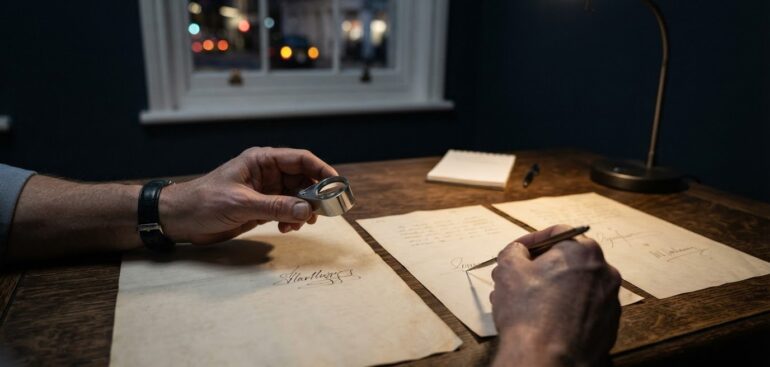
A suspicious signature is a warning, not proof. In England and Wales, how to prove a will was forged depends on the evidence. If a challenger raises sufficient doubt about its authenticity, the person relying on the will must prove it is genuine. Handwriting analysis, witness accounts and records of how the document was prepared can all help establish what happened.
It is understandable to question a will that appears to contradict the deceased’s wishes, especially if there are concerns about how it was signed or when it was discovered. But forgery is different from fraud, undue influence or an authentic document that was later altered. Each allegation needs to be examined on its own facts.
This article explains possible signs of forgery, how experts assess signatures and altered documents, and what fraudulent calumny means. It also covers what may happen if a will is found invalid, including how the estate may be distributed and possible legal consequences for those responsible.
Key Takeaways
- A suspicious signature is a clue, not proof; handwriting analysis can help assess whether it was genuine, traced or copied.
- Witness accounts may clarify how a will was signed and whether the testator appeared to understand and intend what they were signing.
- Forgery, later alterations and fraudulent calumny are distinct concerns, and each calls for evidence that addresses what happened.
- If a will is proved forged, it may be invalid; according to UK Legislation, forgery is punishable by a fine or up to 10 years in prison.
How can you spot a forgery?
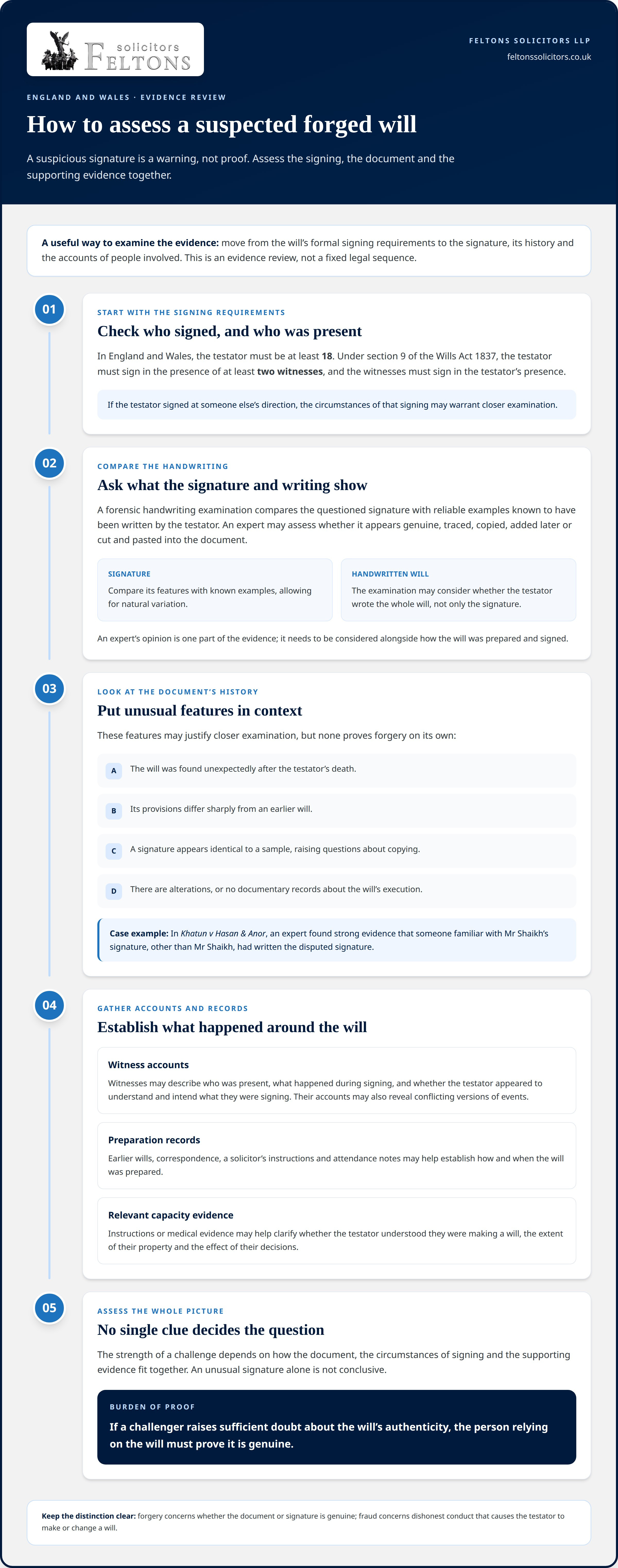
A suspicious signature or unexpected change may justify closer examination, but neither proves forgery on its own. The strength of a challenge depends on how the document, the circumstances of signing and the supporting evidence fit together.
In England and Wales, a testator must be at least 18, and the will must meet the execution requirements in section 9 of the Wills Act 1837. According to UK Legislation, the testator must sign in the presence of at least two witnesses; the witnesses must sign in the testator’s presence. If the testator signs at someone else’s direction, the circumstances of the signing may warrant closer examination.
Handwriting expert evidence
Handwriting expert evidence is an assessment of whether a disputed signature or handwritten will matches writing known to be the testator’s. It can help the court consider a forgery allegation, especially if the signature differs from reliable examples. The expert’s opinion is only one part of the evidence and must be considered alongside how the will was prepared and signed. In Khatun v Hasan & Anor, an expert found strong evidence that someone familiar with Mr Shaikh’s signature, other than Mr Shaikh, had written the disputed signature.
Examining a disputed signature
A forensic handwriting examination compares a questioned signature with examples known to have been written by the testator. The expert assesses features of the handwriting and whether the signature appears genuine, traced, added later or cut and pasted into the document. This can help distinguish natural variation in a person’s signature from possible copying or alteration. The examination may also consider whether the testator wrote the whole handwritten will, not just the signature.
Other warning signs may include a will found unexpectedly after death or provisions that differ sharply from an earlier will. A signature identical to a sample may raise questions about copying. In Khatun v Hasan & Anor, the circumstances of the disputed will, including the absence of documentary records about its execution, formed part of the wider evidence.
Expert reports are most useful when considered alongside evidence about the signing and the document’s history. Witnesses may describe who was present and what happened, while correspondence can help establish when the will was prepared. A solicitor assessing how to prove a will was forged considers these strands together, rather than treating an unusual signature as conclusive. The evidence may affect whether the disputed will is accepted as valid.
Fraud or forgery?
Forgery means that a will or signature is not genuine. Fraud concerns dishonest conduct that causes the testator to make or change a will. The distinction matters because the evidence must address either the document’s authenticity or the conduct that influenced the testator’s decisions.
Witness evidence about the will
Witness evidence describes what people saw or heard before, during and after the will was signed. Witnesses may explain who was present, whether the testator appeared to understand the document and whether anyone directed or pressured them. Their accounts may also reveal conflicting versions of events. A witness who says the testator never signed the will may support a forgery challenge; a witness who recalls apparent pressure may support a separate allegation of fraud.
Solicitor records and capacity evidence
A solicitor’s records and evidence about the testator’s capacity can help show how the will was made and whether the testator’s intentions were understood. A solicitor-drafted will may support its genuineness, while instructions, attendance notes or medical evidence may help clarify capacity. Capacity concerns focus on whether the testator understood they were making a will, the extent of their property and the effect of their decisions.
The cost of challenging a will depends on the dispute’s complexity and is set after a quote request; factors include the evidence required, expert involvement and court proceedings.
Evidence of false statements
Evidence that someone deliberately lied to a testator may support a claim of fraudulent calumny rather than forgery. The allegation is that a person knowingly made false statements about a beneficiary, intended to influence the testator and caused a change to the will. For example, communications repeating an untrue accusation may be relevant if they connect the speaker’s conduct to the testator’s changed inheritance decision.
How a solicitor gathers evidence for a challenge
A solicitor may bring together earlier wills, correspondence, witness accounts and relevant records to assess whether the evidence supports a challenge. Where the original will’s paper, ink, signature or alterations are disputed, a court may be asked to require its production for examination; the probate registry does not decide the underlying validity dispute. A solicitor can also assess whether a caveat is appropriate to prevent a grant being issued while concerns are considered. Wills, Probate, and Estate Planning can help with advice on a will dispute and the evidence involved.
Forgery, altered documents and fraudulent calumny
A forged will may be entirely fabricated or changed without the testator’s knowledge. Fraudulent conduct, by contrast, may affect a genuine will by distorting the testator’s decisions.
Forgery and fraudulent wills
Forgery concerns whether the document or its contents are genuine; fraud concerns dishonest conduct that influences the testator’s wishes. A will signed by someone else without permission, or altered by inserting a page, may involve forgery. Fraudulent calumny is different: someone knowingly makes false statements about a beneficiary to influence the testator, causing a change to their will. The distinction matters because evidence must connect either the disputed document or the dishonest conduct to the alleged wrongdoing. Re Edwards [2007] EWHC 1119 (Ch) is a leading case concerning fraudulent calumny.
Signs of fraud or forgery
Changes to beneficiaries, removed pages or inserted provisions can raise questions about whether a will reflects the testator’s intentions. A late change that sharply departs from long-standing wishes may also need investigation, especially if the circumstances are unclear. These signs do not establish forgery by themselves. Their significance depends on the document’s history and the other evidence.
A caveat may help prevent a grant of probate while a dispute is considered. It must be in place before probate is issued to prevent the grant, so anyone concerned about an estate should act promptly rather than wait for a particular period after the death.
Organised probate fraud can involve fabricated wills for people who died intestate, with gang members named as beneficiaries. The Ministry of Justice took the UK unclaimed estates list offline after a will-fraud scam was uncovered. This illustrates how forged wills can misuse probate, rather than merely alter an inheritance between family members.
Evidence of false claims about a beneficiary may point to fraud; evidence that a page or signature was fabricated may point to forgery. If both concerns arise, a contentious probate challenge may need to examine the document and the conduct surrounding its creation. The aim is for the estate to be dealt with under a valid will or the intestacy rules.
Consequences of a proved forgery
A proved forgery can change who inherits and may lead to a criminal investigation. The civil dispute determines whether the document is valid; criminal proceedings address possible offending.
If a court finds that a will was forged, it is invalid, regardless of what the testator may have intended. The estate is then distributed under an earlier valid will, if one exists, or under intestacy rules if there is no valid will. This can affect an executor’s authority and the inheritance of beneficiaries named in the disputed document. The outcome depends on which will, if any, is established as valid.
In a civil dispute about a will’s validity, the civil standard of proof applies. In a forgery claim, once sufficient doubt is raised, the person relying on the will must prove it is genuine. A handwriting expert’s opinion, witness evidence and examination of original documents may all help the court assess authenticity. A finding that writing or a signature is not genuine can affect whether probate proceeds on the basis of that will.
There may also be criminal consequences. According to UK Legislation, forgery in the UK is punishable by a fine or up to 10 years in prison. Where a forged will is used to obtain property or money, the Fraud Act 2006 may also be relevant in England and Wales. A civil finding does not itself amount to a criminal conviction, which requires proof to the criminal standard.
If a civil judge considers the evidence sufficient to suggest that forgery could be proved to the higher criminal standard, the judge may refer the judgment to the police. The police and criminal courts then consider whether an offence has been committed. Allegations of undue influence or dishonest conduct raise separate issues from forged documents, so the evidence and legal route matter.
For beneficiaries and executors, the practical consequence is that an invalid will cannot determine the estate’s distribution. If a disputed document could affect probate or an inheritance, seek legal advice about challenging the will and the available evidence.
Feltons Solicitors LLP: Wills, Probate, and Estate Planning
Feltons Solicitors LLP advises on wills, probate and estate planning, including concerns about a will’s authenticity that may affect an estate. Legal advice can help clarify how the evidence relates to the disputed document, the probate process and the possible effect on beneficiaries. This can be particularly relevant when an executor is considering an application for probate or a beneficiary questions which will should govern the estate.
Advice can also help distinguish a suspected forgery from other concerns, such as changes made without the testator’s knowledge or allegations of fraudulent conduct. The appropriate next steps depend on the documents and circumstances of the dispute. For guidance on a will or probate concern, contact Feltons Solicitors LLP.
Choose a clear path forward
A will dispute can affect family relationships as well as an estate. The next step is to move from concern to a measured legal assessment of the disputed will and the available evidence. Avoid treating suspicion alone as proof. A focused review can clarify the issues and the options that may follow.
Understanding how to prove a will was forged begins with identifying what is in dispute and which evidence is relevant. The right legal approach depends on the circumstances, including whether the concern is about the document itself or conduct affecting the testator’s decisions. Early advice can help clarify those issues.
For guidance on a will or estate dispute, contact Feltons Solicitors LLP. A considered conversation can help you decide on a practical way forward.
Frequently Asked Questions
How can a solicitor help prove a Will has been forged?
A solicitor can assess whether the available material supports a challenge and identify evidence relevant to the disputed will. For example, they may consider earlier wills, correspondence, witness accounts and a handwriting expert’s opinion together. This can help distinguish a genuine change of intention from an allegedly fabricated document. The strength of the case depends on how the evidence fits together, not on one unusual feature.
Forgery and fabrication … when is a signature not their own?
A signature may be challenged if comparison with reliable examples suggests it was written by someone else, traced or copied. Handwriting can change naturally, so a difference alone does not establish forgery. An expert can compare the questioned signature with known samples and assess how it was added to the document. The court considers that opinion alongside other evidence about the will’s creation.
How can a solicitor help report a forged will?
A solicitor can help organise the evidence and advise on raising concerns about suspected criminal conduct. Keep the distinction clear: a civil challenge asks whether the will is valid, while criminal authorities consider whether an offence has been committed. If a civil judge considers that the evidence suggests forgery could meet the criminal standard, the judge may refer the judgment to the police.
How can a solicitor help me contest a Will?
A solicitor can review the will, explain the grounds for challenging it and assess how the evidence supports those grounds. A dispute about a substituted page, for example, differs from an allegation that someone pressured the testator or made deliberate false statements. Advice can also address the effect on probate and whether a caveat may be appropriate while the dispute is considered.
How long will it take?
The time involved depends on the evidence, the issues in dispute and whether court hearings are needed. Some will disputes may resolve within months; others can take years and involve several hearings. Expert examination, disagreements over witness accounts and the need to determine which will governs the estate can all affect progress. Early assessment helps clarify the likely issues, but the course of a case depends on how it develops.
How to recognise a forged will?
Look for features that need explanation, such as an unexpected will, unexplained changes from earlier wishes, or pages that appear to have been inserted or removed. A signature identical to a sample may also raise questions about copying. None of these features proves forgery alone. Their significance depends on the document’s history and supporting evidence, including how the will was prepared and who was present when it was signed.