

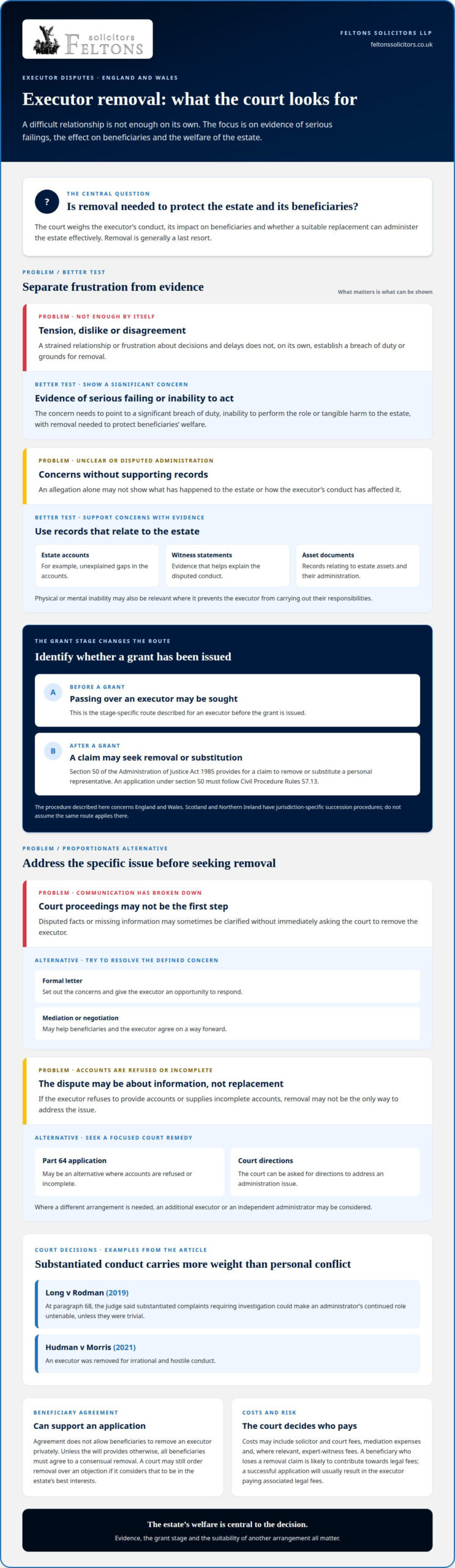
A difficult relationship with an executor is not, by itself, enough to have them removed. The question of how to remove an executor of a will in the UK turns on evidence of serious failings or an inability to perform the role, and whether removal is needed to protect beneficiaries’ interests. After a grant has issued, a claim to remove or substitute a personal representative may be made under section 50 of the Administration of Justice Act 1985, according to The National Archives.
It’s understandable to expect a court to step in when an executor’s decisions cause frustration or delay. But disagreement or tension alone is not enough to establish a breach of duty. Concerns need to be supported by evidence, such as estate accounts, witness statements or documents relating to estate assets. This guide explains what courts consider, how an application works, who may take over and when an independent administrator may be appointed. It also explains why removal is usually a last resort and when another way of resolving the dispute may be more appropriate.
Key Takeaways
- Courts focus on evidence of an executor’s conduct and the effect on the estate, not simply on strained relationships or disagreements.
- The estate’s welfare is central to a removal decision, and the court may consider whether a replacement or independent administrator is appropriate.
- Understanding an executor’s duties can help clarify whether a concern points to a genuine failure, and what records may help explain it.
- The route depends partly on whether a grant has been issued; in some disputes, an application for directions may be a more suitable alternative to removal.
What factors will the court consider in deciding whether to remove an executor?
Courts consider evidence of serious failings, inability to act and the effect on beneficiaries. A poor relationship or disagreement alone does not establish grounds for removal.
Beneficiary agreement and consent
Beneficiaries’ agreement can support a court application, but it does not give them the power to remove an executor privately. Unless the will provides otherwise, all beneficiaries must agree to a consensual removal. However, a court may order removal despite an objection if it considers this to be in the estate’s best interests. Agreement may help resolve a contentious dispute, but it does not replace a court decision where an application is needed.
Applications before and after a grant
The grant stage determines whether the issue is passing over an executor or removing an appointed personal representative. Before a grant is issued, passing over may be sought; removal applies after a grant. After a grant has issued, a claim may seek to remove or substitute a personal representative under section 50 of the Administration of Justice Act 1985, according to The National Archives. An application under section 50 must follow Civil Procedure Rules 57.13, according to the Ministry of Justice. For anyone considering how to remove an executor of a will in the UK, identifying this stage helps frame the application correctly.
Grounds and evidence for removal
Grounds for removal generally require clear evidence of a significant breach of duty or an inability to perform the role. The court considers whether removal is needed to protect beneficiaries’ welfare. Personal dislike, tension or disagreement alone is insufficient without tangible harm to the estate. Evidence may include accounting records, witness statements and documents relating to estate assets. For example, records showing unexplained gaps in estate accounts may support concerns about administration. Physical or mental inability may also be relevant if it prevents the executor from carrying out their responsibilities.
Differences across UK jurisdictions
The procedure described here concerns England and Wales; Scotland and Northern Ireland have jurisdiction-specific succession procedures. Do not assume that section 50 or Civil Procedure Rules 57.13 provides the route in those jurisdictions. The applicable process depends on where the estate is administered. Understanding how to remove an executor of a will in the UK therefore begins by identifying whether the matter concerns England and Wales, Scotland or Northern Ireland.
Court decisions and appointment of an independent administrator
Removal is generally treated as a last resort. The court focuses on the estate’s welfare and whether another arrangement would allow it to be administered effectively.
Factors considered by the court
The court weighs the executor’s conduct, the effect on beneficiaries and whether a suitable replacement can act. In Long v Rodman (2019), the judge said at paragraph 68 that substantiated complaints requiring investigation could make an administrator’s continued role untenable, unless they were trivial. In Hudman v Morris (2021), an executor was removed for irrational and hostile conduct. These decisions show why evidence and the estate’s interests matter more than personal conflict.
Steps a solicitor can take before court action to remove an executor
A solicitor can set out concerns formally in a letter to the executor and give them an opportunity to respond. This may clarify disputed facts or prompt action without court proceedings. Mediation or negotiation may also help beneficiaries and the executor agree on a way forward. The aim is to address the specific problem, such as missing information, before seeking removal.
If the executor refuses to provide accounts, or supplies incomplete accounts, an application under Part 64 of the Civil Procedure Rules may be an alternative. The court can also be asked for directions. These options may address an information dispute without removing the personal representative; an additional executor or independent administrator may be considered where a different arrangement is needed.
Court action carries financial risk. Costs may include solicitor and court fees, mediation expenses and, where relevant, expert-witness fees. The court decides who pays: a beneficiary who loses a removal claim is likely to contribute towards legal fees, while a successful application will usually result in the executor paying associated legal fees. A solicitor can assess the evidence, likely issues and alternatives before proceedings begin. For guidance on the dispute and estate administration, consider probate dispute advice.
Executor responsibilities and duties
An executor’s responsibilities concern the deceased’s estate, from identifying assets to distributing what remains under the will. In England and Wales, section 25 of the Administration of Estates Act 1925 sets out executor duties. These include collecting and valuing estate assets, reporting the estate’s value to HMRC, paying debts and taxes, and distributing assets to beneficiaries. Each task affects the value available to those named in the will.
Beneficiaries’ interests are protected through proper administration and clear records. Executors must keep beneficiaries reasonably informed and provide estate accounts. For example, an account should show the estate’s assets, relevant payments and how the remaining property is distributed. If beneficiaries cannot understand the figures or receive incomplete accounts, they can ask for an explanation. Disagreement about an outcome is different from evidence that the executor has failed to account for estate transactions.
Acting jointly also brings practical responsibilities. Where co-executors or co-personal representatives are appointed, they must act unanimously when making estate-administration decisions. One co-executor cannot simply make a decision on behalf of the others. Disagreement could delay a sale or payment, but delay alone does not establish misconduct. The key question is whether the executors are managing the estate properly and protecting beneficiaries’ interests.
These responsibilities help distinguish a genuine breach from frustration with the process. Estate administration commonly takes up to a year from the date of death and may take longer, so consider any delay in the context of the estate’s circumstances. Missing accounts, unexplained payments or a failure to address estate debts may raise specific questions about the executor’s performance. By contrast, a beneficiary’s preference for a different distribution does not itself show that the executor has breached a duty.
The Administration of Justice Act 1985 concerns the court’s power to remove or substitute a personal representative after a grant; it is distinct from the Administration of Estates Act 1925 duties. That distinction matters when assessing whether concerns relate to administration itself or justify a formal application.
Which court handles an application to remove an executor in England and Wales?
In England and Wales, an application to remove an executor is generally made to the High Court. The procedure depends on whether probate has been granted and what order the applicant seeks. Removal or substitution after a grant is different from asking the court to pass over an executor before a grant. Identifying the stage of administration helps you frame the application correctly.
After a grant, section 50 of the Administration of Justice Act 1985 allows a claim to remove or substitute a personal representative, according to The National Archives. The Ministry of Justice states that applications under section 50 must follow Civil Procedure Rules 57.13. A claimant generally uses a Civil Procedure Rules Part 8 claim. The relief sought should make clear whether removal, substitution or another order is requested.
The evidence should explain why the order is needed and how the executor’s conduct affects estate administration. Relevant material may include estate accounts, witness statements and documents concerning assets. The applicant generally nominates a suitable replacement, and the court considers whether that person can administer the estate. Depending on the circumstances, the remaining executors may also be allowed to continue.
Where the dispute concerns incomplete or withheld accounts, an application for directions under Part 64 may offer another route. It can address the information problem without making executor removal the only remedy. If a personal representative continues to hold estate property on certain statutory trusts after administration, a claim may seek appointment of a new trustee under section 41 of the Trustee Act. These distinct applications address different legal issues, so the order sought must match the problem.
Preparing a claim involves matching the evidence, legal basis and requested order. For support with a probate dispute, discuss your case with a solicitor.
Feltons Solicitors LLP: Wills, Probate, and Estate Planning
Feltons Solicitors LLP advises on probate concerns when an executor’s conduct raises questions about estate administration or a possible court application. Its Wills, Probate, and Estate Planning service can help you understand the relevant evidence, consider whether removal is appropriate and assess alternatives, such as seeking accounts or court directions.
Legal advice can be particularly useful where beneficiaries disagree, the executor disputes the allegations or the estate includes complex assets. A solicitor can explain the available options and help you assess the evidence and potential issues before deciding whether to take formal action. This can clarify your next steps without assuming that removal is always the right outcome.
For advice about an executor dispute or a probate matter, contact Feltons Solicitors LLP.
Choose a clear next step for the estate
Before taking action, define the practical outcome you need for the estate. Is your priority to restore communication, obtain a clear account or change who is responsible for administration? A precise objective can keep discussions focused and help distinguish an immediate administrative issue from a request for formal removal.
If you’re considering how to remove an executor of a will in the UK, identify the central concern and the outcome you want to pursue. A focused discussion can help you assess whether the next step should address the executor’s conduct, resolve a specific dispute or seek a different arrangement. Your choice should reflect the estate’s needs, rather than becoming an extension of family conflict.
Feltons Solicitors LLP can help you consider the legal route and prepare for the decisions ahead. Discuss your situation with Feltons Solicitors LLP and take a measured step towards resolving the matter.
Frequently Asked Questions
What Is an Executor and What Is Their Role?
An executor is a person named in a will to administer the deceased’s estate. In England and Wales, they apply for a Grant of Probate where required, collect estate assets, settle liabilities and distribute what remains under the will. For example, they may need to arrange the sale of a property before beneficiaries receive their inheritances. If there is no will, an administrator performs a similar role.
What happens when a co-executor dies?
If a co-executor dies after obtaining probate and accepting the role, the chain of representation may apply. Their own executor may become responsible for completing the original estate’s administration alongside any surviving co-executor. If the deceased co-executor died intestate, a grant of letters of administration de bonis non administratis may be needed for assets left unadministered. The position depends on whether probate was obtained and the role accepted.
What if the named executor is not performing his duties correctly?
Raise the specific concern formally and seek a clear response before deciding whether to take court action. For example, if the executor has not explained a payment, a solicitor can write setting out the concern and requesting an account. Keep relevant correspondence and estate records together. If the issue remains unresolved, options may include seeking accounts or directions, mediation, or an application for removal where the evidence supports it.
Can an executor be removed simply for being slow?
Delay alone does not automatically justify removal. The court considers why administration is taking time and whether the executor’s conduct is harming the estate or beneficiaries. A property sale, unresolved tax matters or difficulty identifying assets may explain slower progress. By contrast, unexplained inaction combined with a failure to communicate or manage estate matters may raise more serious concerns.
Can an executor choose to step down?
In England, an executor may renounce the role only if they have not intermeddled in the estate, meaning they have not started dealing with its affairs. Renunciation is formalised by signing a Deed of Renunciation. Once an executor has obtained a grant and accepted the role, they cannot simply resign; a court application may be needed to remove them. The timing and actions already taken matter.
Can you change an executor after death?
You cannot rewrite the deceased’s will to replace its named executor, but a court may remove or substitute a personal representative through the appropriate procedure. Before a grant, you may address the issue by asking the court to pass over the named executor. After a grant, an application may seek removal or substitution. The evidence, stage of administration and proposed alternative all affect the application.