

A missing beneficiary does not give an executor permission to distribute their share without taking care to protect the estate. Executors should make reasonable efforts to find them, using available family and estate records and, where useful, professional probate research. In England and Wales, according to UK Parliament, section 63 of the Trustee Act 1925 allows money to be paid into court for a missing beneficiary to claim later.
It’s understandable to want to settle the estate promptly, but distributing a missing beneficiary’s share too soon can leave an executor personally responsible if they later come forward. This guide explains how searches can help, what to consider before distributing or setting aside an inheritance, and when a Benjamin Order or statutory notice may be relevant. It also outlines how to make a careful, properly supported decision.
Key Takeaways
- Before deciding how to handle an inheritance, establish whether the estate follows a valid will or the Rules of Intestacy.
- A Benjamin Order may provide a route to distributing an estate when a beneficiary remains missing, but it involves a court application.
- Statutory notices address potential claims against an estate; they are not a substitute for searching for a particular beneficiary.
- Probate research can combine family information and public records to build a clearer picture of where a beneficiary may be.
What happens if there is a missing beneficiary after somebody dies?
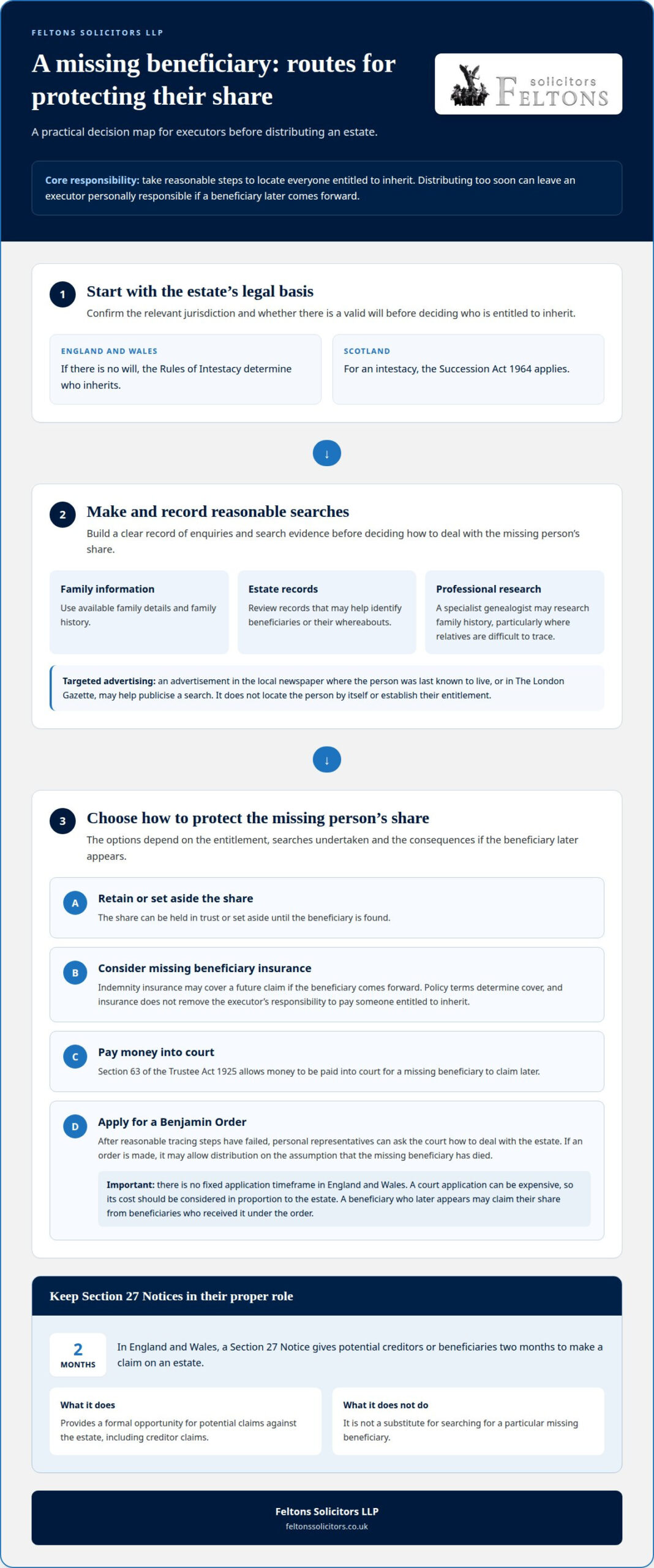
Executors should take reasonable steps to locate every beneficiary before distributing an estate. If someone remains missing, their share can be retained, protected by insurance or dealt with through a court process.
Regional Rules for Missing Beneficiaries
The legal process depends on whether the estate is administered in England and Wales, Scotland or Northern Ireland. This matters because succession rules differ across the UK. In Scotland, the Succession Act (1964) applies when someone dies without a will. For an intestacy in England and Wales, the Rules of Intestacy determine who inherits. Establish the relevant jurisdiction before deciding how to handle a missing person’s share.
Solicitors Who Trace Missing Beneficiaries
Probate solicitors advise personal representatives on their duties, available options and the evidence needed before distribution. A specialist genealogist can research family history to identify beneficiaries, particularly where there is no will or relatives are difficult to trace. The executor remains responsible for taking reasonable steps to locate everyone entitled to inherit. Missing beneficiary probate search solicitors can advise on how search findings affect decisions about the estate.
Where a beneficiary remains untraced, missing beneficiary insurance, also called missing beneficiary indemnity insurance, may cover a future claim if they come forward. The policy terms determine what it covers, and insurance does not remove the executor’s responsibility to pay an entitled beneficiary. Missing beneficiary probate search solicitors can help assess search evidence and explain the risks of relying on insurance.
Other options include holding the share in trust or setting it aside until the beneficiary is found. According to UK Parliament, Section 63 of the Trustee Act 1925 allows money to be paid into court for a missing beneficiary to claim later. A court order may also determine how the estate can be distributed. The decision should account for the person’s entitlement, searches undertaken and consequences if they later appear.
Intestacy makes identifying beneficiaries especially important. According to UK Government, in England and Wales, when the deceased was married and had children, a surviving spouse or civil partner is entitled to the first £322,000 of the net estate. Family trees and estate records can help establish who else may inherit.
Benjamin Orders
A Benjamin Order is a court order that determines how an estate can be distributed when a beneficiary is missing. It may allow personal representatives to proceed on the basis that the person had died.
Benjamin Order Applications
Personal representatives can apply to the court when reasonable steps have failed to locate someone entitled to inherit. They ask the court to decide how to deal with the estate despite the beneficiary’s absence.
There is no fixed timeframe for applying in England and Wales. Whether to apply depends on the search evidence, the circumstances of the estate and whether other options can address the risk. A court application can be expensive, so it is important to consider whether the cost is proportionate, particularly for a very small estate.
Before applying, personal representatives should assemble a clear record of their attempts to trace the beneficiary. Records of enquiries and information supporting the proposed distribution help explain why they are seeking the court’s direction. A Benjamin Order is not an automatic step whenever someone cannot be found.
Using Benjamin Orders
If the court makes an order, personal representatives may distribute the estate on the assumption that the missing beneficiary has died. The order sets out how distribution should proceed and can protect the executor against a later claim to the estate.
That protection does not mean a beneficiary who later comes forward has no route to their inheritance. They can claim their share from beneficiaries who received it under the order. The order guides distribution, but the potential claim remains relevant to those recipients.
Executors should weigh this route against holding the missing person’s share or arranging missing beneficiary insurance. The right approach depends on the quality of the search, the estate’s size and the consequences of delay. Advice on probate and estate planning can help personal representatives assess the application and its implications before distributing the estate.
Statutory advertisements and Section 27 Notices
Advertisements can help alert people to an estate, but they serve different purposes. A notice seeking a particular missing beneficiary is not the same as a Section 27 Notice, which addresses claims against the estate. Understanding that distinction helps personal representatives choose the right step during administration.
To publicise a search for a beneficiary, personal representatives can place an advertisement in the local newspaper where the person was last known to live, or in The London Gazette. If details are available, the advertisement may include the beneficiary’s name, last known address and relationship to the deceased. This can help readers recognise who is being sought. Advertising may be useful when direct enquiries have not resolved a difficult search, but it does not establish the person’s entitlement or locate them by itself.
A Section 27 Notice is a statutory advertisement concerning potential claims against the estate, including creditor claims. In England and Wales, according to UK Parliament, it gives potential creditors or beneficiaries two months to make a claim on an estate. The notice forms part of the Trustee Act 1925. Its purpose differs from a targeted newspaper appeal: it provides a formal opportunity for claims to be raised, rather than conducting a personal search for one named beneficiary.
Creditors may have six years from the date of the grant to make a claim, unless a relevant Section 27 Notice has been issued. After publication, a creditor’s claim limit can be as short as two months. Personal representatives should therefore distinguish the notice period from their separate responsibility to make reasonable efforts to trace each beneficiary. Publishing a notice does not mean an unknown heir has been found.
For example, if estate records identify a beneficiary’s former address, an advertisement in that area may prompt useful information. A Section 27 Notice instead helps address debts or claims arising from the deceased’s estate. Neither notice automatically transfers a missing person’s inheritance to other beneficiaries. The choice of publication and the next steps should reflect the purpose of the notice and the information available.
How probate research locates missing beneficiaries
Research does more than collect possible leads: it assesses whether the evidence identifies the right person. Careful evaluation helps personal representatives distinguish a credible match from a name that merely looks similar.
Research Methods for Tracing Beneficiaries
Researchers compare details across records, looking for consistency in names, dates, relationships and addresses. A change of surname or a common name can make a record inconclusive, so a proposed match should fit the wider family history. Investigate conflicting details rather than making assumptions.
A report can set out the evidence, explain how separate records connect and identify remaining gaps. This gives executors a clearer basis for deciding whether further enquiries are needed or whether the person’s identity and entitlement can be established. Missing beneficiary probate search solicitors can help interpret the report alongside the estate’s legal position.
Tracing Firms and Probate Solicitors
Beneficiary tracing firms focus on genealogical investigation and evidence of identity or family relationships. Probate solicitors address the legal questions that follow, including entitlement, distribution and personal representatives’ responsibilities. The roles can complement each other, but research alone does not determine how an estate should be administered.
Executors remain responsible for taking reasonable steps to identify beneficiaries. Missing beneficiary probate search solicitors can assess how the findings affect that responsibility and whether unresolved evidence calls for further action. In practical terms, researchers build and explain the evidence, while solicitors advise on its legal consequences.
Time Taken to Trace a Beneficiary
There is no single timetable for tracing a beneficiary. The work depends on how much reliable information is available, whether records support one another and whether gaps require further investigation. A well-supported identity may be established sooner than one involving uncertain family links or conflicting documents.
The probate process generally takes between 12 and 18 months, although some cases take longer; that is not a guaranteed tracing period. Executors can use progress reports to understand what has been established and what remains open. For advice on applying research findings to estate administration, discuss probate research and estate administration.
Feltons Solicitors LLP: Wills, Probate, and Estate Planning
Feltons Solicitors LLP advises personal representatives dealing with an estate where a beneficiary is missing. The firm’s wills, probate and estate planning services can help you understand search findings, consider available options and make informed decisions about administering the estate.
Seek legal advice when enquiries have not located someone entitled to inherit, or when you’re considering whether to retain their share, arrange indemnity insurance or apply for a Benjamin Order. Advice can clarify the implications of each option and the information needed to support your next step. It can also help you understand how to proceed without treating a statutory notice as a substitute for tracing a beneficiary.
If you need advice about a missing beneficiary or an estate administration decision, contact Feltons Solicitors LLP.
Choose a considered next step
A missing beneficiary can leave important decisions unresolved, but a clear search record and advice on the options can help you move forward. Before taking the next step, gather the will or intestacy details, any information about the beneficiary and a record of enquiries already made. This gives your solicitor a useful starting point for understanding the estate’s position and the decisions that remain.
Missing beneficiary probate search solicitors can help personal representatives consider how tracing evidence relates to their responsibilities for the estate. The right approach depends on the circumstances, so discuss the available options before distributing the inheritance or taking further action.
For guidance on an estate involving a missing beneficiary, contact Feltons Solicitors LLP for advice. A measured conversation can help you identify a practical way forward.
Frequently Asked Questions
What do you do if you need to locate a beneficiary?
Start with the will and the deceased’s papers, which may contain an address or explain how they knew the beneficiary. Ask relatives and friends for relevant leads, then compare these with electoral registers and birth, marriage and death records. Keep a dated record of enquiries and useful findings. If the family connection is unclear, a professional genealogist can help establish who may be entitled.
What are an executor’s duties towards a missing beneficiary?
An executor must administer the estate according to the will and take reasonable steps to identify and locate everyone entitled to inherit. This includes people named individually and those entitled under intestacy. Record the enquiries made, and don’t treat an unanswered letter as proof that someone has died or given up their entitlement. If a beneficiary remains missing, consider how to protect their share before deciding how to distribute the estate.
Who is entitled to inherit after a death?
Entitlement usually follows a valid will; where there is no valid will, intestacy rules determine who inherits. A will may name individuals or identify a group, such as grandchildren, as beneficiaries. The applicable rules depend on where the estate is being administered. In Scotland, the Succession Act (1964) applies to the control and distribution of estates when someone dies without a will. Family relationships alone do not always establish entitlement.
How can I do this?
To organise a search, collect the beneficiary’s full name, former addresses and clues about their connection to the deceased. Review the will file and estate papers, then ask relatives or friends about possible changes in circumstances. Use records to test leads rather than relying on a single match. Keep search notes together so personal representatives can see what has been checked and what remains unresolved.
What should executors do if a beneficiary cannot be found in the UK?
Executors should continue reasonable enquiries and keep a record of the steps taken. Depending on the circumstances, they can retain the beneficiary’s share, consider indemnity insurance, or seek a court’s direction before distributing. A Section 63 payment into court is another route in England and Wales. These options address different risks, so the executor should consider the evidence, the estate’s position and the likely effect of each decision.
How can you search for a missing beneficiary during probate?
Use the probate period to build a documented trail: review the will and correspondence, speak with people who knew the deceased, and follow credible leads through public records. If the search suggests the beneficiary has died, investigate whether their relatives may be entitled instead. A genealogist can assist with family-history research, while probate legal advice can help personal representatives assess how the results affect the estate.