

What if you remember the dust and conditions in a tunnel, but not every contractor or date you worked there? Incomplete records don’t automatically determine whether your diagnosis could be connected with your work. Tunnel worker dust disease claims solicitors can assess how your medical history may relate to your employment and possible exposure.
It’s understandable to feel unsure, particularly when symptoms or a diagnosis arise years after tunnel work has ended. Conditions such as silicosis can be associated with occupational dust exposure, but every person’s circumstances are different. Medical evidence, recollections of site work and surviving employment records may all help build a clearer picture.
This guide explains which dust diseases may be relevant, what medical, work and exposure information could support an assessment, and why legal time limits need careful consideration. It also outlines how specialist solicitors can review the available evidence and explain your options without promising a particular outcome. Feltons Solicitors handles specialist silicosis litigation and complex disputes, offering considered guidance to people weighing up their next step.
Key Takeaways
- Silicosis, pneumoconiosis and asbestosis are distinct diagnoses. Understanding which condition you have is an important starting point.
- A claim assessment may bring together medical records, tunnel work history and evidence of possible dust exposure.
- Missing work records or symptoms that appeared years later don’t automatically settle your options. Time limits depend on the facts of your case.
- When comparing tunnel worker dust disease claims solicitors, consider their occupational disease experience and how clearly they explain evidence, risks and next steps.
- Feltons handles specialist silicosis claims and complex litigation, with guidance tailored to your medical and work history.
Tunnel worker dust disease claims: which conditions and exposures matter?
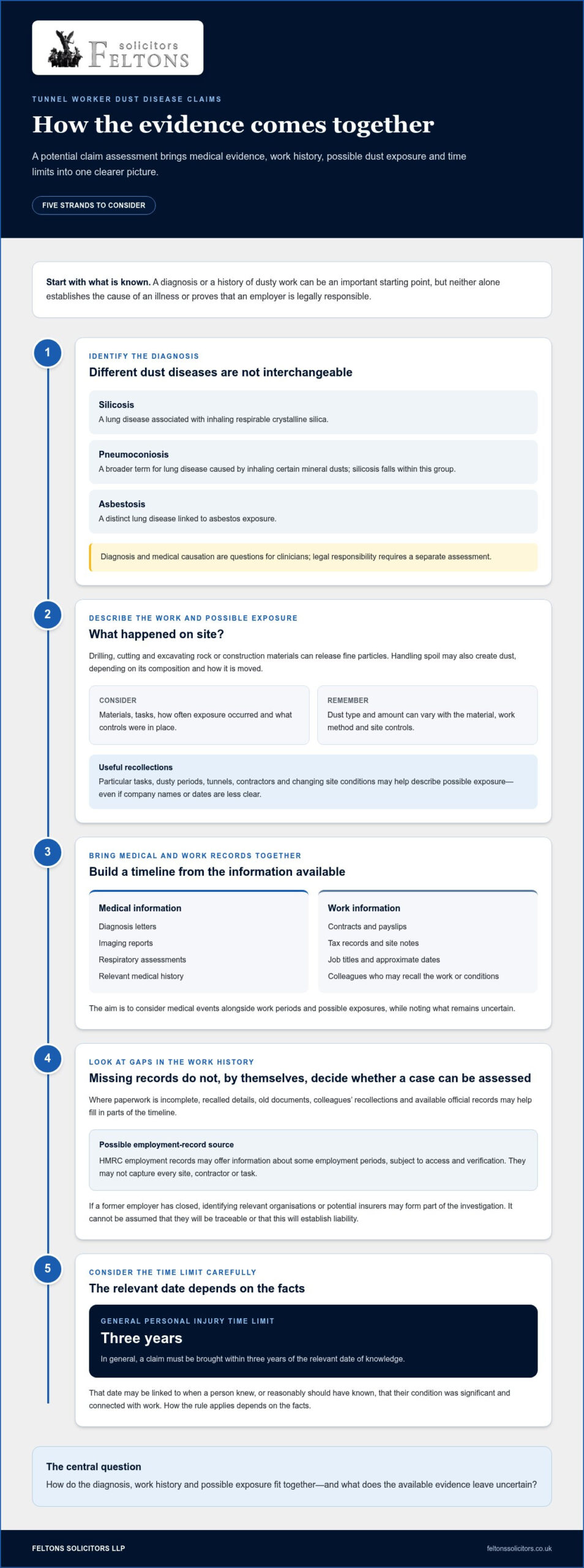
A dust disease claim is a potential personal injury claim assessed by looking at medical evidence alongside a person’s work and exposure history. For tunnel workers, relevant questions may include what materials were present, which tasks created dust, how often exposure occurred and what controls were in place. A diagnosis or history of dusty work can be an important starting point, but neither alone establishes the cause of an illness or proves that an employer is legally responsible.
How can tunnel work expose people to respirable dust?
Drilling, cutting and excavating rock or construction materials can release fine particles into the air. Handling spoil may also create dust, depending on its composition and how it is moved. Some rock and construction materials contain respirable crystalline silica, particles small enough to be breathed deep into the lungs. The type and amount of dust can vary with the material, work method and controls used on site.
A work history may span several tunnels, contractors and changing site conditions. You may recall particular tasks or dusty periods more clearly than company names or dates. Those details can help describe possible exposure, but should be considered alongside records and medical evidence, not treated as proof on their own.
What is the difference between silicosis, pneumoconiosis and asbestosis?
Silicosis is a lung disease associated with inhaling respirable crystalline silica. Pneumoconiosis is a broader term for lung disease caused by inhaling certain mineral dusts; silicosis falls within this wider group. Asbestosis is a distinct lung disease linked to asbestos exposure. These terms describe different diagnoses or categories, not interchangeable names for any illness following dusty work. A general medical overview is available in Pneumoconiosis and other dust-related diseases.
The distinction matters because the suspected substance and medical diagnosis shape how exposure history is examined. Evidence of silica-bearing rock, for example, does not establish asbestosis, just as a history of asbestos exposure does not itself confirm a particular disease. Tunnel materials and conditions can vary between projects, so each potential exposure needs individual consideration. Diagnosis and medical causation are questions for clinicians; legal responsibility requires a separate assessment of the available evidence.
For a potential claim, the key is the connection between diagnosis, work and exposure. Tunnel worker dust disease claims solicitors can consider those strands together, while keeping the medical assessment distinct from the legal question of responsibility.
Linking tunnel worker diagnoses to workplace exposure
Assessing a potential claim means bringing several strands of evidence together: the diagnosed condition, the work and materials involved, the employers or contractors connected with that work, and the applicable legal time limit. Medical records may show when a condition was identified and how it has developed. An occupational history can then be considered alongside them to explore whether particular work may have involved relevant dust exposure.
This is an investigation, not an assumption that a diagnosis proves who was responsible. The Health and Safety Executive’s official statistics on occupational lung disease provide wider context about work-related illness, but general figures cannot establish the cause of an individual’s condition or the outcome of a claim.
Which medical and work records may help assess a claim?
Start with what you have. Useful material may include diagnosis letters, imaging reports, respiratory assessments and relevant medical history. Work evidence could include contracts, payslips, tax records, site notes, job titles, approximate dates and the names of colleagues who may remember the work or conditions.
You don’t need a complete file before an assessment can begin. A solicitor can help organise the information, identify gaps and consider what further investigation may be appropriate. The aim is to build a clear timeline linking medical events with work periods and possible exposures, while noting what remains uncertain.
What if employers have closed or the work history is incomplete?
Missing paperwork does not, by itself, decide whether a case can be assessed. Tunnel work may involve several contractors and changing arrangements, so write down any details you can recall, even if dates are approximate. Old documents, colleagues’ recollections and available official records may help fill in parts of the timeline.
HMRC employment records may offer a possible source of information about some employment periods, subject to access and verification. They may not capture every site, contractor or task. If a former employer has closed, identifying relevant organisations or potential insurers may be part of the investigation. However, it cannot be assumed that they will be traceable or that this will establish liability.
Time limits also need individual attention. In general, a personal injury claim must be brought within three years of the relevant date of knowledge, which may be linked to when a person knew, or reasonably should have known, that their condition was significant and connected with work. How that rule applies depends on the facts, so don’t rely on diagnosis or retirement dates alone to determine your position.
Incomplete evidence can still be worth organising. Tunnel worker dust disease claims solicitors can review the medical and work history together, explain what is known and what needs investigation, and discuss possible next steps. Explore Feltons’ personal injury and silicosis claims support for guidance tailored to your circumstances.
Can you claim if symptoms appeared years later or records are missing?
Symptoms appearing long after tunnel work ended don’t automatically make a claim impossible. Some occupational lung diseases can take years to become apparent, so the passage of time alone doesn’t settle whether a claim can be considered. Equally, a diagnosis or remembered exposure doesn’t, by itself, prove that a particular employer was legally responsible.
How do delayed symptoms affect a potential claim?
In England and Wales, a personal injury claim must generally be brought within three years of the relevant date. For a disease claim, this may run from the date of knowledge: when you knew, or should reasonably have known, that you had a significant condition and that it might be linked to your work. A diagnosis may be important, but it isn’t automatically the relevant date in every case. The way the time limit applies depends on the individual facts, so seek legal advice promptly after a diagnosis rather than trying to calculate the deadline alone.
Keep medical correspondence, appointment dates and diagnosis documents together. A simple timeline can also help: note when symptoms began, when you first sought medical advice, what you were told and when a possible work connection was raised. These details can help a solicitor assess the limitation question alongside medical and occupational evidence. Don’t discard older records, even if they seem incomplete.
Does a former employer closing prevent an investigation?
No. A business closing doesn’t, by itself, establish whether a potential claim can be investigated. Depending on the available evidence, enquiries may include identifying the relevant employer or contractor and exploring whether an insurer can be traced. Those steps can be complex, and there’s no guarantee that a responsible party or insurer will be found. Missing employment paperwork is a separate issue from proving exposure, medical causation, legal responsibility or compliance with the time limit.
There may also be a separate state benefit route. GOV.UK explains the Industrial Injuries Disablement Benefit (IIDB) scheme, which is distinct from a personal injury claim and has its own eligibility rules. Whether it’s relevant depends on the diagnosed condition and personal circumstances.
Don’t assume that years passing or an employer closing answers the legal question. Tunnel worker dust disease claims solicitors can review the circumstances, explain how limitation rules may apply and identify what further enquiries could help. Advice can clarify your options without guaranteeing that a claim will succeed.
How should you compare tunnel worker dust disease claims solicitors?
Choosing legal support is a significant decision, particularly when a possible claim involves a complex work history or a condition identified years after exposure. Look for a solicitor who understands industrial disease litigation and can explain how medical evidence, tunnel tasks and employment history may fit together. Clear advice should also cover uncertainties, possible risks, relevant time limits and next steps, without suggesting that a claim or compensation is guaranteed.
What experience and approach should a specialist demonstrate?
Useful guidance should make technical issues understandable. You should be able to see how a solicitor would consider diagnosis records alongside the materials handled, tasks performed, work sites and contractor relationships you can recall. Feltons handles specialist silicosis litigation and complex disputes, with advice tailored to the information and circumstances of each case.
Use these points to consider whether the proposed approach is clear and practical:
| Question to consider | Useful indicator | What to clarify in writing |
|---|---|---|
| How will my medical and work history be assessed? | The explanation connects diagnosis, possible exposure and employment evidence, and identifies gaps without treating assumptions as facts. | What information is needed from you, and what further enquiries may be considered? |
| How will the legal position and time limits be reviewed? | The solicitor explains that the assessment depends on your circumstances and distinguishes evidence of illness from questions of causation and responsibility. | What limitation issues have been identified, and what should happen next? |
| How will I understand progress and decisions? | Communication is in plain English, reflects your needs and makes risks and options understandable. | How will updates be provided and important decisions explained? |
What should you understand about costs and funding?
Funding terms can differ between firms and cases, so don’t assume one arrangement applies to every claim. Before deciding how to proceed, read the proposed agreement and ask for a written explanation of how legal costs are handled, whether any deductions could apply and when you might be responsible for payments. Make sure you understand the terms and their implications rather than relying on a general description of a funding arrangement.
Clear advice should help you make an informed choice, not rush you towards one. If you’re considering your options, discuss your tunnel worker dust disease claim with Feltons.
What happens when you ask Feltons about a tunnel worker dust disease claim?
Speaking to a solicitor can clarify what information may matter and what options could be available. Feltons handles complex litigation and specialist silicosis claims, with guidance shaped around each person’s medical history, work and potential exposure. An initial conversation doesn’t determine the outcome of a claim, but it can make the next steps clearer.
What information can you prepare before speaking to a solicitor?
If it’s convenient, gather what you have. You don’t need a complete file before making an enquiry. Useful starting details may include:
- A diagnosis summary, medical letters or details of relevant assessments.
- Approximate dates of tunnel work, known employers or contractors, and any sites you remember.
- The tasks you carried out, materials you worked with and conditions where dust was present.
- What you recall about dust controls, protective equipment and colleagues who may remember the work.
Approximate dates and partial memories can still help shape an initial discussion. Don’t delay seeking advice solely because some records are missing or you can’t remember every employer.
How can Feltons support an occupational silicosis enquiry?
The process can be considered step by step:
- Initial enquiry: Share the outline of your diagnosis and tunnel work, including anything you’re uncertain about.
- Information gathering: Relevant medical records, employment details and recollections of tasks or exposure can be organised for review. Gaps may be identified for possible further investigation.
- Case assessment: The available evidence is considered together to assess the potential connection between your condition and work, explain relevant legal issues and discuss possible next steps.
Feltons’ experience in silicosis litigation informs a tailored review of medical evidence, work history and potential exposure. Any assessment is specific to the circumstances and evidence available; it doesn’t guarantee eligibility, legal responsibility or a particular result.
If you’re enquiring on behalf of someone who has died, you may also find Feltons’ guide to a silicosis claim after death helpful. Each situation deserves careful consideration.
A clear first conversation can help you understand what may be relevant. If you’re considering speaking with tunnel worker dust disease claims solicitors, Feltons invites you to discuss your circumstances and potential next steps.
Take a clear next step with your work history
A potential tunnel dust disease claim depends on more than the name of a diagnosis. Silicosis, pneumoconiosis and asbestosis are distinct conditions, and assessing a possible claim means considering medical evidence alongside your work and exposure history. Missing records or symptoms that emerged years later don’t automatically settle the question, but time limits and legal responsibility need careful, individual assessment.
Specialist tunnel worker dust disease claims solicitors can help organise the available information, identify gaps and explain what may happen next. Feltons handles specialist silicosis litigation and complex disputes, with guidance tailored to the circumstances and evidence of each case. No outcome can be assumed, but a considered review can help you make an informed decision.
If you’re ready to discuss your circumstances, speak with Feltons Solicitors. A clear conversation can be a constructive first step towards understanding your options.
Frequently Asked Questions
Can tunnel workers claim compensation for silicosis?
A tunnel worker may be able to explore a claim if medical and workplace evidence supports a link between diagnosed silicosis and occupational exposure. Specialist tunnel worker dust disease claims solicitors can assess the available information, including work history, potential exposure, possible legal responsibility and relevant time limits. A diagnosis or tunnel work alone doesn’t guarantee a successful claim. The assessment depends on the individual evidence and circumstances.
What dust diseases can affect tunnel workers?
Tunnel workers may encounter different dusts depending on the rock, construction materials and tasks involved. Silicosis is associated with inhaling respirable crystalline silica. Pneumoconiosis is a broader term for certain lung diseases caused by mineral dust, whilst asbestosis is linked to asbestos exposure. These are distinct conditions, not interchangeable labels. A clinician must diagnose the illness, and medical evidence is needed to assess its possible connection with an individual’s work.
Can I make a claim if I cannot remember all my tunnel employers?
An incomplete work history doesn’t automatically prevent an initial assessment. Approximate dates, tunnel sites, job roles, contractors, contracts, payslips and the names of former colleagues may help build a timeline. Other employment records may also provide useful details, depending on what is available and accessible. A solicitor can review the information you have, identify gaps and explain whether further enquiries about former employers or insurers may be appropriate.
What if the company I worked for has closed?
A former employer closing doesn’t, by itself, determine whether a claim can be investigated. The company’s history, the work you carried out, potential legal responsibility and any relevant insurance arrangements may need to be examined. Enquiries to trace an insurer or another responsible party may be possible, but there’s no guarantee one will be found. Details such as the employer’s name, work dates, site and role can help guide those enquiries.
How long after tunnel work can dust disease symptoms appear?
There isn’t one timeline that applies to everyone. Some occupational lung diseases may become apparent years after exposure has ended, so stopping tunnel work doesn’t necessarily establish when a condition was recognised or linked to work. In England and Wales, a personal injury claim generally has a three-year limit linked to the relevant date of knowledge, but how it applies is fact-specific. Keep medical correspondence and seek advice about your circumstances promptly.
What evidence do solicitors need for a tunnel dust disease claim?
Useful information may include diagnosis letters, medical records, imaging or respiratory assessment reports, work dates, employers and contractors, tunnel sites, tasks and materials handled. Notes about dust controls or protective equipment may also help, as could contracts, payslips, tax records and colleagues’ details. You don’t need a complete file before seeking advice. A solicitor can help organise what is available, identify missing information and discuss possible next steps.
How much does it cost to instruct tunnel worker dust disease claims solicitors?
Costs depend on the proposed funding arrangement and the circumstances of the case. Don’t assume every solicitor uses the same terms, or that there will be no legal costs or deductions. Before deciding whether to proceed, ask for a clear written explanation of how fees are handled, what deductions may apply and whether you could be responsible for any payments. Read the agreement carefully and raise anything you don’t understand.