

In 2026, the Register of Overseas Entities is no longer a hurdle; it is the foundation of the UK commercial conveyancing process. You likely recognise that the landscape for a commercial property purchase by overseas entity uk has shifted, placing transparency at the heart of every transaction. It’s natural to feel a sense of unease regarding the stringent disclosure of beneficial ownership or the threat of severe penalties for administrative oversights. These concerns are valid, as a single delay in verification can stall a high-value acquisition indefinitely.
We’re here to provide a steady hand through this process, offering the expert legal guidance you need to secure your investment with confidence. This guide provides a clear roadmap for your acquisition, ensuring you meet every requirement of the Register of Overseas Entities. We’ll walk you through the latest reporting standards, the annual update statement cycle, and the practical steps required to achieve a completion that is entirely free from regulatory friction. You’ll gain the clarity necessary to manage your international portfolio whilst maintaining total compliance with Companies House.
Key Takeaways
- Understand how the Economic Crime (Transparency and Enforcement) Act 2022 has made transparency the central pillar of the UK property market.
- Gain clarity on the 25% control tests used to define beneficial owners, ensuring your entity meets all mandatory disclosure requirements without delay.
- Discover how to structure your commercial property purchase by overseas entity uk to balance tax efficiency with regulatory ease.
- Follow a methodical five-step roadmap for conveyancing that integrates Register of Overseas Entities verification into the heart of the legal process.
- Recognise the value of bespoke legal support in avoiding the administrative friction and heavy penalties associated with non-compliance.
The Regulatory Landscape: Buying UK Commercial Property in 2026
The introduction of the Economic Crime (Transparency and Enforcement) Act 2022 fundamentally altered how international investors approach the UK market. By 2026, the era of anonymous property ownership has effectively ended. Every commercial property purchase by overseas entity uk now begins with a rigorous compliance check, as the legislation serves as a robust gatekeeper for the nation’s real estate assets. HM Land Registry acts as the final enforcement point. They’ll simply refuse to register the transfer of title if the purchasing entity hasn’t secured a valid Overseas Entity ID before completion.
The Shift Towards Transparency
The UK has meticulously organised its property laws to prioritise transparency and deter illicit finance. This shift means that corporate structures once favoured for their privacy are now subject to intense scrutiny. To participate in the market, overseas entities must disclose their “Beneficial Owners” to Companies House. This isn’t a mere administrative formality; it’s a mandatory requirement to ensure that the ultimate individuals in control are identifiable. Investors who embrace this “clean” approach often find that their transactions proceed with greater efficiency, whilst those who ignore the requirements face immediate roadblocks. Lenders and sellers are increasingly wary of opaque ownership chains that might trigger money laundering concerns.
Consequences of Non-Compliance
Failing to adhere to these regulations carries risks that extend far beyond simple transaction delays. Without a verified registration, an entity cannot legally register its ownership at HM Land Registry. This leaves the buyer in a precarious position where they’ve paid for a property but don’t hold the legal title. For any commercial property purchase by overseas entity uk, the lack of an OE ID is a terminal flaw in the conveyancing process. Additionally, the legal framework imposes strict restrictions on future dealings. A non-compliant entity will find it impossible to lease, charge, or sell the asset. Perhaps most significantly, directors and officers of the entity may face criminal sanctions, including heavy fines or even imprisonment, if they knowingly provide false information or fail to update the register annually.
Given these complexities, seeking specialist legal advice before signing a Sale and Purchase Agreement (SPA) is essential. A well-drafted SPA should include specific warranties regarding the entity’s status on the Register of Overseas Entities to protect your interests from the outset. Early preparation ensures that the path to completion remains clear and that your investment is protected by a solid legal foundation.
The Register of Overseas Entities (ROE): A Mandatory First Step
The Register of Overseas Entities is a public register managed by Companies House that records the details of foreign-domiciled owners of UK land. It’s a non-negotiable part of any commercial property purchase by overseas entity uk. An Overseas Entity ID (OE ID) is the unique 10-digit code required for all Land Registry filings to prove the entity is compliant. Without this identifier, your transaction cannot legally proceed to completion. The register ensures that the true owners behind corporate veils are identifiable, creating a more transparent environment for high-value investments.
Identifying a “Beneficial Owner” is the core of the registration process. Usually, this refers to any individual or legal entity that holds more than 25% of the shares or voting rights in the overseas company. However, the law also applies control tests. If an individual has the power to appoint or remove a majority of the board of directors, or otherwise exercises significant influence, they’re a beneficial owner regardless of their shareholding percentage. Identifying these individuals accurately is the first step in building a compliant acquisition structure.
The Verification Process Explained
Accuracy is paramount when submitting data to the register. A UK-regulated agent, such as a solicitor, must verify the information before it’s formally submitted. This involves a methodical review of international corporate documents, which often requires certified translations or apostilles to meet UK standards. When dealing with trusts or complex layering in offshore structures, the verification becomes significantly more intricate. We examine the entire chain of ownership to ensure every registrable person is correctly identified, providing a sense of security for our clients whilst satisfying the stringent requirements of the Economic Crime Act.
Maintaining Your OE ID
Registration isn’t a one-off event. You must file an update statement every 12 months, even if your beneficial ownership remains unchanged. This 12-month update cycle is critical for ongoing property management. A lapsed OE ID can freeze your ability to deal with the asset, preventing you from selling or charging the property. If a change in ownership occurs whilst a transaction is mid-flight, the register must be updated within 14 days of the anniversary of the initial registration to avoid administrative friction.
Managing these statutory requirements requires a professional and methodical approach. Feltons Solicitors LLP provides dedicated support for overseas entity beneficial owner registration, ensuring your filings are precise and timely. If you’re concerned about meeting these deadlines or navigating the verification process, our team can act as your trusted legal partner to maintain your entity’s standing and protect your investment.
Structuring Your UK Commercial Property Acquisition
Choosing the right vehicle for a commercial property purchase by overseas entity uk is a decision that balances tax efficiency against administrative ease. Whilst offshore structures in jurisdictions like the British Virgin Islands (BVI) or Jersey remain common, the regulatory tide is turning. Your choice of entity doesn’t just affect your tax profile; it dictates your ability to secure UK debt finance. Many domestic lenders prefer the familiarity of a UK-incorporated subsidiary. It simplifies their own due diligence and security requirements, often leading to more favourable lending terms.
Offshore Entities vs UK SPVs
Using an offshore entity from a jurisdiction like the Isle of Man can offer specific tax advantages, yet it comes with a heavier administrative burden. You’ll often need formal legal opinions from counsel in that jurisdiction to satisfy UK lenders or HM Land Registry. This adds cost and time to the transaction. Conversely, a UK-resident Special Purpose Vehicle (SPV) is often more straightforward to manage. Foreign directors should also consider their legal liability. Whilst a corporate veil exists, UK law can occasionally look through it in cases of environmental breach or health and safety failures. A UK subsidiary can act as a useful buffer for international parents.
Stamp Duty Land Tax (SDLT) and VAT Considerations
The tax landscape for international investors is nuanced. Whilst the 2% non-resident SDLT surcharge primarily targets residential assets, it can impact mixed-use properties or commercial-residential hybrids. You must also account for the Annual Tax on Enveloped Dwellings (ATED) if your commercial acquisition includes high-value residential elements. VAT is another critical factor. If a seller has “opted to tax” the property, the purchase price effectively increases by 20% upfront. Whilst you can often recover this, it creates a significant cash flow requirement that must be managed during the commercial property purchase by overseas entity uk.
Deciding on the right structure requires a methodical look at your long-term goals. We often advise clients to weigh the merits of commercial property law: buying vs leasing before committing to a specific corporate vehicle. A bespoke approach ensures that your structure remains robust against future regulatory shifts. It provides the security and flexibility needed for sophisticated international portfolio management.
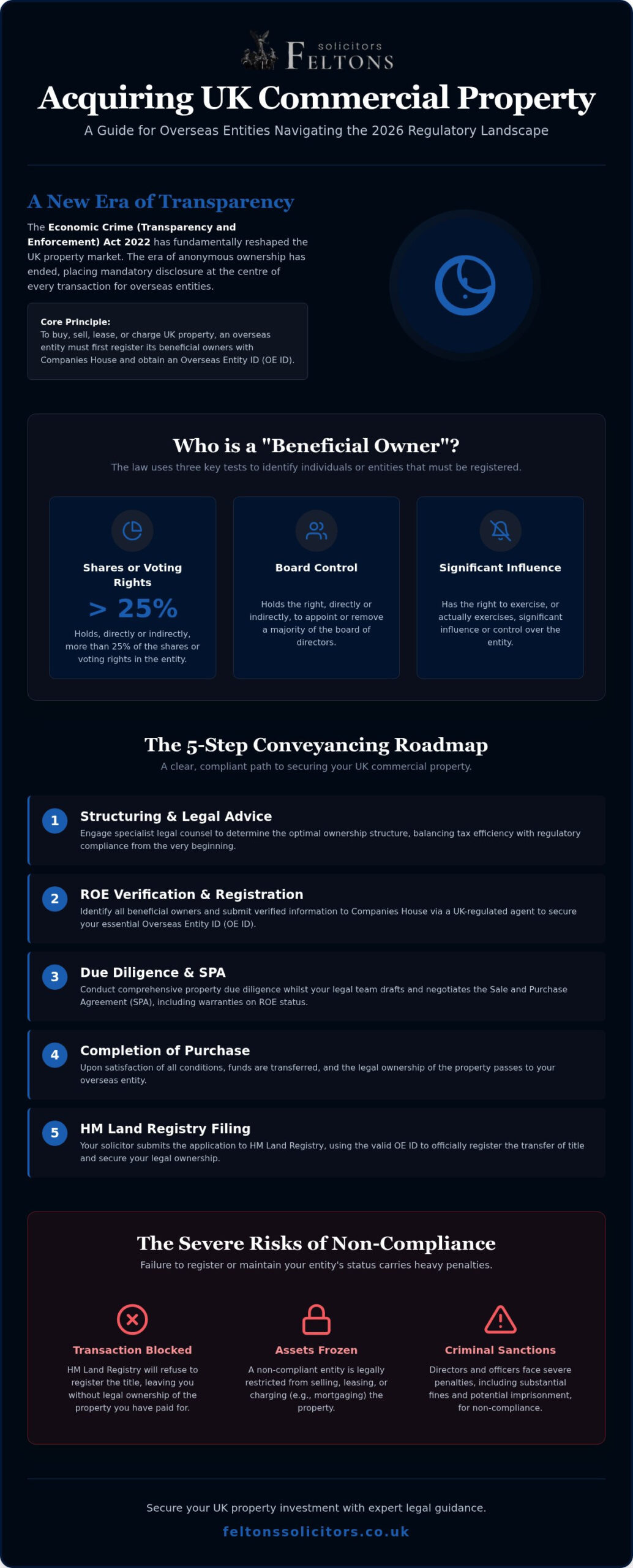
The 5-Step Conveyancing Journey for Overseas Entities
Successfully managing a commercial property purchase by overseas entity uk requires more than just capital; it demands a synchronised legal strategy. By 2026, the Register of Overseas Entities (ROE) isn’t a separate administrative task but a core component of the conveyancing timeline. If these steps aren’t perfectly aligned, you risk significant transaction delays or, in the worst cases, a total collapse of the deal. We guide our clients through a methodical five-step process to ensure a smooth transition from offer to ownership.
- Step 1: Pre-contract due diligence and ROE verification. Before any formal commitment, we verify your entity’s status and ensure your OE ID is active and updated.
- Step 2: Drafting the contract and negotiating the Sale and Purchase Agreement (SPA). We negotiate specific clauses that protect international buyers, particularly regarding warranties for ROE compliance.
- Step 3: Exchange of contracts and payment of the deposit. This is the point of no return. We manage the secure transfer of the 10% deposit, ensuring funds are held safely in a client account.
- Step 4: Pre-completion checks. We perform final anti-money laundering (AML) updates and ensure the seller’s ROE status is also valid, preventing any blocks at the Land Registry.
- Step 5: Completion and registration. Funds are transferred, and we submit the application to HM Land Registry using your unique 10-digit OE ID.
Enhanced Due Diligence and AML
Overseas entities are subject to “Enhanced Due Diligence” under UK law. This means your legal team must go beyond simple identity checks. You’ll need to provide clear documentation regarding your Source of Wealth (SoW) and Source of Funds (SoF). These protocols are designed to confirm that the capital used for the commercial property purchase by overseas entity uk is legitimate and transparent. In 2026, “Know Your Customer” (KYC) requirements are more rigorous than ever, often requiring detailed histories of corporate earnings or investment returns. Preparing this documentation early prevents the “compliance bottleneck” that often stalls international transactions.
Navigating the Completion Process
The final stages of a cross-border transaction involve unique logistical challenges. Coordinating international bank transfers requires precision to account for currency fluctuations and varying time zones. Furthermore, the execution of legal deeds whilst overseas remains a point of detail; whilst digital signatures are increasingly accepted, some documents still require “wet-ink” signatures witnessed by a notary. It’s often beneficial to work with a residential property law firm with deep commercial expertise to handle these nuances. They can bridge the gap between high-standard international service and the practical realities of UK property law.
If you’re planning an acquisition, our specialist commercial conveyancing team is ready to provide the discreet, high-standard support your transaction deserves. Contact us to ensure your next investment is handled with the poise and technical precision it requires.
Why Specialist Legal Support is Essential for Overseas Buyers
In 2026, the complexity of a commercial property purchase by overseas entity uk means that standard legal support is often insufficient. International investors require a partner who understands the high stakes of cross-border acquisitions and the rigorous demands of the Economic Crime Act. At Feltons Solicitors LLP, we position ourselves as a calm, steady presence in the face of these stresses. We recognise that whilst the technical legal work is paramount, the human impact of these transactions is never forgotten. Our approach is designed to provide you with high-end reliability and the quiet confidence that your investment is secure.
Mitigating the risk of transaction collapse is our primary objective. A single administrative oversight in beneficial ownership disclosure or a lapsed OE ID can lead to immediate blocks at HM Land Registry. These errors don’t just delay completions; they can lead to heavy financial penalties and reputational damage. By choosing a specialist firm, you ensure that every detail is scrutinised by experts who handle these complex verification services daily. We manage the intricate due diligence required for international corporate documents, ensuring your path to completion remains clear of regulatory friction.
Discreet and Tailored Service
We believe that high-standard international service should feel personal. As a boutique firm, we prioritise personal connection over high-volume processing, acting as a sophisticated guide through the UK legal market. This allows us to provide pragmatic advice that is tailored to your specific portfolio goals. Whether you are a first-time investor or managing a large commercial estate, we offer the same level of discreet, high-standard care. This commitment to excellence extends across our firm, from our conveyancing team to our leasehold enfranchisement experts, ensuring your property rights are always protected.
Contact Feltons Solicitors LLP for International Acquisitions
Beginning your verification and conveyancing process early is the most effective way to ensure a successful acquisition. We’re ready to assist with your initial registration on the Register of Overseas Entities and manage the entire conveyancing journey on your behalf. Our team bridges traditional professional integrity with modern efficiency to deliver results that respect your time and your capital. To take the first step towards a frictionless completion, secure your UK commercial investment with Feltons Solicitors LLP today. Let us act as your trusted advisor in the UK property market.
Securing Your UK Investment with Confidence
The shift towards total transparency in the UK property market represents a significant evolution, yet it should not deter sophisticated international capital. As we’ve discussed, the key to a successful commercial property purchase by overseas entity uk lies in the early alignment of corporate structuring and ROE verification. By addressing the nuances of beneficial ownership and the specifics of the five-step conveyancing journey, investors can avoid the pitfalls of transaction delays and regulatory penalties. The goal is to transform these statutory requirements from a hurdle into a standard, efficient part of your portfolio management.
At Feltons Solicitors LLP, we provide the calm, steady guidance necessary to handle these high-value matters with precision. Our firm operates as a discreet partner, bridging modern efficiency with a deep respect for professional integrity and personal rapport. We invite you to speak with our specialist commercial conveyancing team today to ensure your next acquisition is managed with the boutique-level care it deserves. Together, we can secure your position in the UK market with absolute confidence.
Frequently Asked Questions
Can an overseas company still buy property in the UK after the 2022 Act?
Yes, overseas companies can continue to invest in the UK market. The Economic Crime (Transparency and Enforcement) Act 2022 didn’t ban foreign ownership; it simply introduced a mandatory registration requirement. To complete a commercial property purchase by overseas entity uk, the buyer must obtain a valid Overseas Entity ID from Companies House. This identifier proves the entity has disclosed its beneficial owners, allowing the Land Registry to process the transfer of title without legal obstruction.
How long does it take to register an overseas entity with Companies House?
Registration typically takes a few working days once Companies House receives the application. However, the pre-submission phase often takes longer. A UK-regulated agent must first verify all beneficial ownership details, which involves reviewing international corporate documents and identity records. Depending on the complexity of your offshore structure and the speed of document retrieval, the entire process from initial instruction to receiving your OE ID usually spans several weeks. Early preparation is essential for maintaining transaction timelines.
What happens if an overseas entity fails to update its beneficial owner information?
Failing to file an annual update statement has severe consequences for your investment. Your Overseas Entity ID will become invalid, which effectively freezes your ability to deal with the property. You won’t be able to sell, lease, or charge the asset until the register is corrected. Additionally, the entity and its officers may face daily fines. For any commercial property purchase by overseas entity uk, maintaining an active registration is a critical ongoing compliance duty.
Do I need a UK bank account to buy commercial property as a foreign entity?
You aren’t legally required to hold a UK bank account to buy commercial property, but it’s practically indispensable. Whilst you can often transfer purchase funds from abroad, you’ll need a domestic account to manage rental income, pay UK taxes, and handle utility bills or service charges. Many international investors find that setting up a UK-resident Special Purpose Vehicle (SPV) makes opening a domestic account significantly easier than doing so for a foreign-domiciled company.
Is the Register of Overseas Entities information available to the public?
Yes, most information on the Register of Overseas Entities is accessible to the public. Anyone can search Companies House to view the names of beneficial owners and the entity’s registration details. Certain sensitive information, such as home addresses or full dates of birth, remains protected from public view. This transparency is a central pillar of the 2022 Act, designed to ensure that the ultimate individuals in control of UK land are identifiable to the public.
How much does the ROE verification process cost for a foreign company?
The cost of the verification process varies based on the complexity of your corporate structure. Companies House charges a fixed registration fee of £100 and an annual update fee of £120. Beyond these government charges, you’ll also incur professional fees for the mandatory verification services provided by a UK-regulated agent. These fees reflect the rigorous due diligence required to examine international deeds, trust documents, and shareholder registers to ensure total accuracy before submission.
Can I use an overseas entity to buy residential property as well as commercial?
Overseas entities can buy both commercial and residential property in the UK. However, the tax regimes differ significantly. Residential acquisitions trigger a 2% non-resident SDLT surcharge, which does not apply to non-residential commercial assets. You may also face the Annual Tax on Enveloped Dwellings (ATED) for high-value homes. Regardless of the property type, the requirement to register with Companies House remains mandatory for any foreign-domiciled legal entity owning UK land.
What are the penalties for providing false information to the Register of Overseas Entities?
Providing false or misleading information to the register is a serious criminal offence. If an individual or entity knowingly submits incorrect data, they face significant penalties under the Economic Crime Act. This includes potential unlimited fines and criminal prosecution for both the entity and its officers. The UK government uses these stringent measures to maintain the integrity of the register, ensuring that all disclosures regarding beneficial ownership are both honest and verifiable.