

Boundary dispute mediation solicitors in the UK: finding your boundary

Boundary dispute mediation solicitors in the UK: finding your boundary

The line on your title plan may not be the legal boundary. Most registered properties in England and Wales are subject to the general boundaries rule, so the plan usually indicates the boundary’s general position rather than fixing it precisely. Boundary dispute mediation solicitors in the UK can help you assess deeds and other evidence, then explore mediation before court proceedings.

It’s understandable to expect a clear answer from the Land Registry plan, especially when a fence or wall appears to mark the divide. But the legal position may depend on how title documents, historic features and conditions on the ground fit together.

This article explains what title plans and deeds can show, what evidence may help establish a boundary, and how mediation works. It also covers when a surveyor’s input may be useful, how to record an agreement, and why court costs make litigation a route to consider carefully rather than an automatic first step.

Key Takeaways

  • Treat the title plan as a guide to the boundary’s general position, then compare it with deeds and evidence from the land itself.
  • Gather relevant documents and photographs before deciding whether expert input could help clarify the dispute.
  • Consider negotiation or mediation as a route to agreement before court proceedings, which can bring substantial costs.
  • Make any agreed boundary clear in the documents and plan, so uncertainty is less likely to arise again when a property is sold.
  • Where an expert is involved, their role is to assist the tribunal impartially, not simply to support the party paying for their report.

Court costs and unreasonable refusal to mediate

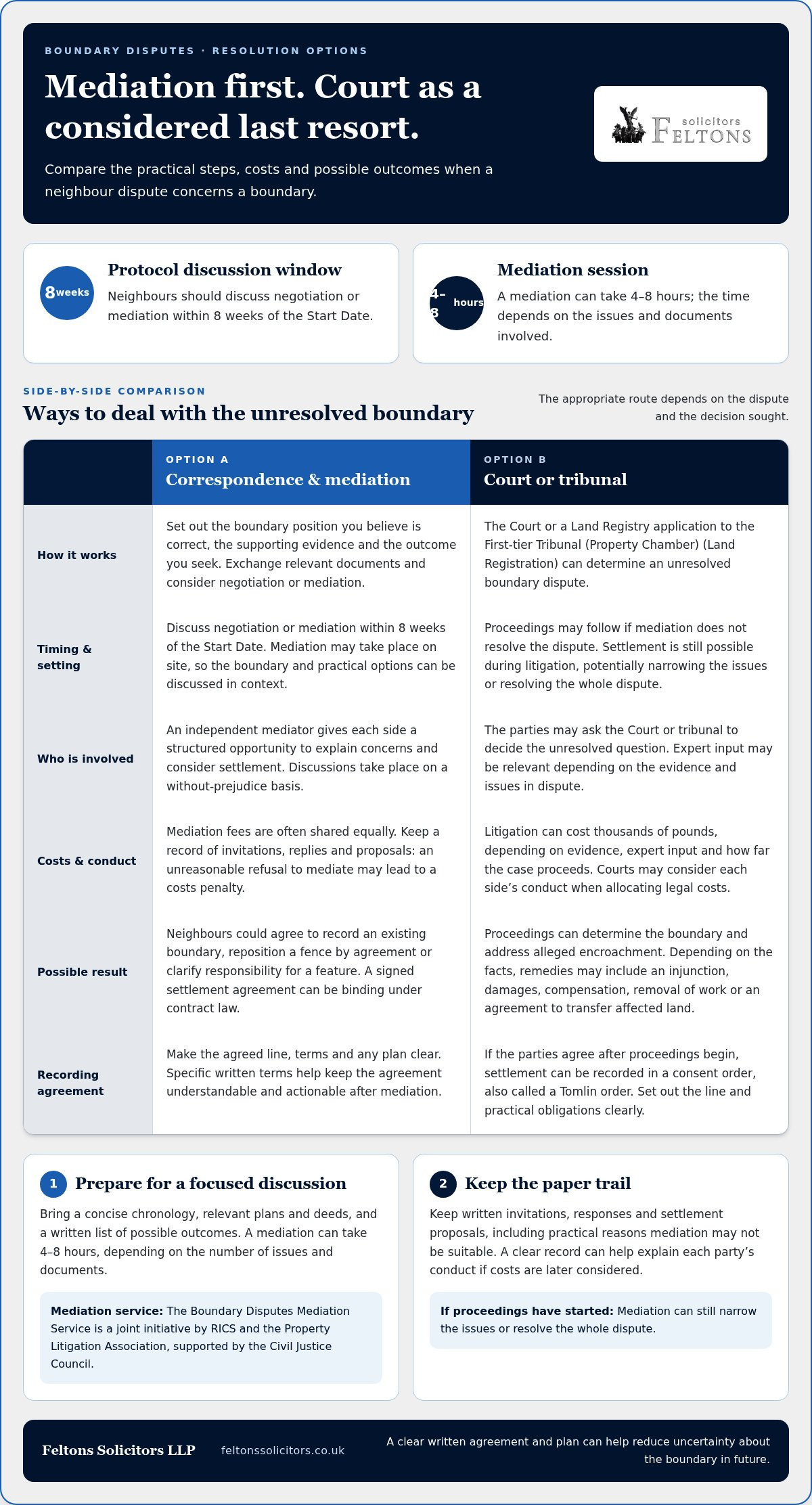
Mediation is recommended before court, and boundary proceedings should be a last resort after the parties have tried alternative dispute resolution. A party who unreasonably refuses mediation may face a costs penalty, even if they later succeed on the boundary question. Courts can consider each side’s conduct when deciding who should bear the legal costs, so a clear written invitation and a reasoned response matter.

In Huntley v Armes, cited by the Court of Appeal (Civil Division) as [2010] EWCA Civ 396, the dispute concerned a strip measuring 14 inches. The case is a reminder that a small area can still lead to formal proceedings and cost consequences. Keep records of proposals, replies and any practical reasons mediation may not be suitable; those details can help explain your conduct if a judge later considers costs.

The Boundary Disputes Protocol identifies the Court or a Land Registry application to the First-tier Tribunal (Property Chamber) (Land Registration) as routes for determining an unresolved boundary dispute. The appropriate route depends on the nature of the dispute and the decision sought. A solicitor can advise on the process, evidence and remedies relevant to your rights before you make an application.

Starting proceedings does not rule out settlement. The parties can mediate during litigation, potentially narrowing the issues or resolving the whole dispute. If they agree, the settlement can be recorded in a consent order, also called a Tomlin order, once proceedings have begun. Set out the agreed line and practical obligations clearly, rather than relying on an informal conversation or ambiguous sketch.

Where the dispute involves building work near a shared wall, distinguish boundary questions from party-wall issues. The Party Wall Act 1996 concerns building work affecting shared structures between two properties, according to UK Parliament. UK Parliament also identifies a 3 metre provision as a frequently misunderstood component of the Party Wall etc Act 1996. That provision should not be treated as deciding ownership of a disputed strip of land.

Court proceedings can determine the boundary and address alleged encroachment. Depending on the facts, possible remedies include an injunction, damages, compensation, removal of work or an agreement to transfer affected land. If construction is still under way, prompt advice may preserve more practical options. Planning permission or building regulations approval does not itself give a neighbour ownership of, or a right to build on, your land.

Before escalating, organise the title documents, photographs and a concise chronology of events. Identify the outcome you want, such as confirming the boundary, stopping work or recording an agreement. Then consider whether negotiation or mediation could achieve that outcome without a final hearing. If the other party declines, keep a record of their reasons and your response; the courts may consider that conduct when allocating costs.

Alternative dispute resolution

Mediation is one route to a practical agreement, alongside focused correspondence and expert discussions. If it fails, the parties can still pursue litigation, which can cost thousands of pounds depending on the evidence, expert input and issues in dispute. A solicitor handling boundary dispute mediation in the UK can help assess which route best fits the unresolved points.

Correspondence and mediation

Start with a clear letter setting out the boundary position you believe is correct, the evidence supporting it and the outcome you seek. Neighbours can then exchange relevant documents and consider whether negotiation or mediation could resolve the difficult points. Under the Boundary Disputes Protocol, they should discuss negotiation or mediation within 8 weeks of the Start Date.

Mediation gives each side a structured opportunity to explain its concerns and consider a settlement with an independent mediator. Discussions take place on a without-prejudice basis, and mediation fees are often shared equally. Boundary mediations can take place on site, helping everyone discuss the precise line and practical options in context.

The Boundary Disputes Mediation Service is a joint initiative by RICS and the Property Litigation Association, supported by the Civil Justice Council. A mediation can take 4-8 hours, though the time depends on the number of issues and documents involved. Prepare a concise chronology, relevant plans and deeds, and a written list of possible outcomes before the meeting. For neighbours considering boundary dispute mediation in the UK, this preparation helps keep discussion focused on achievable terms.

Keep proposals specific. Neighbours might, for example, agree to record an existing boundary, reposition a fence by agreement or clarify responsibility for a feature. A signed settlement agreement can be binding under contract law. Make its terms and any plan clear, so the agreement remains understandable and actionable after mediation ends.

Options after unsuccessful mediation

The Boundary Disputes Protocol identifies the Court or the First-tier Tribunal (Property Chamber) (Land Registration), by way of a Land Registry application, as routes for determining an unresolved boundary dispute. The next step depends on what remains disputed, the available evidence and the decision needed.

Litigation can cost thousands of pounds. The expense depends on how much evidence must be gathered, whether expert reports are needed and how far the case proceeds. Court proceedings may also result in a costs decision, so keep mediation invitations, responses and settlement proposals to show how each party approached dispute resolution.

When legal advisers are instructed after the initial 8-week period, the Protocol says they should consider whether further negotiation or mediation is appropriate and inform the other party within 2 weeks of appointment. For advice on the legal route and next steps, explore dispute resolution support.

A boundary solicitor reviews title documents and evidence, explains the issues and advises on practical next steps. To find a specialist near you, look for experience in property disputes and boundary evidence, rather than relying on distance alone.

Finding the legal boundary

Start by comparing the Land Registry title plan with the deeds and physical features on the ground. Most registered properties in England and Wales follow the general boundaries rule, so a title plan usually indicates a boundary’s general position rather than its precise measurement. A line on the plan may represent several metres on the ground, so it may not settle a disagreement by itself.

Check whether the official copies record a boundary agreement or formal boundary determination. These can be exceptions to the general guide shown by a title plan. Ordnance Survey maps physical features, not legal boundaries, and its mapping is not precise enough to establish ownership on its own.

Legal and surveying advice

An initial legal assessment brings the available documents together and identifies what remains disputed. A solicitor can compare the title plan, deeds, correspondence and neighbours’ accounts, then advise whether negotiation, a boundary agreement or further evidence may help. This also clarifies the outcome you are seeking, such as confirming the existing line or resolving a claim over land.

If comparing documents does not resolve the position, a specialist surveyor can interpret measurements, historic features and how plans relate to the ground. Consider carefully whether that expertise is needed before instructing an expert, since involving one too early can add considerable expense. The key question is whether a surveyor’s independent analysis would answer an unresolved point.

Risks of moving a fence or wall

Moving a fence does not automatically change the legal boundary or transfer ownership. If a neighbour’s new fence appears to cross the line, moving it back before establishing the boundary can escalate the dispute and complicate a later settlement. Record its location with dated photographs and preserve relevant correspondence before taking physical action.

A solicitor can assess the evidence and explain how a proposed change might affect the parties’ positions. If the dispute concerns building work, distinguish ownership from planning permission or building regulations approval. Those approvals do not themselves give someone ownership of, or a right to build on, neighbouring land.

Boundary litigation can become costly, particularly if the parties need expert reports or a court determination. The eventual expense depends on the issues, evidence and how far proceedings progress, so an early assessment can identify what needs clarification before litigation is considered. Record any settlement clearly, with an accurate plan, to reduce the risk of the same uncertainty returning when either property is sold.
Boundary dispute mediation solicitors in the UK: finding your boundary

Gathering evidence and interpreting title deeds

Build a clear record before discussing the boundary with the other owners. Comparing title documents with historic features and evidence from the ground can help identify where accounts differ.

Land Registry plans and boundary evidence

Use the Land Registry title plan as one part of the evidence, not as a precise survey. Most registered properties in England and Wales are subject to the general boundaries rule, so a plan usually shows the boundary’s general position. A line may represent several metres on the ground.

Compare the plan with the physical features it may relate to, such as a wall, hedge or old fence line. Ordnance Survey maps show physical features rather than legal boundaries, so they cannot settle ownership by themselves. Record any difference between the mapped line and what you see on site.

Evidence used to establish a boundary

Gather documents and observations that may explain how the boundary was created and treated over time. Useful material can include title plans, conveyance documents, dated photographs, correspondence between owners and details of historic features on the land. Keep each item in date order and note what it shows.

Boundary disputes can involve deeds 150 years old. Pre-registration deeds may contain a plan or a detailed written description, and those details can be compared with the present layout. A surveyor can help interpret measurements, historic features and the relationship between documents and conditions on the ground.

Make a short chronology of events, including when a fence was installed, repaired or moved, and when either party first objected. Label photographs with their dates and viewpoints. If a previous owner discussed the boundary, preserve letters or messages and identify anyone who witnessed the conversation.

The Boundary Disputes Protocol sets out practical steps for exchanging material. Neighbours should assemble and exchange relevant documents within 4 weeks of the Start Date. After identifying the First Conveyance, parties should exchange documentary evidence and identify proposed witnesses within 3 weeks.

These steps help both parties see which points are agreed and which remain disputed. For example, documents might establish the original line, while photographs show that a later fence was placed elsewhere. Discuss the difference before deciding whether further expert evidence is needed.

Keep the evidence organised in a shared schedule: list each document, its date, its source and the point it supports. Separate direct evidence, such as a deed plan, from interpretation, such as what a physical feature may indicate. This helps owners discuss the same material and consider whether a boundary agreement or further assessment could resolve the disagreement.

Boundary disputes

Boundary disputes can involve a fence, a wall, building work or long occupation of disputed land. Procedures differ across the UK: the Boundary Disputes Protocol and Land Registry routes discussed here concern England and Wales, not Scotland or Northern Ireland.

Start by defining the issue and the outcome you want. Is the disagreement about the boundary’s position, ownership of a strip, responsibility for a shared feature or construction crossing the line? These questions can overlap, but may require different evidence and remedies. For example, an extension built across a boundary raises questions about the land occupied and whether work should stop or be removed.

Long use of land can also complicate a claim. In England and Wales, a new-style adverse possession claim may rely on a condition in Schedule 6 paragraph 5 of the Land Registration Act 2002. That makes it important to distinguish a claim based on occupation from a disagreement about interpreting a deed. Gather evidence of how the land was used and who controlled it, then identify the specific basis of each party’s position.

A surveyor’s role is to provide independent evidence on physical features, measurements and how documents relate to conditions on the ground. The Boundary Disputes Protocol says expert instructions should follow CPR Part 35.3, according to the Civil Procedure Rule Committee. Under that rule, the expert’s duty to help the tribunal overrides obligations to the person instructing or paying them. Their opinion should address the issue, not advocate for either neighbour.

Before commissioning expert work, set out the question the surveyor must answer and the material they need. If the parties jointly appoint an expert, agree the instruction and provide relevant documents consistently. A concise report focused on the disputed line can help narrow complex disagreements. If litigation follows, a boundary surveyor may need to prepare a CPR-compliant expert report for the court.

Possible outcomes depend on the claim. They may include an agreed boundary, an injunction, damages, compensation, removal of encroaching work or a formal transfer of affected land. A boundary agreement can record where the existing legal boundary lies, but cannot be used to give or sell land to a neighbour. If ownership of land is changing, the parties may need a formal transfer instead.

Set out the unresolved issue, evidence and outcome you want before choosing the next step. Discuss your boundary dispute and the legal options available for resolving it.

Feltons Solicitors LLP: Divorce and Financial Arrangements

Feltons Solicitors LLP provides residential and commercial conveyancing when resolving a boundary issue involves a formal transfer of land. A boundary agreement records where the existing legal boundary lies; it cannot itself give or sell land to a neighbour. If a proposed settlement changes ownership, conveyancing support can help with the property transaction involved.

Before taking that step, establish whether the agreement confirms the existing line or transfers part of a title. Keeping that distinction clear helps ensure the paperwork reflects what both owners have agreed. For help with a property transaction arising from a boundary settlement, contact Feltons Solicitors LLP.

Take a considered next step

A boundary disagreement can affect more than the line on a plan. It may shape how neighbours use their gardens, maintain shared features and approach future property decisions. Before agreeing a way forward, set out the outcome you need and consider how the agreement will be recorded and understood by future owners.

Solicitors handling boundary dispute mediation in the UK can help you assess the legal issues and identify a practical route towards resolution. Feltons Solicitors LLP also advises on divorce and financial arrangements, wills, probate and estate planning, and residential and commercial conveyancing. Conveyancing may be relevant if resolving the dispute involves transferring part of a title.

If you’re ready to discuss your circumstances and possible next steps, contact Feltons Solicitors LLP. A clear starting point can help you approach the dispute with greater confidence.

Frequently Asked Questions

Establishing where the boundary actually is?

Compare the registered title, any filed deeds and the history of the disputed strip, rather than relying on a fence line alone. Note where fixed features sit and whether earlier photographs or conveyancing records show a different arrangement. A useful first step is to mark the disputed section on a copy of the plan, then list the documents or observations that support each neighbour’s position. This focuses discussions on evidence, not assumptions.

How long will it take to resolve a dispute?

There is no single timetable for a boundary dispute: the time depends on the issues, available documents and whether an agreement is reached. A mediation can sometimes resolve the dispute in 4-8 hours, but preparing for it and recording an agreement take additional time. If parties need expert reports or a court decision, the process will involve further steps. Set a practical aim for each stage, such as exchanging documents or narrowing disputed points.

Is the mediation outcome binding?

A settlement recorded in an agreement signed by both parties is binding, and a formal settlement agreement can be enforced under contract law. Before signing, make sure the written terms match the decision reached: identify the boundary clearly, describe any agreed work or responsibilities, and attach a plan both parties understand. If court proceedings have already begun, the settlement may be recorded in a consent order, also called a Tomlin order.

What happens if an agreement cannot be reached?

If mediation does not produce an agreement, the parties can continue negotiating or seek a formal decision through court proceedings or an application to the First-tier Tribunal (Property Chamber) (Land Registration). The next step depends on the unresolved issue and the decision needed. Before proceeding, list the points that are agreed, those still contested and the evidence supporting each position. This can help keep any later application focused.

What if the neighbour has used the land for years?

Long occupation can be relevant, but it does not by itself resolve a boundary disagreement. In England and Wales, a neighbour’s use of land may raise an adverse possession issue, even where the registered title appears to include that land. Record how the area has been occupied, maintained or enclosed, and whether permission was given. Dates, historic photographs and correspondence can help distinguish a long-standing arrangement from a later change in position.

Who can apply for mediation?

Either neighbour can propose mediation, and both parties need to participate for a jointly agreed settlement to emerge. A written proposal can identify the disputed area, the outcome sought and the documents each side should bring. The Boundary Disputes Protocol says neighbours should discuss whether to negotiate or mediate within 8 weeks of its Start Date. Legal advisers can also consider whether further mediation is appropriate when instructed later.

Who pays the fees?

Mediation fees are often shared equally between the parties, though they can agree another arrangement. Clarify who will pay which share before arranging the session, and establish how separate expenses, such as expert input, will be handled. Keep a written record of that agreement. If the dispute later reaches court, a judge may also consider whether either party unreasonably refused mediation when deciding costs.

How much do UK boundary dispute solicitors charge, and what are typical costs?

Solicitor fees depend on the case and are provided after a quote request; the main cost factors include the work required, the complexity of the dispute, the evidence and whether expert reports or court proceedings are involved. Boundary disputes can run into thousands of pounds to resolve legally, with litigation generally adding further stages and expense. Mediation may help contain costs, but its suitability depends on what remains disputed.

Removing Overseas Entities: UK Land Registry Guide 2026

Removing Overseas Entities: UK Land Registry Guide 2026

A property sale doesn’t, by itself, remove an overseas entity from the relevant land register or from Companies House. If you’re searching for “removing overseas entity from land registry”, first identify which record needs changing: the property title records ownership, while Companies House maintains the Register of Overseas Entities.

It’s easy to assume one removal application will update both records. In practice, the order matters. The overseas entity must have disposed of its UK property, and the relevant land register must show the new ownership before the entity can apply to leave the Register of Overseas Entities. If a title update is still pending or the entity’s information is out of date, the application may be delayed or rejected.

This guide explains how the two processes fit together, which eligibility checks to complete and what information and verification may be needed before applying. It also covers common filing issues and how to prepare for them. Where ownership records or international details add complexity, legal support can help coordinate the property and Companies House requirements.

Key Takeaways

  • “Land Registry removal” can mean changing a property title or leaving the Register of Overseas Entities. Identify which record needs updating.
  • For removing overseas entity from land registry records, complete the disposal and ensure the relevant title shows the new ownership before applying to Companies House.
  • Check all relevant property titles and bring the entity’s Register of Overseas Entities information up to date before preparing the removal application.
  • Resolve outstanding title registrations, inconsistent details, incomplete updates and missing verification to help avoid preventable delays.
  • Coordinated legal advice can help align conveyancing and Companies House steps, particularly where multiple titles or jurisdictions are involved.

Removing an overseas entity from the Land Registry: which register do you mean?

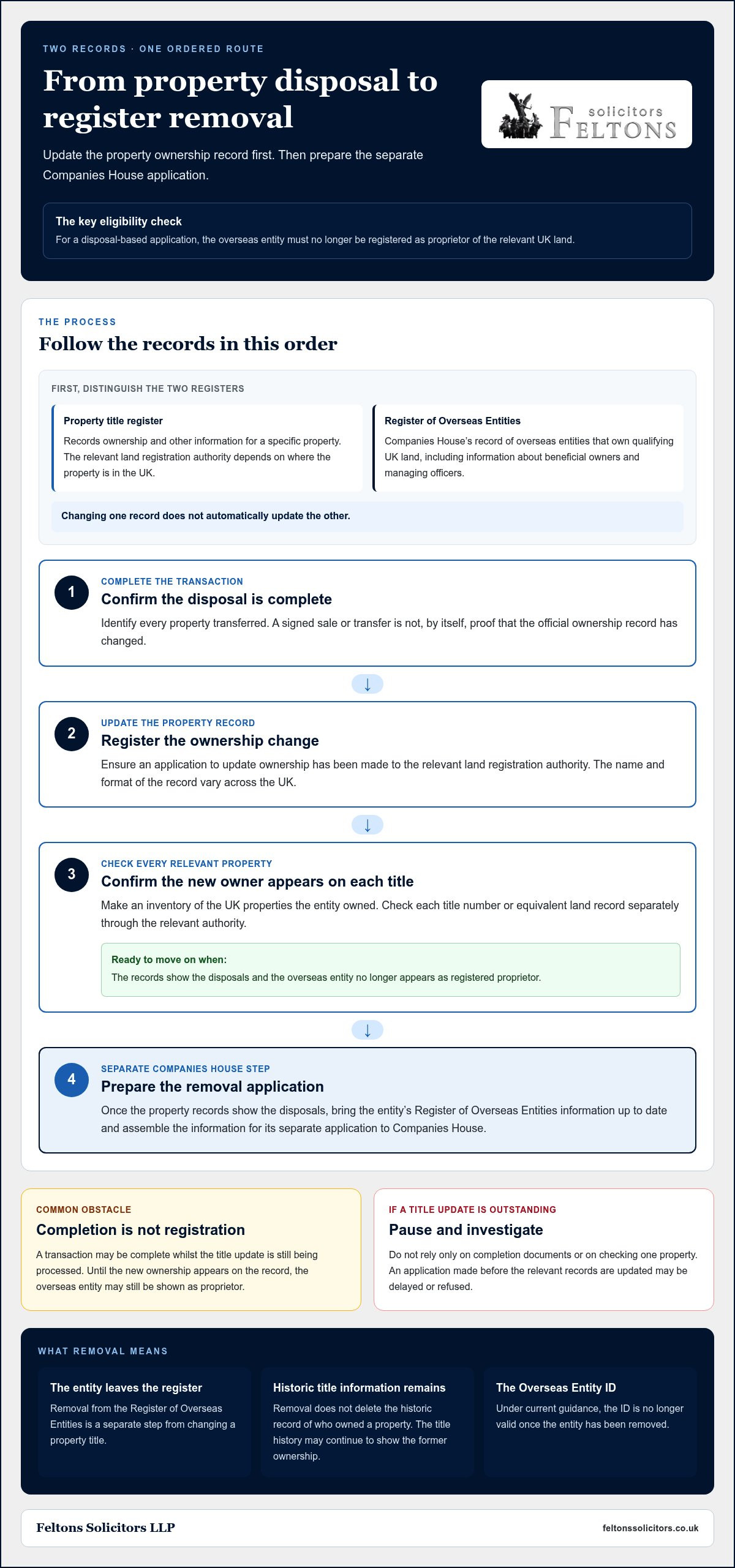
“Land Registry removal” can refer to two different processes: changing the ownership details recorded for a property, or removing an overseas entity from a Companies House register. The processes are connected, but changing one record doesn’t automatically update the other.

Two registers, two purposes

  • Property title register: records the registered ownership and other information for a specific property. The relevant land registration authority maintains it, and the responsible authority depends on where the property is in the UK.
  • Register of Overseas Entities: Companies House’s record of overseas entities that own qualifying UK land, including information about their beneficial owners and managing officers. Companies House is the UK’s registrar of companies; you can find further background on Companies House.

A completed transfer followed by an updated property title changes the ownership record for that property. It does not remove the former owner from the Register of Overseas Entities. That requires a separate application to Companies House, once the eligibility conditions are met. Keeping the two records distinct helps you complete the steps in the right order.

What does removing an overseas entity from the register mean?

Removal means taking the entity off the Register of Overseas Entities, not deleting the historic record of who owned a property. The title history may continue to show the entity’s previous ownership, and information on the public register may remain viewable after removal. Removal also affects the entity’s Overseas Entity ID: under current guidance, the ID is no longer valid once the entity has been removed. Don’t assume the entity can rely on that ID for a future UK land transaction.

When may an overseas entity apply for removal?

For a disposal-based application, the central eligibility test is that the entity is no longer registered as proprietor of relevant UK land. It isn’t enough for a sale or transfer to be signed, or for the parties to consider the transaction complete. The ownership records for the relevant land must reflect the disposal before the entity applies to leave the Companies House register.

This distinction matters when a transaction has completed but the title update is still being processed. Until the register shows the new owner, the public record may still identify the overseas entity as proprietor, creating an obstacle to removal. Check each relevant title rather than relying only on completion documents.

The entity’s registration history also helps explain its reporting obligations and the information held on the register. Feltons’ overseas entity registration guide explains the registration framework for UK property owners. Before preparing a separate Companies House removal application, confirm that each relevant title has been updated.

Before applying to remove an overseas entity, update the property title records

Start with the property records, not the Companies House removal form. Confirm that the completed disposal has been recorded for every relevant property where the overseas entity was registered as proprietor. A signed transfer or sale agreement is evidence of the transaction, but it doesn’t show, by itself, that the public ownership record has changed.

Use this sequence to prepare:

  1. Complete the disposal. Confirm that the transaction has completed and identify each property transferred.
  2. Register the ownership change. Ensure an application to update ownership has been made to the relevant land registration authority. The name and format of the record vary across the UK.
  3. Check every relevant title. Review each title or equivalent land record separately, including properties held under different title numbers.
  4. Prepare for removal. Once the records show the disposals, assemble the information for the separate Companies House application.

The order matters. If an overseas entity applies before the relevant ownership records have been updated, Companies House may be unable to confirm that it meets the removal conditions. The application could be delayed or refused. Resolve the title position first rather than relying on a signed transfer or the parties’ understanding that the sale has completed.

How do you confirm the new owner is recorded?

Make an inventory of the UK properties the entity owned, then identify the title number or equivalent land record for each one. Check the current record through the relevant land registration authority for the property’s jurisdiction. Confirm that the overseas entity no longer appears as the registered proprietor. Checking one property doesn’t confirm the position for the others.

Keep the stages distinct: conveyancing completion concerns the transaction between the parties, while registration updates the official ownership record. The application to register a transfer may still be outstanding after completion. Check the current record before moving to the next stage.

What if a property transfer has not appeared on the register?

Pause the removal application and investigate the outstanding registration. Review the transfer and completion documents, the registration application and any correspondence about requisitions or missing information. This can help establish whether the application is still being processed or whether something needs attention before the title can be updated.

For wider context on ownership records and conveyancing, Feltons’ residential property law guide explains key aspects of residential property transactions. Where several titles or jurisdictions are involved, Feltons’ conveyancing and overseas entity legal support can help coordinate the property records and Companies House steps.

Applying to Companies House After Title Updates

Once the relevant property records reflect the disposals, make the next application to Companies House, not to the land registration authority. These are separate stages: the title update records who owns the property, while Companies House considers whether the overseas entity can be removed from the Register of Overseas Entities.

Before filing, use current Companies House guidance to check the online application route, who is eligible to submit it and what authentication is required. Procedures can change, so don’t rely on an old form or instructions from an earlier filing. Confirm that the entity’s register information is accurate and up to date.

What information should be ready before filing?

Prepare the entity’s identifying details and Overseas Entity ID, then compare the information held by Companies House with the entity’s current records. Check the names and details of beneficial owners and managing officers, including whether any changes need to be reported. The current form and guidance specify what information to supply.

Where information has changed, verification is a key preparation step. Under current requirements, changes to an entity’s information, including new beneficial owners or managing officers, must be verified by a UK-regulated agent no more than three months before the removal application is made. Allow time to organise the evidence and confirm that it relates to the information being filed.

Establish who will submit the application and what evidence of authority to act is required under the current process. A clear file can bring together the entity’s details, relevant ownership information, verification evidence and confirmation that property records have been updated. This helps identify gaps between the conveyancing position and the Companies House filing before submission.

What happens after Companies House receives the application?

Companies House reviews the application against its requirements. It may seek clarification or further information if details are incomplete, inconsistent or need supporting evidence. Respond carefully to any request, and don’t assume that submitting the form means removal has already taken effect.

Removal doesn’t necessarily make information already available on the public register disappear. Treat the application as a change in the entity’s registration status, not as a request to erase its history. Consider what information remains accessible and make sure the entity understands the practical consequences before proceeding.

The Overseas Entity ID is no longer valid after removal. The entity should consider this consequence before applying, especially if it may need to undertake a later transaction involving UK land. For anyone removing overseas entity from land registry records, careful preparation means checking the title position, information and verification together, then following the current Companies House application guidance.

Removing Overseas Entities: UK Land Registry Guide 2026

Common delays when removing an overseas entity from property records

A removal application can be held up when the entity’s property records don’t align with the information filed with Companies House. Use this issue-and-response check to identify what needs attention before submitting.

  • A transfer is still awaiting registration. Check the application status and any correspondence about outstanding requirements. Resolve the registration issue and confirm the current title position before relying on the disposal for a removal application.
  • One property still shows the entity as proprietor. The eligibility test applies across the relevant UK land held by the entity, not just the property most recently sold. Review every property and title, including properties in different parts of the UK. A private sale agreement does not override a public record that still names the entity as registered proprietor.
  • Entity details do not match across records. Compare the entity’s name and identifying details in the property records with its Companies House information and supporting documents. Resolve discrepancies before filing so the application can be assessed against consistent information.
  • Beneficial owner or managing officer details are out of date. Compare the register information with current details and identify any required update. Check Companies House guidance for the applicable verification rules and deadlines. Under current requirements, changes to entity information must be verified by a UK-regulated agent no more than three months before a removal application.
  • An update statement or verification evidence is missing. Establish whether required updates are complete and gather the relevant evidence before applying. An incomplete compliance record or insufficient verification may mean more work is needed before the removal application is ready.

Can an overseas entity be removed if one property is still registered to it?

Generally, no. If a relevant UK property record still lists the entity as proprietor, the entity may not meet the removal eligibility test, even if it has sold its other properties. Resolve the remaining ownership position first, either by completing a disposal or addressing an outstanding title registration. The public proprietor record is central; a contract or private agreement alone does not change it.

What if the entity’s details or verification information have changed?

Check the information held for the entity and relevant people against current records before submission. Changes to beneficial owners or managing officers can affect what needs updating and verifying. Use the latest Companies House guidance to confirm the requirements at the time of filing, rather than relying on old verification documents or a previous application.

There is an additional coordination point if the entity owns or has owned land in more than one UK jurisdiction. England and Wales, Scotland, and Northern Ireland have distinct land registration systems, so the record and process for checking each title may differ. Keep a property-by-property schedule showing the jurisdiction, title reference and current registered proprietor. This helps prevent an overlooked title from undermining an otherwise complete application.

Where multiple titles, inconsistent records or international ownership details make the checks difficult to coordinate, Feltons can assist with overseas entity and property transaction advice to help clarify the next steps.

Coordinating a property disposal with a separate Companies House application can become more involved when the entity has several UK properties, multiple titles or land in different jurisdictions. Legal support can help bring the transaction documents, title position and entity information together, so unresolved issues can be identified before an application is submitted.

Feltons Solicitors advises on overseas entity registration, complex property transactions, and residential and commercial conveyancing. This combination is relevant when work involves both property records and the Register of Overseas Entities. Advice can be tailored to the ownership arrangements and records involved, including where the property history or jurisdiction adds complexity.

What can a solicitor help you coordinate?

A solicitor can review the disposal documents alongside the status of the related title registration, helping establish whether the public record reflects the transaction. They can also help organise entity information and identify inconsistencies or outstanding matters that may need resolution before filing. For multiple properties, this means considering the relevant titles together rather than treating one completed sale as the whole picture.

Where ownership arrangements or jurisdictional requirements are complex, tailored advice can clarify which records and transaction details need attention. This is practical coordination, not a promise that Companies House will accept an application or that a particular result or timescale can be achieved.

What should you prepare for an initial discussion?

A concise file helps make the circumstances easier to assess. Gather the core identification details and documents available, even if you’re unsure which items will be most relevant. The following information provides a useful starting point:

  • Entity details: the overseas entity’s registered name and Overseas Entity ID.
  • Property information: addresses and title references for relevant UK properties, with the jurisdiction of each property noted.
  • Disposal records: signed transfer or sale documents, completion information and correspondence about registration of the ownership change.
  • Title evidence: current title records, equivalent land records or correspondence showing the status of any outstanding registration.
  • Register changes: details of beneficial owners or managing officers who have changed since the entity’s latest filing, alongside any related update or verification information.

You don’t need to resolve every uncertainty before seeking advice. A clear account of what has been sold, what still appears in the property records and what information has changed can focus the discussion on the next steps. This is particularly useful where the entity’s portfolio spans England and Wales, Scotland or Northern Ireland, as each has its own land registration system.

If you’re considering removing overseas entity from land registry records and need to coordinate the property and Companies House aspects, discuss your property records and proposed application with Feltons. Bring the disposal history and available title information so the position can be considered in context.

Make your next step a coordinated one

The point where a disposal, a title update and a register filing meet is often where a tailored legal review can be useful. If you’re considering removing overseas entity from land registry records, bring the property history and the entity’s current position together before deciding how to proceed. A clear view of the matter can help identify outstanding questions and prepare for the next stage.

Feltons advises on overseas entity registration, complex property transactions, and residential and commercial conveyancing. The firm provides pragmatic guidance to domestic and international clients, shaped around the records and ownership arrangements involved.

For advice on your circumstances, discuss your overseas entity and property records with Feltons’ solicitors. A focused conversation can help you establish a practical way forward.

Frequently Asked Questions

Can I remove an overseas entity from the Land Registry after selling a UK property?

You may be able to apply for removal from the Register of Overseas Entities after a sale, once the entity is no longer registered as proprietor of any relevant UK land. A completed sale doesn’t necessarily mean the ownership record has changed. For example, if the buyer’s registration is still pending, the public title may continue to show the seller. Check the relevant records before making a separate Companies House application.

Is the Register of Overseas Entities the same as the Land Registry?

No. The Register of Overseas Entities is maintained by Companies House and records overseas entities that own qualifying UK land, along with relevant ownership information. A property title register records ownership and other details for an individual property. The registers serve different purposes and are updated through separate processes. Changing a property title does not itself change the entity’s status on the Companies House register.

How do I apply to remove an overseas entity from the register?

Apply to Companies House using its current removal process, once the entity meets the eligibility requirements. Before starting, gather its name and Overseas Entity ID, confirm the position of all relevant property records, and review entity and beneficial ownership details for accuracy. Check the latest Companies House instructions for the application route, who may submit it, authentication and any verification evidence required. Requirements should be checked at the time of filing.

What happens if an overseas entity applies before the property title is updated?

If the title still identifies the overseas entity as proprietor, Companies House may be unable to confirm that the entity is eligible for removal. The application could be delayed or refused, leaving the entity to resolve the registration issue and consider what further filing is needed. Check for outstanding correspondence about the title application, such as a request for additional information, before submitting the removal application.

Does removal from the Register of Overseas Entities erase the entity’s public information?

No. Removal changes the entity’s status on the register; it does not necessarily erase information already available about its registration or history. The entity should also consider the effect on its Overseas Entity ID: current guidance says the ID is no longer valid after removal. This matters if the entity may later be involved in a UK land transaction, so consider the consequences before applying.

Can an overseas entity apply for removal if it still owns another UK property?

Generally, no, if it remains registered as proprietor of relevant UK land. Selling one property does not meet the eligibility test if another qualifying property is still registered to the entity. This can be easy to overlook where property is held across different jurisdictions or under separate titles. Check the entity’s full UK property portfolio and resolve any remaining ownership position before applying to Companies House.

Do Scotland and Northern Ireland use the same property register as England and Wales?

No. The UK does not have one single property title register covering all four nations. England and Wales, Scotland, and Northern Ireland have distinct land registration systems, so the relevant authority, record and process depend on where each property is situated. If an entity has held land in more than one jurisdiction, identify and check the corresponding record for every property rather than relying on a search in one system.