
Could a careful reading of the lease resolve a management dispute before it reaches a tribunal? Unclear responsibilities, disputed service charges and concerns about repairs can quickly become stressful, especially when the relevant terms are not straightforward. Residential leasehold management dispute solicitors can help clarify the legal position and assess whether a practical resolution is possible.
If you are concerned that a management decision is unfair or poorly explained, it makes sense to seek clear answers before taking action. The lease, correspondence, service charge accounts and repair records can help establish who is responsible and what options may be available. A measured approach can also help you understand the implications of escalating the disagreement.
This guide explains common residential leasehold management disputes, the documents that may help clarify them and the routes available for addressing a disagreement. It also explains how Feltons Solicitors handles landlord-and-tenant disputes and can provide a pragmatic assessment based on the lease and your circumstances.
Key Takeaways
- A residential leasehold management dispute concerns how a property is administered, maintained or managed. The lease and circumstances help establish each party’s position.
- Read the lease alongside correspondence, service charge demands, accounts, repair records and meeting documents to build a clearer picture of the issue.
- Direct correspondence, negotiation and formal routes may each be appropriate. The right option depends on your evidence, desired outcome and the parties’ positions.
- Before speaking to residential leasehold management dispute solicitors, identify the problem, organise key documents, note important events and record the outcome you want.
- Feltons Solicitors handles landlord-and-tenant disputes. Lease variations, enfranchisement and Right to Manage address distinct leasehold objectives.
What counts as a residential leasehold management dispute?
A residential leasehold management dispute is a disagreement about how a leasehold home or its shared areas are administered, maintained or managed. It may concern what work should be done, how a cost has been calculated, who must arrange a repair or whether a management decision follows the lease. A disagreement alone does not establish that anyone has breached an obligation. The lease, each party’s role and what has happened all matter.
For example, a leaseholder might question how a service charge has been apportioned, report an unresolved leak in a communal area or ask for information about work carried out on the building. A disagreement could also involve a proposed change to shared facilities, a permission request or responsibility for arranging maintenance. The detail matters: a repair clause may need to be read alongside other lease provisions and the building’s management arrangements.
These issues are different from wider leasehold objectives. Enfranchisement concerns rights to acquire a freehold interest, while a lease extension concerns extending the lease term. A Right to Manage claim is a distinct process for seeking management control. These matters may arise alongside a management disagreement, but they are not simply another name for a dispute about existing repairs, accounts or decisions. Identifying the issue accurately helps focus the next steps.
Which leasehold management problems commonly become disputes?
Disputes often begin with practical concerns: communal repairs appear delayed, maintenance falls below the standard a resident expects, or requests for updates go unanswered. A service charge disagreement may concern the figures in a demand, the supporting information or how a cost has been allocated between flats. Disputes can also involve management decisions, permissions or responsibilities. In each case, the lease and available records help show what was agreed and what happened.
Who may be involved in a leasehold management dispute?
The parties may include a leaseholder, freeholder, landlord, managing agent or management company. Their involvement does not mean they all have the same legal responsibility. The lease, appointment documents and wider management arrangements can help identify who is responsible for a particular task, decision or communication. The correct parties and applicable legal framework depend on the facts, so do not assume that the person responding to a complaint is necessarily the only party involved.
Terminology can also cause confusion. The historic Leasehold Valuation Tribunal has been superseded by the First-tier Tribunal (Property Chamber), which deals with certain property matters within its jurisdiction. Not every management disagreement belongs before a tribunal, and legal arrangements differ across the UK. If you are considering residential leasehold management dispute solicitors, start by describing the management problem clearly and identifying the relevant lease provisions and parties.
How do the lease and evidence shape a management dispute?
The lease is the starting point for understanding a management disagreement, but one clause rarely gives the complete answer. Its meaning may depend on defined terms, schedules, other clauses and documents referred to in the lease. The practical arrangements and events matter too. A provision about repairs may identify a responsibility, while correspondence and repair records can help establish what was reported and what happened afterwards.
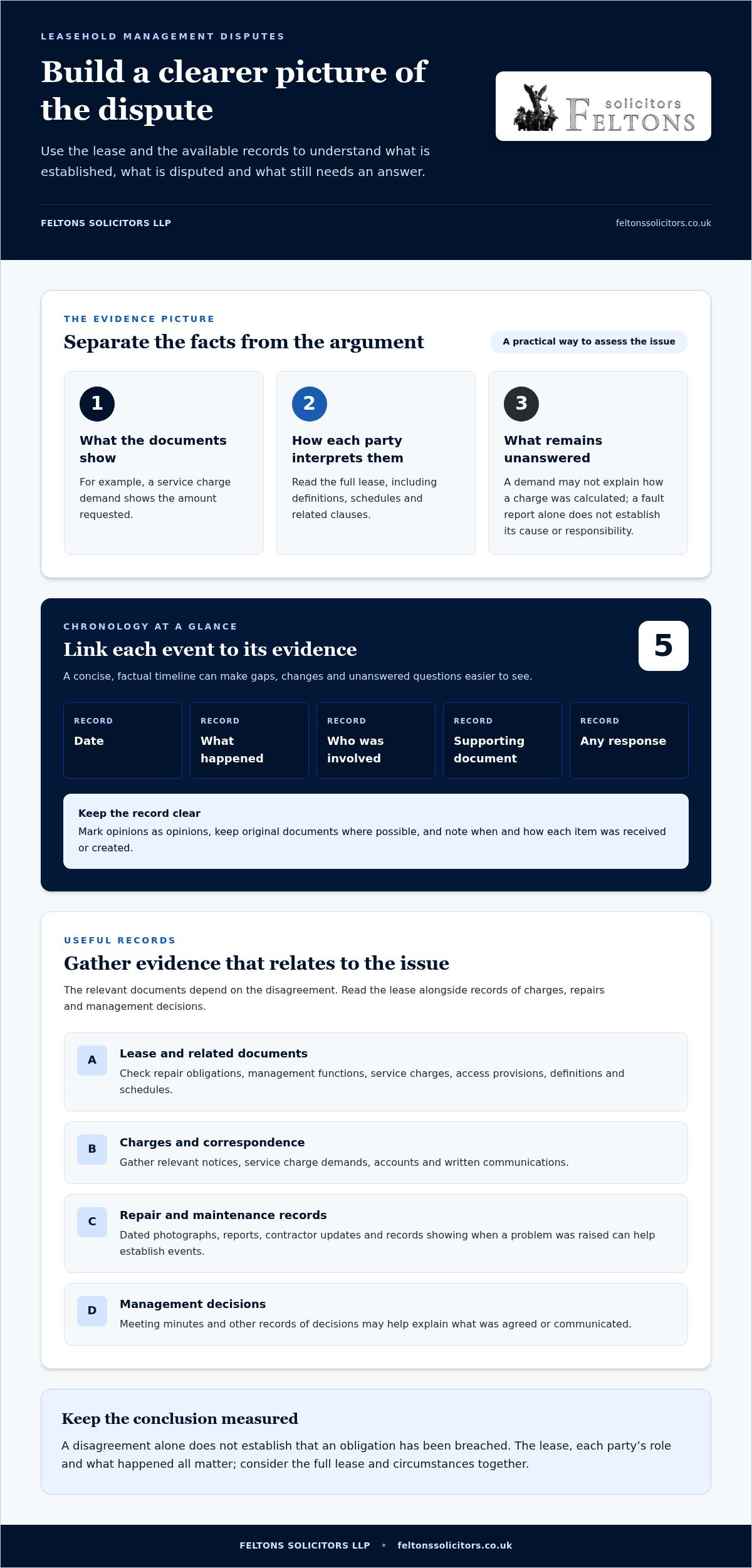
Keep three things separate: what the documents show, how each party interprets them and what remains unanswered. A service charge demand shows the amount requested, but may not explain how it was calculated. A message reporting a fault records that it was raised, but does not by itself establish the cause or responsibility. Making this distinction keeps discussions focused and helps identify what information is still needed.
Which lease terms may matter in a management disagreement?
Depending on the issue, relevant wording may cover repair obligations, management functions, service charges or access to the building and individual flats. Check definitions and schedules as well as the main clauses. They may explain what a term includes, how a cost is apportioned or which areas are covered. Related documents can also matter. There is no universal interpretation: consider the full lease and the circumstances together.
What documents can help clarify the facts?
Gather the lease and any relevant notices, service charge demands, accounts and written communications. For a repair issue, dated photographs, reports, contractor updates and records showing when the problem was raised can help establish the sequence of events. Meeting minutes and other records of management decisions may also be useful. Keep original documents where possible, and note when and how each item was received or created.
A clear chronology links each document to the event in dispute, making gaps, changes and unanswered questions easier to see. Record the date, what happened, who was involved, the supporting document and any response. Mark opinions as opinions, and do not alter original records. A concise, factual timeline is often more useful than a large bundle without an explanation.
Dispute procedures differ across the UK, so establish the relevant jurisdiction before relying on guidance about rights or formal routes. The First-tier Tribunal (Property Chamber), for example, deals with certain property disputes within its jurisdiction, but it is not the correct forum for every issue.
Well-organised evidence can help residential leasehold management dispute solicitors assess the lease, distinguish established facts from disputed interpretations and identify what needs clarification. Feltons handles landlord-and-tenant disputes and can help you consider your position and possible next steps without assuming every disagreement requires formal proceedings.
Which routes can resolve a residential leasehold management dispute?
No single route suits every disagreement. A query about an unexplained charge may call for a request for information, while an ongoing failure to address a serious repair concern may need more urgent attention. The right response depends on the lease, the available evidence, the parties’ positions and the outcome you seek. Consider whether the issue is continuing, whether important facts are agreed and whether a practical remedy is possible.
The appropriate route depends on the dispute, the evidence and the legal procedure available in the relevant jurisdiction. Keep this in mind before escalating a disagreement. A proportionate approach does not mean avoiding formal action at all costs. It means understanding the options and their relevance before deciding what to do.
When might early discussion or negotiation be appropriate?
Where appropriate, start with a clear written account of the issue. Identify the event or decision, explain your concern and set out the practical remedy you are seeking, such as an explanation, a repair update or reconsideration of a decision. Give the other party an opportunity to respond. A written exchange may reveal a misunderstanding or missing information before positions become entrenched, although informal discussion is not effective or appropriate in every case.
If direct correspondence does not resolve matters, negotiation may offer a more structured way to clarify each side’s position and explore a workable resolution. Keep communications factual and retain copies. Be specific about what would address the problem, and separate that outcome from any wider disagreement. For example, an itemised explanation might answer a query about a charge without resolving a separate dispute about the quality of management.
When might a formal legal process need consideration?
Formal advice may be appropriate if the issue remains unresolved, the consequences are serious or you are unsure about your rights and obligations. A solicitor can assess the lease and available evidence, explain potential routes and help you weigh the implications before you commit to a particular course. Formal steps may be relevant where informal efforts have stalled, but their suitability depends on the dispute and the remedy sought.
Some residential leasehold matters fall within the First-tier Tribunal (Property Chamber), while others may require court consideration. Neither forum is the automatic destination for every management disagreement. The appropriate body and procedure depend on the issue and the applicable jurisdiction. Legal arrangements vary across the UK, so do not assume that guidance for one part of the country applies everywhere.
Before choosing a route, consider whether delay could worsen the problem, what documents support your position, what response you have received and what a satisfactory resolution would look like. The evidence may point towards a focused request for clarification, further discussion or a formal process. Residential leasehold management dispute solicitors can help assess these factors and explain the available options. Proceedings are not inevitable, and negotiation will not always succeed.
How should you prepare before instructing leasehold dispute solicitors?
A short, organised account of the problem can make an initial legal discussion more focused. You do not need to decide who is legally responsible before seeking advice. Set out what has happened, what you have done so far and what you hope will change. This gives a solicitor a practical starting point for considering the lease, available evidence and possible next steps.
Use this preparation sequence:
- Define the issue. Describe the management concern in a sentence, such as an unresolved repair, a disputed charge or a decision you are challenging. Separate it from any wider leasehold objective.
- Gather the key records. Collect the lease, relevant correspondence, notices, accounts and documents relating directly to the problem. Include records of responses received and actions taken.
- Record the timeline and outcome sought. Note dates, people involved and important events, then write down what a satisfactory practical resolution would look like.
Keep the material in a clear order, but do not delay seeking advice because you have not found every document. Flag missing records or unanswered questions rather than filling gaps with assumptions. A concise summary can distinguish what is documented from what remains unclear.
What should you organise before seeking legal advice?
Alongside your timeline, list the questions you want answered and any practical concerns, such as ongoing disruption or uncertainty about a decision. Note what response you have received, when it arrived and whether the matter is still developing. This gives your solicitor context for assessing the issue and helps keep the discussion centred on your priorities.
What should clear, tailored legal support address?
Advice should explain the relevant lease terms in plain English, identify the parties’ positions and assess how the available evidence relates to the disagreement. It should also set out realistic options and the considerations attached to each, so you can make an informed decision. The appropriate advice depends on the documents, circumstances and applicable jurisdiction.
Residential leasehold management dispute solicitors can help assess whether the issue calls for further information, a practical discussion or consideration of a formal route. A solicitor can also identify gaps in the evidence and explain their significance. Advice is specific to the facts, and no particular resolution can be guaranteed. A clear understanding of the options can still help you approach the matter with greater confidence.
If you are ready to discuss your circumstances, read about Feltons’ support for residential landlord-and-tenant disputes. Feltons handles litigation, including landlord-and-tenant disputes, and offers pragmatic guidance tailored to the issue and your objectives.
How Feltons Solicitors can help with residential leasehold disputes
A leasehold disagreement can involve more than one legal question. Feltons Solicitors handles litigation, including landlord-and-tenant disputes, and provides legal services in property matters. The first step is to understand the issue in context: what the lease says, how the parties have acted and what outcome you are seeking. Advice can then help you consider a proportionate way forward, whether or not formal proceedings are appropriate.
Feltons provides a bespoke boutique service, combining modern delivery with traditional values. Each disagreement has its own circumstances, so understanding the specific issue matters. Clear, plain-English guidance can help you understand the relevant points and make informed decisions while a stressful property matter is ongoing.
What Feltons’ property and dispute services cover
Feltons’ leasehold property services include leasehold enfranchisement, lease extensions, lease variations and Right to Manage, alongside litigation that includes landlord-and-tenant disputes. These services relate to different objectives:
- Lease variations concern changing the terms of a lease.
- Enfranchisement and extensions relate to acquiring a freehold interest or extending a lease.
- Right to Manage concerns seeking management control through the relevant process.
- Landlord-and-tenant dispute litigation relates to legal disagreements between those parties.
A management concern does not automatically mean litigation, enfranchisement or a Right to Manage claim is the right answer. The relevant route depends on your objective and the facts. Advice can help distinguish a dispute about current management from a separate plan to change the lease or who manages the building.
Taking a considered next step with Feltons
To prepare for a focused discussion, write a concise account of the disagreement, the outcome you want and the response you have received. Bring the lease and key documents already available, such as relevant correspondence or records connected with the issue. You do not need to resolve every uncertainty first. Identifying what remains unclear is useful in itself.
Residential leasehold management dispute solicitors can assess the lease, evidence and parties’ positions, then explain the options and relevant considerations in plain English. Feltons offers discreet, tailored and pragmatic support, without assuming every matter should proceed to a formal claim or promising a particular result. The aim is to help you understand your position and decide on sensible next steps.
Read about Feltons’ support with leasehold management disputes.
Take a clear next step towards resolving the dispute
A leasehold disagreement can be difficult to move forward when responsibilities are unclear or discussions have stalled. You do not need every answer before seeking advice. A concise account of what has happened, what matters most to you and what you hope will change can make the next conversation more purposeful.
Residential leasehold management dispute solicitors can help you consider the facts and understand which options may fit your circumstances. Feltons offers pragmatic, bespoke legal advice and handles litigation, including landlord-and-tenant disputes. Its leasehold work also includes enfranchisement, lease variations and Right to Manage, each suited to a distinct property objective. Advice is tailored to the situation, without promising a particular result.
If you are ready to discuss your position, speak to Feltons about your leasehold dispute. A measured first step can bring greater clarity and help you decide how to proceed.
Frequently Asked Questions
Can a leaseholder challenge a residential service charge?
Yes, a leaseholder may be able to question a service charge, but the lease terms, supporting information and applicable law all matter. First identify the period and services covered by the demand, then pinpoint whether you dispute the amount, the work or how the cost has been allocated. Keep the demand, accompanying accounts and related correspondence together. A solicitor can assess these documents and explain which options may apply to your property and jurisdiction.
Can I withhold service charges whilst disputing them?
Do not assume that withholding payment is risk-free. The lease, nature of the disagreement and rules applying to the property may affect the consequences of non-payment. Keep a written record of what you dispute, when you raised it and any response, and seek advice before deciding how to proceed. A solicitor can review the relevant documents and explain potential implications rather than assuming one approach suits every leaseholder.
What happens if the landlord or managing agent doesn’t arrange repairs?
Check the lease and keep a record of the defect, when it was reported and the replies received. Responsibility may depend on the wording and on whether the problem affects a shared area or a part of the property with different arrangements. If requests have not resolved the issue, legal advice can help clarify the parties’ obligations and possible next steps. Dated photographs and reports may help show how an ongoing problem has developed.
Can a managing agent make decisions without leaseholders’ agreement?
It depends on the lease, the agent’s authority and the relevant management arrangements. A decision may fall within existing responsibilities, or it may raise a question about whether the correct authority or procedure was followed. Keep notices, emails and meeting records relating to the decision, and note how it affects you. A solicitor can assess the documents and explain whether the decision appears consistent with the lease and applicable legal framework.
How long does it take to resolve a leasehold management dispute?
There is no single reliable timeframe. Progress may depend on the complexity of the lease issue, whether relevant information is available, how the parties engage and whether a formal process is needed. An exchange of information may move at a different pace from a dispute involving several issues or parties. A solicitor can discuss the circumstances and explain likely steps, but general estimates are not a promise about timing or outcome.
Do leasehold management disputes always go to court or a tribunal?
No. Some disagreements may be resolved through correspondence or negotiation, while others may need formal consideration. The suitable route depends on the issue, evidence, parties and jurisdiction, and not every tribunal or court deals with every type of dispute. Early legal advice can help identify relevant procedures and their practical implications. Informal resolution is not assured, but formal proceedings are not inevitable either.
Can a solicitor help with disputes involving both leaseholders and freeholders?
Yes. Residential leasehold management dispute solicitors can help clarify the lease, the parties’ roles and the options available in a disagreement involving leaseholders and freeholders. A solicitor will need to understand your position and review relevant documents before assessing the matter. Feltons handles litigation, including landlord-and-tenant disputes, as well as leasehold property work. The appropriate advice and next steps depend on the facts and applicable jurisdiction.