

Residential Leasehold Management Dispute Solicitors: How to Choose Legal Support

Residential Leasehold Management Dispute Solicitors: How to Choose Legal Support

Could a careful reading of the lease resolve a management dispute before it reaches a tribunal? Unclear responsibilities, disputed service charges and concerns about repairs can quickly become stressful, especially when the relevant terms are not straightforward. Residential leasehold management dispute solicitors can help clarify the legal position and assess whether a practical resolution is possible.

If you are concerned that a management decision is unfair or poorly explained, it makes sense to seek clear answers before taking action. The lease, correspondence, service charge accounts and repair records can help establish who is responsible and what options may be available. A measured approach can also help you understand the implications of escalating the disagreement.

This guide explains common residential leasehold management disputes, the documents that may help clarify them and the routes available for addressing a disagreement. It also explains how Feltons Solicitors handles landlord-and-tenant disputes and can provide a pragmatic assessment based on the lease and your circumstances.

Key Takeaways

  • A residential leasehold management dispute concerns how a property is administered, maintained or managed. The lease and circumstances help establish each party’s position.
  • Read the lease alongside correspondence, service charge demands, accounts, repair records and meeting documents to build a clearer picture of the issue.
  • Direct correspondence, negotiation and formal routes may each be appropriate. The right option depends on your evidence, desired outcome and the parties’ positions.
  • Before speaking to residential leasehold management dispute solicitors, identify the problem, organise key documents, note important events and record the outcome you want.
  • Feltons Solicitors handles landlord-and-tenant disputes. Lease variations, enfranchisement and Right to Manage address distinct leasehold objectives.

What counts as a residential leasehold management dispute?

A residential leasehold management dispute is a disagreement about how a leasehold home or its shared areas are administered, maintained or managed. It may concern what work should be done, how a cost has been calculated, who must arrange a repair or whether a management decision follows the lease. A disagreement alone does not establish that anyone has breached an obligation. The lease, each party’s role and what has happened all matter.

For example, a leaseholder might question how a service charge has been apportioned, report an unresolved leak in a communal area or ask for information about work carried out on the building. A disagreement could also involve a proposed change to shared facilities, a permission request or responsibility for arranging maintenance. The detail matters: a repair clause may need to be read alongside other lease provisions and the building’s management arrangements.

These issues are different from wider leasehold objectives. Enfranchisement concerns rights to acquire a freehold interest, while a lease extension concerns extending the lease term. A Right to Manage claim is a distinct process for seeking management control. These matters may arise alongside a management disagreement, but they are not simply another name for a dispute about existing repairs, accounts or decisions. Identifying the issue accurately helps focus the next steps.

Which leasehold management problems commonly become disputes?

Disputes often begin with practical concerns: communal repairs appear delayed, maintenance falls below the standard a resident expects, or requests for updates go unanswered. A service charge disagreement may concern the figures in a demand, the supporting information or how a cost has been allocated between flats. Disputes can also involve management decisions, permissions or responsibilities. In each case, the lease and available records help show what was agreed and what happened.

Who may be involved in a leasehold management dispute?

The parties may include a leaseholder, freeholder, landlord, managing agent or management company. Their involvement does not mean they all have the same legal responsibility. The lease, appointment documents and wider management arrangements can help identify who is responsible for a particular task, decision or communication. The correct parties and applicable legal framework depend on the facts, so do not assume that the person responding to a complaint is necessarily the only party involved.

Terminology can also cause confusion. The historic Leasehold Valuation Tribunal has been superseded by the First-tier Tribunal (Property Chamber), which deals with certain property matters within its jurisdiction. Not every management disagreement belongs before a tribunal, and legal arrangements differ across the UK. If you are considering residential leasehold management dispute solicitors, start by describing the management problem clearly and identifying the relevant lease provisions and parties.

How do the lease and evidence shape a management dispute?

The lease is the starting point for understanding a management disagreement, but one clause rarely gives the complete answer. Its meaning may depend on defined terms, schedules, other clauses and documents referred to in the lease. The practical arrangements and events matter too. A provision about repairs may identify a responsibility, while correspondence and repair records can help establish what was reported and what happened afterwards.

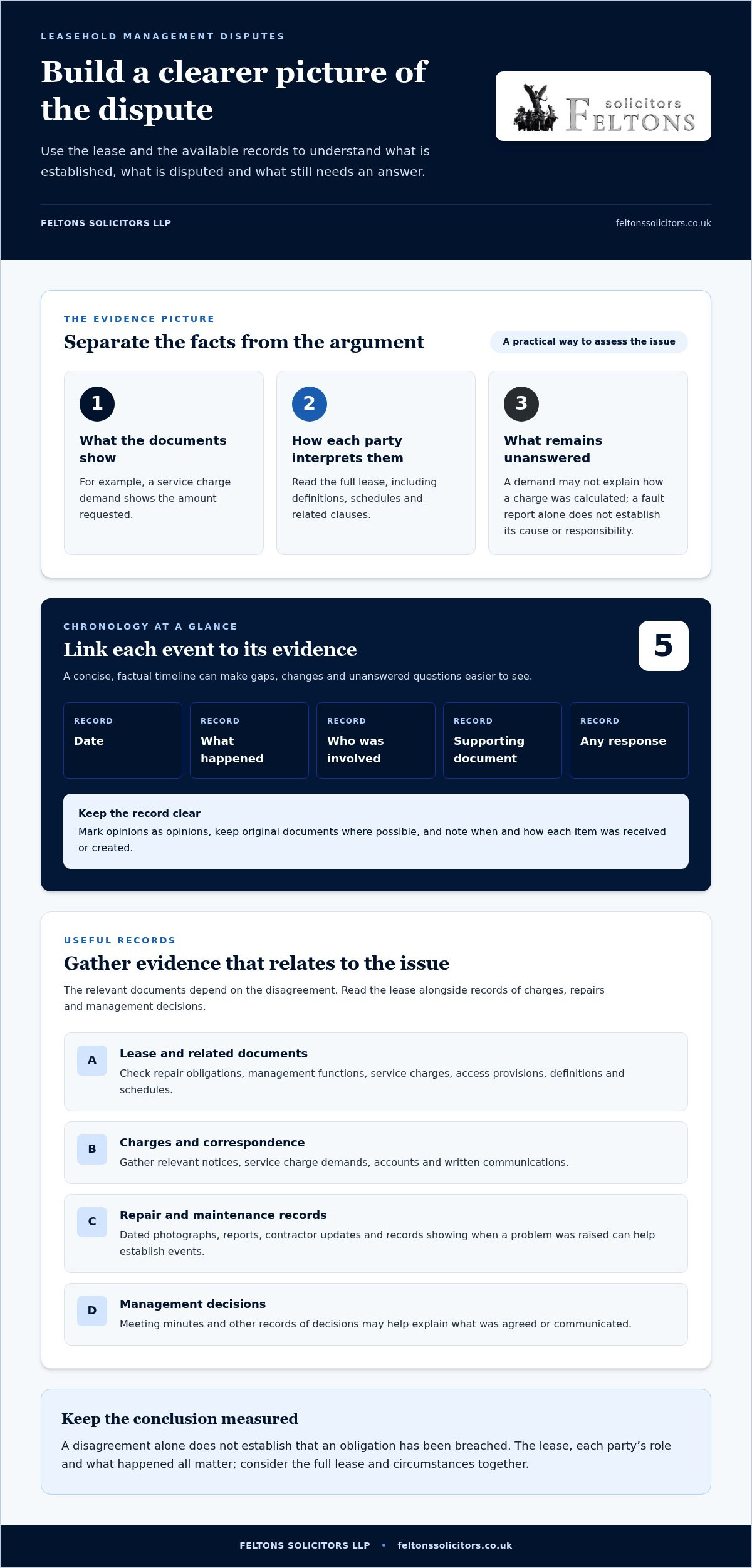
Keep three things separate: what the documents show, how each party interprets them and what remains unanswered. A service charge demand shows the amount requested, but may not explain how it was calculated. A message reporting a fault records that it was raised, but does not by itself establish the cause or responsibility. Making this distinction keeps discussions focused and helps identify what information is still needed.

Which lease terms may matter in a management disagreement?

Depending on the issue, relevant wording may cover repair obligations, management functions, service charges or access to the building and individual flats. Check definitions and schedules as well as the main clauses. They may explain what a term includes, how a cost is apportioned or which areas are covered. Related documents can also matter. There is no universal interpretation: consider the full lease and the circumstances together.

What documents can help clarify the facts?

Gather the lease and any relevant notices, service charge demands, accounts and written communications. For a repair issue, dated photographs, reports, contractor updates and records showing when the problem was raised can help establish the sequence of events. Meeting minutes and other records of management decisions may also be useful. Keep original documents where possible, and note when and how each item was received or created.

A clear chronology links each document to the event in dispute, making gaps, changes and unanswered questions easier to see. Record the date, what happened, who was involved, the supporting document and any response. Mark opinions as opinions, and do not alter original records. A concise, factual timeline is often more useful than a large bundle without an explanation.

Dispute procedures differ across the UK, so establish the relevant jurisdiction before relying on guidance about rights or formal routes. The First-tier Tribunal (Property Chamber), for example, deals with certain property disputes within its jurisdiction, but it is not the correct forum for every issue.

Well-organised evidence can help residential leasehold management dispute solicitors assess the lease, distinguish established facts from disputed interpretations and identify what needs clarification. Feltons handles landlord-and-tenant disputes and can help you consider your position and possible next steps without assuming every disagreement requires formal proceedings.

Which routes can resolve a residential leasehold management dispute?

No single route suits every disagreement. A query about an unexplained charge may call for a request for information, while an ongoing failure to address a serious repair concern may need more urgent attention. The right response depends on the lease, the available evidence, the parties’ positions and the outcome you seek. Consider whether the issue is continuing, whether important facts are agreed and whether a practical remedy is possible.

The appropriate route depends on the dispute, the evidence and the legal procedure available in the relevant jurisdiction. Keep this in mind before escalating a disagreement. A proportionate approach does not mean avoiding formal action at all costs. It means understanding the options and their relevance before deciding what to do.

When might early discussion or negotiation be appropriate?

Where appropriate, start with a clear written account of the issue. Identify the event or decision, explain your concern and set out the practical remedy you are seeking, such as an explanation, a repair update or reconsideration of a decision. Give the other party an opportunity to respond. A written exchange may reveal a misunderstanding or missing information before positions become entrenched, although informal discussion is not effective or appropriate in every case.

If direct correspondence does not resolve matters, negotiation may offer a more structured way to clarify each side’s position and explore a workable resolution. Keep communications factual and retain copies. Be specific about what would address the problem, and separate that outcome from any wider disagreement. For example, an itemised explanation might answer a query about a charge without resolving a separate dispute about the quality of management.

When might a formal legal process need consideration?

Formal advice may be appropriate if the issue remains unresolved, the consequences are serious or you are unsure about your rights and obligations. A solicitor can assess the lease and available evidence, explain potential routes and help you weigh the implications before you commit to a particular course. Formal steps may be relevant where informal efforts have stalled, but their suitability depends on the dispute and the remedy sought.

Some residential leasehold matters fall within the First-tier Tribunal (Property Chamber), while others may require court consideration. Neither forum is the automatic destination for every management disagreement. The appropriate body and procedure depend on the issue and the applicable jurisdiction. Legal arrangements vary across the UK, so do not assume that guidance for one part of the country applies everywhere.

Before choosing a route, consider whether delay could worsen the problem, what documents support your position, what response you have received and what a satisfactory resolution would look like. The evidence may point towards a focused request for clarification, further discussion or a formal process. Residential leasehold management dispute solicitors can help assess these factors and explain the available options. Proceedings are not inevitable, and negotiation will not always succeed.
Residential Leasehold Management Dispute Solicitors: How to Choose Legal Support

How should you prepare before instructing leasehold dispute solicitors?

A short, organised account of the problem can make an initial legal discussion more focused. You do not need to decide who is legally responsible before seeking advice. Set out what has happened, what you have done so far and what you hope will change. This gives a solicitor a practical starting point for considering the lease, available evidence and possible next steps.

Use this preparation sequence:

  1. Define the issue. Describe the management concern in a sentence, such as an unresolved repair, a disputed charge or a decision you are challenging. Separate it from any wider leasehold objective.
  2. Gather the key records. Collect the lease, relevant correspondence, notices, accounts and documents relating directly to the problem. Include records of responses received and actions taken.
  3. Record the timeline and outcome sought. Note dates, people involved and important events, then write down what a satisfactory practical resolution would look like.

Keep the material in a clear order, but do not delay seeking advice because you have not found every document. Flag missing records or unanswered questions rather than filling gaps with assumptions. A concise summary can distinguish what is documented from what remains unclear.

What should you organise before seeking legal advice?

Alongside your timeline, list the questions you want answered and any practical concerns, such as ongoing disruption or uncertainty about a decision. Note what response you have received, when it arrived and whether the matter is still developing. This gives your solicitor context for assessing the issue and helps keep the discussion centred on your priorities.

What should clear, tailored legal support address?

Advice should explain the relevant lease terms in plain English, identify the parties’ positions and assess how the available evidence relates to the disagreement. It should also set out realistic options and the considerations attached to each, so you can make an informed decision. The appropriate advice depends on the documents, circumstances and applicable jurisdiction.

Residential leasehold management dispute solicitors can help assess whether the issue calls for further information, a practical discussion or consideration of a formal route. A solicitor can also identify gaps in the evidence and explain their significance. Advice is specific to the facts, and no particular resolution can be guaranteed. A clear understanding of the options can still help you approach the matter with greater confidence.

If you are ready to discuss your circumstances, read about Feltons’ support for residential landlord-and-tenant disputes. Feltons handles litigation, including landlord-and-tenant disputes, and offers pragmatic guidance tailored to the issue and your objectives.

How Feltons Solicitors can help with residential leasehold disputes

A leasehold disagreement can involve more than one legal question. Feltons Solicitors handles litigation, including landlord-and-tenant disputes, and provides legal services in property matters. The first step is to understand the issue in context: what the lease says, how the parties have acted and what outcome you are seeking. Advice can then help you consider a proportionate way forward, whether or not formal proceedings are appropriate.

Feltons provides a bespoke boutique service, combining modern delivery with traditional values. Each disagreement has its own circumstances, so understanding the specific issue matters. Clear, plain-English guidance can help you understand the relevant points and make informed decisions while a stressful property matter is ongoing.

What Feltons’ property and dispute services cover

Feltons’ leasehold property services include leasehold enfranchisement, lease extensions, lease variations and Right to Manage, alongside litigation that includes landlord-and-tenant disputes. These services relate to different objectives:

  • Lease variations concern changing the terms of a lease.
  • Enfranchisement and extensions relate to acquiring a freehold interest or extending a lease.
  • Right to Manage concerns seeking management control through the relevant process.
  • Landlord-and-tenant dispute litigation relates to legal disagreements between those parties.

A management concern does not automatically mean litigation, enfranchisement or a Right to Manage claim is the right answer. The relevant route depends on your objective and the facts. Advice can help distinguish a dispute about current management from a separate plan to change the lease or who manages the building.

Taking a considered next step with Feltons

To prepare for a focused discussion, write a concise account of the disagreement, the outcome you want and the response you have received. Bring the lease and key documents already available, such as relevant correspondence or records connected with the issue. You do not need to resolve every uncertainty first. Identifying what remains unclear is useful in itself.

Residential leasehold management dispute solicitors can assess the lease, evidence and parties’ positions, then explain the options and relevant considerations in plain English. Feltons offers discreet, tailored and pragmatic support, without assuming every matter should proceed to a formal claim or promising a particular result. The aim is to help you understand your position and decide on sensible next steps.

Read about Feltons’ support with leasehold management disputes.

Take a clear next step towards resolving the dispute

A leasehold disagreement can be difficult to move forward when responsibilities are unclear or discussions have stalled. You do not need every answer before seeking advice. A concise account of what has happened, what matters most to you and what you hope will change can make the next conversation more purposeful.

Residential leasehold management dispute solicitors can help you consider the facts and understand which options may fit your circumstances. Feltons offers pragmatic, bespoke legal advice and handles litigation, including landlord-and-tenant disputes. Its leasehold work also includes enfranchisement, lease variations and Right to Manage, each suited to a distinct property objective. Advice is tailored to the situation, without promising a particular result.

If you are ready to discuss your position, speak to Feltons about your leasehold dispute. A measured first step can bring greater clarity and help you decide how to proceed.

Frequently Asked Questions

Can a leaseholder challenge a residential service charge?

Yes, a leaseholder may be able to question a service charge, but the lease terms, supporting information and applicable law all matter. First identify the period and services covered by the demand, then pinpoint whether you dispute the amount, the work or how the cost has been allocated. Keep the demand, accompanying accounts and related correspondence together. A solicitor can assess these documents and explain which options may apply to your property and jurisdiction.

Can I withhold service charges whilst disputing them?

Do not assume that withholding payment is risk-free. The lease, nature of the disagreement and rules applying to the property may affect the consequences of non-payment. Keep a written record of what you dispute, when you raised it and any response, and seek advice before deciding how to proceed. A solicitor can review the relevant documents and explain potential implications rather than assuming one approach suits every leaseholder.

What happens if the landlord or managing agent doesn’t arrange repairs?

Check the lease and keep a record of the defect, when it was reported and the replies received. Responsibility may depend on the wording and on whether the problem affects a shared area or a part of the property with different arrangements. If requests have not resolved the issue, legal advice can help clarify the parties’ obligations and possible next steps. Dated photographs and reports may help show how an ongoing problem has developed.

Can a managing agent make decisions without leaseholders’ agreement?

It depends on the lease, the agent’s authority and the relevant management arrangements. A decision may fall within existing responsibilities, or it may raise a question about whether the correct authority or procedure was followed. Keep notices, emails and meeting records relating to the decision, and note how it affects you. A solicitor can assess the documents and explain whether the decision appears consistent with the lease and applicable legal framework.

How long does it take to resolve a leasehold management dispute?

There is no single reliable timeframe. Progress may depend on the complexity of the lease issue, whether relevant information is available, how the parties engage and whether a formal process is needed. An exchange of information may move at a different pace from a dispute involving several issues or parties. A solicitor can discuss the circumstances and explain likely steps, but general estimates are not a promise about timing or outcome.

Do leasehold management disputes always go to court or a tribunal?

No. Some disagreements may be resolved through correspondence or negotiation, while others may need formal consideration. The suitable route depends on the issue, evidence, parties and jurisdiction, and not every tribunal or court deals with every type of dispute. Early legal advice can help identify relevant procedures and their practical implications. Informal resolution is not assured, but formal proceedings are not inevitable either.

Can a solicitor help with disputes involving both leaseholders and freeholders?

Yes. Residential leasehold management dispute solicitors can help clarify the lease, the parties’ roles and the options available in a disagreement involving leaseholders and freeholders. A solicitor will need to understand your position and review relevant documents before assessing the matter. Feltons handles litigation, including landlord-and-tenant disputes, as well as leasehold property work. The appropriate advice and next steps depend on the facts and applicable jurisdiction.

House Lease Extension Disputed Premium: How to Challenge the Figure

House Lease Extension Disputed Premium: How to Challenge the Figure

What if the premium in your proposed house lease extension isn’t supported by the figures? A house lease extension disputed premium can leave you unsure whether the valuation is sound, what evidence could influence the discussion and how to keep negotiations moving. A difference of opinion doesn’t automatically mean either figure is right.

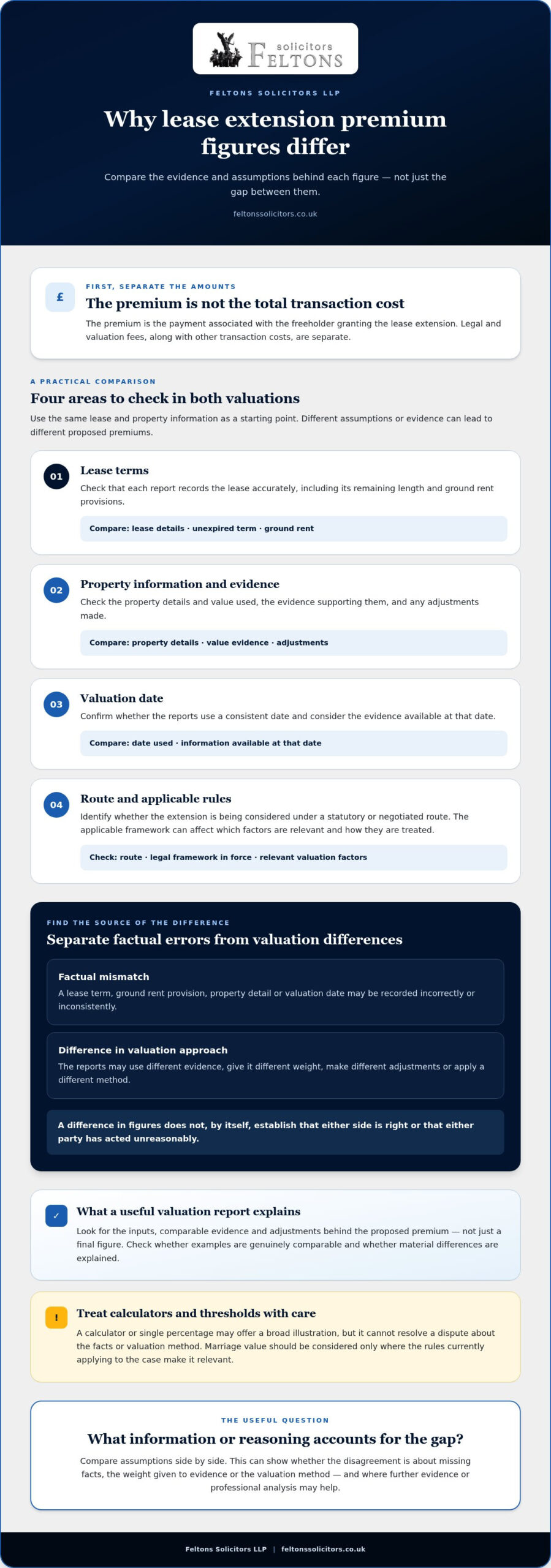
The premium, the amount paid for the extension, is separate from legal and valuation fees and other transaction costs. Keeping those amounts distinct and understanding how the premium was calculated are useful first steps towards a focused negotiation.

This article explains why premiums may be disputed, what valuation evidence and professional input can help assess the figures, and how to consider negotiation or formal determination. The applicable rules and procedures can depend on the lease and the route being used, so timing matters. Legal advice can help you consider the valuation basis, negotiation history and available options together before deciding what to do next.

Key Takeaways

  • A house lease extension disputed premium may reflect different assumptions or valuation evidence. Identify exactly which figures are contested.
  • Assess the valuation against the applicable route and the details of the lease and property, including ground rent and property value where relevant.
  • Compare continued negotiation with formal determination, taking account of the property’s jurisdiction and the procedural consequences of each route.
  • Keep notices, correspondence, lease documents and valuation reports together, then use them to plan a clear, evidence-led response.
  • Legal advice can bring the valuation basis, negotiation history and procedural options into focus without making formal determination the automatic next step.

Why a house lease extension premium may be disputed

A disputed premium is a disagreement between the leaseholder and freeholder about the amount payable for extending a lease. Different figures may result from different assumptions, evidence or valuation approaches. Rather than focusing only on the gap between them, look at the information and reasoning behind each figure.

Lease length affects the value of the leasehold interest, but no single threshold determines every valuation. The property, lease terms and applicable legal framework also matter. Assess a house lease extension disputed premium against the facts of that lease and the route being used, not a general rule of thumb.

What does the lease extension premium represent?

The premium is the payment associated with the freeholder granting the lease extension. It is separate from legal and valuation fees and other transaction costs. Keeping these amounts distinct makes it easier to identify what is disputed and compare like with like. The applicable legal valuation framework depends on the route taken and the law in force for the case.

Lease extensions sit within a framework shaped by legislation, including the historical Leasehold Reform Act 1967. That background does not, by itself, show how a particular premium should be calculated today. The applicable rules and the leaseholder’s circumstances must be considered together.

Why might the landlord and leaseholder disagree?

Each figure may be based on a different view of the lease and property. Relevant inputs can include the unexpired lease term, ground rent and property value, where applicable under the valuation route. The parties may also rely on different dates or information, or interpret evidence differently. A report based on incomplete lease details or outdated property information may not be a sound basis for comparison.

To understand the gap, identify the assumptions behind each calculation. Check whether both parties are using consistent information about:

  • The lease terms, including its remaining length and ground rent provisions.
  • The property’s value and the evidence used to support it.
  • The valuation date and the route under which the extension is being negotiated.
  • Any other inputs the valuers consider relevant to their calculations.

A premium dispute is a valuation disagreement to be tested against evidence, not simply a negotiation tactic. A difference in figures does not establish that either side has acted unreasonably. It identifies questions to examine. Comparing assumptions line by line can show whether the disagreement concerns missing facts, the weight given to evidence or the valuation method.

Before deciding how to respond, establish which assumptions differ and whether both figures address the same lease extension route. This gives negotiations a clearer focus and helps identify what further evidence or professional analysis may be useful.

How a lease extension valuation can produce different premium figures

A valuation is not produced by a universal formula. It must be prepared for the applicable statutory or negotiated route, using the legal framework in force for the case. The route can affect which factors are relevant and how they are treated. A calculator or single percentage may provide a broad illustration, but it cannot resolve a disputed premium when the parties disagree about the facts or method.

Depending on the route and circumstances, relevant inputs may include the unexpired lease term, ground rent provisions and the property’s value. The valuation date and evidence available at that date may also matter. Marriage value should be considered only where the rules currently applying to the case make it relevant. Don’t assume the answer from a headline threshold alone.

Which assumptions should the parties examine?

Start with the source information in each valuation. Is the lease term recorded correctly? Do the ground rent provisions match the lease? Are the property details and valuation date consistent? A factual error can affect the calculation, while different choices about evidence or adjustments may create a wider gap.

Compare the reports side by side and note where their assumptions diverge. One report, for example, may rely on different property evidence or make a different adjustment to it. The legal framework may prescribe relevant factors, so a difference is not necessarily just a matter of professional judgement. Understand what each report assumes and why.

For a house lease extension disputed premium, this comparison is more useful than treating either figure as one that must be accepted. It separates factual disagreements from differences in valuation opinion and gives negotiations a more precise focus.

What can a valuer’s report clarify?

A well-reasoned report should explain how the proposed premium was reached, not simply state a conclusion. It can set out the inputs, comparable evidence and adjustments relied on, helping you identify which parts of the calculation need closer scrutiny. Check whether the examples are genuinely comparable and whether the report explains material differences between them and the property being valued.

A valuation is only as reliable as the evidence and assumptions on which it rests. A different figure from the other party does not, by itself, mean a report is wrong. Instead, test whether the inputs are accurate, the evidence is relevant and the adjustments are explained.

A valuer’s opinion and legal interpretation have different roles. The valuation addresses the evidence and calculation; legal advice considers the applicable route, the lease documents and whether the approach fits the rules in force. Reviewing these together can help identify a proportionate response. Advice on leasehold extensions can bring the valuation basis and procedural position into the same discussion, without making formal determination the automatic next step.

Negotiation or formal determination: routes for a disputed premium

A disagreement over the premium doesn’t automatically mean the parties must go to a tribunal. The next step depends on the lease, the route already being followed and the relevant jurisdiction. A statutory process may provide defined rights and procedures if the leaseholder and property qualify and the required steps are followed. A voluntary extension is negotiated by agreement, so its terms and procedural position may differ.

For broader context on the routes and rights involved, see this leasehold enfranchisement guide. Identify the route before responding to a figure or considering formal determination.

When may continued negotiation be appropriate?

Negotiation may help when the parties can narrow the dispute by addressing specific assumptions. A reasoned counter-proposal can explain which evidence or calculation input you challenge and why. This gives the other side a practical point to consider, rather than an unexplained alternative figure.

If you reach agreement, record the terms clearly within the relevant process and make sure the written documents reflect what was agreed. Informal discussions alone should not be treated as offering the same protections or consequences as a properly pursued statutory claim.

When might formal determination be considered?

If a material issue remains unresolved, formal determination may be an option under the applicable procedure. The correct tribunal or other decision-making body, its jurisdiction and the application requirements depend on the property and route. Establish these procedural points before acting, as a mistaken assumption about the process can create avoidable difficulty.

Legal representation can help assess the evidence, frame the issue for decision and manage procedural requirements. It cannot guarantee that a tribunal will set a lower premium. Weigh formal determination against the strength of the valuation evidence and the practical consequences of continuing.

The routes can be compared at a high level, but the right choice depends on the facts:

Route May suit Key consideration Procedural caution
Continued negotiation Parties willing to exchange evidence and discuss disputed assumptions Use specific, reasoned counter-proposals Record agreed terms and keep the correct process in view
Voluntary agreement Parties seeking mutually agreed extension terms Terms are negotiated by agreement Don’t assume statutory protections apply in the same way
Formal determination A qualifying dispute that remains unresolved A decision-maker considers the issue under the applicable route Verify jurisdiction, procedure and application requirements

For a house lease extension disputed premium, a measured assessment can help avoid treating formal proceedings as the inevitable next move. Reviewing the valuation, negotiation history and procedural position together can clarify whether further discussion is worthwhile or a decision is needed. Pragmatic advice on lease extension disputes can help bring those considerations into focus.

House Lease Extension Disputed Premium: How to Challenge the Figure

What to do about a disputed lease extension premium

A clear evidence file turns a disagreement into questions that can be assessed and answered. Before making a counter-proposal or taking a procedural step, organise the documents, identify the valuation issues and establish which rules and deadlines apply. Use this sequence as a practical starting point.

  1. Collect the key documents. Bring together the lease, any formal notices, proposed premium figures, valuation reports and correspondence about the extension. Keep copies in one organised record and note when each document was sent or received.
  2. Compare the valuation assumptions. Set out each party’s position side by side. Check the lease details, property information, valuation date and evidence relied on, then mark the differences. Separate factual errors from differences of professional opinion.
  3. Record what remains unclear. List unanswered questions and identify which differences appear material to the proposed premium. This creates a focused brief for professional advice, rather than relying on a general statement that the figure seems too high.
  4. Establish the procedural position. Identify whether the extension is being pursued through a statutory or voluntary route and which jurisdiction’s process applies. Check notice dates and any response or application deadlines promptly against the current rules.
  5. Plan a considered response. Once you have reviewed the evidence and procedure, decide whether to seek clarification, make a reasoned counter-proposal or consider another route. Before agreeing a timetable or starting an application, understand how that step may affect your position.

Build a clear evidence file before responding

Keep the record complete and easy to use. A short comparison can note each disputed input, the figure or assumption used by each side and the evidence cited. If valuation reports rely on different property details, for example, record exactly what differs and where each detail appears. This helps show whether a point needs correction, further valuation analysis or legal interpretation.

Include the full negotiation history, not just the latest offer. Dated messages and letters can show what has already been explained, which questions remain unanswered and whether either party’s position has changed. Keep original documents alongside your summary so the source of each point remains clear.

Protect your position while discussions continue

Keep communications factual, dated and focused on the disputed valuation points. If a notice has been served or a formal process is under way, don’t assume discussions pause a deadline. Dates and procedural requirements depend on the route, jurisdiction and current law, so establish them before committing to a response or application.

The lease extension rights guide provides wider context on the statutory process. For a house lease extension disputed premium, Feltons Solicitors LLP can review the documents, valuation evidence and negotiation history together. Discuss your lease extension premium dispute with Feltons to assess the evidence and procedural options before deciding on a response.

How Feltons Solicitors LLP can help resolve a disputed premium

A disputed premium can involve more than a difference between two figures. The lease terms, notices, valuation evidence, negotiation history and procedural position may all affect the next step. Feltons Solicitors LLP advises on leasehold extensions and dispute resolution, bringing these strands together to help you understand the issues and consider a practical way forward.

A tailored review of the dispute

Feltons Solicitors LLP can review the proposed premium alongside the lease and relevant correspondence, including notices and previous offers. This helps establish how the disagreement developed and whether the parties are working from the same information. The residential property law guide provides wider context on related property issues.

The review can distinguish legal questions from valuation questions before considering how they interact. Valuation evidence may raise questions about its assumptions, while legal analysis considers the route being followed and the procedure that applies. Keeping these strands distinct makes it easier to identify what needs clarification without losing sight of how one issue may affect another.

Advice is tailored to the stage the dispute has reached. If discussions are continuing, the focus may be on clarifying the points in dispute and assessing whether a reasoned response could move matters forward. If the disagreement remains unresolved, advice can help assess whether formal determination is available and what procedural requirements or risks may apply. The appropriate route depends on the lease, property, jurisdiction and current law; disagreement does not automatically lead to a tribunal.

For a house lease extension disputed premium, this joined-up assessment can help you make a more informed decision about what to do next. It cannot guarantee agreement or a particular premium, but it provides a structured way to examine the evidence, negotiation history and available options before choosing a course of action.

Taking the next step with confidence

You can begin by outlining where the proposed figures differ and gathering documents such as the lease, notices, valuation reports and relevant correspondence. This gives the discussion a clear factual starting point. If you’re unsure which documents matter most, start with the notice or valuation that prompted your concern and the correspondence that followed.

Feltons Solicitors LLP takes a pragmatic approach, assessing the facts and explaining the options, whether you are considering further negotiation or formal determination. You can discuss your lease extension dispute with the documents available and consider the next step with a clearer understanding of the issues and procedure.

Take a considered next step

A difference in proposed premiums can be difficult to resolve, particularly when each side presents its figure with confidence. You don’t need to assume the matter belongs before a tribunal. First clarify the outcome you’re seeking, which issues remain open and what information would help you make a proportionate decision.

For a house lease extension disputed premium, Feltons Solicitors LLP can assess the lease, valuation material and negotiation history alongside the relevant procedural options. The firm advises on leasehold enfranchisement and extensions, and handles complex litigation and dispute resolution. This supports a measured approach, whether the facts point towards further discussion or formal determination. No route can promise a particular outcome, but clear advice can help you understand the choices ahead.

If you’re ready to consider your next step, discuss your lease extension premium dispute with Feltons.

Frequently Asked Questions

Can I challenge a landlord’s proposed lease extension premium?

Yes. You can question the proposed premium and seek to challenge it through the route available in your circumstances. Start by identifying the specific part of the calculation you dispute, such as a lease detail or the evidence used to assess the property. For a house lease extension disputed premium, a focused challenge supported by relevant documents is more useful than simply saying the figure seems too high.

Is a lease extension premium fixed by a standard formula?

No single standard formula gives a definitive premium for every lease extension. The applicable valuation method depends on the route and the law that applies to the case. A calculator may offer an indication, but it cannot resolve differing assumptions or establish whether the inputs are correct. Treat an estimate as a starting point for questions, not a guaranteed figure or a substitute for case-specific valuation analysis.

Can a lease extension premium be negotiated?

Yes, the parties may negotiate the premium, subject to the process and terms governing the extension. A useful counter-proposal explains the valuation point in dispute and the evidence supporting your position. If the reports use different property information, for example, identify the inconsistency and provide the relevant document. Before accepting revised terms, make sure the agreement is recorded clearly and understand how it fits within the chosen route.

What happens if the parties cannot agree on the premium?

If negotiation doesn’t resolve the dispute, formal determination may be available under the applicable procedure. The appropriate tribunal or decision-making body depends on the property, jurisdiction and route, so don’t assume the same process applies in every case. Check the application requirements and relevant dates before acting. A decision-maker assesses the issue presented, but starting proceedings doesn’t guarantee a reduced premium or that either party will obtain its preferred figure.

Does the 80-year point automatically determine my lease extension premium?

No. The 80-year point doesn’t automatically set the premium or decide the outcome of every valuation. Lease length is one factor, and its effect depends on the valuation rules currently applying to the case. If the lease is approaching or has passed that point, avoid relying on general online guidance alone. Consider the relevant route, current law and lease details before drawing conclusions about the figure.

Are legal and valuation fees part of the disputed premium?

No. Legal and valuation fees are separate from the premium itself. The premium is the payment associated with the lease extension; professional fees relate to the work involved in advising on or valuing it. Other transaction costs may also arise, depending on the route and circumstances. When comparing figures, check whether each document quotes the premium alone or groups it with separate costs, so you are comparing like with like.

Do lease extension rules apply in the same way throughout the UK?

No. Lease extension law and procedures aren’t uniform across the whole UK. England and Wales have their own applicable processes, while Scotland and Northern Ireland have different legal frameworks. Even within a jurisdiction, the route can depend on the property and leaseholder’s circumstances. Before relying on guidance or responding to a notice, establish which jurisdiction governs the property and check the current rules and procedural requirements for the case.