

Could pulmonary fibrosis diagnosed years after leaving work still be linked to workplace exposure? For some people, past contact with harmful dust, fumes or chemicals may be relevant to pulmonary fibrosis compensation claims. However, a diagnosis alone doesn’t establish that a claim is possible. The circumstances and evidence matter.
It’s understandable to be unsure where to begin, particularly if an employer has closed, work records are hard to find or you’re concerned about deadlines. A careful assessment considers whether the condition may be connected to workplace exposure and whether an employer may have failed to take reasonable steps to protect you.
This 2026 guide explains the potential basis for a claim, the medical and employment records that may help, and why expert evidence can matter. It also outlines issues to consider when seeking legal advice, including limitation periods, which depend on the relevant UK jurisdiction and individual circumstances. The aim is to help you consider possible next steps without assuming that every case will qualify.
Key Takeaways
- A pulmonary fibrosis diagnosis alone doesn’t establish that workplace exposure caused the condition or that compensation is available.
- Pulmonary fibrosis compensation claims may depend on evidence connecting the diagnosis and exposure history to a potentially responsible employer.
- If records are incomplete, start building a work-history timeline and look for other sources that may help reconstruct past exposure.
- Prioritise medical care, then preserve relevant employment records and correspondence for an informed assessment.
- When speaking with a solicitor, ask about their occupational-disease experience, how they assess evidence and whether your circumstances fit their expertise.
Pulmonary fibrosis compensation claims: when might a work-related claim arise?
A pulmonary fibrosis diagnosis can raise difficult questions, especially if you’ve worked around dust, fumes or other substances. The diagnosis is a starting point for investigation, not proof that work caused the illness or that compensation is due. A claim may warrant assessment if the available evidence suggests workplace exposure caused or materially contributed to the condition and a party may be legally responsible for that exposure.
What does pulmonary fibrosis mean in a compensation claim?
Pulmonary fibrosis describes scarring in the lungs. As scar tissue builds up, lung tissue can become thicker and stiffer, making it harder for oxygen to pass into the bloodstream. The term describes a change in the lungs, rather than one single cause. Some cases have no identifiable cause; others may be associated with an underlying disease, treatment or exposure. The Pulmonary fibrosis overview provides background, but it can’t determine what caused an individual’s condition.
Diseases that involve lung scarring aren’t interchangeable. A diagnosis such as idiopathic pulmonary fibrosis (IPF) has a different meaning from a condition linked to a known cause. Only an appropriate medical professional can assess an individual diagnosis and whether a particular exposure may have contributed.
When can workplace exposure become legally relevant?
Past work may be relevant if a person encountered a potentially harmful substance and medical evidence supports a connection with their illness. Dust, fumes or chemicals may form part of that investigation. But identifying an exposure alone doesn’t establish that it caused the condition or that an employer was at fault.
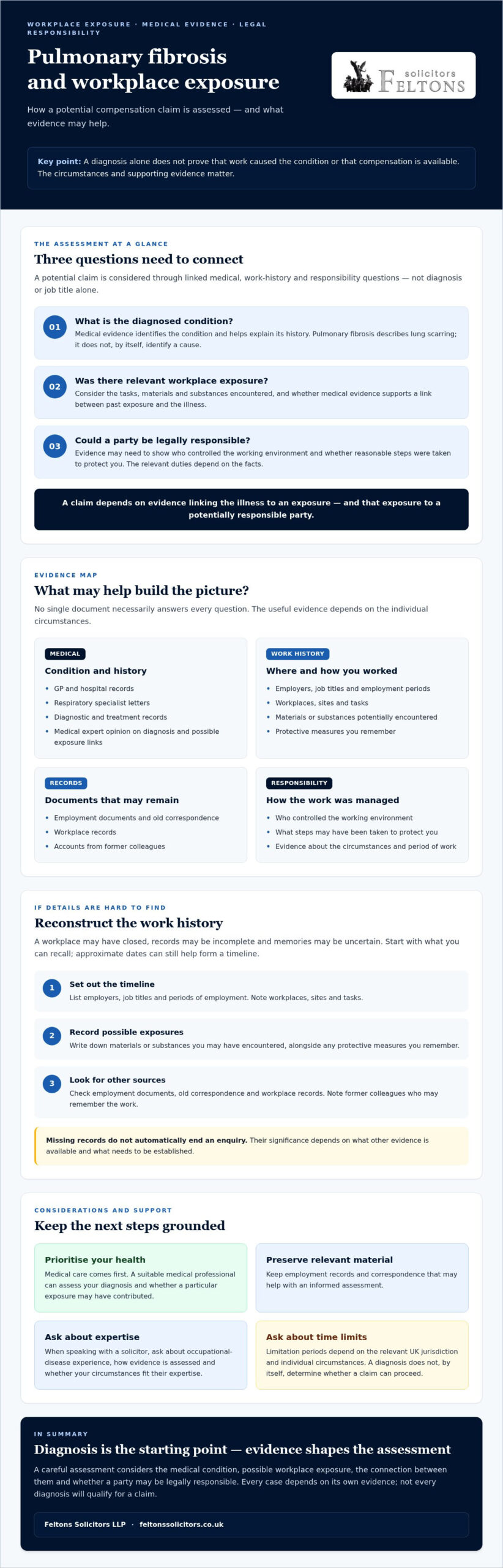
In short: a diagnosis identifies the medical condition; occupational causation concerns whether work exposure caused or materially contributed to it; legal responsibility asks whether a party can be held accountable on the evidence.
These questions need to be considered together. A solicitor may examine the tasks involved, when and where exposure occurred, who controlled the working environment, and what records or witness accounts remain. The relevant legal duties and potential responsibility depend on the facts, including the period and circumstances of the work. Pulmonary fibrosis compensation claims aren’t decided by diagnosis or job title alone. Medical evidence, exposure history and evidence about responsibility all matter.
How do pulmonary fibrosis claims connect diagnosis, exposure and responsibility?
A claim is assessed through several connected questions, not a single document or recollection. The evidence needs to establish the diagnosed condition, the person’s exposure history, whether that exposure caused or materially contributed to the illness, and whether a party may be legally responsible. A claim depends on evidence linking the illness to an exposure and that exposure to a potentially responsible party.
What medical evidence may help assess a claim?
Relevant material may include GP and hospital records, letters from respiratory specialists, diagnostic reports and treatment records. A solicitor can advise which documents may assist in a particular case. Medical experts may also be asked to consider the diagnosis and whether the available evidence supports a possible link with past exposure. The evidence needed will depend on the individual circumstances.
Medical records can confirm a diagnosis and help explain its history, but they don’t, on their own, establish who caused the illness or whether an employer breached a legal duty. Those are separate questions that require evidence about work and responsibility as well as medical opinion.
How can someone reconstruct a past exposure history?
When work took place many years ago, details can be difficult to recall and records may be incomplete. Start with a timeline, even if some dates are approximate. Note:
- Employers, job titles and periods of employment.
- Workplaces, sites, tasks and materials or substances potentially encountered.
- Protective measures you remember, and the names of former colleagues who may recall the work.
Possible sources include employment documents, old correspondence, workplace records and accounts from people who worked alongside you. Don’t assume that a missing file ends the enquiry. Its importance depends on what other evidence exists and what needs to be established.
Keep the different strands of evidence distinct. A work record may help show where and when you worked, but it won’t necessarily prove exposure or medical causation. A medical report may explain the illness without identifying a legally responsible party. Pulmonary fibrosis compensation claims therefore require the evidence to be considered as a whole, with gaps and uncertainties assessed rather than assumed away.
Some people also want to check whether a state benefit may be relevant. GOV.UK explains the eligibility rules for Industrial Injuries Disablement Benefit. Eligibility depends on the prescribed disease and personal circumstances, and the benefit route is distinct from establishing legal liability in a compensation claim.
If you’d like to understand whether your exposure history and available records fit a firm’s experience, you can discuss the evidence and relevant legal issues with Feltons Solicitors LLP. The firm handles personal injury claims, including specialist silicosis litigation, and can assess whether the circumstances are relevant to its experience.
Can I make a pulmonary fibrosis compensation claim if proof is difficult?
Difficulty tracing past exposure doesn’t automatically rule out a claim, but evidence remains central. A long interval between work and diagnosis can make the link feel hard to prove, but it doesn’t answer by itself whether a claim is possible. The strength of a case depends on what can be established about the illness, potential exposure, medical causation and legal responsibility.
There isn’t a single test for eligibility. Each case needs an individual assessment, taking account of the medical evidence, available work history, applicable law and whether a potentially responsible party can be identified. A solicitor can review what is available, explain where evidence may be incomplete and consider whether further enquiries could help. That assessment can clarify the issues, but it can’t guarantee that a claim will proceed or succeed.
What if an employer or work records are no longer available?
Old employers may have closed, changed names or no longer hold relevant records. Other sources may still provide useful detail, such as personal papers, payslips, photographs, correspondence, former colleagues’ recollections or archived workplace information. A solicitor may also investigate whether a potentially responsible organisation or relevant insurer can be traced, but this isn’t always possible.
Record what you remember, even if dates or job details are uncertain. Note the roles you held, places you worked, tasks you carried out and substances or materials you recall encountering. Be clear about what you know first-hand and what you’re unsure of. Missing documents don’t settle the question either way; their significance depends on the wider evidence and what a case needs to prove.
Does a diagnosis automatically mean compensation is available?
No. A diagnosis confirms a medical condition, but it doesn’t establish that work caused or contributed to it, or that another party is legally responsible. Pulmonary fibrosis can have different causes, and appropriate medical experts may need to consider the diagnosis and possible explanations alongside the person’s exposure history.
That’s why pulmonary fibrosis compensation claims shouldn’t be judged on assumptions based on a job title, a remembered substance or the time between exposure and diagnosis. An individual assessment can help distinguish what the evidence supports from what still needs investigation. If you’re uncertain, gather the information you can and ask a solicitor to assess the available material, remaining gaps and relevant legal issues before drawing conclusions about entitlement.
What steps should I take to start a pulmonary fibrosis claim?
Start with your health, not paperwork. Continue to seek medical care and follow advice from your healthcare team; gathering information for a possible claim shouldn’t delay treatment. You don’t need to prove legal causation yourself. A clear account of your work and the records you can locate can help a solicitor identify what may need further investigation.
What information should I prepare before speaking to a solicitor?
Begin with a simple timeline and add to it as you remember details. Approximate dates are useful if exact ones aren’t available. Keep copies of relevant documents, but don’t worry if your file is incomplete.
- Step 1: Note your diagnosis, when you received it, and any relevant medical appointments, reports or correspondence you have.
- Step 2: List employers, job roles, work locations and approximate dates, including periods when you may have encountered dust, fumes or other substances.
- Step 3: Gather available supporting material, such as employment records, payslips, workplace documents or correspondence, and note former colleagues who may remember the work.
- Step 4: Write down questions and uncertainties, including gaps in dates or details you can’t recall clearly. Don’t guess or try to decide what caused the condition.
An initial review can help identify which information may be relevant and what else might be needed. Preserve records and correspondence where you can, but medical care comes first.
Why should I check the time limit promptly?
Personal injury limitation rules may apply, but the relevant deadline can depend on when you became aware of the injury and its possible connection to work, alongside other facts. Rules also differ across UK jurisdictions, so don’t assume a deadline based on general guidance alone. A solicitor can check which rules apply to your circumstances and whether any time limit may affect the next steps.
Don’t assume that ongoing symptoms, delayed diagnosis or discussions with an employer automatically pause a deadline. If you’re considering pulmonary fibrosis compensation claims, seek case-specific legal advice promptly rather than waiting until every record has been found. Early advice can help clarify the issues while you continue to focus on your health.
Feltons Solicitors LLP handles personal injury claims, including specialist silicosis litigation. To discuss whether your work history and available records fit the firm’s experience, contact Feltons Solicitors LLP about your circumstances.
Choosing legal support for a pulmonary fibrosis compensation claim
Occupational disease cases can involve medical questions, old employment histories and evidence about who was responsible for working conditions. The right solicitor should be able to explain how they’ll assess those issues, what remains uncertain and how they’ll keep you informed. Ask questions before deciding whether to instruct a firm, and make sure you understand the proposed approach.
What should I ask a solicitor before instructing them?
Ask for clear, practical answers about the work involved. For example:
- What experience does the firm have with occupational disease claims, and how would it investigate my exposure history?
- How would it assess medical causation and identify any potentially responsible parties?
- Who would handle my matter, how would updates be provided, and how would important decisions be discussed?
- What funding arrangements may be available, and how would fees, disbursements and any other costs apply to my circumstances?
Ask for costs and funding information in writing before deciding. Arrangements vary, so don’t assume that a particular funding option is available or suitable. A solicitor should explain the terms relevant to your case in language you can follow.
How can Feltons Solicitors LLP assess whether its experience is relevant?
Feltons Solicitors LLP handles personal injury claims, including specialist silicosis litigation, as well as complex disputes. That experience may be relevant where the facts connect with the firm’s occupational-disease work, but it doesn’t establish that every pulmonary fibrosis matter falls within its expertise. Relevance depends on the individual diagnosis, suspected exposure, available evidence and legal issues.
An initial discussion can help clarify what is known, what may need investigation and whether the circumstances fit the firm’s experience. Ask directly about Feltons Solicitors LLP’s current expertise in relation to your particular condition and any suspected workplace exposure, and what the next steps would involve.
Readers considering a related issue may also find the guide Silicosis Claim After Death: A Legal Guide for Bereaved Families in 2026 useful. It concerns a different occupational disease and situation, so it shouldn’t be taken as an indication that the legal issues or outcome will be the same.
If you’d like to discuss your exposure history, available evidence and relevant legal questions with Feltons Solicitors LLP, Discuss your circumstances with Feltons Solicitors LLP. The discussion can help establish whether the firm’s experience is relevant; it can’t determine the outcome of a claim in advance.
Take a considered next step
A pulmonary fibrosis diagnosis doesn’t, by itself, establish that work caused the condition or that compensation is available. A potential claim needs evidence connecting the medical diagnosis with workplace exposure and a legally responsible party. Where old records are missing or the link is uncertain, an individual review can help identify what is known and what may need further investigation.
If you’re considering pulmonary fibrosis compensation claims, keep relevant medical and employment information, write down what you remember and seek case-specific advice about evidence and time limits. Don’t delay medical care while gathering documents.
Feltons Solicitors LLP handles personal injury claims, including specialist silicosis litigation, and provides pragmatic advice on complex disputes. An initial discussion can help assess whether your circumstances fit the firm’s relevant experience, without assuming eligibility or an outcome. Discuss your circumstances with Feltons Solicitors LLP and take the next step with a clearer understanding of your options.
Frequently Asked Questions
Can I claim compensation for pulmonary fibrosis caused by workplace exposure?
Possibly, if evidence supports a connection between workplace exposure and your condition, and establishes that a party may be legally responsible. A diagnosis alone doesn’t prove either point. Pulmonary fibrosis compensation claims are assessed individually, taking account of medical opinion, work and exposure history, available records and applicable law. A solicitor can review what you know and explain whether further investigation may be needed, without guaranteeing eligibility or an outcome.
How do I prove that work caused my pulmonary fibrosis?
You’ll generally need evidence about the diagnosis, potential workplace exposure, medical causation and responsibility. Useful material may include medical records and reports, a timeline of employers and roles, workplace documents, correspondence and recollections from former colleagues. Medical experts may be asked to consider possible causes, while a solicitor assesses the legal evidence. No single record necessarily proves the whole case, and the evidence required depends on your circumstances.
Is pulmonary fibrosis the same as silicosis?
No. Pulmonary fibrosis describes scarring in lung tissue, whereas silicosis is a specific lung disease associated with breathing in respirable crystalline silica dust. The terms aren’t interchangeable, although lung scarring may be relevant to different diseases. A medical professional must assess an individual’s diagnosis and possible cause. Feltons handles personal injury claims, including specialist silicosis litigation, but that doesn’t mean every pulmonary fibrosis condition falls within its current expertise.
How long do I have to make a pulmonary fibrosis compensation claim?
Personal injury claims generally have a three-year time limit, often linked to when the injury and its possible connection to work became known. This isn’t a universal answer: the relevant rules may depend on your circumstances and UK jurisdiction. Don’t assume that ongoing symptoms, delayed diagnosis or discussions with an employer pause a deadline. Seek prompt, case-specific advice so a solicitor can check which limitation rules apply to you.
Can I make a claim if my former employer has closed?
A former employer closing down doesn’t necessarily rule out a claim, but it can make identifying the responsible party more complex. A solicitor may investigate whether relevant historical records or an insurer can be traced, alongside other evidence such as personal papers and former colleagues’ accounts. There’s no guarantee that an organisation, insurer or document will be found. The available evidence and legal position need to be assessed individually.
What should I do first if I suspect work contributed to pulmonary fibrosis?
Continue with medical care and follow your healthcare team’s advice. Then make a timeline of your employers, roles, work locations and any substances you remember encountering. Keep relevant medical, employment and workplace records, and note gaps or questions rather than trying to prove causation yourself. Consider seeking legal advice promptly, as limitation rules may apply. An initial assessment can help clarify which evidence may assist and what further information might be needed.