

What if registering an overseas entity is only the start of its UK property compliance duties? For organisations that own UK land, overseas corporate property ownership compliance is an ongoing process. A registered entity must file an update statement with Companies House at least once every 12 months, even if its beneficial ownership hasn’t changed. The filing is due within 14 days of the registration anniversary.
It can be difficult to know which changes to report, what records to keep current and how the Register of Overseas Entities fits alongside other obligations. These duties are connected: a change in ownership or company information may require a prompt review.
This guide explains the continuing duties linked to overseas entity registration and the events that may need attention. It distinguishes register requirements from land, company, tax and sanctions considerations, and compares a structured self-managed process with tailored legal support. Feltons Solicitors LLP advises on registration of overseas entities and property matters, helping owners assess how the requirements apply to their particular structure.
Key Takeaways
- Treat overseas corporate property ownership compliance as an ongoing process, not a one-off registration task.
- Review changes to beneficial ownership, registrable beneficial owners or managing officers promptly to assess whether reporting action is needed.
- Use the property’s status, planned transaction and ownership structure as prompts for a focused compliance review.
- Keep ownership evidence, Companies House submissions and relevant correspondence organised in one controlled record.
- Compare self-managed administration with tailored legal support to decide how best to coordinate register duties with property transactions.
Overseas corporate property ownership compliance: why registration is only the starting point
Overseas corporate property ownership compliance covers the continuing legal and administrative responsibilities that may apply when an overseas entity owns or seeks to acquire relevant UK land. Registration with Companies House is a key part of the process, but it doesn’t keep the entity’s information accurate by itself or satisfy every obligation connected with its company, property or wider regulatory position.
Start by identifying the legal owner, the property and the relevant UK jurisdiction. An entity may have registered correctly when it acquired a property, but later changes to its ownership or management could mean its register information needs attention. The position may also depend on when the land was acquired and what type of interest is held. Treating registration as a one-off task risks overlooking these continuing responsibilities.
What does the Register of Overseas Entities do?
Companies House maintains the Register of Overseas Entities under the Economic Crime (Transparency and Enforcement) Act 2022. Its purpose is to make information available about overseas entities that own or seek to acquire qualifying UK land, including details of registrable beneficial owners or, where relevant, managing officers. The register helps show who stands behind an entity, but it doesn’t replace checks on the entity’s wider obligations.
For the registration regime, qualifying land interests include freehold ownership and certain leasehold interests. A non-UK legal entity may need to register before it can complete a relevant property transaction. The position should be assessed against the property’s location, legal interest and transaction history. Companies House registration doesn’t replace land registration requirements, company filings, tax considerations or other regulatory checks.
Which overseas property owners should review their position?
Overseas legal entities should review their position if they already hold relevant UK land, plan to acquire it or are preparing to dispose of it. This means checking the entity’s ownership chain and the information recorded about its beneficial owners or managing officers. A sale or other transaction can bring register status into focus, so assess it as part of property planning rather than waiting until completion is imminent.
Individual overseas buyers shouldn’t assume that the Register of Overseas Entities applies to them in the same way simply because they live outside the UK. The regime is directed at overseas legal entities. The correct analysis depends on who legally owns the property and how that ownership is structured.
Historic holdings also need careful review. The registration rules have retrospective application for certain properties acquired on or after 1 January 1999 in England and Wales, and 8 December 2014 in Scotland. Transitional circumstances and jurisdiction-specific land rules can affect the analysis, including where a property has changed hands or the ownership structure has been reorganised. Check current Companies House guidance and assess the facts before drawing a conclusion.
- Identify the registered owner: distinguish the overseas entity from individuals or other entities in its ownership chain.
- Establish the property history: record where the land is, the interest held and when it was acquired.
- Review the wider position: consider register duties alongside relevant land, company and regulatory requirements.
The continuing compliance duties overseas entities need to understand
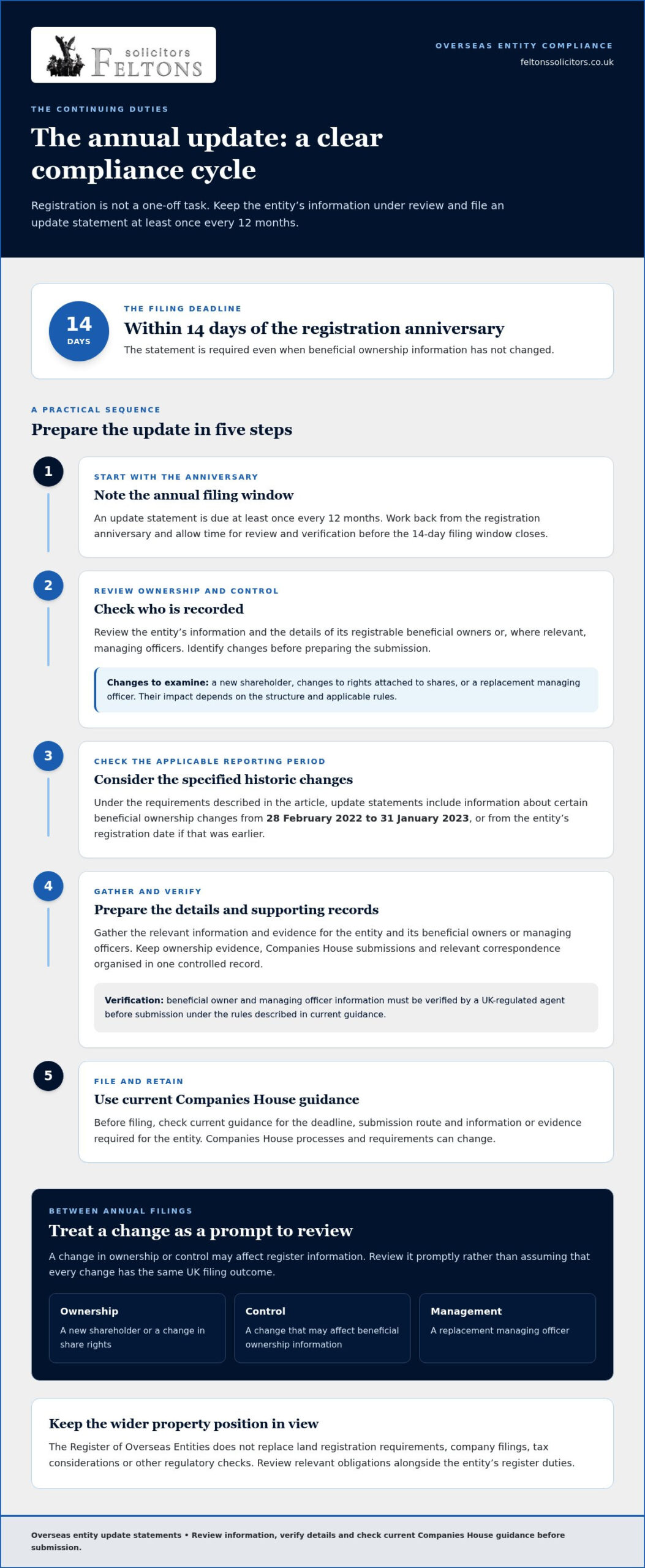
For an overseas entity on the Register of Overseas Entities, compliance means keeping its recorded information current, not simply retaining a registration number. The annual update statement is the recurring Companies House filing used to confirm or update information about the entity and its beneficial owners or managing officers. It’s required at least once every 12 months, even if nothing has changed.
Annual updates and keeping information accurate
The filing deadline is 14 days after the anniversary of the entity’s registration. Before preparing a submission, review the ownership and control information, identify any changes and gather the relevant details. The review should also account for applicable reporting rules: under current requirements, update statements include information about certain beneficial ownership changes from 28 February 2022 to 31 January 2023, or the entity’s registration date if earlier.
Companies House processes and requirements can change. Before filing, check its current guidance for the deadline, submission route and information or evidence required for the entity. Beneficial owner and managing officer information must be verified by a UK-regulated agent before submission under the rules described in current guidance. Allow time for review and verification rather than leaving these steps until the deadline.
Changes, verification and supporting records
A change in ownership or control should trigger a compliance review. A new shareholder, a change in the rights attached to shares or a replacement managing officer could affect information relevant to the register. The impact depends on the structure and applicable rules, so don’t assume that a change in the overseas entity’s home jurisdiction has the same UK filing outcome in every case.
Keep a clear record of the change, the assessment, supporting documents and any submission or correspondence. The evidence and verification steps depend on the filing and current requirements. Companies House identity-verification reforms are separate from verification of Register of Overseas Entities information. As implementation can depend on role and timing, check current Companies House guidance before deciding who must verify their identity or when.
Register duties are only one part of the picture. Tax reporting, filings required in the entity’s place of incorporation and registration of the land itself are separate matters, each with its own rules and processes. For land registration context, HM Land Registry Practice Guide 78 is an official reference. Requirements can vary according to the property’s UK jurisdiction and the transaction.
A disciplined process makes overseas corporate property ownership compliance easier to manage: assign responsibility for monitoring changes, maintain an organised evidence file and diarise the annual review. Where the ownership chain or a property transaction raises questions, tailored advice on overseas entity registration can help connect register information with the particular structure and property circumstances.
How compliance considerations differ by ownership structure and property situation
Begin the review with the event under consideration: a purchase, continued ownership or a proposed disposal. Each raises different questions about the entity’s registration position, ownership information and the property transaction. The correct compliance steps depend on the entity’s structure and the property’s history.
Acquiring, holding or disposing of UK property
Use the comparison below to organise an initial review. It helps identify issues, but it doesn’t determine whether a particular filing or restriction applies. The answer depends on the facts, current rules and the property’s jurisdiction.
| Situation | Questions to investigate |
|---|---|
| Proposed acquisition | Is the buyer a legal entity incorporated outside the UK? What type of land interest is being acquired, and what registration and transaction steps apply before completion? |
| Existing holding | When and where was the property acquired? Has the ownership or control structure changed since acquisition, and is the recorded information consistent with the current position? |
| Proposed disposal | What is the entity’s current register status? Do the title, entity details and ownership records align, and are any additional steps needed for the planned transaction? |
Land transaction work and Register of Overseas Entities duties are related, but they are not interchangeable. A purchase or sale involves property-specific conveyancing and land registration considerations as well as a review of the entity’s register obligations. The steps can vary across England and Wales, Scotland and Northern Ireland. Don’t assume registration alone resolves every transaction requirement, or that the same restriction applies in every case. Companies House guidance on the Register of Overseas Entities provides an official overview of the regime.
Ownership chains, beneficial owners and managing officers
Direct ownership may make it easier to identify the entity that holds the property, but the underlying ownership and control still need review. With layered ownership, trace the chain through each organisation and consider who ultimately owns or controls the overseas entity. A change at an upper level can prompt a fresh assessment of the information relevant to the register, even if the entity named on the property title hasn’t changed.
In plain English, a beneficial owner is a person or entity identified under the applicable rules as owning or exercising relevant control. A managing officer is someone who manages the overseas entity where the rules require that information to be reported. These roles are distinct, and a person’s involvement in day-to-day decisions doesn’t by itself settle how they should be classified. Review the facts against current guidance.
Trusts, nominees and arrangements involving several connected entities need particular care. The legal documents, actual control and reporting requirements may all matter. As part of overseas corporate property ownership compliance, record the structure clearly and assess changes before a property transaction advances. Coordinated advice on overseas entity registration and property matters can help bring these considerations together without treating a general framework as a determination of a specific case.
A practical overseas corporate property compliance checklist
A repeatable process helps identify filing or information issues before they become urgent. For overseas corporate property ownership compliance, assign responsibility, maintain a reliable record trail and treat changes in ownership or property plans as prompts for review. Use the checklist below as a practical sequence, adapting it to the entity’s structure and circumstances.
- Identify the legal owner. Record the overseas entity’s full name and jurisdiction of incorporation, along with the UK property it owns or plans to acquire. Check that the entity name matches the relevant corporate and property records.
- Map the ownership and control structure. Set out each organisation in the ownership chain and identify the individuals or entities whose ownership or control may be relevant. Note any layers, trusts, nominees or management arrangements that need closer analysis.
- Confirm the registration position. Review whether the entity is registered and whether the information held is consistent with its current structure. For practical background on identifying reportable individuals, see this guide to overseas entity beneficial owner registration. For an overview of the registration process connected with UK property, consult the guide to registering an overseas entity for UK property.
- Monitor changes and transactions. Treat ownership restructuring, changes to beneficial owners or managing officers, acquisitions and proposed disposals as review triggers. A trigger calls for assessment; it doesn’t automatically mean register information or a filing must change.
- Diarise recurring reviews. Assign a named person or team to monitor relevant filing dates and review the ownership information at planned intervals. Include a handover process so responsibility doesn’t disappear when staff or advisers change.
Build a repeatable review and record-keeping process
Keep a controlled file containing ownership charts, source documents used to assess control, submitted forms, confirmation records and relevant correspondence. A dated record of who reviewed the information and what action followed can help the organisation respond consistently if questions arise. Restrict access appropriately and keep the file organised instead of relying on scattered email threads or one person’s notes.
Set retention and access practices with reference to the requirements for each record type. Don’t assume one retention period suits every document. The aim is a usable audit trail that can be updated as the entity, its ownership or its property position changes.
Recognise when a change needs legal assessment
Flag changes early, particularly when a transaction is being planned alongside a restructure or change in control. A review can establish whether the event affects reported information, requires supporting evidence or raises a separate property registration question. Feltons Solicitors LLP advises on overseas entity registration and property matters. Explore legal support for overseas entity registration for a tailored assessment of the next steps.
Choosing legal support for overseas corporate property ownership compliance
Some entities manage routine administration internally, using a clear ownership record and a reliable system for monitoring filing dates. This keeps the process close to the people who understand the organisation’s structure. It also requires someone with the time and knowledge to recognise when a change may affect the register or a planned property transaction.
Tailored legal support can help where ownership is layered, the property has a complex history, or an acquisition or disposal is approaching. A legal review can connect Companies House information with the entity’s ownership structure and relevant property-law questions. Neither approach suits every owner. The right level of support depends on the facts, internal resources and confidence in assessing the requirements.
What tailored legal support can help coordinate
Advice can clarify how registration and ownership information relate to the entity’s particular structure, and identify property-law questions arising from its holdings or planned transactions. This can be especially useful when a change in control occurs alongside a restructure or proposed sale, and it isn’t clear which records or obligations need review.
Feltons Solicitors LLP advises on registration of overseas entities and property matters, including conveyancing. This combined perspective helps organise a review around the entity’s circumstances rather than treating register information and property activity as unrelated tasks. Legal advice can guide the process, but the entity remains responsible for the accuracy and completeness of information it provides for its filings.
Prepare for a focused conversation about compliance
A focused discussion is easier when the relevant material is ready. Consider gathering:
- the overseas entity’s name, jurisdiction of incorporation and registration details
- property details, including location, ownership history and any planned transaction
- ownership charts, relevant company records and information about beneficial owners or managing officers
- previous Register of Overseas Entities submissions and related correspondence
Note known changes, such as a transfer of ownership interests, a new managing officer or a proposed acquisition or disposal. This gives the review a practical starting point and helps distinguish changes that need investigation from routine updates. Keep source documents organised, but don’t assume every event automatically requires a filing: its effect depends on the facts and current requirements.
For tailored guidance on overseas corporate property ownership compliance, discuss overseas entity and property compliance with Feltons Solicitors LLP. A conversation can clarify how the register, ownership structure and property plans fit together, so the next steps can be considered in context.
Make your next compliance decision with clarity
Build overseas corporate property ownership compliance into the organisation’s forward planning rather than treating it as an isolated filing task. Before an ownership change or property decision moves ahead, identify unanswered questions about the entity’s structure, register information and legal steps connected with the property. A considered review helps the organisation decide what needs attention and who should take responsibility.
Where a matter involves both register duties and a property transaction, joined-up advice can bring those considerations into one discussion. Feltons Solicitors advises on overseas entity registration and residential and commercial conveyancing, so relevant points can be considered in the context of the organisation’s property plans.
If you’d value a clear assessment of your circumstances, discuss your overseas entity and property compliance matter with Feltons Solicitors. A considered next step can make a complex issue more manageable and help you plan with confidence.
Frequently Asked Questions
Does an overseas company have to register to own property in the UK?
An overseas legal entity may need to register if it owns or intends to acquire qualifying UK land, such as a freehold or a lease exceeding seven years. The requirement depends on the entity and the property interest, so “overseas company” alone doesn’t settle the question. An individual buying in their own name shouldn’t assume the entity rules apply to them. Review the ownership documents and relevant jurisdiction before proceeding.
Is overseas entity registration a one-off requirement?
No. Registration establishes the entity’s entry on the Register of Overseas Entities, but the entity must continue to review and report its information under the applicable rules. For example, a change in who owns or controls the entity may need assessment even if the property title remains unchanged. Registration also doesn’t remove separate company, tax or land-registration responsibilities, which should be managed separately.
What changes must an overseas entity report to Companies House?
Changes to beneficial ownership, registrable beneficial owners or managing officers should prompt a review of the entity’s register information. The entity should also consider whether other recorded details have changed and what the current filing rules require. For instance, a new parent company may alter the ownership chain even though the registered property-owning entity stays the same. Assess the change against current Companies House guidance before preparing a submission.
How often must an overseas entity update its information?
An overseas entity must file an update statement at least once every 12 months, including when there’s been no change to its beneficial owners. The filing deadline is 14 days after the anniversary of its registration. Keep the anniversary and submission deadline in a central calendar, allowing time to review the information and complete any required verification. Check current Companies House filing guidance before submitting, as processes can change.
Can an overseas entity sell UK property if its register information is out of date?
It may face a restriction that prevents a property transaction from proceeding. A restriction on the title can affect an entity’s ability to sell, lease or charge the property while it remains non-compliant. The practical effect depends on the title, the property’s jurisdiction and the entity’s circumstances. If a sale is planned, review the register position early alongside the conveyancing work rather than assuming an update can wait until completion.
What is the difference between an overseas entity and a beneficial owner?
An overseas entity is the non-UK legal body that may own or acquire qualifying UK land. A beneficial owner is a person or entity identified under the applicable rules as owning or exercising relevant control over that body. For example, a property title may name an overseas company, while another organisation or individual further up its ownership chain may be relevant to beneficial ownership reporting.
Do the same overseas property ownership rules apply across the UK?
No. The Register of Overseas Entities is UK-wide, but land registration systems and property processes differ between England and Wales, Scotland, and Northern Ireland. The property’s location and acquisition history can therefore affect the review. For example, retrospective registration dates differ for some holdings in England and Wales and in Scotland. Don’t assume that a conclusion about a property in one jurisdiction applies to another.
Can a solicitor help manage overseas corporate property compliance?
Yes. A solicitor can help assess how the entity’s ownership structure, register information and property plans fit together, and advise on relevant registration and conveyancing questions. This can be particularly useful before a proposed transaction or after a change in control. Legal support can help organise the review, but the entity remains responsible for ensuring the information it provides is accurate. Feltons Solicitors LLP advises on overseas entity registration and property matters.