

The most useful first step in a party wall dispute may not be a formal legal letter. If you’re unsure whether the Party Wall etc. Act 1996 applies, or building work is about to begin without agreement, it’s understandable to feel you need to act quickly. Sound party wall dispute legal advice can help you clarify your options and risks before the disagreement escalates, without treating every concern as a court case.
This article explains how to check the position and what to do if work has started or you haven’t received a clear response. You’ll learn which documents to gather, how a party wall surveyor’s role differs from a solicitor’s, and when each may be useful. It also explains how to approach the next step proportionately, keep a clear record and protect your position. Legal advice can help you understand your rights and routes forward, but it doesn’t replace a surveyor’s role in the Act’s dispute process. If you’re considering a solicitor, first confirm they can assist with your particular issue.
Key Takeaways
- Check whether the proposed work may fall within the Party Wall etc. Act 1996 before treating the matter as a general boundary disagreement.
- Keep copies of notices, plans and correspondence. Then check what work is planned and whether the relevant notice and response steps have been followed.
- A party wall surveyor deals with the statutory process; a solicitor can help explain legal options and wider dispute-resolution risks. One does not automatically replace the other.
- Use party wall dispute legal advice to clarify your position, understand possible next steps and decide whether specialist input is proportionate.
- Before instructing an adviser, ask about their relevant experience, the scope of help they can provide, the likely process and the information they’ll need from you.
Party wall dispute legal advice: identify the issue before it escalates
A party wall disagreement is not simply any dispute between neighbours about building work. It concerns work that may fall within the Party Wall etc. Act 1996, the framework for specified work in England and Wales. A statutory party wall matter may arise when work covered by the Act affects a shared wall, a boundary structure or nearby land, and the owners need to follow the relevant procedure.
A party wall dispute concerns the statutory process for specified building work; a general boundary dispute concerns where ownership or the property line lies. The issues can overlap, but they are not interchangeable. The Act does not apply to every renovation or neighbour disagreement, so the nature and location of the proposed work matter. The Party Wall etc. Act 1996 offers background on the legislation, but the particular facts still need to be assessed.
What kinds of work can raise a party wall issue?
Depending on the circumstances, the Act may apply to work directly affecting a party wall or structure, building a wall at the boundary, or certain excavations near a neighbouring building. Calling a project an extension or loft conversion doesn’t establish whether the Act applies. The plans, the properties’ positions and the details of the work all matter.
Check the proposed work and property circumstances before assuming that a notice is or isn’t required. If the scope is unclear, a qualified party wall professional can assess the building work and its relationship to the Act.
Is this a party wall matter or another property dispute?
A boundary disagreement concerns the location or ownership of the dividing line. A party wall issue concerns specified work and the procedure that may govern it. Concerns about damage, access to land or nuisance may raise separate legal questions, even when they relate to the same building project.
One situation can therefore call for more than one kind of input. A party wall surveyor may be relevant to the Act’s process, while a solicitor may help assess wider legal rights or dispute-resolution options. Party wall dispute legal advice can help identify which questions need attention, but a short online description cannot determine your rights. Keep the plans and correspondence together, and seek advice based on the full circumstances before taking a position.
How the party wall process works: notices, responses and awards
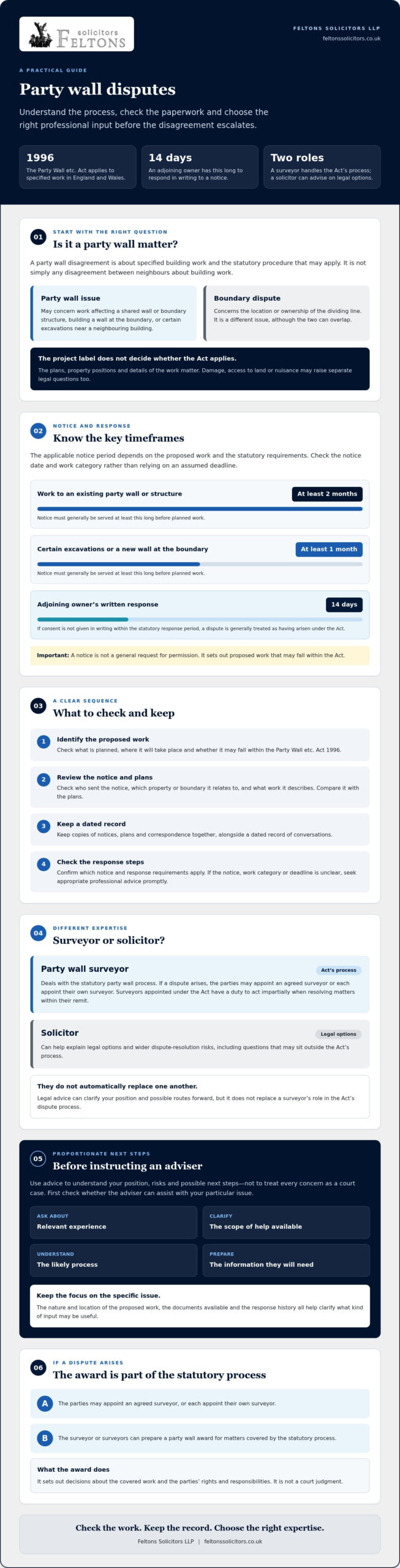
The process depends on the proposed work and whether the relevant notice has been served. A notice is not a general request for permission. It sets out proposed work that may fall within the Party Wall etc. Act 1996. The applicable notice period and response timetable depend on the proposed work and the statutory requirements that apply.
For example, the research for this guide confirms that notice for work to an existing party wall or structure must generally be served at least two months before work is planned, while notice for certain excavations or a new wall at the boundary must generally be served at least one month beforehand. An adjoining owner has 14 days to respond in writing. Check the notice date and work category carefully, and seek advice if either is unclear.
What should an owner do after receiving a party wall notice?
Start by checking who sent the notice, what work it describes and which property or boundary it relates to. Compare it with any plans you’ve received, then keep copies of the documents together with a dated record of conversations and correspondence. GOV.UK’s Party walls and building work guidance provides practical information about the process.
Don’t rely on an assumed deadline or respond without checking what the notice requires. The relevant period may depend on the notice and the work involved. If you’re unsure how to respond, obtain appropriate professional advice promptly.
What happens if an adjoining owner dissents or does not respond?
If the adjoining owner doesn’t consent in writing within the statutory response period, a dispute is generally treated as having arisen under the Act. The parties may then appoint an agreed surveyor, or each appoint their own surveyor. Surveyors appointed under the Act have a duty to act impartially when resolving matters within their remit.
Where the statutory process applies, the surveyor or surveyors can prepare a party wall award. This document sets out decisions about the covered work and the parties’ rights and responsibilities. It isn’t a court judgment, although it is legally binding. An award may be appealed to the county court within 14 days of service.
The sequence depends on the circumstances. If a notice wasn’t served, the Act’s surveyor procedure may not be available, and the appropriate route can differ. Party wall dispute legal advice may help clarify wider legal options, but it doesn’t replace a surveyor’s role in the statutory process. For related property or dispute questions, you can ask Feltons Solicitors about its property and dispute resolution services and whether it can assist with your specific issue.
Party wall surveyor or solicitor: which advice do you need?
The right professional depends on the question you need answered. A party wall surveyor deals with matters within the Party Wall etc. Act 1996 process, while a solicitor can advise on legal rights, how the Act may apply and wider dispute-resolution options. Their roles differ. Instructing a solicitor doesn’t automatically replace a surveyor appointed under the Act.
Use this comparison to identify a sensible first question:
| Your concern | Professional who may help | Suitable first question |
|---|---|---|
| How proposed work should be dealt with under the Act, or what an award should address | Party wall surveyor | “Does this work fall within your remit under the Act?” |
| Uncertainty about legal rights, alleged damage, access or possible court action | Solicitor, subject to confirming relevant experience and service scope | “Can you advise on this issue, and what documents do you need to assess it?” |
| Questions about both the statutory process and wider legal rights | Potentially both, with each professional’s role agreed clearly | “Which parts of the matter can you advise on, and who should address the others?” |
When is a party wall surveyor usually the relevant professional?
A surveyor is generally the relevant professional for resolving matters within the Act’s procedure, including considering the works and preparing or dealing with a party wall award. Surveyors appointed under the Act must act impartially in that process, rather than simply advocate for the person who appointed them. Before proceeding, check the surveyor’s appointment, precise remit and how the statutory role applies to your circumstances.
A surveyor’s role doesn’t automatically extend to deciding who owns a disputed strip of land, interpreting every property agreement or resolving all questions about access. Those issues may need separate legal input.
When may party wall dispute legal advice be useful?
Legal advice may help if you’re unsure how the legislation applies, damage is alleged, access is contested or someone threatens legal proceedings. A solicitor can review the documents, explain potential options and risks, and help you understand whether the issue extends beyond the surveyor-led process. Seeking advice doesn’t mean you’ve committed to going to court. Early clarity may help you consider proportionate ways forward.
Consider seeking advice promptly if a deadline is approaching, an injunction is raised or the impact on your property could be substantial. Feltons Solicitors handles property law and litigation and dispute resolution matters, but its available information doesn’t confirm a dedicated party wall service. Establish whether the firm can assist with your specific issue before instructing it.
Party Wall Disputes: Practical Steps Before Escalation
A calm, organised response can help you understand what has happened before taking a formal step. First preserve the available records, clarify the work and check whether any notice or party wall award exists. Then consider whether a surveyor, solicitor or both may be appropriate. This isn’t about conceding a point; it’s about making decisions with a clearer picture of the facts.
Which documents and evidence should you gather?
Bring the key information together in one place. Keep original documents unchanged, and note when you received or created each item. Useful records may include:
- Party wall notices, plans, schedules of condition and any award.
- Letters, emails and messages exchanged with the neighbour, building owner or surveyor.
- Dated photographs showing the property before work, visible changes or damage.
- A factual timeline of what you observed, when it happened and who you contacted.
Separate what you’ve personally seen from what you suspect or have been told. For example, record when a crack appeared and where it is, rather than assuming what caused it. For wider background on property matters, Feltons’ residential property law guide may provide useful context.
How can you communicate without making the dispute worse?
Keep messages courteous, concise and focused on the work and the information you need. You could ask for a copy of the relevant notice or plans, or request clarification about what work is planned and when. Avoid unsupported allegations or statements that could be read as accepting responsibility or confirming a legal position. If you’re uncertain, get advice before making substantive admissions or assurances.
Don’t obstruct access or try to stop building work yourself without first checking your position. Equally, don’t assume that silence or an informal conversation resolves the issue. Keep a copy of each communication and note any reply.
Seek prompt, case-specific advice if work is underway and you’re concerned that a procedural step may have been missed, if damage is alleged, or if someone raises urgent court action. Party wall dispute legal advice can help assess legal options and risks, while a party wall surveyor may be needed for matters within the Act’s process. To ask whether the firm can assist with your particular property or dispute issue, contact Feltons Solicitors about its services.
Choosing party wall dispute legal advice and agreeing the next step
Choose an adviser based on the issue you need resolved, not simply the fact that neighbours disagree. A party wall surveyor may be the appropriate professional for matters within the Act’s procedure; a solicitor may be able to advise on wider legal rights or dispute-resolution options. Before instructing anyone, explain the particular concern and confirm that it falls within their experience and service scope.
What should you ask before instructing a solicitor?
Ask whether the firm can advise on your specific party wall issue and any connected property dispute. Confirm who would handle the matter, what work the proposed instruction covers and how you’ll receive updates. You can also ask what documents are needed to assess your position, what the possible next steps might be, and how costs will be explained before you decide whether to proceed.
Useful questions include:
- Have you dealt with issues of this type, and can you advise on the particular facts?
- Would the matter require input from a party wall surveyor as well as a solicitor?
- What information or documents do you need before advising on options and risks?
- How will the scope of work, likely timescales and costs be set out?
Costs, timescales and prospects depend on the documents, the work involved and the points in dispute. An adviser should explain the basis of any estimate and what could affect it, rather than promise a particular outcome.
When might a dispute need a more formal route?
Court action isn’t the automatic next step. A disagreement may be addressed through the relevant surveyor process or another proportionate route, depending on the facts. However, unresolved questions about legal rights, alleged property damage or an urgent risk may justify discussing formal options with a solicitor. Seek advice promptly if proceedings are threatened or a deadline may affect your choices.
Feltons Solicitors handles property law and dispute resolution matters, but the available information doesn’t confirm that the firm accepts party wall instructions. Confirm whether it can assist with your specific issue, and ask what legal work it could undertake. Party wall dispute legal advice should help you understand options and risks, not assume that litigation is inevitable or replace the surveyor’s statutory role.
If you’d like to establish whether the firm can help with your circumstances, discuss your property dispute with Feltons.
Take a measured next step with confidence
A party wall concern is easier to assess when you separate the statutory process from wider property questions. Check the proposed work and any notices, preserve relevant records, and identify what remains unresolved. A party wall surveyor may be relevant to matters under the Act, while a solicitor can help explain legal options and risks beyond the surveyor’s remit.
Good party wall dispute legal advice doesn’t mean court action is inevitable. It can help you understand the available routes and decide what is proportionate to your situation. The right next step depends on the documents, the work and the specific issues involved.
Feltons Solicitors provides property law and conveyancing services and handles litigation and dispute resolution. The firm’s available information doesn’t confirm a dedicated party wall service, so ask whether it can assist with your particular issue before instructing. For a discussion about your circumstances, discuss your property dispute with Feltons. A clear understanding of your options can help you move forward calmly.
Frequently Asked Questions
Does every party wall dispute need a solicitor?
No, not every party wall matter requires a solicitor. Where the statutory process applies, a party wall surveyor may deal with matters within that process. A solicitor may be useful if there are wider questions about legal rights, alleged damage, access or possible court action. Party wall dispute legal advice can help clarify your options, but check that the solicitor can advise on your particular circumstances.
Can I stop my neighbour’s building work because I dispute it?
Disagreeing with your neighbour doesn’t automatically give you the right to stop their work. Don’t obstruct the work or access without first checking your legal position. If you believe work that may require notice has started without the proper process, or there’s an immediate risk to your property, seek prompt, case-specific advice. The appropriate remedy depends on the facts and may involve the courts rather than the Act’s surveyor procedure.
What happens if I disagree with a party wall award?
A party wall award is legally binding unless it’s successfully challenged. If you disagree, get advice promptly: an appeal must be made to the county court within 14 days of the award being served. Don’t assume that raising concerns with a surveyor pauses this period. Gather the award and related correspondence, and ask an adviser to explain whether your grounds and circumstances justify an appeal.
Do I need a party wall surveyor or a solicitor?
Choose according to the issue. A party wall surveyor deals with matters within the Act’s statutory process, including preparing or dealing with an award. A solicitor may advise on legal rights and wider disputes, such as alleged damage or threatened proceedings. You may need input from both, but a solicitor doesn’t automatically replace a surveyor appointed under the Act. Confirm each professional’s role and scope before instructing them.
Who pays for party wall dispute legal advice?
Don’t assume that party wall process costs and solicitor fees are treated the same way. In most cases, the building owner who initiates the work is responsible for the costs of the Act’s process, including the adjoining owner’s surveyor fees. A solicitor’s fees are separate, so ask the solicitor to explain who would be responsible for their costs and whether any recovery may be possible in your circumstances.
Does the Party Wall etc. Act 1996 apply throughout the UK?
No. The Party Wall etc. Act 1996 applies in England and Wales, not throughout the whole UK. If the property is in Scotland or Northern Ireland, don’t assume that this Act or its procedure applies. The relevant rules depend on where the property is and what work is proposed. Check the position with a suitably qualified professional before relying on a notice, deadline or process described for England and Wales.
What documents should I take to a party wall solicitor?
Take the party wall notice, plans, any award and correspondence with your neighbour, building owner or surveyor. Include dated photographs and a short timeline of events, especially if you’re concerned about damage or work changing. Keep original records unaltered, and distinguish what you’ve observed from what you suspect. If you don’t have every document, take what’s available and ask the solicitor what else is needed to assess the issue.