

For an international property owner, the most critical phase of a UK sale isn’t the exchange of contracts, but the sixty days that follow it. Missing this narrow window for reporting and payment can lead to immediate HMRC penalties, even if no tax is actually due. Engaging specialist non-resident capital gains tax uk property solicitors ensures that your disposal is handled with the precision required to meet these stringent deadlines. You’ve likely noticed that the UK tax landscape has become increasingly complex, moving from a relatively relaxed regime to one defined by real-time reporting and the rigorous transparency of the Register of Overseas Entities.
It’s understandable to feel a sense of trepidation when facing these evolving regulations, but with the right guidance, you can manage your obligations with confidence. This article provides a clear roadmap for navigating non-resident CGT, showing you how to minimise your liability through strategic rebasing and ensure your conveyancing process proceeds without delay. We’ll examine the current 2026-2027 tax rates, the nuances of the 60-day reporting window, and how to maintain full compliance whilst protecting your investment’s value.
Key Takeaways
- Master the strict 60-day reporting and payment window to ensure full compliance and avoid costly HMRC penalties.
- Explore how rebasing your property value to 2015 or 2019 levels can effectively minimise your overall tax liability.
- Understand why registration with the Register of Overseas Entities is a mandatory prerequisite for any valid UK land transfer.
- Discover how non-resident capital gains tax uk property solicitors provide an integrated approach to conveyancing and tax reporting.
- Recognise the common pitfall of failing to report a disposal to HMRC, even in instances where no tax is actually payable.
Understanding Non-Resident Capital Gains Tax (NRCGT) in the UK
NRCGT is the tax due on profits made from disposing of UK land or property whilst living abroad. This specific branch of Capital Gains Tax in the United Kingdom has seen significant expansion over the last decade. In 2015, the UK government introduced these rules for residential assets, extending them in April 2019 to include all non-residential property and land. The logic behind this shift was to align the tax treatment of overseas owners with that of UK residents, ensuring a level playing field across the property market. Whether you’re selling a buy-to-let flat or a commercial warehouse, the profit is now firmly within the HMRC net. Engaging non-resident capital gains tax uk property solicitors early in the process is essential to understand which specific tax triggers apply to your disposal.
Who is Classified as a Non-Resident?
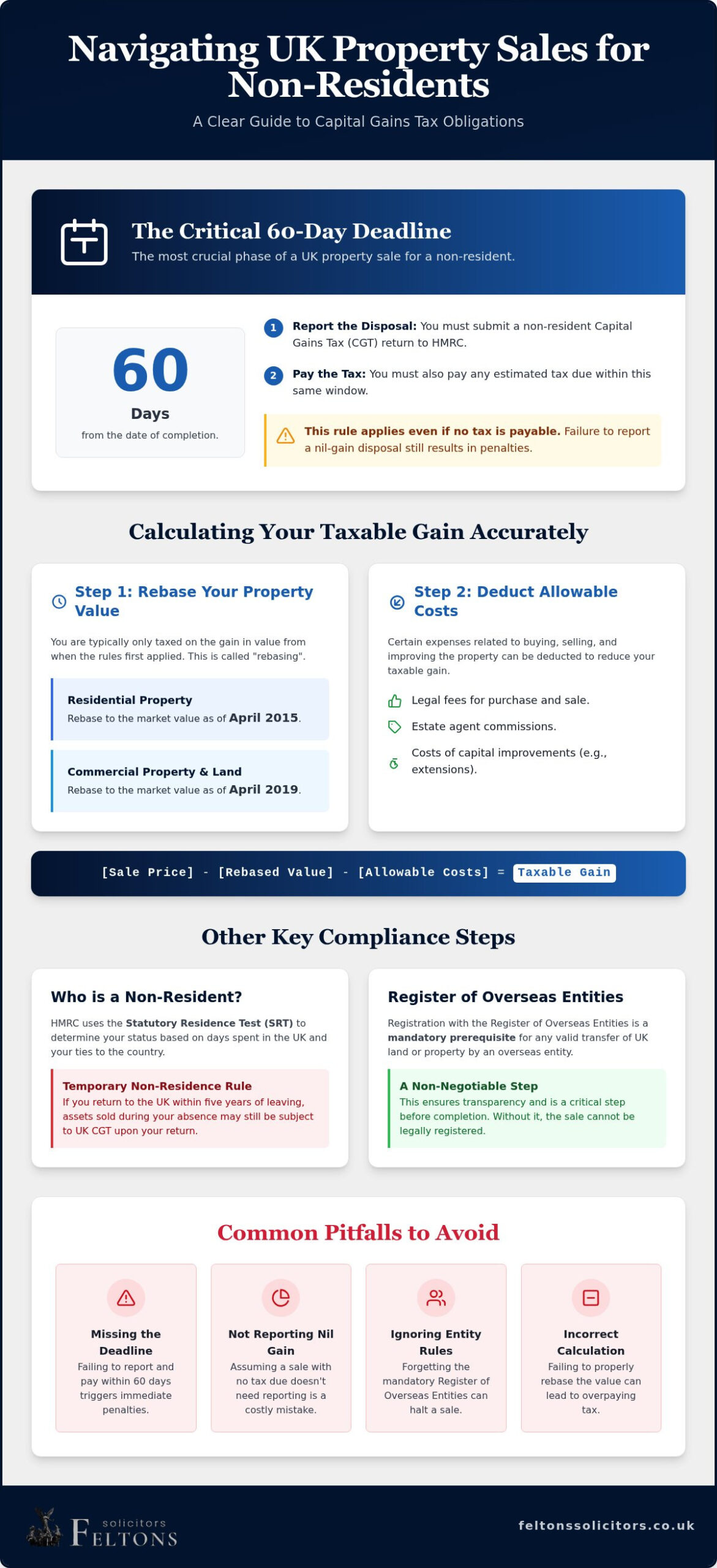
Determining your status isn’t always straightforward. HMRC uses the Statutory Residence Test (SRT) to assess how many days you’ve spent in the UK and the nature of your ties to the country. This classification extends beyond individuals to include trustees and personal representatives of deceased estates. A common complication arises with “temporary non-residence” rules. If you leave the UK and return within five years, assets sold during your absence might still be subject to UK tax upon your return. Because these rules are nuanced, consulting non-resident capital gains tax uk property solicitors before you list a property is the most secure way to clarify your liability and residency status.
The 60-Day Reporting and Payment Rule
The timeline for compliance is exceptionally tight. You must report the disposal and pay any tax due within 60 days of the completion date. It’s a frequent misconception that you can simply wait until your annual self-assessment return to declare the sale. This mistake is costly. Failing to file within this window triggers immediate penalties and accruing interest, even if there’s no tax to pay. For many international clients, legal experts provide the necessary oversight to ensure these filings are accurate and timely. This proactive approach prevents the stress of HMRC investigations and avoids unnecessary financial loss at the end of a transaction.
Calculating Capital Gains for Overseas Sellers
Calculating the gain on a UK property disposal is rarely as simple as subtracting the purchase price from the sale price. For international owners, the UK tax system allows for “rebasing,” which means you only pay tax on the growth in value from specific dates. For residential property, this is generally April 2015, whilst for commercial property, the date is April 2019. This provision is designed to ensure that gains accrued before these rules applied to non-residents aren’t unfairly taxed. Expert non-resident capital gains tax uk property solicitors play a vital role here, ensuring that the completion statement and acquisition data are precisely aligned for HMRC.
To establish a robust tax position, professional valuations at these rebasing dates are highly recommended. HMRC may challenge self-estimated figures, so having a formal report provides a layer of security. Additionally, some expats may still benefit from Private Residence Relief (PRR) for the period they occupied the property as their main home. This can significantly reduce the taxable gain, provided the residency criteria are strictly met. For a deeper look at the technical framework used by legal professionals, the official guidance on Non-Resident Capital Gains Tax outlines the current statutory requirements.
Residential vs Commercial Property Calculations
The distinction between residential and commercial assets is fundamental. Residential dwellings have been subject to these rules since 2015, whereas commercial property and indirect disposals, such as selling shares in a property-rich company, only fell into the scope in April 2019. It’s important to focus on the “gain” rather than just the “proceeds” of the sale. The gain is the profit remaining after accounting for the rebased value and all eligible deductions. Non-resident capital gains tax uk property solicitors can help you identify which rebasing method is most advantageous for your specific circumstances.
Deducting Costs and Professional Fees
You can effectively reduce your tax liability by deducting specific costs associated with the sale and acquisition. These include:
- Legal fees for both the purchase and the eventual sale
- Estate agent commissions and professional marketing costs
- Stamp Duty Land Tax (SDLT) paid upon the initial purchase
- Capital expenditure, such as structural extensions or significant improvements
It’s crucial to distinguish between capital improvements, which are deductible, and general maintenance or repairs, which are not. When managing a high-value disposal, having specialist property solicitors handle your conveyancing ensures that all deductible legal costs are clearly documented and evidenced for your tax filing.
The Register of Overseas Entities: A Critical Compliance Step
For corporate owners and foreign trusts, the ability to sell UK land is now inextricably linked to transparency. The Register of Overseas Entities (ROE), managed by Companies House, requires any foreign legal entity owning UK property to identify and verify its beneficial owners. This isn’t merely a reporting exercise; it’s a fundamental gatekeeper in the conveyancing process. An overseas entity cannot sell UK property without a valid Overseas Entity ID. Without this unique identifier, the Land Registry will simply refuse to register the transfer of title to a buyer, effectively freezing your assets in place. Non-resident capital gains tax uk property solicitors ensure that this registration is not only active but fully compliant with the latest 2026 regulations before a sale is even negotiated.
Maintaining your standing on the register requires constant vigilance. An annual update statement must be filed within 14 days of the anniversary of your initial registration. HMRC and Companies House use this data to ensure that the individuals profiting from UK land are clearly identified. If your registration has lapsed or the annual update is overdue, your Overseas Entity ID becomes invalid. This can lead to catastrophic delays during the final stages of a transaction, often at the very moment you are preparing to settle your capital gains tax obligations.
ROE Verification and the Role of the Solicitor
The verification process is the most rigorous aspect of the ROE. A UK-regulated professional must independently verify the identity of all registrable beneficial owners before the information is submitted. This step is designed to prevent disputes and ensure that the “people with significant control” are accurately documented. It’s a complex task, particularly when dealing with multi-layered international corporate structures or discretionary trusts. For a detailed breakdown of this process, you may find our guide on Overseas Entity Beneficial Owner Registration helpful. Specialist non-resident capital gains tax uk property solicitors provide the pragmatic oversight needed to bridge the gap between international corporate law and UK property compliance.
Consequences of Non-Compliance for Sellers
The risks of ignoring ROE obligations are severe and go beyond simple administrative hurdles. If an entity fails to register or update its details, the Land Registry places a “restriction” on the property’s title. This restriction prevents the entity from selling, leasing, or charging the land. Beyond the commercial impact, non-compliance is a criminal offence. Directors or officers of a non-compliant entity can face significant daily fines or even imprisonment. Organising your documentation well in advance of your sale date is the only way to avoid these sanctions. By integrating ROE compliance with your wider tax strategy, you ensure a smooth exit from your UK investment without the threat of legal or financial paralysis.
Common Pitfalls for Non-Resident Property Owners
HMRC compliance is rarely intuitive, and for international owners, the margin for error is non-existent. One of the most frequent errors involves the disposal date. Whilst the tax year of the sale is determined by the date of exchange, the 60-day reporting window begins strictly on the date of completion. Miscalculating this distinction can result in automatic penalties before you’ve even realised the deadline has passed. Additionally, properties held within corporate structures may have existing obligations under the Annual Tax on Enveloped Dwellings (ATED). The interaction between ATED-related gains and standard NRCGT is complex, often requiring non-resident capital gains tax uk property solicitors to untangle the overlapping liabilities and ensure you aren’t overpaying.
Logistical hurdles also pose a significant threat to a smooth exit. Anti-money laundering (AML) checks for international clients are now more rigorous than ever. Underestimating the time required for these checks, or for international currency transfers, can delay the entire conveyancing process. If these delays push your reporting past the sixty-day mark, HMRC will not accept bank delays or administrative friction as a valid excuse for late filing. It’s a high-stakes environment where timing is as important as the financial calculation itself.
Reporting a Sale with No Tax Due
A common HMRC trap is the belief that a loss-making sale or a break-even disposal requires no action. This is incorrect. Non-residents must file a “nil return” to declare the disposal, even if no tax is payable. Failing to submit this return within the 60-day window triggers the same penalty regime as a high-profit sale. Establishing this paper trail is not just about avoiding fines; it’s also essential for your own international tax reporting, providing clear evidence to your local tax authorities that the disposal has been handled according to UK law. For those with broader European interests, such as in Italy, professional Italian fiscal representation services can assist in ensuring that all cross-border reporting is accurately synchronised.
The UK maintains an extensive network of double taxation treaties amongst different nations to ensure that you aren’t taxed twice on the same gain. In most instances, you can claim credit for the UK CGT paid against your local tax liability in your country of residence. However, the mechanics of claiming this credit vary significantly between jurisdictions. Coordinated advice between your UK legal team and local tax advisors is the only way to ensure you aren’t left out of pocket. If you are concerned about how these pitfalls might affect your sale, you should contact our property law specialists for a comprehensive compliance review.
How Feltons Solicitors Manage Your Non-Resident Disposal
Most firms treat property law and tax compliance as separate silos, often leaving the client to coordinate between a conveyancer and an accountant. At Feltons Solicitors LLP, we provide a sophisticated, integrated service that bridges this gap. Our role as non-resident capital gains tax uk property solicitors is to manage the entire lifecycle of your disposal, from the initial legal due diligence to the final HMRC submission. We provide discreet and professional representation for high-net-worth individuals and international corporate investors, ensuring that every transaction is handled with the quiet confidence and precision it deserves. Our people-first philosophy means we prioritise your peace of mind, acting as a steady guide through the often stressful landscape of UK tax regulations.
We understand that international property owners face unique pressures, particularly when dealing with high-value estates and multi-layered corporate structures. Our team is equipped to handle the most complex matters with a boutique level of care, ensuring that your personal rapport with your solicitor remains at the heart of our service. By combining modern efficiency with traditional professional integrity, we protect your interests whilst maintaining the highest standards of HMRC compliance.
Our Proactive Approach to the 60-Day Window
The sixty-day reporting window is unforgiving, and we don’t believe in leaving compliance to the final hour. We begin preparing your NRCGT return alongside the conveyancing process, often starting the work as soon as contracts are exchanged. This proactive stance allows us to accurately capture all deductible costs, including acquisition legal fees and capital expenditure, to minimise your eventual tax liability. For those managing a broader portfolio, our guide on Navigating Residential Property Law provides essential context for maintaining residential assets in the UK. By the time completion occurs, the majority of the tax work is already finalised, allowing for a seamless transition to the reporting phase.
Specialist Support for Overseas Entities
For clients holding property through foreign companies or trusts, we manage the Register of Overseas Entities (ROE) registration and verification process entirely in-house. This ensures that your Overseas Entity ID is valid and your annual update statements are current long before they are required for a Land Registry transfer. We act as a trusted advisor for long-term UK property portfolios, providing the worldly experience necessary to handle international-scale matters with ease. If you are planning a disposal or require expert guidance on your current tax position, we invite you to contact our property team for a professional consultation.
Securing Your UK Property Exit
Successfully managing a UK property disposal as a non-resident requires a meticulous approach to timing and transparency. We have explored how the strict 60-day reporting window and the Register of Overseas Entities have transformed the compliance landscape for international owners. By leveraging rebasing rules and identifying all allowable deductions, you can significantly reduce your tax burden whilst maintaining a clear standing with HMRC.
Navigating these complexities is far simpler with the support of non-resident capital gains tax uk property solicitors who understand the intersection of conveyancing and tax law. Feltons Solicitors provides a comprehensive service. We offer pragmatic legal advice for international clients and specialist expertise in Overseas Entity Registration. You can instruct Feltons Solicitors for your UK property disposal to ensure your transaction is handled with the highest level of professional integrity and care. With the right legal partner, your exit from the UK market can be both fully compliant and commercially rewarding.
Frequently Asked Questions
Do I have to pay Capital Gains Tax if I am not a UK resident?
Yes, non-residents are liable for CGT on the disposal of all UK land and property. This includes residential dwellings, commercial buildings, and land without structures. The tax is calculated on the profit made during the period of ownership, subject to specific rebasing rules. Expert guidance from non-resident capital gains tax uk property solicitors is recommended to ensure you apply the correct rates for the 2026-2027 tax year.
What is the 60-day rule for non-resident CGT?
The 60-day rule requires non-residents to report the disposal of UK property and pay any tax due within sixty days of completion. It is a common error to assume the clock starts at the exchange of contracts. Missing this window triggers automatic penalties. Because this timeline is exceptionally tight, we prepare the necessary documentation alongside the conveyancing process to ensure you remain fully compliant with HMRC’s real-time reporting requirements.
How is CGT calculated for a non-resident selling UK property?
Calculations for non-residents typically focus on the gain accrued since April 2015 for residential property or April 2019 for commercial assets. This rebasing ensures you aren’t taxed on growth that occurred before the current rules applied to overseas owners. You subtract the rebased value and allowable expenses from the final sale price. For the 2026-2027 tax year, residential rates are 18% or 24% depending on your total UK income and gains.
Can I deduct my solicitor fees from my Capital Gains Tax bill?
Yes, you can deduct professional fees from the gain to reduce your overall tax liability. This includes the legal costs incurred during both the acquisition and the disposal of the property. Other deductible expenses include estate agent commissions, Stamp Duty Land Tax paid at purchase, and capital expenditure for structural improvements. Keeping precise records of these costs is essential for non-resident capital gains tax uk property solicitors to maximise your available tax relief.
What happens if I miss the HMRC reporting deadline?
Missing the 60-day deadline results in immediate financial penalties and accruing interest on any unpaid tax. Initial late filing penalties are usually £100, but these increase significantly if the return is more than three or six months overdue. HMRC rarely accepts administrative delays or international bank friction as a valid excuse. Proactive legal management ensures that your reporting is submitted accurately and on time, avoiding these unnecessary costs and potential investigations.
Do I need to report the sale if I made a loss on the property?
You must report the disposal to HMRC even if the sale resulted in a loss or no tax is due. This is a mandatory requirement for all non-residents disposing of UK land. Failing to submit a nil return within the 60-day window triggers the same penalty regime as a profitable sale. Reporting a loss is also beneficial, as it can often be offset against future UK capital gains to reduce your future tax liabilities.
Is commercial property treated differently for non-resident CGT?
Commercial property disposals follow the same 60-day reporting window but use a different rebasing date of April 2019. Unlike residential property, which was brought into the non-resident CGT net in 2015, commercial assets and indirect disposals only became taxable for non-residents in 2019. The calculation methods and tax rates can also differ, particularly if the property is held within a corporate structure rather than being owned by an individual.
How does the Register of Overseas Entities affect my property sale?
The Register of Overseas Entities is a mandatory compliance step for any foreign company or trust owning UK land. You cannot legally transfer the title to a buyer without a valid Overseas Entity ID from Companies House. If your registration isn’t current or your annual update is overdue, the Land Registry will block the sale. We handle the verification and registration process in-house to ensure your transaction proceeds without any regulatory delays.