
Register of Overseas Entities Solicitors: UK Property Guidance

Register of Overseas Entities Solicitors: UK Property Guidance

Could an unresolved ownership detail complicate a UK property transaction? For an overseas entity, registration is more than a Companies House filing: it can affect the steps involved in buying, selling or holding UK property. A search for “register of overseas entities solicitors” may reflect a need to understand whether an entity falls within the regime and what its ownership structure must disclose.

It’s understandable to feel uncertain when information needs to be gathered across different jurisdictions, particularly if a property transaction is under way. This article explains the Register of Overseas Entities, the responsibilities it places on an overseas entity and the practical preparation registration may involve.

You’ll also learn how legal advice can connect registration with the wider property matter, so related steps are considered in context. Feltons Solicitors LLP provides registration of overseas entities alongside residential and commercial conveyancing, with pragmatic advice for national and international clients.

Key Takeaways

  • Learn why an overseas entity’s connection with UK land or property may bring it within the Register of Overseas Entities regime.
  • See the main stages of registration, from assessing the entity’s circumstances to organising information and maintaining its records.
  • Understand how legal advice, verification and filing are distinct parts of the process, and why it helps to clarify responsibilities.
  • Prepare for a more focused discussion by mapping the ownership structure and identifying who can provide relevant information.
  • Explore how register of overseas entities solicitors london can help connect registration advice with the wider property matter.

What is the Register of Overseas Entities and who may need to use it?

If an overseas entity owns, buys or otherwise has a relevant connection with UK land or property, establish whether the Register of Overseas Entities rules apply before a transaction progresses. The answer depends on the entity’s legal form, its ownership and control, and the nature and location of its property activity. An organisation’s everyday description may not match how it is treated under the legislation, so it is important to assess the legal structure and the property circumstances together.

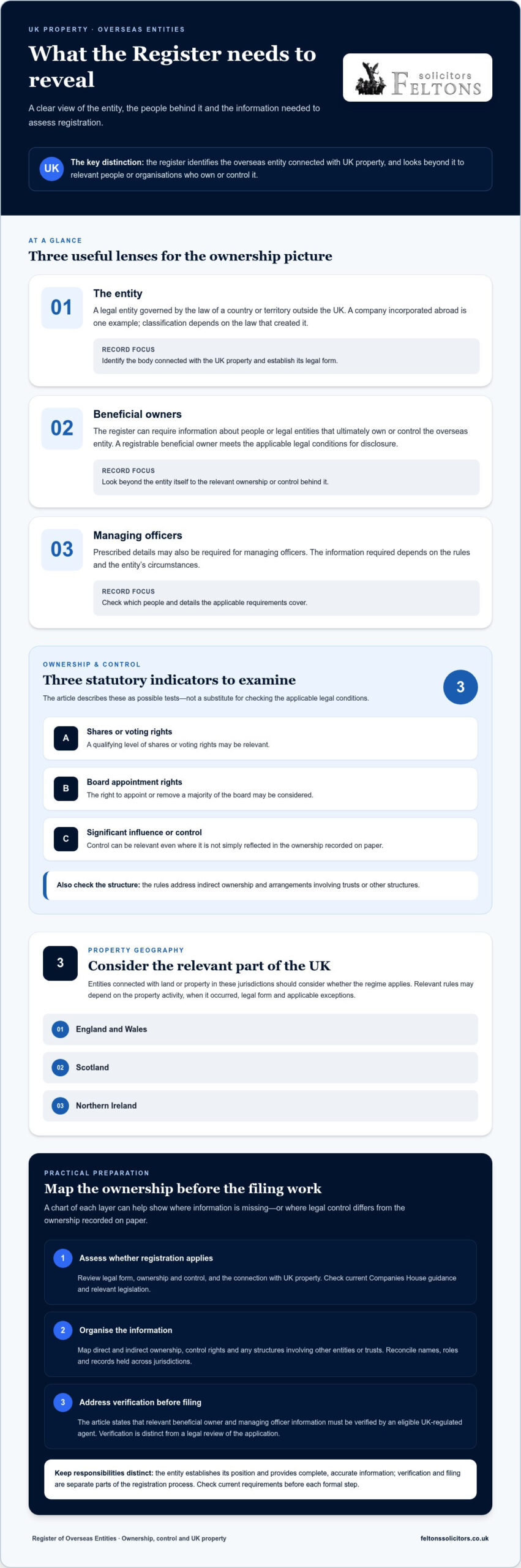
The Register of Overseas Entities is a Companies House register created to make information about overseas entities holding UK property, and the people who own or control them, more transparent. It is administered by Companies House, the UK’s registrar of companies. The register distinguishes the legal entity associated with property from the people or organisations behind its ownership and control.

What does the Register of Overseas Entities record?

An overseas entity is a legal entity governed by the law of a country or territory outside the UK. A company incorporated abroad is one example, although the precise classification depends on the entity’s legal status under the law that created it.

The register records prescribed details about the entity and information relating to its beneficial owners or managing officers, as required by the rules. A beneficial owner is, in broad terms, a person or legal entity that ultimately owns or controls the overseas entity. Statutory tests can include holding a qualifying level of shares or voting rights, having the right to appoint or remove a majority of its board, or exercising significant influence or control. Specific rules also address indirect ownership and arrangements involving trusts or other structures.

A registrable beneficial owner is someone who meets the applicable legal conditions for disclosure under the regime. The entity’s details identify the body connected with the UK property; beneficial ownership information looks beyond that body to relevant ownership or control. The two are related, but they are not interchangeable. Reviewing the structure carefully is particularly important where ownership passes through several companies or jurisdictions. A chart showing each layer can help reveal where information is missing or where legal control differs from the ownership recorded on paper.

Which overseas entities should consider their position?

Overseas entities connected with land or property in England and Wales, Scotland or Northern Ireland should consider whether the regime applies to their circumstances. The relevant rules can depend on factors such as the property activity, when it occurred, the entity’s legal form and any applicable exceptions. A foreign company’s name on property paperwork alone may not resolve every question about its reporting obligations.

Before drawing a conclusion, compare the entity’s circumstances with current Companies House guidance and the rules for the relevant part of the UK. The overseas entity beneficial owner registration guide offers further context on how ownership information connects with UK property. For advice specific to the entity, consider its legal structure, property activity and any planned transaction as one set of connected facts.

How does overseas entity registration work, from preparation to Companies House?

Registration is easier to manage when the entity first establishes what the rules require, then gathers information in a structured way. The precise filing route and evidence depend on the entity’s circumstances, so treat this as an overview rather than a substitute for current Companies House guidance. Keep a record of decisions and check the applicable requirements before each formal step. In practice, this means separating the questions of whether registration applies, what information must be disclosed, who verifies it and who submits and maintains the filing.

Accurate ownership information helps Companies House assess who ultimately owns or controls the entity and whether the application meets the regime’s requirements.

  1. Assess whether registration applies. Review the entity’s legal form, ownership and control, and its connection with UK property. The entity is responsible for establishing its position. Check current Companies House guidance and relevant legislation, including any rules or exceptions that may apply to the particular facts.
  2. Organise the entity and ownership information. Identify the details required about the overseas entity, its beneficial owners and, where relevant, managing officers. Map direct and indirect ownership, control rights and structures involving other entities or trusts. The entity is responsible for providing complete and accurate information. Where records are held across different jurisdictions, coordination may be needed to reconcile names, roles and ownership details.
  3. Address verification before filing. Current rules require relevant information about beneficial owners and managing officers to be verified by an eligible UK-regulated agent before registration. The applicable rules set who can act, the necessary supervision and authorisation, and the timing of verification. Check those requirements against current Companies House guidance. Verification is a distinct compliance function, not simply a legal review of the application.
  4. Submit and maintain the register details. The overseas entity must make the required application to Companies House, following the current filing process and requirements. After registration, it must meet the applicable update obligations, including filing an annual update statement even if there has been no change. The entity remains responsible for keeping its information accurate and meeting deadlines; confirm the current filing window and process with Companies House.

What information may be needed for an application?

Expect to organise information about the entity’s identity and legal form, its ownership and control, and relevant officers. The precise information and supporting material depend on the structure and the rules that apply. Where records are held in different jurisdictions, allow time to resolve differences in names, dates or ownership records. A useful first step is to compare the information held by the entity with records from each ownership layer, then note any gaps or inconsistencies. Don’t assume a generic document checklist will fit every entity; confirm current requirements before gathering or submitting evidence.

What role can a solicitor or verification agent play?

Legal advice can help clarify how the regime relates to the entity’s ownership and property circumstances, and identify issues that may need attention before an application. Verification is a separate formal role governed by eligibility and authorisation requirements. Filing is another distinct step, and responsibility for the application and ongoing compliance remains with the overseas entity. The roles may be handled by different parties. Feltons provides registration of overseas entities and conveyancing advice, helping clients consider the registration process alongside the property matter. You can discuss your registration and property circumstances with Feltons.

Useful legal support should make clear which parts of the matter require legal analysis, which involve formal verification and who is responsible for filing. These functions are related, but they aren’t automatically carried out by the same provider. Before work begins, establish the scope of advice, the information the entity will need to provide and how registration fits alongside any property transaction. This gives the entity a practical way to understand the work involved and its own continuing responsibilities.

A layered ownership structure doesn’t make registration impossible. It may mean that the people or entities behind the overseas entity need to be identified through several levels of ownership or control. Records held in different jurisdictions can add practical work, especially if information needs to be reconciled with corporate and fund administration specialists such as atgfunds.com. Careful analysis helps build an accurate picture without treating complexity as a reason to assume something is wrong. It can also identify questions that need to be resolved before information is prepared for filing.

Why can ownership structures make the matter more involved?

For example, an overseas entity may be owned by another company, which is itself controlled by individuals or a further entity. The assessment needs to follow the relevant ownership and control through the structure, rather than stop at the first company named. Overseas records and differences in how entities are organised can affect how information is gathered. The aim is to understand and report the relevant facts accurately under the applicable rules.

Question Why it matters What legal support can address
What does the structure show? Indirect ownership or control can make it less obvious who may be reportable. Analyse the structure and identify points that need clarification.
Who is responsible for verification? Verification is a formal role subject to current eligibility and authorisation requirements. Explain how the verification step fits the process and clarify responsibilities without assuming every legal adviser can perform it.
Who will submit and maintain the information? Filing and ongoing compliance are distinct from advice and verification. Clarify the filing arrangements and the entity’s continuing responsibilities under current Companies House guidance.

How does registration relate to a property transaction?

Registration status may be relevant when an overseas entity deals with UK land or property. The effect depends on the circumstances and current legal requirements, so don’t assume a registration issue will have the same consequence in every transaction. Where a purchase, sale or other property matter is planned, considering registration alongside the conveyancing work can bring related questions into view. For example, the entity can identify how its ownership structure relates to the transaction and whether its registration position needs attention as part of the wider matter. The residential property law guide provides wider context on property matters.

Feltons Solicitors provides registration of overseas entities alongside residential and commercial conveyancing. This makes it possible to consider registration in the context of the property matter, with advice tailored to the entity’s circumstances. Focus on how ownership analysis, verification arrangements and property work relate, while keeping each party’s role distinct.
Register of Overseas Entities Solicitors: UK Property Guidance

What practical steps can an overseas entity take before seeking registration advice?

A little preparation can make an initial discussion more focused. You don’t need to resolve every legal question or assemble a definitive set of documents first. Start by organising what the entity knows, noting what remains uncertain and identifying who can help clarify the information. This avoids spending time trying to make incomplete records look consistent before their significance has been considered.

Use this checklist as a way to prepare for advice, not as a complete list of application documents or filing requirements:

  • Map ownership and control. Draw a clear outline from the overseas entity through any intermediate companies or other arrangements to the people or entities who may ultimately own or control it. Note where ownership and control differ.
  • Identify information holders. Record who can explain the entity’s structure and who holds relevant company or ownership records, including contacts in other jurisdictions. This helps show where information may need to be requested.
  • Compare key details. Check whether the entity’s name and other identifying details appear consistently across the records available to you. Flag spelling differences, incomplete information or changes in structure rather than trying to resolve their legal significance yourself.
  • Note changes and gaps. Record changes in ownership or control and any parts of the structure you can’t yet explain. A simple note of what is known, what is uncertain and who may be able to clarify it can help guide the legal review.
  • Keep sensitive information secure. Avoid sharing personal or confidential ownership details in public or unsecured channels. Organise the information privately and discuss an appropriate way to provide it as part of the legal process.

How can an entity organise its ownership information?

A simple structure chart can be a useful starting point. Show each ownership layer, the relationship between the parties and any known control rights, then annotate unclear points for discussion. If a record uses a different name or describes a structure differently, preserve the original detail and note the discrepancy. Don’t assume it is a minor issue or alter records to make them match; let a solicitor consider what the difference means under the applicable rules. This gives the legal review a clearer basis and helps distinguish confirmed information from points that still need investigation.

What should be considered alongside a property matter?

Registration and conveyancing are related when an overseas entity has a UK property matter, but they remain distinct legal tasks. Give your adviser a concise outline of the transaction and its current stage so registration questions can be considered in context. Useful details to note include:

  • Whether the matter concerns a purchase, sale or another property transaction.
  • The UK property involved and the entity’s connection to it.
  • Any key steps already taken and decisions still to be made.
  • Known timing considerations, without assuming these replace applicable filing requirements.

This context can help shape a tailored discussion of the entity’s registration position and the related property work. The overseas entity registration and beneficial ownership guide offers further background on the link between ownership information and UK property.

Feltons provides registration of overseas entities alongside residential and commercial conveyancing. A focused discussion can consider both the entity’s registration circumstances and the connected property matter, with a pragmatic approach tailored to the facts.

How can Feltons Solicitors support an overseas entity property matter?

An overseas entity’s registration and its UK property plans are closely connected, but each matter has its own legal considerations. Feltons Solicitors provides registration of overseas entities alongside residential and commercial conveyancing. The entity can discuss registration in the context of its wider property circumstances, rather than treating the register as an isolated administrative issue.

The right advice depends on the facts. An entity with a straightforward ownership structure and no active transaction may have different questions from one preparing to buy or sell property through several layers of ownership. Understanding both the entity and its property plans helps shape a practical discussion about what needs attention and which issues should be considered together.

What does a tailored legal approach bring to the matter?

Feltons takes a bespoke, pragmatic approach, helping clients consider their particular circumstances with clear, measured guidance. That may mean looking at how the entity’s structure relates to its UK property interests, or considering registration questions alongside conveyancing work. Advice is tailored to the matter, without assuming every entity’s requirements or transaction will be the same.

Feltons combines modern delivery with traditional values. The firm serves national and international clients, bringing a discreet, considered approach to matters that may involve information and interests across borders. Clear communication can help keep the legal issues understandable, especially where ownership arrangements or property plans raise questions that need careful analysis. It doesn’t remove the need to meet applicable requirements, but it can help the entity understand the issues and decisions in front of it.

When assessing legal support, consider whether the advice will address both the registration question and its relationship to the property matter. Registration, verification and filing are distinct functions, and their responsibilities should be understood clearly. Feltons provides registration and conveyancing services, while the precise steps and responsibilities in any case depend on the entity’s circumstances and current requirements.

What is a sensible next step?

To begin a focused conversation, outline the entity’s ownership structure as you currently understand it and note any areas that remain unclear. Add a brief description of the UK property matter, such as whether it involves a purchase, sale or another conveyancing issue, and where it stands. You don’t need to settle every point before seeking advice. A clear account of what is known, what needs clarification and how the property plans fit together is a helpful starting point.

Feltons can discuss the entity’s registration circumstances and any connected residential or commercial conveyancing needs. Discuss your overseas entity property matter with Feltons.

Take the next step with clarity

Before moving forward, consider what decision the entity needs to make and how its UK property plans shape that decision. A clear account of the ownership structure, any points that need clarification and the transaction’s current position can help make the first legal discussion focused and useful. You don’t need to have every answer before seeking guidance.

If you’re looking for register of overseas entities solicitors london, discuss the specific registration questions alongside any connected property requirements. Feltons can provide tailored legal advice on overseas entity registration and related conveyancing, with an approach shaped around your circumstances.

Discuss your overseas entity property matter with Feltons and take the next step with considered support.

Frequently Asked Questions

What is the Register of Overseas Entities?

It’s a Companies House register recording information about overseas entities and relevant beneficial ownership connected with UK land or property. Its purpose is to improve transparency about who owns or controls an entity. The information required depends on the entity and applicable rules. For example, a structure involving several companies may need closer analysis than a single overseas company. Use current official guidance, and seek legal advice if the ownership picture is complex.

Does an overseas entity need to register before dealing with UK property?

Not every property situation can be answered with a simple yes or no. Requirements depend on the entity’s relationship with the land, the type of dealing and the rules that apply. Before committing to a transaction, identify the property and proposed activity, then check current Companies House and land registration requirements. Legal advice can help assess the entity and transaction together.

Who can verify information for the Register of Overseas Entities?

Only a person who meets the verification requirements in force for the application may perform the formal verification role. Those rules can specify who is permitted to act and what authorisation is required, so check current Companies House guidance for the relevant filing. A solicitor may advise on the entity’s legal position without acting as its verification agent. Clarify each person’s role before relying on a verification statement in an application.

What information is needed to register an overseas entity?

An application may call for information about the overseas entity and people connected with its ownership or management. The details and supporting evidence depend on the entity’s structure and the current rules, so a general checklist can’t establish exactly what your case requires. As a practical first step, compare the entity’s records, map who owns or controls it, and note gaps or inconsistent details for legal review before preparing an application.

Can a solicitor help with both overseas entity registration and a property transaction?

Yes. Legal support can consider registration questions alongside a related property matter, although registration and conveyancing remain separate tasks with distinct requirements. Feltons Solicitors provides registration of overseas entities and residential and commercial conveyancing. For instance, if an entity is preparing for a property purchase, advice can take account of both the registration issue and the conveyancing context. The appropriate work depends on the entity’s circumstances and the rules that apply.

What happens if an overseas entity’s ownership information changes?

A change in ownership or control may affect the information the entity must keep current on the register. Keep a dated record of what changed, when it took effect and which records reflect the new position. Then check the current Companies House requirements promptly, rather than assuming the change can wait until a property transaction concludes. If a sale or purchase is also under way, raise the change as part of the legal discussion.

Is the Register of Overseas Entities the same as registering a company in the UK?

No. The Register of Overseas Entities concerns overseas entities with a relevant connection to UK land or property; it isn’t the process for incorporating a new UK company. An organisation might have separate company-law or registration obligations depending on its activities and legal status. For example, creating a UK subsidiary doesn’t by itself answer whether an overseas parent has responsibilities under the overseas entities regime. Assess each entity and obligation separately.

International Family Law Solicitors: Navigating Cross-Border Legal Challenges

International Family Law Solicitors: Navigating Cross-Border Legal Challenges

What if the future of your family’s financial security depended entirely on which country’s court received your paperwork first? For families with global connections, the “race to issue” is a high-stakes reality that can dictate the outcome of a divorce for years to come. When your life spans multiple borders, the complexity of conflicting legal systems often leads to profound anxiety and confusion. Working with experienced international family law solicitors ensures that you aren’t just reacting to events, but proactively managing them. It’s natural to feel overwhelmed by the prospect of competing jurisdictions or the fear of a less favourable legal landscape.

We understand that your primary concern is securing a clear, pragmatic strategy for your financial settlements and, most importantly, the welfare of your children. This guide provides expert insight into navigating international divorce proceedings, child relocation challenges, and the nuances of cross-border asset protection. You’ll learn how to establish the most advantageous jurisdiction whilst maintaining the discreet, professional approach your private matters require. Feltons Solicitors LLP will examine the essential steps to safeguard your family’s interests across international lines and provide a steady hand through these complex legal transitions.

Key Takeaways

  • Understand the critical roles of ‘habitual residence’ and ‘domicile’ in determining which court has the authority to oversee your family law matters.
  • Identify the most effective strategies for protecting complex global assets and navigating the nuances of international financial settlements.
  • Partnering with expert international family law solicitors london ensures that the welfare of your children remains the primary focus during cross-border relocation disputes.
  • Learn how to draft international nuptial agreements that offer robust protection and remain enforceable across various legal jurisdictions.
  • Discover the benefits of a boutique legal service that prioritises personal discretion and provides specialised expertise in the Registration of Overseas Entities.

What is International Family Law and Why Jurisdiction Matters

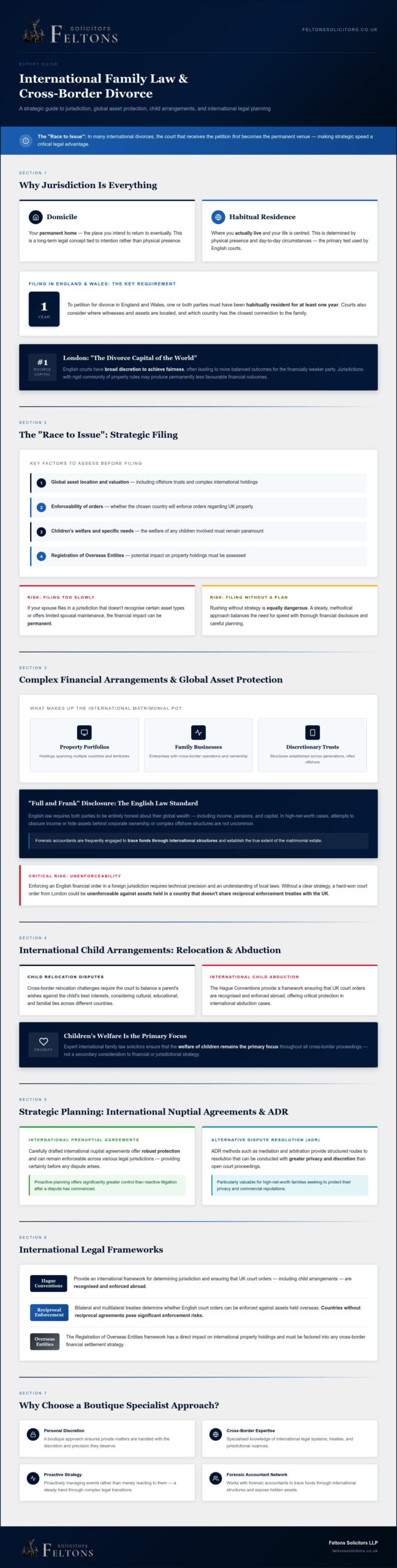
International family law governs legal matters where a family has connections to more than one country. This might involve a couple of different nationalities, a family living abroad, or assets located in multiple territories. At the heart of these cases are two legal anchors: habitual residence and domicile. Domicile is your permanent home, the place you intend to return to eventually. Habitual residence is where you actually live and your life is centred. Identifying these correctly is the first task for international family law solicitors london, as they dictate which country’s laws will govern your future.

Choosing the right forum isn’t just a technicality; it’s a decision that shapes your financial settlement and your children’s arrangements. London is often referred to as the “divorce capital of the world” because English courts have a broad discretion to achieve fairness, often leading to more balanced outcomes for the financially weaker party. If you lose the “race to issue” and the case proceeds in a jurisdiction with rigid community of property rules, the financial impact can be permanent. A boutique approach ensures these nuances are handled with the discretion and precision they deserve.

Determining Which Country Has Jurisdiction

To file for divorce in England and Wales, you must establish a legal connection to the jurisdiction. Usually, this means one or both parties have been habitually resident here for at least a year. If two countries could potentially handle the divorce, the court must decide which is the most appropriate place for the trial. This decision involves looking at where the witnesses are, where the assets are located, and which country has the closest connection to the family. International treaties, such as the Hague Conventions, provide a framework for these decisions, ensuring that UK court orders are recognised and enforced abroad.

The ‘Race to Issue’: Strategic Filing

In many international cases, the court that issues the petition first becomes the permanent venue for the divorce. This makes speed a vital component of your legal strategy. If your spouse files in a jurisdiction that doesn’t recognise certain types of assets or has limited spousal maintenance, you could be at a significant disadvantage. Experienced international family law solicitors london will prioritise securing the most favourable jurisdiction whilst protecting your privacy. However, rushing without a plan is equally dangerous. You must consider several factors before filing:

  • The location and valuation of global assets, including offshore trusts.
  • Whether the chosen country will enforce orders regarding UK property.
  • The specific needs and welfare of any children involved.
  • The potential for the Registration of Overseas Entities to impact property holdings.

Balancing the need for speed with thorough financial disclosure is essential. A steady, methodical approach allows for detailed planning, ensuring that your filing is both swift and strategically sound.

Complex Financial Arrangements and Global Asset Protection

Families with global connections often hold wealth in intricate structures that span multiple continents. This isn’t just about shared bank accounts; it’s about property portfolios, family businesses, and discretionary trusts that may have been established generations ago. Identifying the true extent of the matrimonial pot is the first major hurdle in any cross-border case. Professional international family law solicitors london work to ensure these assets are correctly identified, categorised, and valued according to current market conditions. Enforcing an English financial order in a foreign jurisdiction requires technical precision and an understanding of local laws. Without a clear strategy, a hard-won court order from London could be unenforceable against assets held in a country that doesn’t share reciprocal enforcement treaties with the UK.

Disclosure and Transparency in Cross-Border Cases

English law demands “full and frank” disclosure. This means both parties must be entirely honest about their global wealth, including income, pensions, and capital. In high-net-worth cases, it’s not unusual to see attempts to obscure income or hide assets behind layers of corporate ownership or complex offshore structures. We often work with forensic accountants to trace funds through international banking systems. A methodical approach ensures that the final settlement reflects the family’s actual financial reality rather than just what’s visible on the surface. Transparency is the only way to achieve a fair outcome for both parties.

Protecting UK Property Interests

For many international families, UK real estate is a central and highly valuable asset. The overseas entity beneficial owner registration has introduced a new level of transparency that directly impacts family law. Foreign companies owning UK land must now disclose their beneficial owners, making it much harder to shield property from matrimonial claims. Seeking advice from international family law solicitors london allows you to address these property concerns alongside the broader divorce strategy. Developing a clear strategy for protecting your assets during a divorce settlement is vital for your long-term security. If you’re managing cross-border assets, it’s helpful to partner with a firm like Feltons Solicitors LLP that offers specialised expertise in both family law and the registration of overseas entities.

International Child Arrangements: Relocation and Abduction

Whilst financial settlements are technically complex, the most sensitive challenges in cross-border cases involve the future of your children. In the UK, the court’s primary consideration is the “welfare principle.” This means any decision made must be in the child’s best interests, above all other factors. When families have ties to multiple countries, disputes often arise regarding where a child should live or how they will maintain a relationship with a parent residing abroad. Working with specialist international family law solicitors london provides the necessary clarity to manage these delicate situations whilst ensuring your child’s emotional and physical security remains the priority. To gain a deeper understanding of safeguarding, you may explore CPD certified online courses and educational resources that focus on domestic violence prevention.

Preventative measures are often essential for families with significant global mobility. If there’s a risk that a child might be removed from the jurisdiction without consent, a Prohibited Steps Order can be sought to prevent travel. In some instances, the court may order the surrender of passports to the Tipstaff or another neutral party. These steps are not about creating conflict; they are about establishing a steady and secure framework that protects the child’s stability during a period of transition.

Moving a child abroad permanently, known as “leave to remove,” requires either the written consent of every person with parental responsibility or a court order. The court examines a relocation proposal with extreme care. You must provide a detailed plan that covers housing, schooling, healthcare, and, crucially, how the child will maintain a meaningful relationship with the parent remaining in the UK. Opposing a relocation application requires showing that the move would be detrimental to the child’s welfare rather than simply inconvenient for the parent. It’s a rigorous process where the quality of your evidence and the viability of your future plans are under constant scrutiny.

Responding to International Child Abduction

Alongside legal arrangements, prioritising the emotional well-being of everyone involved is essential for a stable future. To support your family through the complexities of relocation or separation, you might discover De Relatiespecialist, which provides specialised relationship therapy for parents with children.

If a child is removed from the UK without consent, or kept abroad beyond an agreed holiday, it’s considered international child abduction. This is a legal emergency that requires immediate action. For countries that are signatories to the Hague Convention, there’s a clear legal framework designed to return children to their country of habitual residence as quickly as possible. We work closely with the Central Authority to initiate these proceedings. In cases involving non-signatory countries, the process is more complex and often involves wardship proceedings in the High Court. Whatever the destination, acting within the first 24 to 48 hours is often critical to a successful return. Expert international family law solicitors london can guide you through these high-pressure moments with the quiet confidence and technical skill required to secure your child’s safe return.

International Family Law Solicitors: Navigating Cross-Border Legal Challenges

Strategic Planning: International Prenups and ADR

Forward-thinking families often choose to manage potential legal complexities long before a dispute arises. For those with international assets or diverse nationalities, a well-drafted nuptial agreement is a vital tool for financial security. Whether it’s a prenuptial agreement before marriage or a postnuptial agreement during the relationship, these documents provide a clear framework for asset division. Working with international family law solicitors london allows you to address the specific requirements of the English legal system whilst considering the laws of other relevant countries. This proactive approach reduces uncertainty and protects your family’s future.

International Nuptial Agreements

In England and Wales, the landmark ruling of Radmacher v Granatino significantly changed how courts view prenups. Whilst they aren’t strictly binding in the same way as a commercial contract, the court will usually uphold them if they were entered into freely and both parties understood the implications. For international families, the document must be enforceable in every country where you hold significant assets. This requires independent legal advice from qualified solicitors in each relevant jurisdiction. We ensure that your agreement includes specific clauses addressing global property, offshore interests, and choice of law provisions to prevent future jurisdictional battles.

Dispute Resolution Outside the Courtroom

Litigation isn’t the only path, and for many high-profile families, the public nature of the Family Court is a significant concern. Alternative Dispute Resolution (ADR) offers a discreet, private, and often more cost-effective way to settle cross-border matters. Mediation allows couples to reach a bespoke agreement through facilitated discussion, which is particularly helpful when managing complex child arrangements across borders. Arbitration provides a faster alternative, where a private judge makes a binding decision in a confidential setting. This level of privacy is a hallmark of the boutique service we provide.

Collaborative law is another effective strategy. In this process, both parties and their lawyers commit to reaching a settlement without going to court. It fosters a more cooperative environment, which is invaluable for preserving long-term family relationships. If you’re looking to protect your interests through a tailored legal strategy, you can contact our international family law solicitors london to discuss your options. Choosing the right method of resolution can save significant time and emotional energy whilst securing a result that respects your family’s unique global circumstances.

Why Choose Feltons for International Family Law?

Choosing the right legal partner is a decision that impacts your privacy, your finances, and your family’s future stability. Feltons Solicitors LLP provides a boutique level of care that prioritises personal connection over high-volume processing. As international family law solicitors london, we offer a calm, steady presence in the face of complex cross-border challenges. Established in 2010 by Paula Felton, our firm combines traditional professional integrity with modern efficiency to deliver a service that feels both grounded and current. We act as a discreet partner for high-net-worth individuals who require pragmatic, plain-English advice that cuts through the noise of international legal systems.

Discreet and Tailored Legal Support

We manage high-stakes cases with a quiet confidence that reassures our clients during stressful transitions. You won’t be passed between departments; instead, you’ll work with a dedicated solicitor who understands the full context of your global life. This continuity is essential for maintaining the high standards of reliability our clients expect. Our commitment to a “people-first” philosophy ensures that whilst the technical legal work is paramount, the human impact is never forgotten. We value the personal rapport that comes with a boutique firm, providing a tailored experience that larger, more impersonal practices often struggle to match.

A Multidisciplinary Perspective

Our strength lies in the seamless integration of family law, property law, and estate planning. For international families, these areas are often inseparable. We uniquely offer specialised expertise in the Registration of Overseas Entities, a critical service for those with UK property interests held through foreign structures. This multidisciplinary approach allows us to handle complex financial disputes whilst simultaneously protecting your broader legacy. Our worldly experience is balanced with a community-conscious ethos, making us a trusted advisor for families navigating the complexities of modern life.

  • Pragmatic advice that focuses on realistic, achievable outcomes.
  • Discreet management of sensitive private client matters.
  • Worldly experience applied to local and international litigation.
  • Clear, transparent communication without dense legalese.

If you’re ready to discuss your circumstances, our team is here to provide the steady guidance you need. We invite you to begin your consultation with our international family law solicitors london to develop a strategy that secures your interests across every border.

Securing Your Family’s Global Future

Managing a life that spans multiple borders requires more than just technical legal knowledge; it demands a strategy that respects the human impact of every decision. We’ve explored how establishing the correct jurisdiction and identifying global assets are vital steps in protecting your financial security. Whether you’re navigating the complexities of international child relocation or drafting a nuptial agreement that stands up in multiple courts, having a steady hand to guide you makes all the difference. Our boutique approach ensures that your privacy is maintained whilst we apply our specialised expertise in matters like the registration of overseas entities to your unique situation.

Expert international family law solicitors london provide the clarity needed to turn confusion into a coordinated plan of action. At Feltons Solicitors, our pragmatic, client-first philosophy means we cut through international complexity with plain-English advice and quiet confidence. You don’t have to face these cross-border challenges alone. We invite you to contact Feltons Solicitors for a discreet consultation on your international family matter. With the right support, you can move forward with certainty and protect the things that matter most to your family.

Frequently Asked Questions

How do I know if the UK court has jurisdiction over my international divorce?

You can file for divorce in England and Wales if you or your spouse meet specific criteria regarding habitual residence or domicile. Usually, this requires one party to have lived here for at least 12 months. Identifying these legal anchors is a primary task for international family law solicitors london. The court will assess where your life is centred and where you intend to remain permanently before confirming it has the authority to proceed with your case.

Can I stop my ex-partner from moving our child abroad?

If you believe your child is at risk of being moved abroad without your consent, you can apply to the court for a Prohibited Steps Order. This legal safeguard prevents a parent from removing a child from the jurisdiction. UK courts prioritise the child’s welfare above all else. In urgent situations, your solicitor can seek an emergency order or request the surrender of passports to ensure the child remains secure whilst arrangements are finalised.

What happens to our overseas property during a UK divorce settlement?

English courts have the power to include global assets, including foreign real estate and offshore trusts, within the matrimonial pot for division. Whilst the court can make orders regarding these assets, enforcing those orders in a foreign territory depends on reciprocal treaties. We often utilise our expertise in the Registration of Overseas Entities to ensure transparency regarding property ownership, helping to secure a fair and pragmatic financial settlement for our clients during these complex negotiations.

Are international prenuptial agreements legally binding in England?

Prenuptial agreements are not automatically binding in England and Wales, but they carry significant weight following the Radmacher v Granatino ruling. For an international agreement to be upheld, it must be entered into freely by both parties with a full understanding of its implications. It’s essential that each person receives independent legal advice in both relevant countries. This ensures the document is robust enough to be considered fair and enforceable by the court when assets are divided.

What is the ‘race to issue’ and why is it important in family law?

The ‘race to issue’ refers to the strategic advantage gained by being the first to file a divorce petition in a favourable jurisdiction. In many international cases, the court that receives the paperwork first will retain the case. This is vital because financial outcomes vary significantly between countries. Acting quickly with the support of international family law solicitors london ensures you don’t lose the opportunity to have your case heard in the most appropriate and beneficial forum.

How long does an international divorce usually take compared to a domestic one?

International divorces typically take longer than domestic cases due to the additional layers of complexity involved. Delays often arise from the need to serve legal documents across borders, value assets in multiple currencies, or resolve disputes over which country has jurisdiction. Whilst a standard UK divorce might take six to nine months, a cross-border case involving complex financial arrangements or child relocation can extend significantly beyond this timeframe as essential international evidence is gathered and verified.

Can I enforce a UK child maintenance order if my ex-partner lives abroad?

You can often enforce a UK maintenance order through the Reciprocal Enforcement of Maintenance Orders (REMO) system. This international agreement allows UK orders to be recognised and enforced in many other countries. If your ex-partner lives in a REMO signatory nation, the court in that jurisdiction can take steps to collect payments on your behalf. Our team provides pragmatic advice on how to navigate these international frameworks to ensure your family’s financial interests are protected effectively.

Do I need a solicitor in both countries for an international family law case?

It is often necessary to engage legal representation in both jurisdictions to ensure your interests are fully protected. Whilst your UK solicitor manages the proceedings in England and Wales, a local lawyer in the other country can advise on local property laws or the enforcement of financial orders. We frequently coordinate with international legal professionals to provide a seamless strategy, ensuring every aspect of your cross-border case is handled with professional authority and discretion.

Conveyancing Solicitors in London: A National Guide to Seamless Property Transactions 2026

Conveyancing Solicitors in London: A National Guide to Seamless Property Transactions 2026

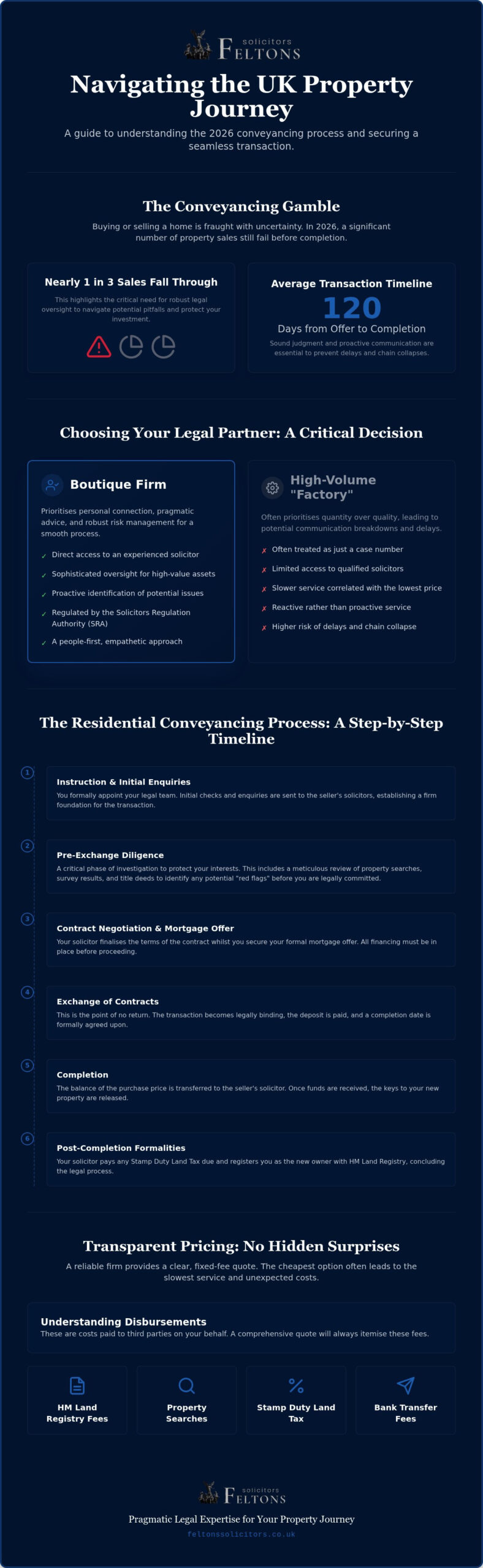
Did you know that in 2026, nearly one in three property sales in England still falls through before reaching the finish line? Buying or selling a home shouldn’t feel like a gamble, yet the process often remains fraught with uncertainty. You’ve likely heard the horror stories: silent solicitors, unexpected fees cropping up at the final hour, or the sinking feeling when a property chain begins to wobble. It’s frustrating when you’re treated like just another file in a high-volume system. Finding the right conveyancing solicitors london can change that experience entirely, providing the calm, steady presence needed to steer through the current market.

This guide shows you how to secure a seamless transaction by choosing a partner who provides pragmatic advice and a boutique level of care. We’ll explore how to avoid hidden costs, manage complex leasehold matters, and ensure you have direct access to an experienced professional throughout your journey. Whether you’re calculating the latest Stamp Duty rates or registering an overseas entity, this guide provides the clarity you need for a stress-free completion, combining London-standard expertise with a truly national reach.

Key Takeaways

  • Learn how to distinguish between high-volume “conveyancing factories” and boutique firms that prioritise personal connection and robust risk management.
  • Understand the critical stages of the 2026 property timeline, including how to identify potential “red flags” during the search and survey review phase.
  • Gain clarity on complex legal requirements, such as leasehold enfranchisement and the mandatory registration of overseas entities owning UK property.
  • Discover why instructing conveyancing solicitors london provides the sophisticated legal oversight necessary for high-value transactions, regardless of where in the country you are moving.
  • Explore the value of pragmatic advice and fixed-fee pricing in ensuring a stress-free exchange and completion without the worry of hidden costs.

Selecting the Right Conveyancing Solicitors in London for Your Move

Conveyancing is the essential legal process of transferring property ownership from a seller to a buyer. It’s a journey that involves rigorous title checks, contract negotiations, and the secure transfer of significant funds. Whilst many providers offer these services, choosing conveyancing solicitors london provides a layer of legal protection that high-volume “factories” often lack. Solicitors are uniquely qualified to handle complex titles, restrictive covenants, or unregistered land. Unlike licensed conveyancers who specialise solely in property, a solicitor’s broader legal training allows them to identify issues that might impact your future estate planning or wider litigation risks.

Peace of mind comes from knowing your firm is regulated by the Solicitors Regulation Authority (SRA). This regulation ensures strict adherence to professional standards and provides access to a compensation fund if errors occur. Many clients seek London-based expertise for transactions across England and Wales because they require a “sophisticated guide” who can manage high-value assets with precision. This level of oversight is particularly valuable in a market where roughly one in three sales currently falls through before completion.

The Role of Professional Integrity in Property Law

Maintaining a balance between modern efficiency and traditional legal values is essential for a successful transaction. A “people-first” philosophy ensures that you aren’t just a reference number in a database. In 2026, where the average home purchase takes roughly 120 days, sound judgment amongst complex legal jargon is what prevents a property chain from collapsing. Your solicitor should act as a steady hand, providing empathetic reassurance whilst managing the technical intricacies of the law to keep your move on track.

Fixed Fees vs. Hourly Rates: What to Expect

Transparency in pricing is the cornerstone of a stress-free move. You should always look for clear, fixed-fee quotes to avoid “hidden extra” surprises on completion day. It’s a common pitfall to choose the cheapest quote available; often, the lowest price correlates with the slowest service and high-volume processing. A reliable firm will provide a comprehensive breakdown of disbursements. These are costs paid to third parties on your behalf, which typically include:

  • HM Land Registry fees: Costs for registering your ownership.
  • Property Searches: Local authority, water, and environmental reports.
  • Stamp Duty Land Tax (SDLT): The tax due on your purchase.
  • Bank transfer fees: Charges for the secure movement of completion funds.

By prioritising fixed pricing and direct access to an experienced solicitor, you protect yourself from the delays and communication breakdowns that often plague the UK property market.

The Residential Conveyancing Process: A Step-by-Step Timeline

The journey from an agreed offer to receiving your keys is often viewed as a complex black box. In 2026, the average timeline for a property transaction in England remains roughly 120 days. It begins with “Instruction,” where you formally appoint your legal team. Experienced conveyancing solicitors london will immediately issue initial enquiries to the seller’s side, setting a firm foundation. This stage aligns with the official government guide on buying and selling, ensuring all legal protocols are met from the outset. Once the foundation is laid, the process moves into property searches and a rigorous survey review to uncover any potential “red flags” before you’re financially committed.

Pre-Exchange Diligence: Why Detail Matters

A solicitor’s primary duty is to protect your interests by investigating title deeds and local authority searches with precision. “A meticulous approach to pre-exchange enquiries is the only way to prevent costly disputes after completion.” At Feltons, we provide pragmatic advice during the survey review stage. We don’t just pass on technical reports; we help you interpret how a specific search result or survey finding might affect your long-term investment or future resale value. This level of scrutiny is what prevents the fear of a chain collapsing at the eleventh hour.

Once your mortgage offer is issued, your solicitor ensures the lender’s requirements align perfectly with the contract terms. This is a critical checkpoint where legal and financial requirements meet. If you’re looking for a firm that prioritises this level of detailed oversight, you might speak with a specialist solicitor to discuss your specific requirements. Following this, you reach the exchange of contracts, the definitive point where the transaction becomes legally binding.

Preparing for Completion Day

Completion day involves the precise coordination of transferring funds through the banking system. Your solicitor manages this flow, ensuring the seller’s side receives the balance on time so that keys can be released. The work doesn’t end when you move in. Your legal team handles the essential post-completion tasks, such as paying Stamp Duty Land Tax (SDLT) to HMRC on your behalf. The final step is the formal registration of your title with HM Land Registry, a process that provides the ultimate security of ownership. Using conveyancing solicitors london ensures these administrative hurdles are cleared with professional efficiency, regardless of where your new home is located.

Standard residential transactions are often straightforward, but complex titles require a higher level of legal scrutiny. This is where the expertise of conveyancing solicitors london becomes indispensable. Whilst standard administrative tasks keep a move progressing, adhering to The Law Society’s Conveyancing Protocol ensures that even the most intricate matters are handled with professional integrity. For property developers managing multiple plots or investors looking at commercial leasing, the legal requirements shift significantly. Commercial property law demands a deeper analysis of repairing obligations and usage classes, which differs greatly from the consumer-focused protections of residential law.

Leasehold Extensions and Tenant Rights

Leaseholders often face specific challenges as their term shortens. It’s vital to consider extending a lease before the remaining term drops below 80 years. Once this threshold is crossed, the cost of extension increases significantly due to “marriage value” calculations. Our role as a sophisticated guide is to help you secure these rights efficiently. Whether you’re interested in an individual extension or participating in collective enfranchisement to purchase your freehold, seeking guidance from Leasehold Enfranchisement Experts ensures your long-term investment remains secure and marketable.

The Register of Overseas Entities (ROE)

Legal requirements for international owners have become much more stringent in 2026. Beneficial owners of overseas entities that own UK property must register with Companies House. Non-compliance isn’t just a minor administrative error; it carries severe risks. Failing to register can lead to restrictions on your ability to sell, lease, or even charge the property against a mortgage. We provide the pragmatic advice needed to handle this registration process with precision. You can find detailed support through our guide on Overseas Entity Beneficial Owner Registration, which helps international clients maintain full control over their UK assets. This niche expertise allows us to support complex, international-scale matters whilst maintaining the personal connection of a boutique firm.

For developers, managing these layers of complexity across multiple titles requires a methodical approach. Sound judgment is required to balance the fast-paced nature of development with the rigorous demands of the Register of Overseas Entities and modern leasehold reform. By choosing a firm that combines London-grade expertise with a national reach, you ensure that every plot and every entity is handled with the same high-end reliability.

Conveyancing Solicitors in London: A National Guide to Seamless Property Transactions 2026

Why a Boutique National Firm Beats a High-Volume Conveyancing Factory

The UK property market is increasingly dominated by “conveyancing factories” that prioritise volume over individual care. These firms often operate on a call centre model, where clients rarely speak to the same person twice and files are processed by junior clerks rather than qualified professionals. For a high-value asset, this lack of continuity is a significant risk. Choosing conveyancing solicitors london with a boutique ethos ensures that your transaction is managed by a dedicated expert who understands the nuances of your specific case. This approach combines modern digital efficiency with the traditional human touch, providing a steady presence whilst navigating the complexities of a national move.

Direct Access to Expert Legal Minds

There is a stark contrast between being a reference number in a database and having direct access to an experienced solicitor. At Feltons, we reject the junior clerk approach in favour of senior oversight. This direct line of communication is vital because it prevents delays in the property chain; your solicitor can make immediate, informed decisions without waiting for a supervisor’s approval. We define pragmatic legal advice as the ability to solve complex title problems or chain issues through sound judgment without resorting to unnecessary litigation. This focus on practical solutions keeps your transaction moving forward when others might stall amongst technicalities.

By maintaining a lower case-to-staff ratio, boutique firms can act as a sophisticated guide through every stage of the process. This personalised oversight is particularly effective for transactions involving high-value properties where the margin for error is slim. If you value a partner who prioritises your legal security and provides clear, direct communication, you can contact our team for a tailored quote.

Discreet and Personalised Service

Privacy is a paramount concern for many of our clients, especially high-net-worth individuals or those involved in sensitive sales. A boutique firm has the flexibility to tailor its behaviour to the specific needs and expectations of the client, providing a level of discretion that high-volume firms simply cannot match. We understand that a property transaction is a personal milestone as much as a legal one. Our methodology is designed to provide empathetic reassurance whilst maintaining the highest professional standards. For those seeking a deeper understanding of the legal framework surrounding their move, our guide on Navigating Residential Property Law offers further insights into securing your property rights with confidence.

Ultimately, the “people-first” philosophy of a boutique firm ensures that the human impact of the legal work is never forgotten. Whether you are buying a first home or managing a complex commercial lease, having a trusted advisor who values personal rapport makes the difference between a stressful ordeal and a seamless completion.

Feltons Solicitors LLP isn’t a high-volume legal practice. We’ve built our reputation on the belief that property law is about people, not just paperwork. By choosing conveyancing solicitors london who value personal rapport, you ensure that your transaction receives the dedicated oversight it deserves. Our firm balances the technical precision required for complex property matters with a supportive approach that keeps you informed at every stage. We act as a steady presence in a market that can often feel unpredictable, providing the calm authority needed to see your move through to a successful completion.

Whilst we are rooted in the capital, our reach is truly national. We handle transactions across England and Wales, applying the same high-end reliability to a rural freehold purchase as we do to a sophisticated London leasehold extension. Our expertise extends across the full spectrum of property law, ensuring we can support you through various life stages and investment goals. Our services include:

  • Residential and commercial conveyancing.
  • Commercial lease renewals and negotiations.
  • Registration of overseas entities owning UK property.
  • Leasehold enfranchisement and extensions.
  • Complex litigation and dispute resolution.

A Legacy of Sound Judgement

Established in 2010 by Paula Felton, the firm has grown into a trusted advisor for clients seeking more than just a standard administrative service. Our background in complex litigation and dispute resolution provides us with a unique perspective on property law. We don’t just process files; we anticipate risks before they become obstacles. This legacy of sound judgement means your property interests are in safe, expert hands. We understand that we’re protecting your legacy as much as your financial investment, and we take that responsibility seriously.

Next Steps for Your Conveyancing

Moving property is a significant life event that requires a methodical and supportive legal process. We invite you to experience a different standard of care, where direct access to an experienced solicitor is the norm, not the exception. Obtaining a tailored quote is a straightforward process designed to provide you with clear, fixed-fee transparency from the outset. We encourage you to reach out for an initial consultation to discuss the specific nuances of your transaction.

Contact Feltons Solicitors for a pragmatic approach to your conveyancing and discover how our boutique level of care can provide the security and peace of mind you need for your next property journey. Whether you’re navigating a first-time purchase or a complex commercial divestment, our team is ready to act as your sophisticated guide.

Securing Your Property Future with Confidence

Navigating the UK property market in 2026 requires a partner who understands that every transaction is a significant life event. We’ve explored how the right legal oversight prevents the common pitfalls of slow communication and hidden fees. By choosing a firm that prioritises direct access to experienced legal experts over high-volume call centres, you ensure that even the most complex leasehold or overseas entity matters are handled with precision. The sophisticated guidance provided by conveyancing solicitors london acts as a steadying force, allowing you to move forward with quiet confidence.

Feltons Solicitors LLP was established in 2010 to provide the pragmatic advice and boutique level of care that high-net-worth individuals and diligent homeowners deserve. Whether you’re managing a national sale or a commercial lease renewal, our team is committed to delivering a stress-free exchange and completion. We invite you to instruct Feltons Solicitors for your property transaction today and experience a more methodical, supportive approach to property law. Your next chapter deserves the security of expert hands, and we’re here to guide you every step of the way.

Frequently Asked Questions

How long does the conveyancing process usually take in 2026?

In 2026, the average timeline for a property transaction in England is approximately 120 days. This duration can vary depending on the complexity of the property chain and the responsiveness of all parties involved. Whilst some transactions might exchange in around 68 days, many factors can extend the process. A dedicated solicitor helps manage these timelines through proactive communication and pragmatic advice.

What are the main costs involved in hiring conveyancing solicitors in London?

The costs associated with hiring conveyancing solicitors london generally consist of professional fees and disbursements. Professional fees cover the legal expertise and time dedicated to your file. Disbursements are costs paid to third parties on your behalf, including HM Land Registry fees, local authority searches, and Stamp Duty Land Tax. You should look for a fixed-fee quote to ensure transparency and avoid unexpected charges during completion.

Do I need to visit my solicitor’s office in person during the move?

No, you do not typically need to visit our office in person. Modern digital efficiency allows us to manage transactions across the country through secure electronic portals, video consultations, and digital identity checks. This approach ensures you receive high-end reliability and personal connection regardless of your location. Whilst we value personal rapport, our systems are designed to provide a seamless experience that respects your time and geographical distance.

What is the difference between a solicitor and a licensed conveyancer?

A solicitor is a qualified legal professional with broad training across various areas of law, including litigation and dispute resolution. This background is invaluable for identifying complex title issues that a licensed conveyancer might overlook. Choosing a solicitor provides a more comprehensive level of risk management for high-value assets. It ensures that your property journey is guided by a professional with a deep understanding of the wider legal landscape.

What happens if my property chain collapses at the last minute?

If a property chain collapses, your solicitor will immediately assess the legal and financial implications. Whilst a collapse is stressful, having a calm and steady presence is vital to exploring alternative solutions, such as finding a new buyer or negotiating a delayed completion. We provide pragmatic advice to protect your deposit and minimise losses. Our experience in dispute resolution helps us manage these high-pressure situations with the quiet confidence needed to find a way forward.

Can Feltons Solicitors handle property purchases outside of London?

Yes, Feltons Solicitors LLP provides a boutique level of care with a truly national reach. We handle residential and commercial conveyancing across the whole of England and Wales. Our London-grade expertise is accessible to clients regardless of their property’s location. By utilising modern digital tools and maintaining a methodical flow of communication, we ensure that every client receives the same high standard of service and personal attention, whether they are buying in a city centre or a rural area.

What is Stamp Duty Land Tax and how is it calculated?

Stamp Duty Land Tax (SDLT) is a tax paid to HMRC when you purchase a property or land over a certain price in England and Northern Ireland. It’s calculated using tiered rates based on the purchase price. For example, in 2026, the portion up to £125,000 is 0%, whilst the portion between £250,001 and £925,000 attracts a 5% rate. Different rules apply for first-time buyers and those purchasing additional properties.

Why is leasehold enfranchisement important for flat owners?

Leasehold enfranchisement is a powerful legal right that allows flat owners to collectively purchase the freehold of their building or individually extend their lease. This process is essential because a shortening lease can significantly decrease a property’s market value and make it difficult to remortgage. Under the Leasehold and Freehold Reform Act 2024, standard extensions have increased to 990 years. Securing these rights ensures long-term asset protection and gives you greater control over management costs.