
Leasehold Enfranchisement Experts: A Guide to Securing Your Property Rights in 2026

Leasehold Enfranchisement Experts: A Guide to Securing Your Property Rights in 2026

Owning a leasehold property shouldn’t feel like a race against a ticking clock, yet for many, the 80-year threshold remains a source of significant financial anxiety. You likely feel that the legal process is unnecessarily opaque, especially when faced with strict statutory deadlines and the fear of escalating premiums. It’s a common frustration to feel like a tenant in your own home while the freeholder retains control. By partnering with leasehold enfranchisement experts, you can transform this uncertainty into a strategic advantage, ensuring your property remains a secure asset for decades to come.

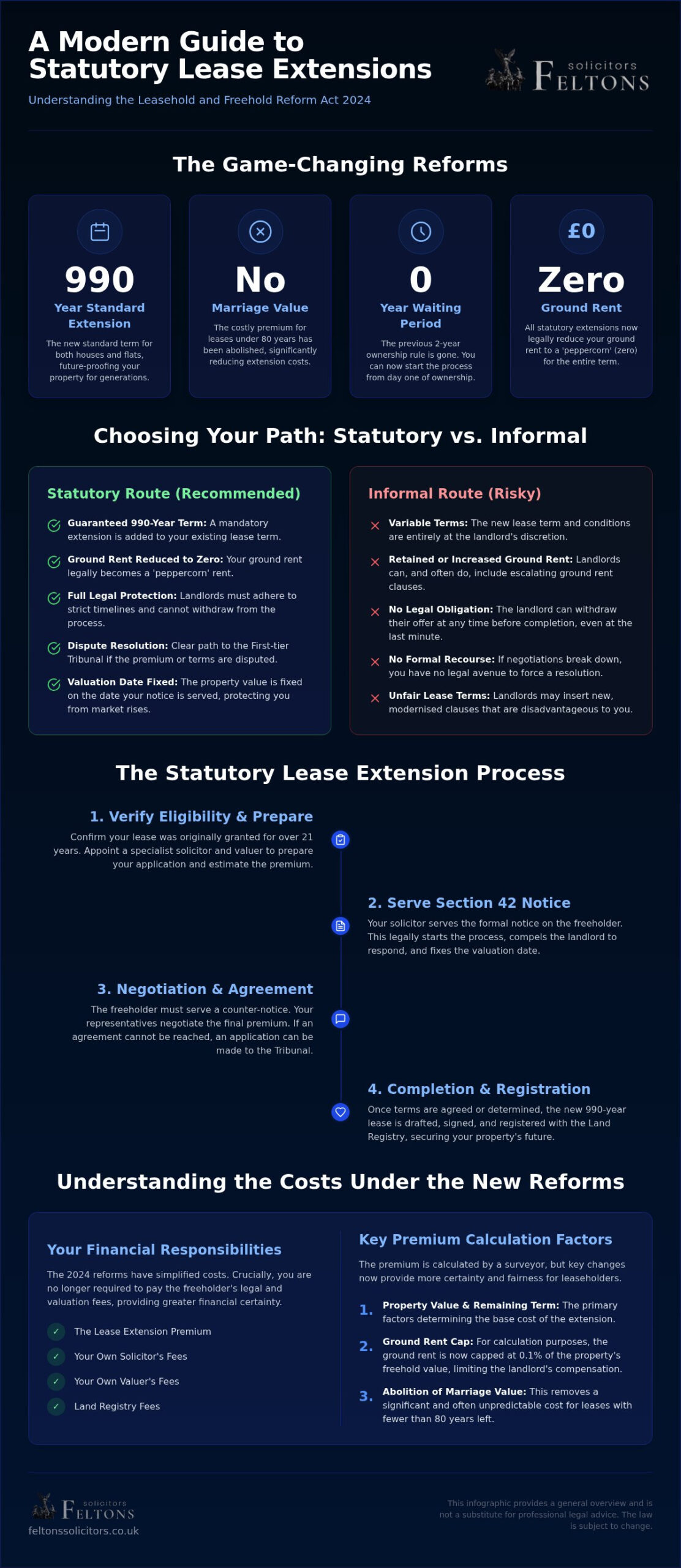
In this guide, we’ll show you how to navigate the complexities of the latest legislation, including the 2024 reforms that have already simplified the path to ownership. We will explore how the abolition of the two-year ownership requirement and the new 990-year extension standards allow you to eliminate ground rent and regain management control. You’ll discover a clear, methodical approach to increasing your property’s market value whilst avoiding the pitfalls of complex legal notices. From understanding premium calculations to managing collective enfranchisement, this overview provides the professional clarity you need to secure your property rights in 2026.

Key Takeaways

  • Understand why the 80-year threshold acts as a financial cliff and how acting early prevents the significant costs associated with Marriage Value.
  • Distinguish between the legal protections offered by the statutory route and the potential pitfalls of informal agreements with freeholders.
  • Discover how the 50% rule empowers you and your neighbours to force the sale of a freehold and gain full control over building management.
  • Learn how leasehold enfranchisement experts navigate complex premium calculations and procedural risks to secure your property’s long-term value.
  • Identify the strategic steps required to eliminate ground rent obligations and secure a 990-year lease extension under current legislation.

Understanding Leasehold Enfranchisement and the Critical 80-Year Rule

Leasehold enfranchisement is the legal mechanism that empowers flat owners to secure their investment and gain genuine autonomy. In essence, it allows you to either extend your lease or, in collaboration with your neighbours, purchase the freehold of the entire building. For many homeowners, this isn’t just a legal formality; it’s a vital step to remove onerous ground rent clauses and ensure the property remains attractive to future buyers. Seeking guidance from leasehold enfranchisement experts ensures that these complex statutory procedures are handled with the precision they require.

Why the 80-Year Threshold is a Critical Deadline

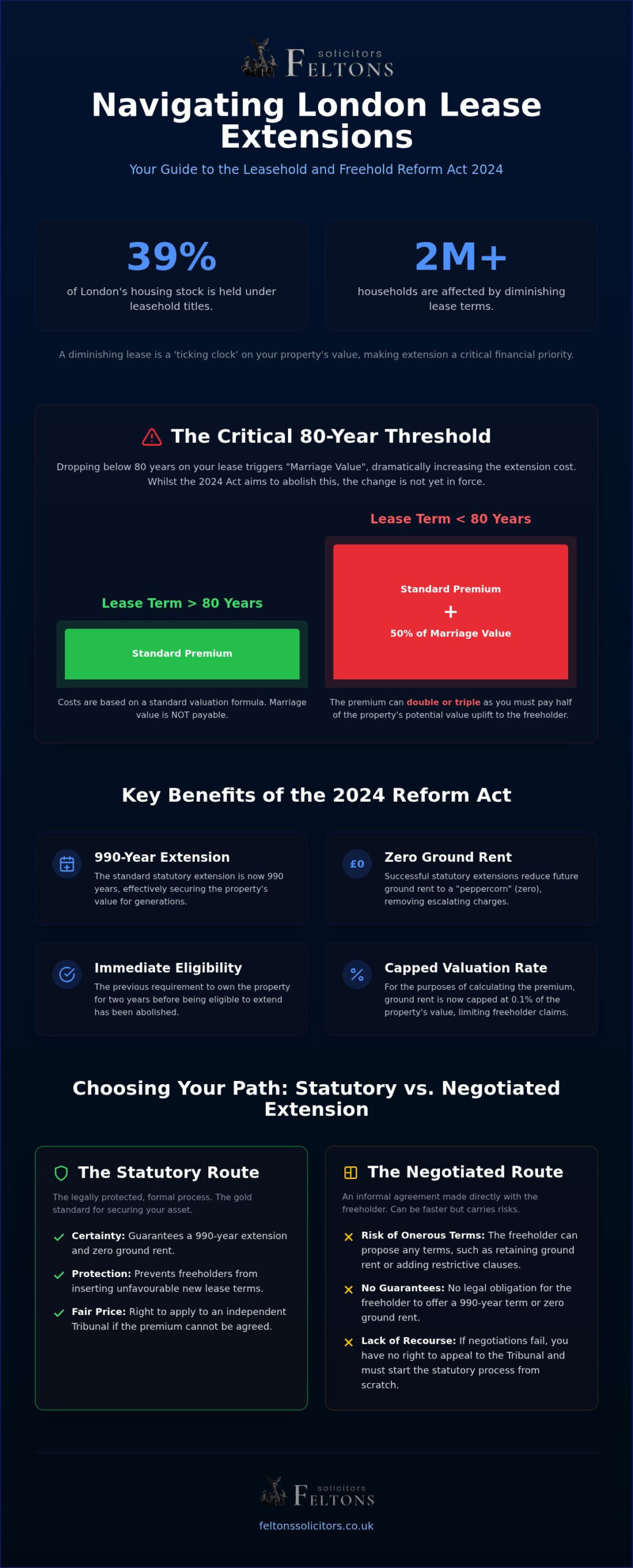
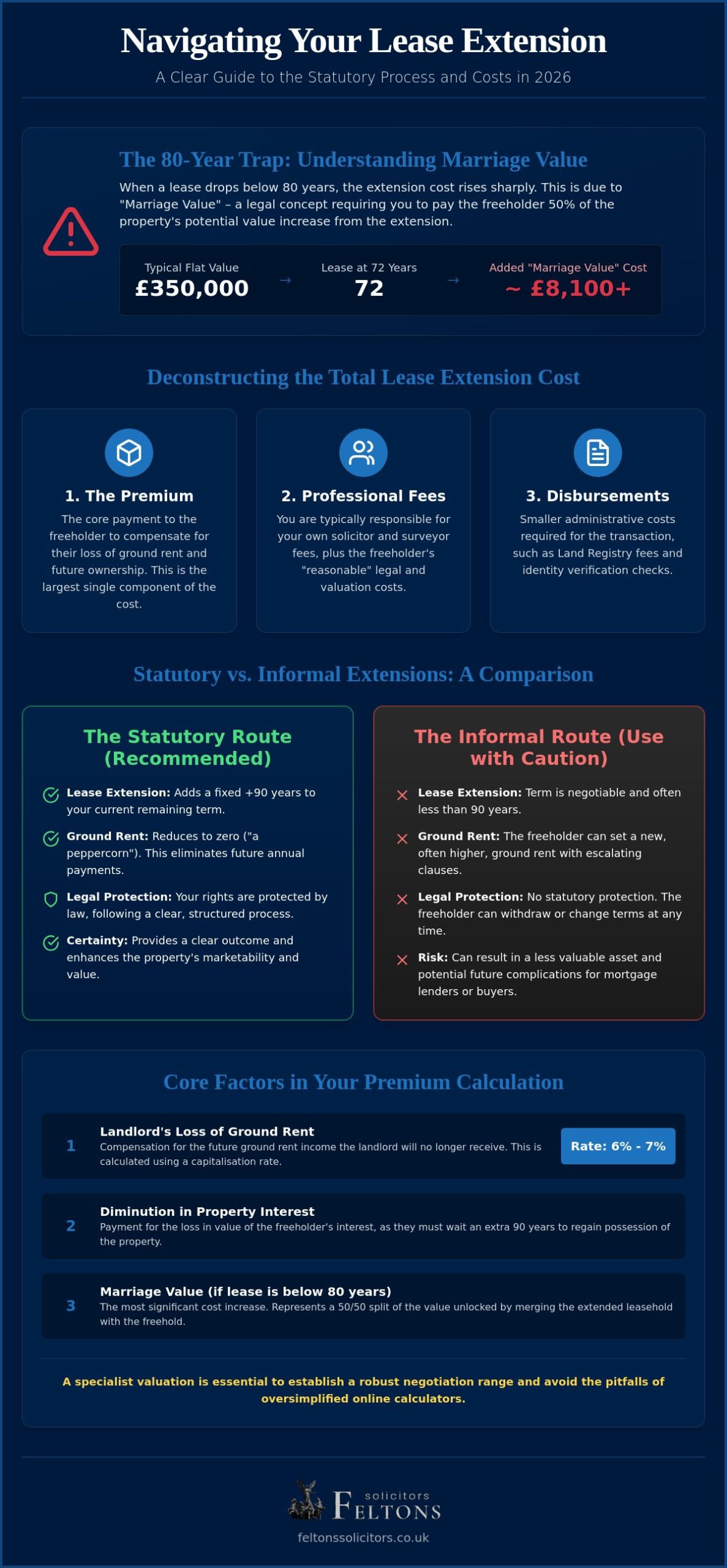
The 80-year mark represents a significant financial pivot point. Once a lease drops below this threshold, a concept known as Marriage Value enters the calculation. This represents the potential increase in the property’s value after a lease extension is granted. Under current rules, the leaseholder must pay the freeholder 50% of this added value as part of the extension premium. This additional cost can run into thousands of pounds, making the process far more expensive than it needs to be.

Beyond the immediate expense, a short lease severely impacts mortgageability. Most high-street lenders are reluctant to offer finance on properties with fewer than 80 years remaining, which significantly reduces the pool of potential buyers. Acting before you hit this financial cliff is always the most cost-effective strategy. While recent reforms aim to eventually phase out Marriage Value, it remains a present factor in 2026 that requires careful navigation to avoid overpaying.

Individual Extension vs. Collective Enfranchisement

Deciding between an individual extension and a collective purchase depends on your long-term goals for the building. A statutory lease extension, now standardised to 990 years under recent reforms, is often the simplest path for an individual tenant. It resets the clock and reduces ground rent to zero. This is a pragmatic choice if you’re looking for immediate security without needing to coordinate with other residents.

However, if you’re frustrated by high service charges or poor building maintenance, the Collective enfranchisement process might be more appropriate. This involves joining forces with at least 50% of the qualifying tenants in your block to buy the freehold. Once successful, you and your neighbours become your own landlord, providing total control over management decisions and future costs. This collective approach doesn’t just protect your lease; it transforms how your building is run. Our team of leasehold enfranchisement experts can help you weigh these options to determine which strategy aligns best with your financial interests.

When you decide to secure your property rights, you’ll face a choice between the statutory path or an informal negotiation. The statutory route, primarily governed by the Leasehold Reform, Housing and Urban Development Act 1993 for flats, provides a robust shield for homeowners. For those owning houses, the Leasehold Reform Act 1967 offers the primary legal foundation. Choosing the formal route ensures that the freeholder cannot simply ignore your request or impose arbitrary terms. It requires the service of a valid Section 42 notice for extensions or a Section 13 notice for collective enfranchisement. These documents are precise legal instruments that, when handled by leasehold enfranchisement experts, lock the freeholder into a strict, legally binding process.

Navigating the Statutory Process under the 1993 Act

The statutory framework is defined by its methodical timeline. Once your initial notice is served, the freeholder has a fixed period to provide a counter-notice. This structure prevents the delays that often plague private negotiations. Under the updated 2026 landscape, the Act guarantees a significant extension, typically moving towards the new 990-year standard, and reduces ground rent to a peppercorn value. If a premium cannot be agreed through negotiation, you have the right to take the matter to the First-tier Tribunal. This serves as an essential safety net, ensuring that the final price is determined by law rather than a landlord’s whim.

The Pitfalls of Informal Lease Extension Agreements

It’s common for freeholders to approach leaseholders with “friendly” informal offers. These deals might appear attractive because they often bypass the initial costs of a formal valuation. However, these agreements can be a trap. Freeholders frequently use informal deals to slip in rising ground rent clauses or shorter extension terms than the law would otherwise grant. Without the protection of the 1993 Act, you lose your right to appeal to a tribunal if things go wrong. These private arrangements often lack the long-term security provided by the statutory route.

A boutique approach ensures that every detail of your agreement is scrutinised to prevent long-term financial loss. If you’re unsure which path to take, consulting with leasehold enfranchisement experts can help you avoid these expensive pitfalls and secure a deal that truly protects your equity. Relying on professional, pragmatic guidance is the only way to ensure an informal proposal doesn’t compromise your investment for years to come. By choosing the formal statutory route, you remain in control of the process from start to finish.

Collective Enfranchisement: Uniting to Purchase the Freehold

Collective enfranchisement is a powerful tool for leaseholders seeking to escape the limitations of a third-party landlord. By joining forces, you can legally compel your freeholder to sell the building’s freehold to a company owned by you and your neighbours. This process is governed by the 50% rule; if half of the flats in your block agree to participate, the freeholder cannot refuse the sale. Working with leasehold enfranchisement experts ensures that this collective effort is managed with the necessary legal rigour to avoid procedural delays and interpersonal friction.

The strategic advantage of owning a “share of freehold” in the current UK market cannot be overstated. It significantly increases the liquidity of your asset, as buyers often prefer properties where they have a direct say in management. Beyond the financial gain, it eliminates the frustration of dealing with unresponsive managing agents or inflated service charges. You and your fellow residents become the masters of your own building’s destiny.

This level of control is particularly valuable when planning future renovations or maintenance. For residents who wish to upgrade their building to a premium standard, partnering with a high-end firm such as Daniels Contractors ensures that any development work reflects the property’s increased value and prestige.

Eligibility Criteria for Qualifying Tenants

To proceed, the building itself must meet specific criteria. Primarily, at least two-thirds of the flats must be held by “qualifying tenants”, which is defined as those with original lease terms exceeding 21 years. Mixed-use buildings also have strict thresholds that have evolved recently. As of March 2025, the threshold for non-residential space was increased, allowing buildings with up to 50% commercial use to qualify for enfranchisement. This change has opened the door for many residents in urban centres to take control of their properties. However, certain exclusions apply, such as buildings where the landlord is a resident and the block contains four or fewer flats.

Organising a Nominee Purchaser and Participation Agreements

Success in a collective claim requires a clear legal structure. You must form a “Nominee Purchaser,” which is typically a private limited company. Each participating leaseholder becomes a shareholder, and this entity will eventually hold the freehold title once the transaction completes. Because these claims involve multiple parties and significant sums of money, the risk of a neighbour withdrawing mid-process is a genuine concern. This is why participation agreements are vital. These contracts ensure every member remains committed to their financial share of the premium and professional fees.

Even during these collective negotiations, individual tenant lease extension rights remain a factor, as the new freehold company can often grant 999-year leases to its members at a peppercorn rate. If disputes arise regarding the purchase price or “premium” during the negotiation phase, you can refer to official tribunal guidance to understand how the First-tier Tribunal resolves valuation disagreements. By partnering with leasehold enfranchisement experts, you can navigate these interpersonal and legal complexities with quiet confidence, ensuring a smooth transition to a share-of-freehold status. For a comprehensive step-by-step walkthrough of this process, our guide on working with collective enfranchisement solicitors to buy your freehold in 2026 provides a detailed blueprint from initial organisation through to completion.

Leasehold Enfranchisement Experts: A Guide to Securing Your Property Rights in 2026

Managing the Costs and Procedural Risks of Enfranchisement

Dealing with a difficult or unresponsive freeholder is often the most taxing part of the enfranchisement journey. It is a high-stakes negotiation where financial interests directly collide. You’re legally required to pay a “Premium” to compensate the freeholder for their loss of interest in the property. This figure isn’t just a simple purchase price; it also includes the freeholder’s “reasonable” legal and valuation fees, which you are statutory bound to cover. Our role as leasehold enfranchisement experts is to ensure these costs remain truly reasonable and aren’t used as a tactic to stall your progress or inflate the total bill.

Calculating the Premium and Marriage Value

The premium is built from several technical components, primarily the capitalisation of future ground rent and the “reversionary value,” which represents the value of the property returning to the landlord at the end of the term. Marriage Value is the profit created by merging the leasehold and freehold interests. Whilst recent reforms aim to simplify these calculations, Marriage Value remains a significant factor for any lease with fewer than 80 years remaining. A specialist solicitor works closely with a qualified valuer to challenge freeholder estimates. We use expert evidence to build a robust case, often significantly reducing the final premium if the matter reaches a Tribunal.

Avoiding Professional Negligence and Procedural Delays

In this area of law, precision is your greatest asset. One of the most dangerous procedural traps is missing the strict six-month window to apply to the First-tier Tribunal after receiving a counter-notice. If this deadline passes without a formal agreement or an application, your claim is “deemed withdrawn.” This mistake can be devastating, as you may be barred from reapplying for 12 months, during which time the premium may increase. Understanding exactly what to expect when your landlord response to lease extension notice arrives is essential to ensuring you act within these critical statutory windows. This is where the expertise of a residential property law firm becomes indispensable. We manage the administrative burden, ensuring every notice is served correctly and every statutory deadline is met with room to spare.

Sometimes, the challenge isn’t a difficult freeholder, but an “absentee” one. If your landlord cannot be located after reasonable searches, we can guide you through the Vesting Order process. This allows the County Court to sign the transfer on the freeholder’s behalf, ensuring your rights aren’t held hostage by a missing person. If you’re ready to protect your investment from these technical risks, speak with our leasehold specialists for a pragmatic assessment of your case. We provide the calm, steady presence needed to navigate these complex waters whilst keeping your long-term interests at the forefront of every decision.

How Leasehold Enfranchisement Experts Protect Your Investment

Securing the future of your property requires more than just a successful valuation; it demands a strategic legal approach that spans from the initial notice to final registration. Enfranchisement is a high-stakes manoeuvre where the margin for error remains slim. By engaging leasehold enfranchisement experts, you gain a calm, steady presence that navigates the friction of landlord negotiations whilst protecting your capital. We focus on delivering a bespoke strategy that balances speed and cost with absolute legal security, ensuring your home remains a liquid and valuable asset throughout the 2026 property landscape.

The Role of a Specialist Property Solicitor

A specialist property solicitor provides a level of depth that “off-the-shelf” legal services simply cannot match. Every lease is unique, containing specific covenants and historical quirks that can impact the success of a claim. We move beyond generic advice to provide tailored solutions for complex titles, particularly in mixed-use developments or estates with intricate management structures.

Our work involves close coordination with specialist valuers to ensure that the legal framework and financial strategy are perfectly aligned. Once a premium is agreed or determined by a Tribunal, the process moves into a technical conveyancing phase. This requires the drafting of new lease terms or the transfer of the freehold title with meticulous precision. Managing the registration of these new interests at HM Land Registry is the final, critical step. Any administrative oversight at this stage could cloud your title, making future sales or remortgaging difficult.

Securing Your Property’s Future with Feltons Solicitors LLP

At Feltons Solicitors LLP, we’re committed to a “people-first” philosophy that prioritises your peace of mind. Our approach is defined by traditional professional integrity blended with modern efficiency. We provide pragmatic advice designed to achieve your goals without the need for unnecessary or expensive litigation. This discreet, high-standard service is why we’re trusted by both local residents and international clients who hold significant UK leasehold interests. Whether you’re extending a single lease or leading a collective purchase of a freehold, we act as your sophisticated guide through every stage.

The landscape of property law is shifting, and the reforms of 2026 have created new opportunities for leaseholders to reclaim control. However, the complexity of the statutory process remains. We believe a preliminary consultation is the most vital part of the journey. It allows us to assess the specific merits of your case, identify potential hurdles, and set a clear path forward. By partnering with leasehold enfranchisement experts at Feltons Solicitors LLP, you ensure that your property rights are not just exercised, but fully secured for the long term. It’s about more than just a legal result; it’s about the security of your home and your investment.

Secure Your Property’s Future with Expert Guidance

Securing your property rights in 2026 is no longer a matter of waiting for legislative change; it’s about taking proactive steps to protect your equity. By acting before the 80-year threshold, you avoid the significant costs of Marriage Value and ensure your home remains mortgageable. Whether you choose a statutory 990-year extension or join with neighbours to purchase the freehold, the result is the same: increased market value and the elimination of ground rent obligations. These technical manoeuvres require precision to avoid the procedural traps that often derail informal negotiations.

Established in 2010 by Paula Felton, our firm specialises in complex property litigation and residential conveyancing. We provide pragmatic, discreet legal support for both national and international clients, ensuring every statutory deadline is met with quiet confidence. If you’re ready to move from uncertainty to autonomy, consult our leasehold enfranchisement experts today. We’ll help you navigate the complexities of the law whilst providing the boutique care your investment deserves. Your property is likely your most significant asset; it’s time to ensure it’s fully under your control.

Frequently Asked Questions

What is the difference between a lease extension and enfranchisement?

A lease extension increases the length of your existing lease, whilst enfranchisement involves purchasing the freehold title outright. For flat owners, enfranchisement is usually a collective process where you and your neighbours buy the building. Both routes effectively eliminate ground rent obligations and increase the market value of your property. Our team of leasehold enfranchisement experts can help you determine which path provides the best long-term security for your specific circumstances.

How much does it cost to extend a lease or buy the freehold?

The total cost is comprised of the premium paid to the freeholder and the professional fees for both parties. You are legally responsible for the freeholder’s reasonable legal and valuation costs in addition to your own. The premium varies significantly based on the remaining lease term and the property’s value. Because these calculations are complex, we recommend obtaining a formal valuation to ensure you don’t overpay during the negotiation phase.

What is the 80-year rule in leasehold enfranchisement?

The 80-year rule is a critical threshold where extending a lease becomes significantly more expensive due to Marriage Value. This is the potential increase in property value created by the extension, half of which must be paid to the landlord. Whilst the Leasehold and Freehold Reform Act 2024 aims to eventually phase this out, it remains a vital consideration for leaseholders in 2026. Acting before your lease drops below this mark is the most effective way to protect your equity.

Can my freeholder refuse to extend my lease or sell the freehold?

No, a freeholder cannot refuse a valid statutory request if you meet the eligibility criteria under the 1993 Act. This is a mandatory legal right, not a discretionary favour. If the landlord fails to respond or disputes the terms unreasonably, leasehold enfranchisement experts can apply to the First-tier Tribunal to have the terms determined by law. This ensures that you aren’t held hostage by a difficult or unresponsive landlord.

How long does the leasehold enfranchisement process take?

Most claims take between six and twelve months to complete from the service of the initial notice. The timeline depends heavily on the freeholder’s response and the complexity of the valuation negotiations. If the parties cannot agree on a premium and the matter proceeds to a Tribunal, the process may take longer. We manage every administrative step to ensure your claim stays on track and meets all strict statutory deadlines.

Do I need my neighbours’ permission to buy the freehold?

You don’t need your neighbours’ permission to extend your individual lease, but you do need their participation to buy the freehold. Collective enfranchisement requires at least 50% of the qualifying tenants in a building to join the claim. You don’t need the consent of the remaining residents, though they will have the opportunity to participate if they wish. This collective approach gives you total control over the building’s future management and service charges.

What happens if I cannot find my freeholder?

If your freeholder is missing, you can still proceed by applying for a Vesting Order through the County Court. This legal mechanism allows the court to sign the transfer or lease extension on the freeholder’s behalf after you’ve made reasonable attempts to find them. The premium is then paid into court for the landlord to claim later. It’s a methodical process that ensures an absentee landlord cannot block your legal right to enfranchisement.

Can I extend my lease if I have only just bought the property?

Yes, you can now apply to extend your lease or buy the freehold immediately after purchasing your home. As of 31 January 2025, the previous requirement to have owned the property for two years was abolished. This change allows new owners to act quickly to secure their investment, which is particularly beneficial if the lease is approaching the 80-year mark. You no longer have to wait or rely on the seller to start the process for you.

Tenant Lease Extension Rights: A Comprehensive Guide for 2026

Tenant Lease Extension Rights: A Comprehensive Guide for 2026

A lease extension is no longer just a complex legal chore; it is a strategic financial right that grants you permanent security and absolute control over your home’s future value. It’s entirely natural to feel overwhelmed by the conflicting advice surrounding the Leasehold and Freehold Reform Act 2024 and the more recent Renters’ Rights Act 2025. You may be concerned about the notorious 80-year trap or feel anxious about approaching an uncooperative freeholder who seems to hold all the cards. Understanding your tenant lease extension rights is the essential first step toward protecting your investment from unnecessary costs and market volatility.

This comprehensive guide will help you navigate the 2026 legal landscape with confidence. You’ll discover how the abolition of the two-year ownership rule has accelerated the process for new buyers and why the current delay in marriage value reforms makes your timing more critical than ever. We’ll provide a clear roadmap through the statutory process, compare formal notices against informal deals; and offer the expert clarity you need to ensure your property remains a secure, high-value asset for years to come.

Key Takeaways

  • Understand how the 1993 Act provides the legal foundation for adding 90 years to your lease whilst reducing ground rent to a peppercorn.
  • Confirm your eligibility under modernised criteria, including your tenant lease extension rights as a new owner following the abolition of the two-year ownership rule.
  • Evaluate the critical differences between the secure statutory route and informal agreements to ensure your investment remains protected by legal safeguards.
  • Recognise the strategic urgency of the 80-year threshold and understand why extending before this point is vital for avoiding costly marriage value premiums.
  • Master the Section 42 notice process to formally trigger your extension and ensure your opening premium offer is professionally validated.

Understanding Your Statutory Right to a Lease Extension

The Leasehold Reform, Housing and Urban Development Act 1993 serves as the bedrock for most flat owners in England and Wales. It transformed what was once a matter of landlord discretion into a powerful, non-negotiable legal entitlement. Under this legislation, a qualifying leaseholder has the statutory power to compel their freeholder to grant a 90-year extension on top of their current remaining term. This process isn’t merely about adding time; it also mandates that the ground rent is reduced to a “peppercorn” value, effectively making it zero for the remainder of the lease. This protection is vital because it prevents freeholders from arbitrarily refusing to extend or demanding escalating ground rents that could make your property difficult to sell.

This modern framework evolved from earlier legislation like the Leasehold Reform Act 1967, which initially focused on houses. Today, your tenant lease extension rights provide a predictable and secure path to maintaining your home’s equity. By following the formal statutory route, you aren’t at the mercy of a landlord’s whims; you’re exercising a right that the law strictly enforces.

The Definition of a Qualifying Tenant

To exercise these rights, you must be a “qualifying tenant.” This typically means you hold a “long lease,” which is defined as a lease originally granted for a term exceeding 21 years. It’s a common misconception that the number of years left on your lease affects your right to qualify. Even if you only have 30 years remaining, you’re still eligible to start the process. However, there are specific exclusions to keep in mind. Business or commercial leases are generally excluded; properties owned by charitable housing trusts where the flat is part of the charity’s functions don’t qualify; and if the freeholder is the Crown or a specific National Trust property, different rules may apply.

The 2025 Rule Change: Abolition of the Two-Year Ownership Requirement

Perhaps the most significant shift in recent years occurred on 31 January 2025. Previously, leaseholders were required to own their property for at least two years before they could serve a formal Section 42 notice. This often left new buyers in a vulnerable position, forced to wait whilst their lease ticked closer to the expensive 80-year threshold. This requirement has now been abolished. You can now initiate your tenant lease extension rights as soon as you’re the registered owner at HM Land Registry. This change has fundamentally streamlined the conveyancing process, allowing buyers to secure their investment immediately after completion rather than waiting for a two-year window to open.

For those purchasing a flat with a lease nearing 80 years, this reform is a game-changer. In the past, buyers had to rely on the seller “assigning” the benefit of a notice, which was a procedurally delicate task. Now, the path is direct. You can factor the extension cost into your initial purchase plans and act without delay. This immediate eligibility provides a level of certainty that was previously missing from the market, ensuring that your asset’s value is protected from the moment you receive the keys. For those requiring dedicated conveyancing support during this process, Triangle Legal Services Limited offers specialised assistance to ensure all legal transfers are executed correctly.

Eligibility Criteria: Do You Have the Right to Extend?

Determining your eligibility is the first practical step in exercising your tenant lease extension rights. Whilst the law is generally on your side, the property must meet the definition of a residential leasehold flat held under a long lease. This typically encompasses any lease originally granted for a term exceeding 21 years. You must also identify the “competent landlord,” who is the party with a sufficiently long interest in the property to grant the 90-year extension. Detailed guidance on the initial steps for Leasehold property owners is available through official channels to help you confirm these basic facts.

It’s vital to distinguish between flats and houses. Owners of leasehold houses operate under different legislation, which often provides a choice between a 50-year extension or the right to buy the freehold entirely. Unlike the 90-year extension for flats, a house extension may allow the landlord to review the ground rent after the original term ends. This distinction is one of the most common areas of confusion for homeowners; the statutory path for flats is generally more robust in its ground rent protections.

Shared ownership leaseholders face unique hurdles. In most cases, you cannot access the statutory lease extension process unless you have “staircased” to 100% ownership. If you own less than the full share, you are usually restricted to informal negotiations with your housing association. These voluntary deals often lack the peppercorn rent protections found in the statutory route, making the timing of your staircasing a strategic priority.

Property Types and Specific Rights

Property types also dictate your strategy. Purpose-built flats usually follow a standard path; however, converted Victorian or Edwardian houses can present complexities if the building is mixed-use. If the commercial element of your building, such as a ground-floor shop, exceeds 25% of the total internal floor area, it may disqualify the group from collective enfranchisement. Individual tenant lease extension rights for the residential flats usually remain intact even in these scenarios, provided the flat itself remains a private residence.

Identifying Potential Disqualifiers

Certain disqualifiers can stall your progress. A landlord might legally oppose an extension if they can prove they intend to repossess the property for redevelopment, though this only applies if the lease is within five years of expiry. Being in significant breach of your lease terms, such as unauthorised structural alterations or substantial rent arrears, can also complicate your standing. Consulting a specialist residential property law firm early ensures that these potential roadblocks are identified before you commit to valuation and notice costs. Taking a proactive approach allows you to resolve minor disputes and proceed with the expert guidance on leasehold matters you deserve.

The Statutory Route vs Informal Agreements: A Strategic Comparison

Choosing between the statutory route and an informal negotiation is a pivotal decision for any leaseholder. Your tenant lease extension rights are most robustly protected under the formal statutory framework, which guarantees a 90-year extension and a mandatory reduction of ground rent to zero. Whilst the informal route may appear faster or cheaper initially, it lacks the stringent legal safeguards that prevent landlords from inserting unfavourable clauses. By exercising your statutory right to extend your lease, you ensure that the freeholder cannot arbitrarily refuse your request or demand an escalating ground rent that might hinder a future sale.

Landlords often favour informal agreements because they allow for the retention of ground rent income or the introduction of “modern ground rent” reviews. These reviews can cause the premium to appear lower today whilst creating a significant financial burden for you or a future buyer. In a statutory extension, the law is clear: the ground rent must become a peppercorn. This transparency is often absent in private deals, where hidden fees or variations to the lease terms can be slipped into the fine print. Without the 1993 Act’s protection, you’re essentially entering a private contract where the landlord holds the majority of the leverage.

Why Legal Certainty Trumps Short-Term Speed

The statutory process provides a structured timeline that prevents freeholders from “stalling” to gain a tactical advantage. Once a Section 42 notice is served, the landlord must respond within a fixed period, usually two months. If a dispute arises over the premium or the terms, you have the right to apply to the First-tier Tribunal (Property Chamber), formerly known as the Leasehold Valuation Tribunal. This independent body ensures that the price you pay is fair and based on established valuation principles. This level of protection ensures that the new lease doesn’t contain unfavourable variations that could complicate your mortgage or a future conveyance.

  • Fixed Deadlines: Landlords must adhere to statutory timeframes for counter-notices.
  • Tribunal Oversight: Access to independent adjudication if the premium cannot be agreed.
  • Lease Integrity: Protection against the introduction of new, onerous lease obligations.

When an Informal Deal Might Be Pragmatic

There are rare scenarios where a friendly or resident-controlled freeholder offers genuinely better terms through an informal route. This might occur in small blocks where all parties are keen to avoid the administrative costs of the formal process. However, even in the most amicable situations, it’s vital to have a solicitor review any “private” offer before you sign. They’ll check for hidden “doubling” ground rent clauses or changes to service charge structures that could prove costly. Whilst informal deals may seem more cost-effective at the outset, they often lead to substantial long-term property devaluations if the resulting lease contains non-standard or onerous terms. Working with leasehold enfranchisement experts ensures you have the specialist knowledge to evaluate any offer against the protections the statutory route provides.

Tenant Lease Extension Rights: A Comprehensive Guide for 2026

Strategic Timing and the Impact of the 80-Year Threshold

The 80-year mark is the most significant milestone in leasehold ownership. Once a lease drops below this threshold, your tenant lease extension rights become significantly more expensive to exercise due to a concept known as “marriage value.” In simple terms, marriage value represents the potential increase in the property’s value once the lease is extended; under long-standing legislation, the freeholder is entitled to 50% of this calculated “profit.” This can add thousands of pounds to your premium overnight. Acting whilst your lease still has 85 to 90 years remaining is the most effective way to avoid this “danger zone” and keep your costs predictable.

Navigating this transition in 2026 requires a clear understanding of the current legal climate. Whilst the Leasehold and Freehold Reform Act 2024 was designed to abolish marriage value, legal challenges from freeholder groups in July 2025 have led to significant implementation delays. As of 2026, many leaseholders are still required to pay this premium whilst the courts finalise the new valuation structures. This uncertainty makes proactive timing even more critical. Waiting for a legal decision that may still be months away could result in your lease slipping under the 80-year mark, potentially costing you far more than the price of a timely application.

The Financial Logic of Early Extension

Extending your lease early is a sound investment in your home’s marketability. Most high-street mortgage lenders have strict criteria regarding lease length, often requiring at least 70 to 75 years to be remaining at the end of a mortgage term. If your lease is short, you may find it difficult to remortgage or attract buyers who require financing, effectively limiting your pool of potential purchasers to cash buyers. By securing a longer term now, you instantly increase the liquidity of your asset and ensure that its value remains robust in a competitive property market. The cost of the premium is almost always outweighed by the immediate uplift in the property’s capital value.

Navigating the 2024 Reform Act Benefits

The 2024 Reform Act has introduced the prospect of standardising lease extension terms to 990 years for qualifying tenants, moving away from the traditional 90-year statutory addition. This shift represents a move toward greater long-term security for homeowners. Beyond the immediate financial gain, it is useful to consider a bespoke estate planning perspective. A short lease is a wasting asset that diminishes over time; a 990-year lease, by contrast, secures your property as a permanent part of your legacy. Protecting your investment today ensures that it remains a high-value asset for future generations. If you are approaching the 80-year threshold, seeking expert guidance on leasehold extensions is a vital step in securing your financial future.

Exercising Your Rights: The Section 42 Notice Process

Initiating the formal process requires a shift from strategic planning to precise execution. The first practical step is instructing a specialist valuer to determine a “bona fide” premium offer. This valuation is not merely an estimate; it is a professional calculation that forms the basis of your opening offer in the Section 42 Tenant’s Notice. Serving this notice is the formal trigger for your tenant lease extension rights, and it marks the moment the freeholder is legally compelled to engage with your request. Once served, the landlord has exactly two months to respond with a Section 45 Counter-Notice, in which they will either accept your terms or, more commonly, propose a counter-premium for negotiation. Understanding what to expect from the landlord response to lease extension notice is essential preparation for navigating this critical stage with confidence.

The period following the Counter-Notice opens a statutory negotiation window, typically lasting between two and six months. During this time, the surveyors for both parties attempt to reach an agreement on the final price. Once the premium is settled, the legal teams proceed to finalise the new lease deed. This document must reflect the 90-year addition and the reduction of ground rent to a peppercorn. The final stage involves registering the new lease at HM Land Registry, ensuring your title is updated and your property’s value is fully secured for the future.

The Role of the Specialist Solicitor

Success in a statutory extension depends heavily on procedural accuracy. A specialist solicitor provides the meticulous preparation required to avoid “deemed withdrawal,” a costly error where a notice is invalidated due to technical mistakes. If a notice is deemed withdrawn, you may be barred from serving a new one for twelve months, during which time your lease continues to shorten. The team at Feltons Solicitors LLP manages all professional correspondence with the freeholder’s solicitors, ensuring that every statutory deadline is met with quiet precision. This high level of care protects your legal standing and prevents the landlord from using procedural delays to their advantage.

What Happens if Negotiations Stall?

Whilst most cases are settled through surveyor-led discussions, you have the right to apply to the First-tier Tribunal (Property Chamber) if an agreement cannot be reached. This application must be made within six months of the Counter-Notice date to preserve your claim. The Tribunal acts as an independent adjudicator, setting a fair premium based on evidence provided by expert witnesses. Having professional representation at this stage is essential; it ensures your case is presented with authority and that the final determination reflects the true market value. Feltons Solicitors LLP remains committed to a pragmatic and discreet approach to dispute resolution, providing a steady hand to guide you through even the most complex negotiations until your asset is fully protected.

Securing Your Property’s Future Value

Understanding your tenant lease extension rights is the most effective way to transform a wasting asset into a permanent legacy. We’ve explored how the statutory route offers unparalleled security; providing a guaranteed 90-year extension and a mandatory reduction in ground rent. By acting proactively, especially before your lease drops below the critical 80-year threshold, you protect yourself from the financial burden of marriage value whilst ensuring your home remains mortgageable and attractive to future buyers.

Navigating these legislative reforms requires more than just technical knowledge. It demands a partner who understands the human impact of property law. Feltons Solicitors LLP combines specialist expertise in leasehold enfranchisement with a boutique level of care, offering pragmatic advice for complex property litigation. Our approach is rooted in traditional professional values, ensuring you receive a steady and discreet service throughout the process. Contact Feltons Solicitors LLP for expert guidance on your lease extension rights to begin securing your investment today. You have the legal power to control your property’s future; taking that first step provides the peace of mind you deserve.

Frequently Asked Questions

Can my landlord refuse to extend my lease if I follow the formal route?

Your landlord cannot arbitrarily refuse a formal request if you meet the qualifying criteria under the 1993 Act. The only statutory exception is if the landlord can prove to a court that they intend to demolish or redevelop the building, and even then, this only applies if your lease is within five years of its expiry date. Outside of this rare scenario, your tenant lease extension rights are legally enforceable and protected by the court.

How much does a lease extension typically cost in 2026?

The total cost is comprised of the premium paid to the landlord, a statutory deposit, and professional fees for both your own and the landlord’s legal and valuation teams. The premium itself is determined by a specialist valuer who considers the property’s market value, the remaining lease term, and any applicable marriage value. Whilst we cannot provide specific fee amounts here, you should budget for the statutory deposit, which is either £250 or 10% of the proposed premium, whichever is greater.

Do I still have to pay ground rent after I extend my lease?

No, a statutory lease extension reduces your ground rent to a “peppercorn,” which is effectively zero for the entire duration of the new term. This is one of the primary advantages of the formal route over informal negotiations, where landlords often try to maintain or even increase ground rent payments. Eliminating this ongoing cost significantly enhances the long-term value and marketability of your flat.

What is a Section 42 notice and why is it important for my rights?

A Section 42 notice is the formal legal document that triggers the statutory lease extension process and “fixes” the valuation date. It is critical because it prevents the landlord from benefiting from any property price increases or lease shortening that occurs during the negotiation period. By serving this notice, you move from a position of negotiation to one of legal entitlement, compelling the freeholder to respond within a fixed two-month timeframe.

How long does the statutory lease extension process take from start to finish?

The entire process typically takes between six and twelve months to complete, depending on the complexity of the negotiations and the responsiveness of the freeholder. This timeline includes the two-month period for the landlord’s counter-notice and several months for surveyors to agree on the premium. If a dispute reaches the First-tier Tribunal, the process can take longer, though most cases are settled through professional negotiation well before that stage.

Can I extend my lease if I am currently in the process of selling my flat?

Yes, you can initiate the process and then assign the benefit of the Section 42 notice to your buyer upon completion of the sale. This is a common strategy that allows a new owner to bypass any ownership requirements and proceed with the extension immediately. It provides significant reassurance to buyers who might otherwise be hesitant to purchase a property with a shortening lease.

What happens to my lease extension rights if the freeholder is missing or absent?

You can still exercise your tenant lease extension rights even if your landlord cannot be found by applying for a “Vesting Order” through the County Court. The court will effectively stand in for the missing freeholder to grant the extension, provided you can demonstrate that reasonable efforts have been made to locate them. The premium is then paid into court, allowing you to secure your title despite the landlord’s absence.

Is it better to buy the freehold or just extend the lease?

Buying the freehold offers the highest level of control but requires at least 50% of the flat owners in your block to participate in collective enfranchisement. A statutory lease extension is often a more pragmatic choice for individual owners who want to secure their asset without the administrative burden of managing a building. Feltons Solicitors LLP can provide a tailored assessment of your building’s circumstances to help you decide which path best serves your long-term property investment goals.