

Would you continue to pay for a property you already bought if there was a way to claim the ground beneath it forever? For many of the 4.9 million leaseholders in England, the dream of full ownership often feels stalled by the 80-year rule or the silence of an unresponsive freeholder. Whilst the Leasehold and Freehold Reform Act 2024 promised sweeping changes, the reality in 2026 remains a nuanced transition where certain costs like marriage value still apply. Engaging experienced leasehold enfranchisement solicitors is no longer just a legal formality; it’s a vital financial strategy to protect your asset’s marketability and long-term value.
We understand the frustration of navigating a system that can feel designed to keep you in the dark. This guide provides the clarity you need to master these complexities and take total control of your property with a tailored approach and expert legal guidance. We’ll examine the abolition of the two-year ownership rule, the latest government consultations on valuation rates, and the precise steps required to eliminate ground rent and secure your freehold for good.
Key Takeaways
- Understand the legal distinction between collective enfranchisement and individual lease extensions to determine which path offers the best long-term control over your home.
- Learn how the abolition of the two-year ownership rule now allows you to begin the process of securing your freehold from the very first day of ownership.
- Discover why partnering with specialist leasehold enfranchisement solicitors is essential to avoid “deemed withdrawal” and other clerical errors that could invalidate your claim.
- Gain insight into the critical role of formal valuations and how to navigate the current legislative landscape regarding marriage value and proposed ground rent caps.
- Explore how a boutique legal approach manages the specific complexities of mixed-use buildings and the registration of overseas entities during the enfranchisement process.
Understanding Leasehold Enfranchisement: Your Rights in 2026
Leasehold enfranchisement is the legal mechanism that allows you to compel your freeholder to sell their interest in the land and building. It represents a fundamental shift in status. You move from being a long-term tenant with a finite interest to a genuine property owner with absolute control over your environment. In 2026, this process has become more accessible than ever, yet it remains a complex legal journey that requires the steady hand of specialist leasehold enfranchisement solicitors.
There’s a critical distinction between extending a lease and full enfranchisement. While an individual lease extension adds time to your current term, Collective enfranchisement allows a group of leaseholders to join forces and purchase the freehold of the entire block. This route offers the ultimate level of autonomy. You and your neighbours become your own landlord, effectively ending the cycle of ground rent and giving you the power to manage the building’s maintenance and insurance on your own terms.
The Legal Basis for Enfranchisement
The framework for these rights was established by the Leasehold Reform, Housing and Urban Development Act 1993. While this remains the bedrock of property law, the Leasehold and Freehold Reform Act 2024 has significantly modernised the landscape. For instance, the previous requirement to have owned a property for two years before starting a claim was abolished on 31 January 2025. If negotiations reach a stalemate, the First-tier Tribunal (Property Chamber) acts as the independent arbiter to resolve disputes over price or terms. This ensures freeholders cannot block your path with unreasonable demands or tactical delays.
Why Act Now? The Cost of Delay
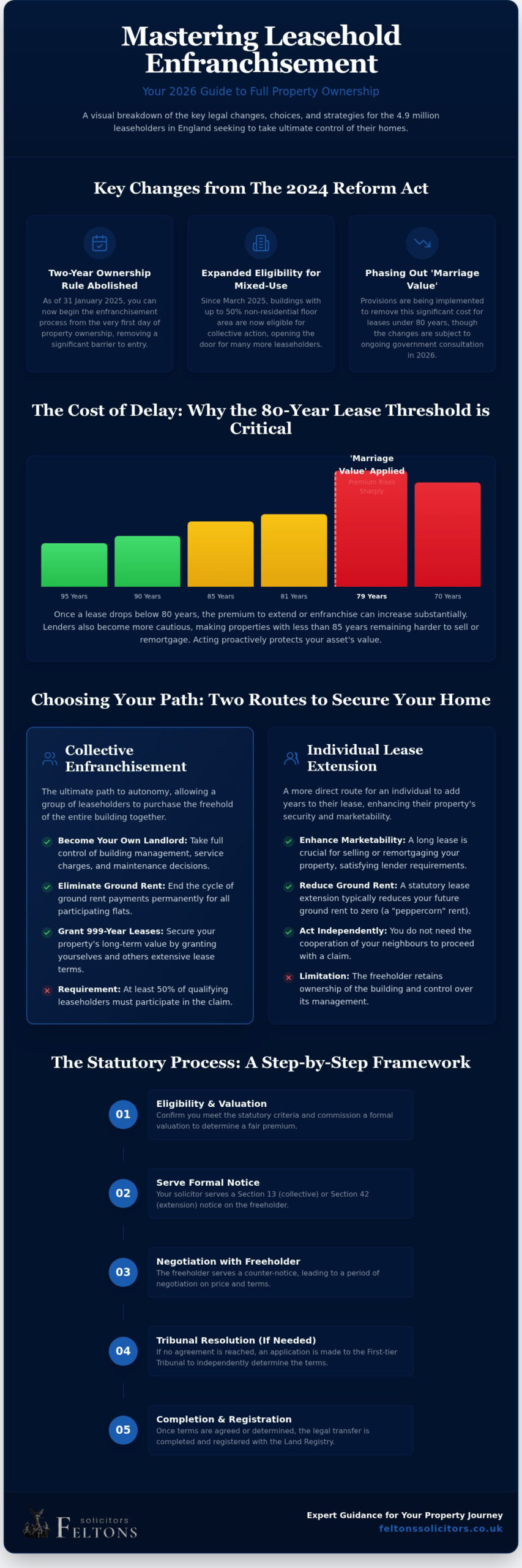
Time is the most critical factor in property valuation. Once a lease drops below 80 years, the cost of enfranchisement or extension often rises sharply due to “marriage value.” Although the 2024 Act includes provisions to remove this cost, these changes are being implemented in phases and are still subject to government consultation in late 2026. Short leases don’t just cost more to fix; they make properties significantly harder to sell or remortgage. Lenders are increasingly cautious about dwindling lease terms, often refusing to provide funds for properties with less than 85 years remaining. Acting now secures your financial legacy and ensures your home remains a marketable, high-value asset in an evolving market.
Collective Enfranchisement vs. Lease Extensions: Choosing Your Path
Selecting the right mechanism to protect your property investment requires a careful balance of legal eligibility and neighbourly cooperation. Whilst both paths enhance marketability, they offer different levels of autonomy. Buying the freehold through collective enfranchisement is often the gold standard for those seeking absolute control, yet it requires at least 50% of qualifying leaseholders to participate. In large blocks, coordinating this many individuals can be logistically demanding, particularly where overseas entities or corporate owners are involved. Specialist leasehold enfranchisement solicitors provide the necessary structure to manage these disparate interests, ensuring that formal notices are served correctly to avoid costly delays.
Financial considerations are equally paramount. The premium paid for a freehold share often mirrors the cost of a lease extension, but the long-term savings on ground rent and management fees can be substantial. Decisions made now are heavily influenced by the government consultation on valuation rates closing in September 2026. This consultation will define the “prescribed rates” for years to come, making it a pivotal moment for leaseholders to assess their building’s statutory criteria. Since March 2025, leaseholders in mixed-use buildings have also benefited from the increased 50% non-residential floor area limit, making more properties eligible for collective action.
The Case for Collective Enfranchisement
Owning a share of the freehold transforms the way you interact with your home. It allows the resident group to take direct control of service charges and building management, ensuring that maintenance funds are spent effectively rather than lining a third-party’s pockets. Once the purchase is complete, you can grant yourselves 999-year leases with zero ground rent. This also removes the burden of the freeholder’s “consent fees” for simple alterations or sub-letting, which are common frustrations in the traditional leasehold system.
When a Lease Extension is More Practical
If your neighbours are unwilling to participate or the building doesn’t meet the 50% participation threshold, an individual lease extension remains a powerful tool. Under the 2024 Act, you can secure a 990-year extension, effectively future-proofing the property for generations. This path is often faster and less prone to the interpersonal friction that can arise during collective purchases. You can read more about these individual rights in our guide on Leasehold Enfranchisement Experts: A Guide to Securing Your Property Rights in 2026.
If you’re unsure which route best suits your specific circumstances, a discreet consultation with our team can provide the clarity you need to move forward with confidence.
The Statutory Process: A Step-by-Step Legal Framework
The journey toward full ownership follows a rigid statutory timetable that requires precision from the outset. It begins with a thorough eligibility check to ensure the building qualifies under the latest 2026 standards. Following the March 2025 updates, buildings with up to 50% commercial floor area now qualify, which is a significant increase from the previous 25% limit. Once eligibility is confirmed, your leasehold enfranchisement solicitors will work alongside a specialist surveyor to determine a realistic purchase price. This valuation forms the basis of the Section 13 Initial Notice, the formal document that triggers the legal process and forces the freeholder to respond within a strict two-month window.
The freeholder’s Counter-Notice often disputes the proposed premium, leading to a period of intensive negotiation. This stage is where legal expertise is most valuable, as it prevents the freeholder from using tactical delays to derail your claim. For impartial guidance on your rights during these negotiations, the Leasehold Advisory Service provides a wealth of foundational information for residential leaseholders. If an agreement isn’t reached within the statutory timeframe, the matter may be referred to the First-tier Tribunal to determine the final price.
Organising the Enfranchisement Company
Participating leaseholders typically form a “Right to Enfranchise” (RTE) company to act as the nominee purchaser. This limited company will ultimately hold the freehold title on behalf of the group. Drafting a robust participation agreement is essential. This document outlines how purchase costs are shared, how directors are appointed, and how building management decisions are made. It protects the group from internal disputes and ensures the company meets its ongoing statutory obligations once the freehold is secured.
Valuation and the “Premium”
Calculating the premium is the most technically demanding part of the process. In late 2026, we remain in a transitional phase. Whilst the Leasehold and Freehold Reform Act 2024 contains provisions to abolish marriage value for leases with less than 80 years remaining, these measures are not yet in force. The final cost is currently influenced by the ongoing government consultation on prescribed valuation rates. Our role as leasehold enfranchisement solicitors is to provide a clear, realistic projection of these costs, including complex components like “hope value” for future development potential.
Common Pitfalls and How Expert Solicitors Avoid Them
The path to enfranchisement is often described as a legal minefield, and for good reason. Even a minor oversight can trigger a “deemed withdrawal,” a scenario where your claim is legally cancelled and you are barred from reapplying for twelve months. Specialist leasehold enfranchisement solicitors are essential to manage the rigid statutory timetable, ensuring every document is served within the non-negotiable windows defined by the 1993 Act. Clerical accuracy is paramount. A simple misspelling of a freeholder’s name or an incorrect floor area calculation can invalidate an Initial Notice, forcing leaseholders to restart the process and absorb wasted costs.
Financial liability also extends beyond your own legal team. Under current regulations, leaseholders are generally responsible for the freeholder’s reasonable legal and valuation costs. Whilst the 2024 Act aims to limit these burdens, the transition in 2026 requires careful oversight to ensure you aren’t overcharged for administrative tasks. Expert guidance ensures these fees are scrutinised and challenged if they don’t meet the “reasonable” threshold. This protective layer of service prevents the freeholder from using inflated costs as a deterrent to your claim.
Handling Contentious Freeholders
When a freeholder disputes your right to enfranchise, the situation can quickly become adversarial. Preparation for a First-tier Tribunal hearing requires meticulous evidence gathering, from historical lease data to expert valuation reports. We focus on pragmatic, discreet litigation to resolve these standoffs before they escalate into protracted battles. You can learn more about our approach to Dispute Resolution: Avoiding Costly Court Battles.
Overseas Entities and Enfranchisement
Complexity increases significantly when the freeholder is an overseas company. Since the implementation of the Register of Overseas Entities, leaseholders must verify that their freeholder is compliant with UK transparency laws before certain property transactions can proceed. Feltons manages the entire process of overseas entity beneficial owner registration to ensure your claim isn’t stalled by international regulatory hurdles. If you are facing a missing freeholder or a complex corporate structure, our team can provide the bespoke legal advice needed to secure your property rights.
Securing Your Future: The Role of Feltons Solicitors
At Feltons Solicitors LLP, we recognise that buying your freehold is about more than just legal paperwork; it’s about securing the ground beneath your feet for future generations. Our team of leasehold enfranchisement solicitors provides a calm, steady presence throughout what can often be a high-stakes process. We combine traditional professional integrity with a forward-thinking methodology. This means you receive the meticulous attention to detail expected of a boutique firm, supported by modern efficiency that keeps your claim moving forward without unnecessary delays.
Every building has its own unique personality and set of challenges. Whether you’re dealing with a silent freeholder or coordinating a large group of neighbours with differing priorities, our advice is always pragmatic. We don’t believe in one-size-fits-all solutions. Instead, we tailor our strategy to the specific dynamics of your building, ensuring that the human impact of the legal work is never forgotten. Our “people-first” philosophy is designed to reduce the stress of property litigation, providing you with a clear roadmap from the initial notice to the final signature.
Comprehensive Property Expertise
One of the primary benefits of partnering with Feltons Solicitors LLP is our ability to handle the entire lifecycle of your claim. Once the enfranchisement or extension is successfully negotiated, our residential conveyancing team ensures that your new title deeds are robust and accurately registered at the Land Registry. This seamless transition prevents the common errors that occur when files are passed between different firms. Our broader expertise in Navigating Residential Property Law allows us to spot potential issues with easements, rights of way, or title restrictions before they become obstacles. Having a single firm manage litigation, valuation negotiation, and the subsequent conveyancing provides a level of security and continuity that is rare in the industry.
Next Steps for Leaseholders
Taking control of your property begins with a preliminary consultation. During this initial review, our specialists will examine your current lease and the status of your building to determine the most effective path forward. To make the most of this consultation, it’s helpful to have certain documents prepared:
- A copy of your current lease agreement
- Recent service charge and ground rent demands
- Details of any previous correspondence with the freeholder
- A list of participating neighbours for collective claims
If you’re ready to eliminate ground rent and future-proof your asset, we’re here to guide you. Contact us to organise a comprehensive review of your building’s status and discover how we can help you achieve full ownership in 2026.
Securing Your Property Legacy for 2026 and Beyond
The journey from being a leaseholder to a genuine property owner is a significant step toward long-term financial security. We’ve explored how the 2024 reforms have simplified eligibility, yet the technical demands of the statutory process remain high. Success depends on precise valuations and meeting strict deadlines to avoid the risk of a deemed withdrawal. By choosing specialist leasehold enfranchisement solicitors, you ensure that every legal nuance, from collective coordination to Land Registry updates, is handled with the highest standard of care.
Feltons Solicitors LLP offers a boutique service with a national reach, providing expert guidance on the Leasehold and Freehold Reform Act 2024. As specialists in complex property litigation and enfranchisement, we prioritise a personal connection and pragmatic advice. We help you navigate the minefield of property law with quiet confidence and discreet professionalism, ensuring your interests are protected at every stage.
If you’re ready to take full control of your building and eliminate ground rent, contact Feltons Solicitors for a discreet consultation on your leasehold rights. Your property is more than an asset; it’s your future, and we’re here to help you protect it.
Frequently Asked Questions
What is the 80-year rule in leasehold enfranchisement?
The 80-year rule refers to the critical threshold where “marriage value” becomes payable during a lease extension or freehold purchase. If your lease has fewer than 80 years remaining, the cost of enfranchisement increases significantly. Whilst the Leasehold and Freehold Reform Act 2024 contains provisions to abolish this additional cost, these measures are not yet in force as of late 2026. Acting before your lease hits this threshold remains a vital financial strategy.
Can my freeholder refuse to sell the freehold to me?
No, a freeholder cannot refuse to sell the freehold if you meet the statutory eligibility criteria under the 1993 Act. This is a compulsory purchase right provided by law. If the freeholder fails to respond to your Initial Notice or disputes the claim without valid legal grounds, your leasehold enfranchisement solicitors can apply to the County Court or First-tier Tribunal to protect your rights and force the sale through a vesting order.
How many neighbours do I need to buy the freehold collectively?
You need at least 50% of the qualifying leaseholders in your building to participate in a collective enfranchisement claim. For example, in a block of ten flats, at least five owners must join the process. Additionally, the building must be independent and contain no more than 50% non-residential floor area. Coordinating these participants requires a formal participation agreement to ensure everyone is committed to the shared costs and legal obligations of the purchase.
How much do leasehold enfranchisement solicitors cost?
Legal costs vary based on the complexity of the building, the number of participating leaseholders, and whether the freeholder is contentious. Generally, you’ll be responsible for your own legal fees and a portion of the freeholder’s reasonable legal and valuation costs. It’s important to choose a firm that offers a transparent fee structure. At Feltons, we provide bespoke quotes that reflect the individual requirements of your building and the depth of expertise required for the claim.
What happens to my ground rent after enfranchisement?
Ground rent is effectively eliminated once you successfully complete the enfranchisement process. When you buy the freehold, the existing leasehold structure is usually replaced by 999-year leases with a “peppercorn” ground rent, which means you pay nothing. This provides immediate financial relief and removes the risk of escalating ground rent clauses that can often make properties difficult to sell or remortgage in the secondary housing market.
Do I still have to pay service charges if I own the freehold?
Yes, you’ll still need to contribute toward the upkeep of the building, but you gain control over how that money is spent. Instead of paying a third-party freeholder, the enfranchisement company you and your neighbours own will manage the maintenance, insurance, and repairs. This allows for greater transparency and ensures that service charges are used efficiently to preserve the building’s value rather than generating profit for an external landlord.
How long does the statutory enfranchisement process take?
The statutory enfranchisement process typically takes between six and twelve months from the service of the Initial Notice. This timeline accounts for the freeholder’s two-month response window and a subsequent period of four to six months for price negotiations. If the matter requires a First-tier Tribunal hearing to resolve a dispute, the process can take longer. Engaging experienced leasehold enfranchisement solicitors helps maintain momentum and ensures all legal deadlines are met.
Can I buy the freehold of a leasehold house?
Yes, owners of leasehold houses have a separate statutory right to buy their freehold under the Leasehold Reform Act 1967. The process differs slightly from the collective route used for flats, but the outcome is the same: full ownership of the land and building. Recent reforms have simplified this process, making it easier for house owners to eliminate ground rent and secure their property’s future without the restrictions of a dwindling lease term.