

In property auctions, legal due diligence is completely inverted. The decisive work happens before you ever raise your hand to bid, not after the hammer falls. Engaging agile auction property conveyancing solicitors UK purchasers can rely on is essential, particularly because traditional high-street practices simply move too slowly for urgent auction environments where contracts exchange instantaneously.
It’s completely understandable to feel pressured by an unyielding 28-day completion deadline, especially when trying to interpret dense legal packs that may conceal costly title defects, tenancy complications, or onerous special conditions. In this guide, you will discover how to select specialist legal representation to rigorously scrutinise pre-sale documentation, protect your capital, and secure seamless completion across both traditional and modern auction formats. We will examine the core criteria for vetting auction solicitors and the precise safeguards required before committing your funds.
Key Takeaways
- Understand why the instantaneous contract exchange triggered by the auction hammer renders conventional, slow-paced conveyancing obsolete.
- Discover how specialist auction property conveyancing solicitors UK purchasers instruct can uncover hidden liabilities, onerous special conditions, and title defects before bidding commences.
- Learn the essential framework for dissecting dense legal packs, with particular focus on buried vendor costs, missing searches, and complex tenancy arrangements.
- Master the end-to-step operational timeline to coordinate finance, pre-bid reports, and fund transfers safely within rigid 28-day or 56-day deadlines.
- Evaluate prospective legal representatives using targeted criteria that favour agile, boutique attention over impersonal, high-volume case processing.
Understanding Auction Property Conveyancing: Why Traditional Timelines Fail
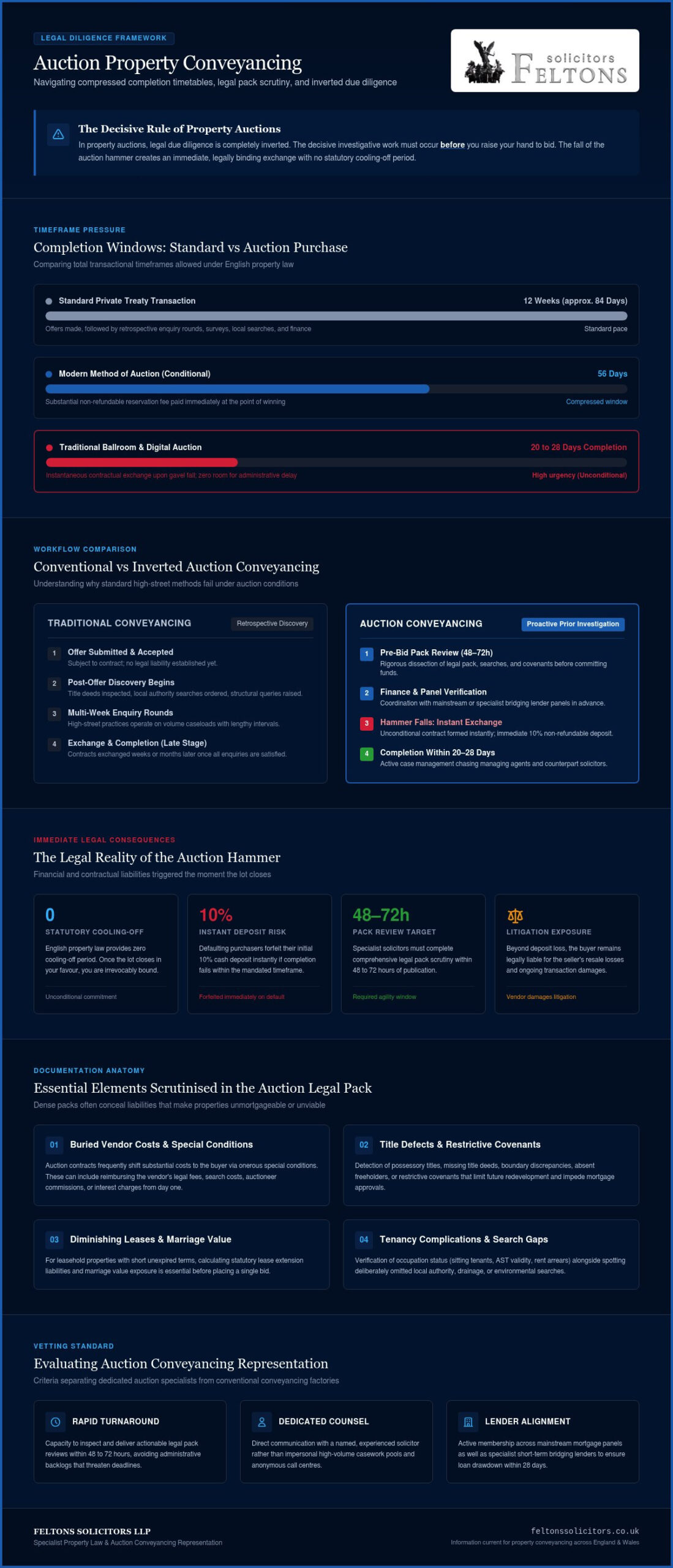
Auction conveyancing is an urgent, deadline-driven legal discipline operating on a compressed timescale. In a standard private treaty transaction, buyers typically enjoy a twelve-week window to raise enquiries, arrange surveys, and coordinate lending. Conversely, traditional UK property auctions contractually mandate completion within 20 to 28 days from the fall of the hammer. This rapid window leaves zero room for administrative inertia or procedural delay.
Traditional Conveyancing vs Auction Conveyancing Mechanics
The standard conveyancing process in England and Wales handles legal discovery retrospectively. A buyer submits an offer, and only then do conveyancers investigate title deeds, order local authority searches, and resolve structural queries. Auction conveyancing completely upends this sequence by demanding exhaustive due diligence prior to placing a bid.
High-street conveyancing practices built for volume caseloads often struggle with this pace. Their standard operating rhythms rely on multi-week inquiry rounds that simply collapse under rigid auction deadlines. While everyday purchases benefit from routine residential property law firm services, auction acquisitions require specialised legal counsel capable of interrogating documents proactively before financial commitments are made.
The Legal Reality of the Auction Hammer
The fall of the auction gavel creates an immediate, legally binding exchange of contracts. In traditional ballroom and digital auctions, this commitment is unconditional. English property law provides no statutory cooling-off period; once the lot closes in your favour, you are irrevocably bound to complete the purchase.
Conditional formats, such as the Modern Method of Auction, offer a slightly longer 56-day completion timeline, yet they still extract a substantial, non-refundable reservation fee at the point of winning. Under both frameworks, failure to complete within the contractual deadline carries devastating financial consequences. Defaulting purchasers forfeit their initial 10% deposit instantly and risk exposure to litigation for the seller’s resale losses. Instructing specialist auction property conveyancing solicitors UK buyers rely on ensures critical legal defects are resolved well before the gavel strikes, protecting your capital and securing your position.
Key Evaluation Criteria: What to Look for in Auction Solicitors
Selecting legal representation for an auction acquisition requires a disciplined assessment. Standard residential practices simply lack the infrastructure to review complex packs within days or manage post-sale settlements against rigid contractual clocks. When evaluating auction property conveyancing solicitors UK buyers should consider whether a firm treats auctions as an exceptional emergency or a core specialism. As highlighted in the RICS consumer guide to property auctions, robust pre-bid diligence forms the bedrock of every sound auction purchase.
Speed, Capacity, and Proactive Communication
Urgency dictates that you avoid high-volume legal factories where files pass between anonymous administrative pools. Demand direct communication with a dedicated property solicitor who provides decisive advice rather than generic updates. A capable auction solicitor should offer prompt turnarounds on comprehensive legal pack reviews, typically within 48 to 72 hours of publication. Beyond initial analysis, the firm must possess the operational capacity to pursue counterpart solicitors and managing agents proactively, ensuring the strict 28-day completion timetable remains protected.
Technical Acumen and Lender Panel Alignment
Technical depth separates specialist auction conveyancers from standard conveyancing clerks. Auction lots frequently involve legal entanglements such as restrictive covenants, possessory titles, boundary discrepancies, or absent freeholders. For leasehold properties with diminishing terms, collaborating with proficient leasehold enfranchisement experts is vital to calculate statutory lease extension liabilities and potential marriage value costs before bidding.
Financing adds another critical dimension. Your solicitor should hold active panel membership with both mainstream mortgage lenders and specialist bridging providers. If a conveyancer isn’t on your chosen lender’s approved panel, dual representation is required; this introduces administrative friction that can easily breach a 28-day completion window. Aligning with an established practice like Feltons Solicitors ensures your transaction receives the tailored technical competence, direct access, and methodical oversight essential for high-stakes property auctions.
The Auction Legal Pack: Essential Elements Your Solicitor Must Scrutinise
A property auction legal pack is compiled by the vendor’s legal team to facilitate a rapid, binding sale. Because these documents serve the seller’s commercial interests, they frequently obscure liabilities that would stall a conventional private treaty transaction. Scrutinising every disclosure before you submit an offer is an essential protective measure. Competent auction property conveyancing solicitors UK investors trust will dissect this documentation systematically to separate genuine investment opportunities from costly legal liabilities.
Special Conditions of Sale: The Primary Danger Zone
The Special Conditions override standard auction rules and represent the greatest financial hazard for unrepresented buyers. Unscrupulous sellers routinely insert clauses that shift substantial overheads onto the successful bidder. Your conveyancer must review these terms to detect:
- Transferred Vendor Overheads: Direct contractual stipulations requiring you to reimburse the seller’s legal fees, auction administration charges, and local search costs upon completion.
- Punitive Delayed Completion Penalties: Contractual daily interest rates significantly exceeding standard commercial bank rates, applied immediately if funding fails to arrive on the exact completion date.
- Outstanding Liabilities: Clauses forcing the buyer to assume responsibility for unresolved local authority enforcement actions, historic maintenance arrears, or outstanding planning enforcement notices.
Title Deeds, Leases, and Local Authority Searches
Defective legal title can prevent future refinancing and drastically reduce resale value. Your solicitor must examine HM Land Registry Official Copies to uncover restrictive covenants limiting alterations, historic access easements running across the boundaries, or un-discharged commercial charges. For leasehold units, the conveyancer will evaluate the unexpired lease term, escalating ground rent formulas, and service charge accounts to ensure the asset satisfies institutional lending criteria.
Search packs require equal scrutiny. Many vendor bundles supply outdated local authority searches or omit environmental and drainage reports altogether. If missing searches cannot be obtained before bidding, an experienced practitioner will assess whether search indemnity insurance offers viable protection.
Tenancy Documentation and Vacant Possession Checks
Tenanted auction lots demand thorough regulatory verification. With the Renters’ Rights Act 2025 replacing assured shorthold agreements with periodic tenancies and abolishing Section 21 evictions, removing problematic occupants post-completion has become far more complex. Your legal representative must confirm genuine vacant possession or rigorously inspect existing tenancy agreements, rent payment records, and statutory deposit protection certificates. Uncovering unregularised tenancies, squatter liabilities, or rent arrears beforehand ensures you do not inadvertently inherit prolonged property litigation.
Auction Conveyancing Guide: From Pre-Bid to Completion
Successfully navigating an auction purchase requires a structured operational sequence where every day counts. Missing a single procedural milestone jeopardises your deposit and contract rights. Working alongside proven auction property conveyancing solicitors UK purchasers trust transforms this demanding process into a controlled, manageable pathway.
Phase One: Pre-Auction Preparation and Due Diligence
The process starts several weeks prior to the auction event. Download the complete legal pack the moment the auctioneer releases it online. You must then immediately instruct your solicitor to conduct a thorough analysis and produce a formal written report detailing title structure, onerous terms, and search deficiencies.
Concurrently, ensure your funding mechanisms are fully arranged. If you aren’t bidding with cash, secure formal approval in principle for specialist auction finance or bridging loans, as traditional mortgage underwriting rarely aligns with auction timelines.
Phase Two: Bidding, Exchange, and Financial Coordination
When registering with the auctioneer, supply your solicitor’s precise details so documentation flows without delay. If your bid wins, contract exchange happens on the spot. You will immediately need to:
- Provide your confirmed 10% deposit payment along with the auction house buyer’s administration fee.
- Obtain the formally executed Memorandum of Sale and catalogue addendum notices from the auction team.
- Forward all signed contract paperwork to your conveyancer on Day 1 to commence post-auction requisitions immediately.
Phase Three: The 28-Day Sprint to Completion
The post-hammer period is an intensive procedural sprint. Your conveyancer will draft and approve the Land Registry Transfer Deed (TR1), raise formal requisitions on title, and prepare detailed completion statements factoring in apportionments and legitimate contractual disbursements.
Your legal team will coordinate directly with your bridging provider or mortgage lender to guarantee funds arrive in time for the designated completion date. Following monetary completion, your conveyancer must remit your Stamp Duty Land Tax return within the mandatory 14-day statutory timeframe and lodge your title application with HM Land Registry.
To safeguard your investment throughout this intensive schedule, instruct Feltons Solicitors today to review your upcoming auction lot and lead your transaction to a secure, punctual completion.
Securing Your Auction Purchase: The Value of Specialist Legal Counsel
Specialist conveyancers serve as indispensable risk managers rather than mere document processors. An auction acquisition involves significant capital exposure where overlooked legal liabilities can erode investment margins instantly. Choosing bespoke legal attention over impersonal case factories prevents costly procedural oversights. Meticulous oversight ensures every clause, restriction, and obligation is laid bare before you commit your capital.
The Long-Term Cost of Inadequate Due Diligence
Acquiring an auction lot without exhaustive legal scrutiny can lead to severe operational and financial distress. Title defects that leave a building uninsurable or unmortgageable will trap your funds indefinitely. Unresolved boundary disputes, historic planning breaches, or outstanding local authority enforcement notices frequently result in substantial remedial expenses and diminished resale values.
Securing long-term refinancing or executing a future open-market exit becomes exceptionally difficult when structural flaws remain attached to the title deeds. Rectifying possessory titles, establishing missing rights of access, or dealing with contentious covenants through property litigation requires considerable time and financial expense. Thorough pre-bidding due diligence represents a prudent protective measure that shields your capital from avoidable complications.
Partnering with Feltons Solicitors LLP
Navigating commercial, mixed-use, or intricate residential titles requires steady, technically astute legal representation. Selecting experienced auction property conveyancing solicitors UK buyers rely on provides clear strategic guidance under intense time constraints. Dedicated legal oversight ensures that every potential encumbrance is uncovered, evaluated, and explained before the gavel strikes.
Established in 2010 with a distinguished record in property law, Feltons Solicitors LLP provides the calm authority and technical precision required for high-stakes property transactions nationwide. We prioritise tailored attention over high-volume processing, ensuring you receive direct access to dedicated legal counsel throughout the transaction. Contact Feltons Solicitors to discuss your auction purchase and secure your property investment with complete confidence.
Secure Your Capital Before the Auction Gavel Falls
Securing a property at auction delivers remarkable efficiency and transparency, but financial success ultimately hinges on the legal steps taken before you place an initial bid. Thoroughly dissecting the legal pack, verifying tenancy rights, and identifying onerous special conditions ahead of time removes the danger of costly defects and protects your initial completion deposit.
Partnering with dedicated auction property conveyancing solicitors UK buyers trust ensures your transaction proceeds smoothly through the rigorous 28-day completion timetable. Established in 2010, Feltons Solicitors LLP provides meticulous boutique legal counsel across residential conveyancing, leasehold enfranchisement, and complex property matters. We combine progressive digital delivery with traditional professional standards, ensuring your high-stakes investment receives direct, senior-level attention from start to finish. Instruct Feltons Solicitors to review your auction legal pack today and approach the auction room with absolute certainty.
Frequently Asked Questions
Can I buy a property at UK auction without instructing a solicitor beforehand?
While legally permitted, buying at auction without prior legal representation isn’t advisable. The fall of the gavel constitutes a binding exchange of contracts, leaving no opportunity to renegotiate terms or rescind an offer. Instructing specialist auction property conveyancing solicitors UK buyers rely on ensures that onerous conditions, uninsurable titles, or structural enforcement liabilities are identified beforehand, protecting your non-refundable 10% deposit and capital from catastrophic oversights.
How quickly can a solicitor complete an auction legal pack review?
An agile property solicitor typically completes an auction legal pack appraisal within 48 to 72 hours of receiving the documentation. Because auction catalogues are frequently published shortly before sale dates, responsive practices maintain dedicated capacity for expedited analysis. Your conveyancer reviews title registers, checks planning consents, evaluates search documentation, and delivers a concise written summary highlighting immediate red flags well before bidding commences.
What happens if I cannot complete an auction purchase within 28 days?
Missing the contractual completion date places you in formal breach of contract. The seller’s solicitor will usually serve a Notice to Complete, granting a strict 10-day grace period whilst applying punitive daily interest penalties. If you fail to complete before the notice expires, the vendor can rescind the contract, forfeit your 10% deposit, and sue you for any shortfall if the property subsequently resells at a lower price.
What is the difference between unconditional and Modern Method auction conveyancing?
Traditional unconditional auctions exchange contracts immediately when the hammer falls, mandating completion within 20 to 28 days. The Modern Method of Auction grants a longer timeframe, typically 56 days, allowing buyers to arrange conventional mortgage finance. However, modern auctions require a substantial, non-refundable reservation fee upfront, meaning buyers still carry considerable financial exposure if title complications or administrative delays prevent completion within the agreed window.
Are search packs included in the auction legal pack legally sufficient?
Not always, as sellers often provide selective or outdated searches to cut upfront costs. A pack might include a local search that is several months old, or omit drainage and environmental reports altogether. A diligent solicitor will examine the search dates, verify whether institutional lenders will accept them, and determine whether obtaining specific search indemnity insurance policies can adequately bridge any outstanding legal gaps before you submit a bid.
Can I use bridging finance or a mortgage for an auction property purchase?
Yes, but your financing choice must match the required timeline. Mainstream mortgages often take six to eight weeks, so they don’t easily fit the rigid 28-day window of traditional auctions unless processed under modern auction rules. Consequently, traditional auction purchasers predominantly rely on pre-approved bridging finance. These short-term facilities drawdown rapidly to fund completion, allowing you to refinance onto a term mortgage later.
How much are typical auction solicitor fees in the UK?
Legal fees for auction property conveyancing depend heavily on title complexity, required turnaround speed, and transaction structure. Auction purchases involve two distinct stages: the pre-bidding legal pack review and post-auction completion conveyancing. Rather than relying on rigid averages, reputable firms assess the title structure, leasehold requirements, and finance arrangements to provide tailored fee quotes. Third-party disbursements, such as Land Registry fees and search fees, are billed separately.
What hidden costs frequently appear inside auction special conditions of sale?
Vendors frequently insert clauses requiring buyers to reimburse their legal expenses, auction entry fees, and document production disbursements upon completion. You might also encounter clauses transferring search fees, past management pack charges, or outstanding service charge arrears onto the purchaser. When combined with strict daily interest rates for late completion, these hidden contractual stipulations can add substantial unexpected costs to your overall acquisition budget.