

A strong tribunal strategy starts by defining the valuation issue, not simply arguing that a proposed premium is too high. If you’re considering leasehold reform valuation tribunal solicitors, first identify which parts of the valuation are genuinely in dispute and whether the tribunal can determine them.
When a premium, valuation evidence and formal procedure are all in play, it can be difficult to know whether to challenge a figure, continue negotiating or prepare for a formal determination. The First-tier Tribunal can decide certain statutory leasehold valuation disputes, but it does not determine every disagreement between a leaseholder and a landlord. A focused assessment can help clarify the evidence, procedural options and practical demands of proceeding.
This guide explains the tribunal’s role and limits, the documents and valuation evidence that may be relevant, and how the process can unfold. It also considers how a solicitor can work alongside a specialist valuer to clarify your options, prepare your case and assess legal costs. Feltons Solicitors LLP advises on leasehold enfranchisement, extensions and property disputes, helping you make an informed decision about your next step.
Key Takeaways
- Pinpoint the statutory valuation issue before deciding whether to challenge or defend a proposed premium.
- Understand the First-tier Tribunal’s role and why not every leasehold disagreement falls within its remit.
- Use the lease, notices, valuation material and correspondence to organise relevant evidence for the specific route and issue.
- Consider whether leasehold reform valuation tribunal solicitors could help clarify procedural options, evidence and the demands of handling the matter yourself.
- See how Feltons’ experience in leasehold enfranchisement, extensions and dispute resolution can inform a tailored assessment of next steps.
Leasehold reform valuation disputes: when can the tribunal help?
A disputed premium can make an important leasehold decision difficult: accept the figure, keep negotiating or seek a formal determination? The right forum depends on the legal route and the precise question in dispute. A disagreement about a statutory lease-extension premium is not automatically the same as a complaint about a landlord’s conduct or a service charge.
In England, the First-tier Tribunal (Property Chamber) determines particular property disputes assigned to it by legislation. In leasehold enfranchisement and extension cases, it may decide disputed valuation terms or other matters referred to it under the applicable statutory procedure. The tribunal decides specified leasehold questions that legislation places within its jurisdiction; it does not resolve every disagreement between a leaseholder and a landlord.
The name can cause confusion. The former Leasehold Valuation Tribunal’s functions in England transferred to the First-tier Tribunal, and the Leasehold Valuation Tribunal (LVT) entry offers historical context. Wales has a separate tribunal system, so the appropriate forum and procedure depend on where the property is and which statutory route applies.
Which leasehold valuation issues may reach the tribunal?
In a qualifying lease extension or enfranchisement process, the parties may disagree about the premium or a component of the statutory valuation. The tribunal may be able to determine the issue where legislation provides for it and the matter is properly referred. Define the disagreement precisely: challenging an assumption in a valuation is different from objecting to the whole process or the other party’s conduct.
The statutory route shapes what can be decided, what evidence matters and how the issue reaches the tribunal. Relevant rights and valuation rules can also change as leasehold reforms take effect. Leasehold reform valuation tribunal solicitors can help clarify whether the point falls within the tribunal’s remit and what procedural options may be available. A hearing is not necessarily the only route to consider.
What the tribunal does not decide automatically
A valuation determination is not a general landlord-and-tenant complaint service. A dispute about repairs, management conduct or service charges may involve different legal provisions, procedures or forums. Nor does the tribunal simply settle negotiations because the parties cannot agree: its authority is limited to questions assigned to it by law. The Housing Ombudsman is not the decision-maker for leasehold valuation disputes.
Related concerns should be considered on their own facts and legal basis. An unsatisfactory premium does not mean every connected complaint belongs in the same proceedings. A broader understanding of leasehold enfranchisement and extensions can help you identify the statutory choices, while tailored legal advice can assess how those choices apply to the property and dispute.
How leasehold reform valuation proceedings examine the disputed figure
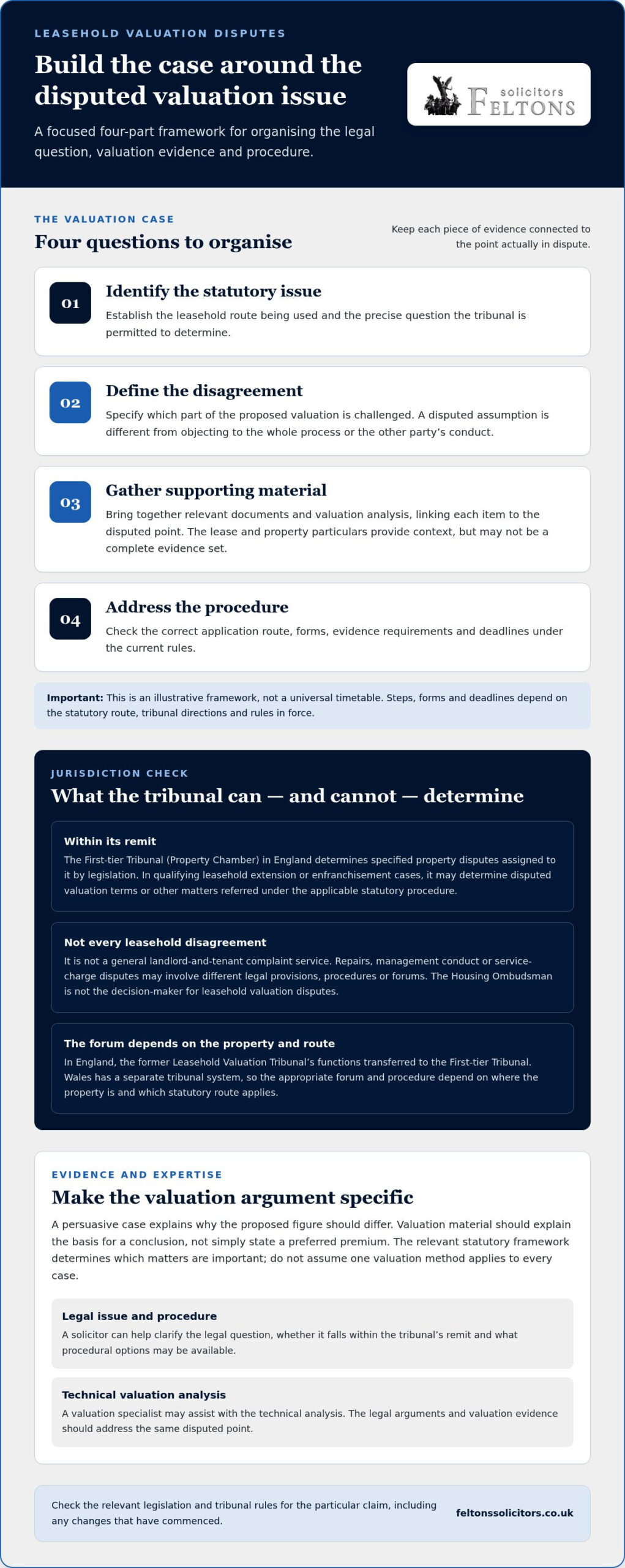
A persuasive tribunal case identifies the legal question and explains why the proposed figure should differ. Saying a premium feels unfair does not show which assumption is disputed or how the evidence supports another view. Connect the figure to the applicable statutory framework and the facts of the property.
In England, the First-tier Tribunal (Property Chamber) considers matters within its statutory jurisdiction. Check the relevant legislation and tribunal rules against the particular claim, including any changes that have commenced. A practical way to organise the issues is:
- Identify the statutory issue. Establish the leasehold route being used and the question the tribunal is permitted to determine.
- Define the disagreement. Specify which part of the proposed valuation is challenged, rather than treating the whole figure as one unexplained difference.
- Gather supporting material. Assemble relevant documents and valuation analysis, linking each item to the disputed point.
- Address the procedure. Check the correct application route, forms, evidence requirements and deadlines under the current rules.
This is an illustrative framework, not a universal timetable. The steps, forms and deadlines depend on the statutory route, tribunal directions and rules in force. A solicitor can help clarify the legal issue and procedural options, while a valuation specialist may assist with the technical analysis. Leasehold reform valuation tribunal solicitors can also help ensure the legal arguments and valuation evidence address the same point.
How valuation evidence can support each party’s position
Valuation material should explain the basis for a conclusion, not simply state a preferred premium. Depending on the issue, the analysis may address assumptions or property characteristics that affect the calculation. The lease and property particulars provide important context, but may not be a complete evidence set. Other documents or expert analysis may be needed to address the specific disagreement. The statutory framework determines which matters are relevant, so do not assume one valuation method applies to every case.
For example, if the parties rely on different assumptions about a feature of the property or the lease, identify the difference, explain why it matters and support your position with relevant material. This gives the tribunal a reasoned comparison rather than a bare assertion that one figure is too high or too low.
Why statutory changes need careful checking
The Leasehold and Freehold Reform Act 2024 received Royal Assent on 24 May 2024, but enactment does not mean every provision applies immediately. As at October 2026, the reforms are being implemented in stages, and some key provisions require secondary legislation. Check the applicable valuation framework against commencement provisions and any relevant transitional rules before relying on a changed calculation.
An Act may be on the statute book before the provisions relevant to a particular valuation are in force. This can affect both the legal route and the valuation arguments. A tailored review can help establish which rules apply to the matter. Leasehold valuation legal support can help clarify the issue and the next procedural step.
Solicitor or direct representation: choosing support for a valuation tribunal dispute
There is no single right choice between handling a tribunal matter yourself and seeking solicitor input. Consider the legal and valuation issues, the evidence available, the procedural work involved and how confident you feel presenting your position. A focused review can clarify your options without assuming full representation is necessary.
Use these considerations as a starting point, then assess your particular case:
| Factor | Handling it directly | Solicitor input |
|---|---|---|
| Issue complexity | May feel manageable where the point is clearly defined and the route is understood. | Can help clarify how the statutory route applies and frame the legal issue. |
| Evidence | You organise the documents and explain how they support your position. | A solicitor can help identify gaps, organise the case and liaise with valuation expertise where appropriate. |
| Procedure | You take responsibility for understanding the relevant process and meeting its requirements. | Legal advice can help interpret the applicable procedure and identify dates or steps that need attention. |
| Your confidence | May suit someone comfortable communicating their case and managing formal correspondence. | Can provide structure and support if the process or opposing arguments feel difficult to manage. |
Legal advice can help you test the strengths and weaknesses of each position, consider the risks of continuing and assess whether further negotiation is sensible. It cannot guarantee a particular tribunal decision or ensure that representation reduces the overall cost. The scope of advice can vary, so understand what work is proposed and how it relates to your priorities before deciding how to proceed.
When tailored solicitor advice may be particularly useful
Advice may be especially useful if the statutory route is unclear, the valuation turns on contested assumptions or you’re unsure how to meet a procedural requirement. You may need help separating a legal disagreement from a technical valuation question, or assessing whether the evidence answers the other party’s case. These are examples, not legal tests. The benefit of an assessment is that it considers your circumstances before you commit to a course of action.
Questions to resolve before deciding on representation
Before choosing how much support you need, write down the precise issue, the other party’s stated position and any dates or directions that could affect the next step. Consider whether you need help with an initial case assessment, particular documents, negotiation or the tribunal process as a whole. Asking what the advice will cover and what work it involves helps you make a considered decision. A guide to leasehold enfranchisement and property rights can provide context for the statutory process.
Feltons Solicitors LLP advises on leasehold enfranchisement and extensions, alongside litigation and dispute resolution. A tailored assessment can clarify the issue, procedural options and a proportionate level of support. For leasehold valuation legal advice, provide the key documents and explain where the disagreement stands.
Preparing documents and decisions for a leasehold valuation dispute
An organised record helps show how the disagreement developed and which evidence relates to the question the tribunal may need to decide. Gather the documents that appear relevant, then check them against the statutory route and the particular valuation issue. Not every item will matter in every case.
Depending on the circumstances, your starting file may include:
- The lease and any relevant variations or related documents.
- Formal notices and responses exchanged as part of the lease extension or enfranchisement process.
- Valuation reports, calculations, supporting material and any revised figures.
- Correspondence recording negotiations, explanations or points of disagreement.
- Procedural documents, such as applications, directions or other tribunal communications, if proceedings have begun.
Organise evidence around the question the tribunal must determine. For each disputed figure or assumption, note what the other party says, your response and the documents that support it. A clear chronology makes changes in position easier to follow and helps distinguish agreed facts from matters still in dispute.
Organising the valuation record
Keep dated correspondence and copies of key documents together and in order. A simple index can identify each document, its date and the issue it relates to. Separate agreed facts, such as a recorded lease term, from contested valuation assumptions or calculations. Preserve original records and present material fairly: selective extracts or overstated conclusions can obscure the point you need to explain. If a document seems relevant, note why rather than assuming its significance is self-evident.
Assessing procedure, risk and possible resolution
Good preparation includes checking what must happen next. Filing requirements, forms, deadlines and costs rules can depend on the statutory route and current tribunal rules. Use current authoritative guidance for the relevant procedure. Do not rely on a date or process mentioned in an older document without checking that it applies to your case. If directions have been issued, make sure your working chronology reflects them.
Negotiation may remain practical while a dispute is being prepared, and a clearer record can help the parties understand where their positions differ. However, discussions should not be assumed to pause or replace a procedural requirement. Before taking an irreversible step, consider the possible consequences of proceeding, settling or changing course. Early legal advice can clarify the issue, evidence and options. Leasehold reform valuation tribunal solicitors may also help assess how the legal position relates to the valuation material, without promising a particular result or lower overall costs.
Feltons Solicitors LLP advises on leasehold enfranchisement and extensions, as well as litigation and dispute resolution. A measured assessment can help identify the key disagreement and practical next steps. Read about support for your leasehold valuation dispute.
How Feltons Solicitors can support leasehold reform valuation disputes
A leasehold valuation disagreement can affect important decisions about your home or property interests. Feltons Solicitors LLP advises on leasehold enfranchisement and extensions, property matters, litigation and dispute resolution. This experience can help bring the legal route and the practical dispute into focus, without assuming that every disagreement should proceed to a tribunal.
For those looking for leasehold reform valuation tribunal solicitors, support starts with understanding the specific matter. An assessment can consider the property issue, the figure or assumption in dispute, the other party’s position and the stage the matter has reached. The aim is to clarify available options and next steps, not to promise a particular outcome.
A pragmatic assessment of the dispute
Property law and dispute-resolution experience can inform a measured review of the relevant facts and documents. Depending on the circumstances, advice may consider whether the issue fits the statutory route, how the valuation arguments are framed, what evidence may be relevant and which procedural requirements need attention. The assessment can also consider whether further discussion with the other party remains practical alongside any formal steps that apply.
Property decisions often carry personal as well as financial weight. A clear explanation of strengths, uncertainties and possible routes forward can help you decide with a better understanding of the risks. Advice is tailored to the facts, available records, applicable law and procedural position. The right approach depends on those details; neither a tribunal application nor legal representation can guarantee a particular result.
Taking the next step with Feltons
To make an initial discussion more focused, explain the valuation issue, what the other party has said and whether you know of any important procedural dates or tribunal directions. Relevant documents may include the lease, valuation correspondence and formal notices, where applicable. You do not need to resolve every point in advance. A clear account of what you understand and what remains uncertain is a useful starting point.
For wider context, Feltons’ residential property law guide may help explain how a valuation question sits alongside other property rights and responsibilities. The guide cannot determine how the law applies to your particular dispute, but it may help you identify questions for a tailored assessment.
Feltons takes a pragmatic, supportive approach to leasehold and property disputes. Speak to Feltons about leasehold valuation legal support and explain the issue and documents you have available.
Choose your next step with a clearer view
A tribunal should be a considered route, not simply the next move when negotiations become difficult. Before acting, decide what you need to understand: whether the disputed point falls within the tribunal’s role, what evidence could address it, or which procedural choices remain open. That focus can make a conversation with leasehold reform valuation tribunal solicitors more useful, whether you’re weighing up advice or preparing to proceed.
Feltons’ work in leasehold enfranchisement and extensions, alongside litigation and dispute resolution, brings property and dispute experience to an individual assessment. The aim is pragmatic, tailored guidance that helps you understand your position and choose a course suited to the facts, without promising a particular outcome.
If you’re ready to discuss the issue, explain what you disagree with and what you hope to resolve. Discuss your leasehold valuation dispute with Feltons to get a clearer view of your next step.
Frequently Asked Questions
What does a leasehold valuation tribunal solicitor do?
A solicitor helps you understand the legal route, frame the issue and manage the legal aspects of a valuation dispute. They may review the claim and response, identify arguments that need evidence, explain procedural obligations and advise on possible settlement discussions. The specialist valuation assessment itself may require input from a valuer. The solicitor connects the legal case with the facts and helps you make informed decisions, but cannot guarantee a result.
Can the First-tier Tribunal decide a lease extension premium?
In England, the First-tier Tribunal (Property Chamber) may determine a disputed premium where the applicable statutory lease-extension route gives it jurisdiction and the matter is properly brought before it. The answer depends on the type of claim and the specific point in dispute. The tribunal’s role may differ depending on whether the parties disagree about the premium itself or another issue under the statutory process. Wales has a separate tribunal system.
Do I need a solicitor for a leasehold valuation tribunal?
No. Having a solicitor is not automatically required, and some people choose to present their own case. Whether that is practical depends on your understanding of the statutory process, the valuation dispute and the evidence. You might seek limited legal advice to assess a draft position or clarify a procedural question without asking a solicitor to handle every aspect. Consider the work involved and your confidence before deciding what support you need.
What evidence is needed for a leasehold valuation tribunal?
There is no single evidence bundle that suits every application. The material should relate to the specific valuation question and may include documents showing the basis of each party’s position, such as relevant lease provisions, formal notices, valuation reports or calculations. If a report relies on an assumption you dispute, identify that assumption and the material that supports your response. The tribunal’s directions and the applicable route determine what must be filed.
How long does a leasehold valuation tribunal case take?
There is no reliable fixed timeframe for every case. The duration can depend on the application route, the issues raised, the evidence required, tribunal directions and whether the parties reach agreement before a hearing. A case involving a narrow point may require different preparation from one with several disputed issues. Check current tribunal guidance and any directions in your proceedings for case-specific timings, and seek advice promptly if a date is unclear.
Can a leasehold valuation dispute be settled without a tribunal hearing?
Yes. Parties may reach agreement through negotiation, including after a formal application has been made. A settlement should clearly record what has been agreed and how it affects any ongoing tribunal steps. Do not assume discussions suspend a deadline or remove a procedural requirement; check the applicable rules and directions. Legal advice can help you assess proposed terms and understand the practical consequences before accepting them.
Can I appeal a First-tier Tribunal leasehold valuation decision?
An appeal may be possible, but it is not simply a chance to ask another tribunal to reconsider the valuation because you disagree with the result. The appeal route, grounds, permission requirements and time limits depend on the applicable rules and decision. Read the decision notice carefully, as it should explain relevant next steps. If you are considering an appeal, obtain advice promptly so the potential grounds and any deadline can be assessed.