

What if the freeholder can’t be found, or simply isn’t replying? Either situation can put a lease extension in doubt, particularly when a sale or remortgage is approaching. The missing freeholder lease extension procedure may offer a route forward in England and Wales, but a court will expect evidence that reasonable efforts have been made to trace the landlord.
It’s understandable to worry that an absent freeholder means the process has to stop. In some cases, a leaseholder can apply to the County Court for a vesting order, allowing an eligible extension claim to proceed without the freeholder. The right steps depend on the circumstances, and the evidence gathered to locate the landlord matters.
This guide explains how to distinguish an unresponsive freeholder from one who is genuinely missing, what tracing records may support an application, and how the court and later valuation steps fit together. It also considers the position in 2026: not all changes under the Leasehold and Freehold Reform Act 2024 are in force, and marriage value may still affect the premium if your lease has fewer than 80 years remaining.
Key Takeaways
- The missing freeholder lease extension procedure may provide a legal route forward, but eligibility and the correct process depend on the property and circumstances.
- Build a clear record of proportionate tracing enquiries, tailored to whether the registered freeholder is an individual or a company.
- A vesting order may allow a qualifying lease extension claim to proceed, but it does not automatically settle the premium or every lease term.
- Understand the likely sequence before a sale or remortgage, so you can plan for evidence gathering, a court application and any later determination.
- Feltons advises on leasehold enfranchisement and extensions, with pragmatic, tailored legal support for complex property matters.
Missing freeholder lease extension procedure: what does an absent landlord mean?
A missing freeholder doesn’t automatically make a lease extension impossible. In qualifying cases, a court route may allow the claim to proceed. First, however, you need to establish what has happened to the freeholder and whether you meet the relevant statutory requirements.
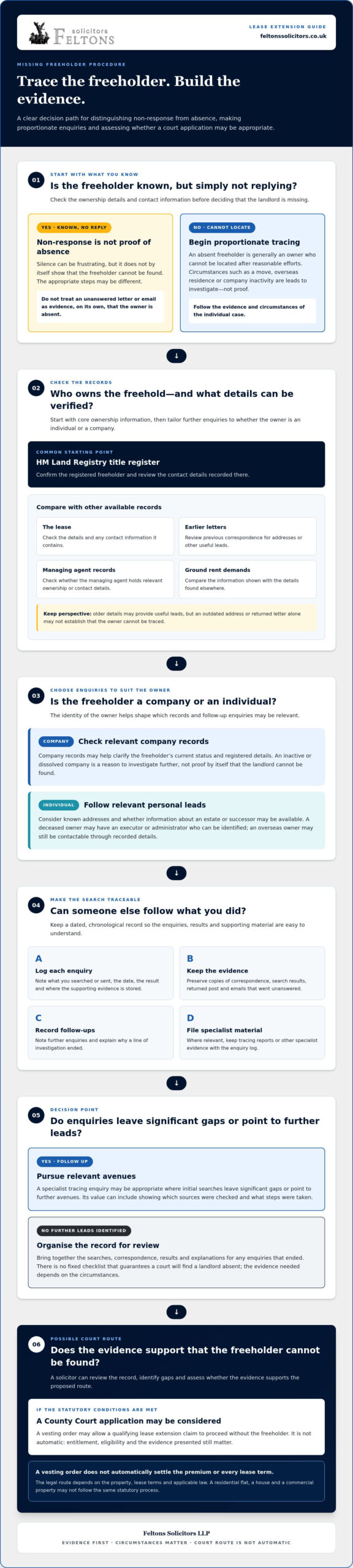
An absent freeholder is generally an owner who cannot be located after reasonable efforts to find them. That is different from a freeholder whose address or identity is known but who ignores letters or fails to engage. Silence can be frustrating, but it doesn’t by itself prove that the owner is absent. The evidence and circumstances of the individual case matter.
The legal route can depend on the property, the lease terms and the law that applies. A residential flat, a house and a commercial property may not follow the same statutory process. The leasehold enfranchisement guide explains the wider context of leaseholder rights. Advice on the specific facts can help identify which route may apply.
When may a freeholder be considered absent?
An owner may be difficult to locate for several reasons. They might have died, moved without leaving a forwarding address, live overseas, or be connected with a company that has been dissolved or become inactive. These circumstances are starting points for enquiries, not proof that the freeholder cannot be found. A deceased owner, for example, may have an executor or administrator who can be identified; an overseas owner may still be contactable through recorded details.
The court considers the evidence and circumstances of the individual case. A change of address or an inactive company alone won’t establish that the freeholder is absent. The key question is whether reasonable efforts have been made to locate the legal owner and whether those efforts support the conclusion that they cannot be found.
Does a missing freeholder mean you cannot extend your lease?
No. A court route may be available where the statutory conditions are met, including an application for an order that can allow a qualifying lease extension claim to proceed without the freeholder. It isn’t automatic: you still need to establish your entitlement and eligibility, and the court will consider the evidence presented.
It helps to distinguish two situations early. If the freeholder is genuinely untraceable, the focus may be on documenting the search and assessing a court application. If the freeholder is known but simply not responding, the appropriate steps may be different. Treating non-response as proof of absence could cause delay or lead to an unsuitable application.
The missing freeholder lease extension procedure begins with the facts, not an assumption. Check the lease and ownership records, identify who holds the freehold, and establish what contact has been attempted and what happened. These details help determine the next step and which legal route may apply to the property.
How to trace a missing freeholder and build a clear evidence record
Approach tracing as a proportionate investigation, not a single search. The aim is to show what you checked, why each enquiry was appropriate and what it revealed. There’s no fixed checklist that guarantees a court will find a landlord absent; the evidence needed depends on the circumstances.
What records and searches may help locate the owner?
Start with the title register at HM Land Registry. Confirm the registered freeholder and review the contact details recorded there. Compare these with information in the lease, earlier letters, managing agent records and ground rent demands. Older details can still provide useful leads, but a returned letter or outdated address alone may not establish that the owner can’t be traced.
Tailor further enquiries to the owner’s identity. If the freeholder is a company, relevant company records may help clarify its current status and registered details. If the owner is an individual, consider known addresses and whether estate or successor information may be available. The Official Leasehold Reform Act 1993 sets out statutory provisions relevant to lease extensions, although the route and requirements in a particular case need careful assessment.
How should you document reasonable tracing efforts?
Keep a dated, chronological record so that someone else can follow the enquiries from start to finish. For each step, note what you searched or sent, the date, the result and where the supporting evidence is stored. Preserve copies of correspondence and search results, including evidence that a letter was returned or an email went unanswered.
- Record the source checked, such as a title register, company record or managing agent file.
- Keep copies of letters, emails, returned post and any replies.
- Note follow-up enquiries and explain why a line of investigation ended.
- File tracing reports or other specialist evidence with the enquiry log, where relevant.
A specialist tracing enquiry may be appropriate if initial searches leave significant gaps or point to further avenues worth pursuing. The value of a report is not just its conclusion: it can also show which sources were checked and what steps were taken. A solicitor can review the record, identify gaps and consider whether the evidence supports the proposed route. Wider residential property law guidance can help place the issue in the context of property ownership and conveyancing.
Good preparation makes the next stage clearer, particularly if you are considering a court application. Feltons advises on leasehold enfranchisement and extensions, including lease extension matters, and provides pragmatic, tailored support to assess tracing evidence and the appropriate legal route.
Applying for a lease extension when the freeholder cannot be found
If the freeholder remains untraceable after reasonable enquiries, a vesting order may allow a qualifying lease extension claim to proceed through the court. This is a possible route within the missing freeholder lease extension procedure, not an automatic outcome. You must establish eligibility and provide evidence that the legal conditions for an application are met.
The distinction between an absent owner and an unresponsive one remains important. If the landlord’s identity and address are known but they refuse to engage, absence may not be the appropriate basis for an application. Assess the facts, correspondence and applicable statutory route before deciding how to proceed.
What is a vesting order in a lease extension claim?
A vesting order is a court order that can address the landlord’s absence in an eligible statutory claim. It may enable the lease extension process to move forward when the freeholder cannot be found, provided the court is satisfied that the relevant legal conditions are supported by evidence. The order does not, by itself, resolve every issue: the proposed lease terms and premium may still need to be dealt with through the applicable process.
For a general overview of the statutory framework, Understanding Statutory Lease Extensions provides useful context. The precise rules and procedure depend on the claim and should be checked against the law in force at the time.
What are the broad stages of the court application?
The application is not identical in every case. Broadly, you and your legal adviser will need to establish the appropriate route, prepare the claim and evidence, then follow the court’s directions. A practical sequence may include:
- Assess eligibility. Review the lease, ownership and property details to establish whether you qualify and which statutory route applies.
- Prepare the evidence. Organise the tracing record and supporting documents, alongside the information needed to explain the proposed claim.
- Apply to the court. The court considers the evidence. It may request further information, give directions or make an order, depending on the circumstances.
- Follow the next steps. If an order is made, proceed in accordance with its terms and any directions. The lease terms and premium may require further agreement or determination.
There’s no reliable fixed timetable: progress depends on the case, the evidence and the court procedure. Legal reforms have also been phased, so check statutory references and procedural requirements against current law in 2026 and the specific property. Feltons’ leasehold enfranchisement and extension experience can help assess the evidence and the appropriate route.
What happens after the court accepts the missing freeholder claim?
A court order may allow a qualifying lease extension claim to continue without the freeholder, but it doesn’t necessarily settle the whole matter. You may still need to establish the proposed lease terms and premium under the relevant statutory process. The order’s effect and the steps that follow depend on its wording, the applicable law and the facts of the claim.
Think of the order as a way past the obstacle created by the landlord’s absence, not as an agreed extension ready to register. The claim may still require valuation evidence, consideration of the lease terms and compliance with any court directions. Keep a copy of the sealed order and note any instructions or deadlines it sets out.
How are the premium and lease terms dealt with?
The premium and terms are assessed in light of the statutory route and the individual lease. The existing lease, the proposed extension and relevant valuation evidence all need careful review. The court order may direct or enable the next stage, but the route for resolving outstanding issues should be confirmed from the order and current law.
Agreement may be possible where the process allows it. If the premium cannot be agreed, the First-tier Tribunal (Property Chamber) may be relevant to determine it under the applicable procedure. That isn’t an inevitable step in every case, and the correct forum and process must be checked rather than assumed. The lease’s provisions and any directions made by the court can affect what happens next.
What should you consider if a sale or remortgage is approaching?
An unresolved freeholder issue can affect how you plan a sale or remortgage. A buyer, conveyancer or lender may need clarity about the current lease, the court application and what remains to complete the extension. Requirements can vary, so don’t assume that a court order alone will answer every transaction question.
An early review can help you understand where the matter stands and identify information that may be needed for the transaction. Bring together the lease, title documents, court papers and relevant correspondence. A solicitor can consider these alongside the proposed sale or remortgage timetable, explain outstanding steps and help coordinate the lease extension with the wider conveyancing process.
The missing freeholder lease extension procedure can continue beyond the court application, with valuation, terms and transaction planning requiring separate attention. Feltons provides pragmatic, tailored advice on leasehold enfranchisement and lease extensions. Discuss your lease extension with Feltons to consider the next steps in your circumstances.
Plan your next steps with a solicitor experienced in lease extensions
A clear decision path can make a complicated property issue easier to manage: establish who owns the freehold, organise the tracing evidence, assess your eligibility, then consider whether a court application is appropriate. The missing freeholder lease extension procedure depends on the particular lease and property, so don’t treat a general guide or another leaseholder’s experience as a decision on your own case.
Preparing a concise set of documents before taking advice can help focus the discussion. You don’t need to have every answer already. A solicitor can review what you have, identify important gaps and explain practical next steps in light of your transaction or other plans for the property.
What information should you prepare before taking advice?
Gather the key records that show your leasehold interest, freehold ownership and history of contact. Keep the documents together and make a short note of anything you’re still trying to locate. Include any deadlines that could affect your plans, such as a proposed sale or remortgage.
- Property documents: the lease and available title register information.
- Payment and notice records: ground rent records and any relevant notices or correspondence about the lease.
- Tracing history: a dated summary of searches, letters, emails, returned post and replies, with copies of supporting documents.
- Transaction details: any planned sale, remortgage or other important property timetable.
Accuracy matters more than a long bundle of disorganised papers. A short chronology can show which address or record was checked, what happened and whether further enquiries followed. If a document is missing, note that rather than assuming it has no bearing on the matter.
How can legal advice help move the matter forward?
Advice can help distinguish a freeholder who cannot be located from one who is contactable but not responding. A solicitor can review the lease and ownership information, assess whether you and the property appear to qualify for the relevant statutory process, and consider whether the tracing record needs further proportionate enquiries. The applicable law and court procedure should be checked against the circumstances and current requirements.
If a court route appears relevant, legal support can help organise the evidence and prepare the application. It can also help you understand what may follow, including issues around the lease terms and premium. This is practical guidance, not a promise that a court will make an order or that an extension will proceed on a particular basis.
Feltons Solicitors LLP advises on leasehold enfranchisement and lease extensions, with pragmatic, tailored support for complex property matters. Bringing your documents and a clear account of your plans can make an initial discussion more focused. Discuss your lease extension with Feltons to consider the appropriate next steps for your circumstances.
Take a considered next step
A freeholder’s absence can make property decisions feel stalled, but uncertainty needn’t prevent you from getting clarity. Use the information you’ve gathered to get advice on the route that may apply to your lease and plans, rather than waiting for the situation to resolve itself. The missing freeholder lease extension procedure is fact-specific, so an early assessment can help you understand what remains to be established and how it may affect your next move.
Feltons advises on leasehold enfranchisement and lease extensions, as well as residential property and complex conveyancing matters. Its pragmatic, tailored approach can help you consider the legal options without assuming that a particular application or outcome is assured. Discuss your lease extension with Feltons.
With clear advice, you can make your next property decision with greater confidence while the freeholder issue is being addressed.
Frequently Asked Questions
Can I extend my lease if the freeholder is missing?
It may be possible if you and the property meet the relevant statutory requirements. A court may make a vesting order where the freeholder can’t be found despite reasonable efforts, allowing an eligible claim to proceed. The missing freeholder lease extension procedure isn’t a substitute for checking your entitlement: the order may address the landlord’s absence, while the extension’s terms still need to be dealt with. Have the lease and title reviewed before relying on this route.
What counts as reasonable efforts to find a freeholder?
Reasonable efforts depend on the information available and the leads each enquiry produces; no single search necessarily settles the question. For example, if a letter to the registered address is returned, that may prompt further checks against older lease correspondence or ownership records. Record the date, source and outcome of each enquiry, and keep supporting documents. A solicitor can help assess whether the steps taken are proportionate to the circumstances.
Can I apply for a vesting order if the freeholder is ignoring me?
Not simply because they haven’t replied. If you know who the freeholder is and have a usable address, silence may point to a non-responsive landlord rather than an untraceable one. Keep copies of letters and delivery records, and note whether any correspondence has been returned. Before applying on the basis of absence, get advice on whether the facts support that route or whether another procedure should be considered.
Does the missing freeholder procedure apply to leasehold houses as well as flats?
Don’t assume the same statutory rights apply to both. The legal route may differ depending on whether the property is a flat or a house, as well as on the lease and ownership structure. For instance, a house leaseholder should not rely on guidance written for flat extensions without checking how it applies. A review of the title and lease can identify which legislation and potential remedy are relevant.
Can I sell my flat while a lease extension claim is underway?
A sale may still be possible, but the claim’s stage can affect how the transaction is handled. Before exchange, tell your conveyancing solicitor about the freeholder issue and provide any court papers or claim documents. The buyer’s solicitor or mortgage lender may need to understand what remains unresolved. Whether a claim can be transferred depends on the circumstances. Discuss the sale timetable and lease extension together rather than treating them as separate matters.
Will a vesting order automatically set the premium and new lease terms?
No, not necessarily. The order may allow an eligible claim to proceed, but it doesn’t automatically settle the premium or every provision in the new lease. Depending on the statutory route and case, outstanding matters may be agreed or referred for determination through the appropriate process, which may include the First-tier Tribunal (Property Chamber). Review the applicable valuation approach and any court directions before relying on a figure or assuming the terms are final.