

A commercial property transaction is never just a legal formality; it’s a high-stakes business manoeuvre where the smallest oversight in a lease can lead to years of financial liability. You’ve likely felt the frustration of slow, non-responsive legal processes that threaten to derail your timelines, or perhaps you’re concerned about the complex SDLT implications of your next acquisition. It’s understandable to feel that the legal side of property can be a bottleneck rather than a bridge to your commercial goals.
Partnering with experienced commercial conveyancing solicitors ensures these risks are managed with precision rather than left to chance. This strategic guide offers pragmatic advice designed to prioritise your business interests, providing you with a clear roadmap for a risk-mitigated acquisition or lease. We will examine how to identify hidden liabilities early, streamline the communication process, and ensure your property strategy remains robust as we look toward the market conditions of 2026. By the end of this article, you’ll have the clarity needed to move forward with quiet confidence and secure a seamless completion.
Key Takeaways
- Understand why commercial due diligence requires a more rigorous approach than residential moves to protect your firm from hidden liabilities.
- Learn how to master the property transaction lifecycle, starting with the critical ‘Heads of Terms’ to set a firm foundation for your acquisition.
- Evaluate the strategic financial impact of purchasing a freehold versus negotiating a commercial lease to ensure the tenure aligns with your business model.
- Discover how commercial conveyancing solicitors London manage modern risks, including the latest EPC standards and the mandatory registration of overseas entities.
- Gain pragmatic insights into mitigating risk through thorough environmental audits and sustainability checks before you commit to a binding contract.
Understanding the Complexity of Commercial Conveyancing in the UK
Commercial conveyancing is the legal process of transferring the title of business-related property from one entity to another. While it shares a foundational lineage with the conveyancing process in England and Wales, the commercial variant is a far more intricate undertaking. It involves a high-stakes environment where the property isn’t just a building; it’s a functional business asset. Whether you are acquiring a high-street retail unit, a sprawling industrial warehouse, or a city-centre office space, the legal framework must be robust enough to support your operational goals. Partnering with commercial conveyancing solicitors london provides the specialised oversight necessary to manage these diverse property types and their unique title structures.
The role of a sophisticated guide is vital here. Commercial transactions require a level of due diligence that far exceeds residential moves. You aren’t just checking for basic boundaries. You’re investigating complex planning permissions, environmental liabilities, and restrictive covenants that could stifle your business growth. It’s about looking beyond the physical structure to see the legal risks and opportunities hidden within the deeds.
Commercial vs Residential: The Core Differences
One of the most striking differences in commercial law is the absence of standard contracts. In residential deals, solicitors often use familiar, pre-approved forms. Commercial contracts are bespoke. They’re drafted from scratch to reflect the specific nuances of the deal. This flexibility is a double-edged sword; it allows for tailored terms but requires expert negotiation to ensure your interests remain protected.
The principle of ‘Caveat Emptor’-let the buyer beware-is also much more rigorous in a business context. There are fewer consumer protections for commercial buyers. If you fail to uncover a defect or a legal restriction before exchange, you’ll likely have no recourse against the seller. Additionally, the tax landscape is significantly more complex. You’ll need to navigate intricate VAT elections on the property and specific SDLT (Stamp Duty Land Tax) thresholds that apply to non-residential acquisitions. Miscalculating these can lead to unexpected costs that impact your bottom line.
Why Strategic Legal Advice Matters for Your Business
Property acquisitions must align with your long-term corporate objectives. Sound judgment is required to identify potential hurdles early, such as ‘licence to alter’ restrictions that might prevent you from renovating the space to suit your needs. We also prioritise the negotiation of ‘break clauses’. These are essential exit strategies that allow you to terminate a lease early if market conditions change or your business needs to relocate. Without these strategic safeguards, a property can quickly turn from an asset into a liability. Clear, pragmatic advice ensures that every clause in your contract serves your business’s future, not just the immediate transaction.
The Commercial Property Transaction Lifecycle: A Step-by-Step Framework
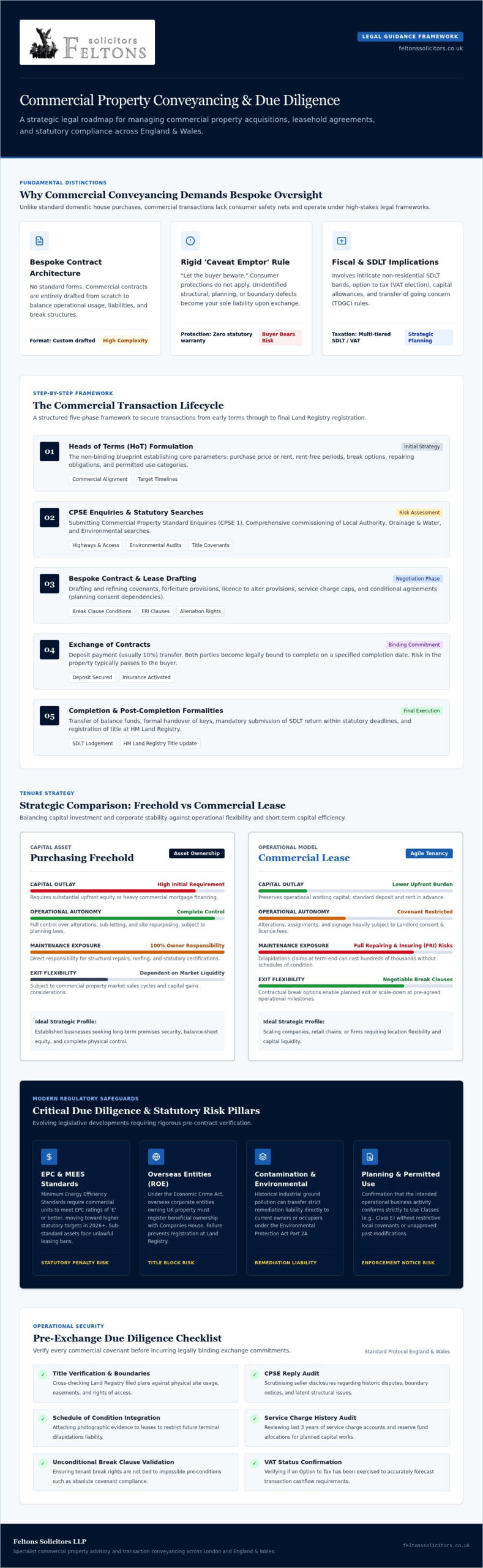
Every successful property move begins with a clear roadmap. Once you instruct commercial conveyancing solicitors london, the first priority is refining the ‘Heads of Terms’. While these documents are typically not legally binding, they serve as the strategic blueprint for the entire deal. They outline the agreed price, rent, and core conditions, ensuring both parties are aligned before the heavy legal lifting begins. Clear communication at this stage prevents misunderstandings that could otherwise surface weeks into the process.
Following this, we enter the investigative phase. This is where thorough local authority and environmental searches become paramount. In 2026, Land Registry processing times for commercial titles require proactive management to avoid delays. We look for anything that could impact your business operations, from contaminated land issues to upcoming local infrastructure projects that might disrupt access. We then move to drafting and negotiating the bespoke contract or lease agreement, ensuring every clause supports your commercial objectives.
Pre-Contract Enquiries and Due Diligence
This stage involves a deep dive into the Commercial Property Standard Enquiries (CPSE) forms. These are comprehensive documents where the seller provides detailed information about the property’s history. We scrutinise planning permissions and building regulation compliance to ensure no unauthorised works have been carried out. It’s also the time to check for ‘hidden’ encumbrances, such as chancel repair liabilities or ancient easements that could grant third parties rights over your land. Identifying these issues early allows us to negotiate indemnity insurance or price reductions before you’re committed.
From Exchange to Completion and Beyond
The exchange of contracts is the moment of legal finality. In a commercial setting, this creates a binding obligation to complete the transaction, usually requiring a deposit payment. Between exchange and completion, we finalise the financial arrangements and prepare the necessary documents for the transfer of title. We also coordinate with your lenders to ensure funds are ready for the completion date.
After completion, the work continues with essential administrative tasks. We manage the submission of SDLT returns, ensuring you pay the correct non-residential Stamp Duty Land Tax rates based on the current thresholds. We also handle the Land Registry registration to officially record your ownership. Organising the transfer of keys and the management of service charge accounts ensures a smooth handover for your team. If you’re managing a complex portfolio, seeking professional conveyancing advice can help you navigate these final hurdles with ease.
Strategic Comparison: Purchasing Freehold vs Negotiating a Commercial Lease
Deciding between acquiring a freehold or entering a commercial lease is one of the most consequential decisions a business owner will face. It isn’t merely a choice of location; it’s a strategic move that dictates whether your property costs are a fixed operational expenditure or a long-term capital investment. Engaging commercial conveyancing solicitors london allows you to weigh these options through a pragmatic lens, ensuring your choice supports both your current cash flow and your ultimate exit strategy. Each path carries distinct legal obligations that can significantly impact your business’s balance sheet and operational freedom.
When working with commercial conveyancing solicitors london, you’ll find that for many, the appeal of a lease lies in its flexibility. It allows a business to scale or pivot without being tied to a building that may become difficult to sell. However, this flexibility comes with the burden of ‘dilapidations’. This is the legal obligation to return the property to its original state at the end of the term, which can result in substantial costs if not managed correctly. Conversely, purchasing a freehold builds equity and provides a legacy for the business, though it requires a significant upfront capital investment that could otherwise be used for operational growth.
The Benefits and Burdens of Freehold Ownership
Ownership grants you complete sovereignty over your premises. You can execute alterations, reconfigure office layouts, or even sub-let surplus space without seeking a landlord’s consent. This control is a powerful tool for building brand identity and improving operational efficiency. Over time, the property may also offer capital growth, serving as a robust asset that strengthens your business’s financial position.
Autonomy brings total responsibility. As a freeholder, you’re liable for all maintenance, structural repairs, and environmental compliance. There is no landlord to call when the roof fails or when new sustainability regulations demand costly upgrades to the building’s infrastructure. You must manage the property’s lifecycle with the same diligence you apply to your core business operations, ensuring you have the financial reserves to handle unexpected structural issues.
Navigating the Nuances of Commercial Leases
Commercial leases are governed by complex statutes, most notably the Landlord and Tenant Act 1954. This Act provides ‘Security of Tenure’, giving most business tenants a legal right to renew their lease when it expires. Understanding whether your lease is ‘inside’ or ‘outside’ the protection of this Act is critical for your long-term stability. If you’re excluded from these protections, a landlord can refuse to renew your lease, potentially forcing a costly relocation.
You must also scrutinise the financial mechanisms within the lease. Rent reviews can be linked to the Retail Price Index (RPI) or based on open market value; each carries different risks in a fluctuating economy. Most commercial agreements are Full Repairing and Insuring (FRI) leases, meaning the tenant pays for all repairs and building insurance. For leases exceeding seven years, you must also follow the HM Land Registry guidelines on lease registration to ensure your legal interest is properly protected. Expert guidance ensures these technicalities don’t become expensive liabilities that hinder your business’s progress.
Navigating Due Diligence and Mitigating Risk in Commercial Property
Due diligence in a commercial transaction is a rigorous exercise in risk management that extends far beyond verifying boundaries. It requires a methodical investigation into the financial and operational health of the asset you are about to acquire. Expert commercial conveyancing solicitors london provide the forensic oversight needed to uncover liabilities that aren’t immediately visible on the surface. We focus on pre-empting disputes by analysing every facet of the property’s history, ensuring your investment is protected from the moment you commit to the purchase.
One often overlooked area is the history of service charge accounts and planned capital expenditure. We scrutinise past spending patterns to identify whether a landlord has been deferring essential maintenance. If a building requires significant structural work or a roof replacement in the next three years, these costs will likely be passed to you through the service charge. By identifying these future financial obligations early, we can negotiate a price reduction or a service charge cap, preventing your operational budget from being blindsided by avoidable costs.
The Register of Overseas Entities (ROE) Compliance
For transactions involving foreign corporations, compliance with the Register of Overseas Entities is a mandatory legal requirement that cannot be bypassed. Any overseas entity wishing to buy, sell, or lease UK property for more than seven years must register with Companies House and disclose its beneficial owners. Failing to maintain this registration can result in a ‘void’ transaction; the Land Registry will simply refuse to register the transfer of title, leaving your deal in legal limbo. Our firm provides specialised support for overseas entity beneficial owner registration, ensuring that international clients meet these transparency standards well before the completion date.
Environmental Liabilities and EPC Ratings
Sustainability is no longer a peripheral concern; it’s a core legal requirement that dictates the future value of your property. We conduct thorough environmental audits to identify potential land contamination from previous industrial uses, which could lead to remediation notices from local authorities. We also prioritise Minimum Energy Efficiency Standards (MEES) to ensure the property remains legally letable in the coming years. The UK government has proposed that all let commercial buildings must achieve an Energy Performance Certificate (EPC) rating of ‘B’ by 2030. If a property currently holds a lower rating, you must factor the cost of energy-efficiency upgrades into your initial investment strategy. To secure your business interests against these evolving regulations, you should contact our commercial property team for a comprehensive risk assessment.
Why Feltons Solicitors is Your Trusted Partner for National Commercial Conveyancing
Choosing the right legal partner is about more than technical skill; it is about finding a guide who understands the human impact of every commercial deal. Feltons Solicitors LLP provides a calm, steady presence that national and international clients rely on for high-end reliability. As commercial conveyancing solicitors london, we prioritise personal connection over high-volume processing, ensuring your matters are handled with the discretion they deserve. Our boutique approach means you aren’t just another file in a system. You have direct access to senior legal expertise, providing the quiet confidence needed to navigate the most complex property transactions.
We blend traditional professional integrity with modern delivery methods. This forward-thinking methodology allows Feltons Solicitors LLP to provide pragmatic advice that remains grounded in sound judgement. Whether you are managing a single local unit or an international portfolio, our steady rhythm guides you through each step without the frantic energy of high-pressure sales. We act as a discreet partner, valuing privacy and building long-term rapport with every client we serve.
Tailored Support for Property Developers and Investors
For those managing mixed-use projects, the legal landscape is particularly nuanced. Feltons Solicitors LLP offers extensive expertise in navigating residential property law alongside our commercial services, ensuring every aspect of your development is legally sound. Our team handles high-value transactions and complex leasehold enfranchisement matters with a poised, dependable approach. We understand that developers need more than just a solicitor; they need a trusted adviser who can align legal strategies with commercial timelines and corporate objectives.
Clear Communication and Methodical Progress
We believe that clarity is the foundation of trust. Our communication style avoids dense, archaic legalese in favour of a “plain English” approach that remains formal yet accessible. This methodical flow ensures you feel informed and supported throughout the transaction lifecycle. By stripping away unnecessary complexity, Feltons Solicitors LLP allows you to focus on your business goals whilst we manage the technical details.
Every property objective is unique, and our “people-first” philosophy ensures that your specific needs are never forgotten. We invite you to discuss your commercial property goals with a team that values your time and prioritises your success. Our commercial conveyancing solicitors london are ready to provide the sophisticated guidance your next transaction requires.
Securing Your Commercial Property Future
A successful property transaction in 2026 requires more than just technical legal processing; it demands a strategic alignment with your firm’s long-term corporate objectives. Whether you’re navigating the rigorous due diligence of an industrial acquisition or negotiating the nuanced terms of a commercial lease, your focus should remain on mitigating risk whilst maintaining operational flexibility. By identifying potential liabilities early and ensuring compliance with evolving standards like the Register of Overseas Entities, you protect your business’s financial health and its future legacy.
Choosing commercial conveyancing solicitors london who prioritise partner-led expertise ensures that you receive pragmatic, sound judgment tailored to your specific needs. Feltons Solicitors LLP offers a boutique legal service designed to provide a calm, steady presence throughout the most complex domestic and international transactions. We invite you to secure your commercial property interests with Feltons Solicitors and experience a “people-first” approach that values your time and discretion. With the right legal guide, you can move forward with quiet confidence, knowing your business interests are in capable hands.
Frequently Asked Questions
What is the average timescale for a commercial conveyancing transaction?
The average timescale for a commercial conveyancing transaction is typically between eight and twelve weeks from the point of instruction to completion. This duration can vary significantly based on the complexity of the title and the responsiveness of third parties. Factors such as Land Registry processing times and the depth of environmental searches required often influence the final timeline. We maintain a methodical approach to ensure every stage progresses without unnecessary delays.
Do I need a solicitor for a commercial lease renewal?
Engaging a solicitor for a commercial lease renewal is essential to ensure your statutory rights under the Landlord and Tenant Act 1954 are fully protected. A legal expert helps you navigate the intricacies of ‘Security of Tenure’ and negotiates favourable rent review terms. Without professional guidance, you risk losing your right to remain in the premises or accepting restrictive clauses that could stifle your business operations in the future.
What are the typical costs involved in commercial property conveyancing?
Typical costs in a commercial property transaction include professional legal fees, search disbursements, Land Registry registration fees, and Stamp Duty Land Tax (SDLT). Professional fees are often calculated based on the transaction’s value and complexity. Disbursements cover essential local authority, environmental, and drainage searches. commercial conveyancing solicitors london provide a clear breakdown of these expenses early in the process to help you manage your acquisition budget effectively.
What is a ‘licence to alter’ in a commercial lease?
A ‘licence to alter’ is a formal legal document issued by a landlord that grants a tenant permission to carry out specific works or alterations to a leased property. Most commercial leases prohibit structural or significant internal changes without this express consent. The document outlines the conditions for the work, ensuring that the modifications comply with building regulations and do not negatively impact the property’s value or structural integrity.
How does the ‘Register of Overseas Entities’ affect my property purchase?
The Register of Overseas Entities requires foreign corporations to register with Companies House and disclose their beneficial owners before transacting in UK property. This mandate affects any purchase or lease exceeding seven years. If an entity fails to comply, the Land Registry will refuse to register the transfer of title, effectively stalling the transaction. Professional oversight ensures that all ROE requirements are met well before the exchange of contracts occurs.
What is the difference between a freehold and a leasehold commercial property?
Freehold ownership means you own the building and the land it stands on outright, granting you complete control over the property’s usage and alterations. In contrast, a leasehold gives you the right to occupy the premises for a fixed term under the conditions of a lease agreement. Whilst freehold offers long-term asset growth, leasehold provides the flexibility to scale your business without the burden of total structural maintenance responsibility.
Can a commercial solicitor help with mixed-use property developments?
A commercial solicitor possesses the specialised expertise required to manage mixed-use property developments, where residential and business spaces coexist within a single title. These transactions involve complex legal frameworks, including residential leasehold enfranchisement and commercial planning permissions. We provide pragmatic advice that balances the different statutory requirements of each component, ensuring that the entire development remains legally robust and commercially viable for investors and developers alike.
What happens if a commercial property does not meet current EPC standards?
If a commercial property does not meet the Minimum Energy Efficiency Standards (MEES), the landlord may be prohibited from granting a new lease or renewing an existing one. Currently, properties must hold an EPC rating of ‘E’ or above, with proposals suggesting a shift to ‘B’ by 2030. Non-compliance can lead to significant financial penalties. commercial conveyancing solicitors london assess these risks during due diligence to prevent unexpected upgrade costs from impacting your bottom line.