

Commercial Conveyancing Solicitors London: A Strategic Guide to UK Property Transactions 2026

Commercial Conveyancing Solicitors London: A Strategic Guide to UK Property Transactions 2026

A commercial property transaction is never just a legal formality; it’s a high-stakes business manoeuvre where the smallest oversight in a lease can lead to years of financial liability. You’ve likely felt the frustration of slow, non-responsive legal processes that threaten to derail your timelines, or perhaps you’re concerned about the complex SDLT implications of your next acquisition. It’s understandable to feel that the legal side of property can be a bottleneck rather than a bridge to your commercial goals.

Partnering with experienced commercial conveyancing solicitors ensures these risks are managed with precision rather than left to chance. This strategic guide offers pragmatic advice designed to prioritise your business interests, providing you with a clear roadmap for a risk-mitigated acquisition or lease. We will examine how to identify hidden liabilities early, streamline the communication process, and ensure your property strategy remains robust as we look toward the market conditions of 2026. By the end of this article, you’ll have the clarity needed to move forward with quiet confidence and secure a seamless completion.

Key Takeaways

  • Understand why commercial due diligence requires a more rigorous approach than residential moves to protect your firm from hidden liabilities.
  • Learn how to master the property transaction lifecycle, starting with the critical ‘Heads of Terms’ to set a firm foundation for your acquisition.
  • Evaluate the strategic financial impact of purchasing a freehold versus negotiating a commercial lease to ensure the tenure aligns with your business model.
  • Discover how commercial conveyancing solicitors London manage modern risks, including the latest EPC standards and the mandatory registration of overseas entities.
  • Gain pragmatic insights into mitigating risk through thorough environmental audits and sustainability checks before you commit to a binding contract.

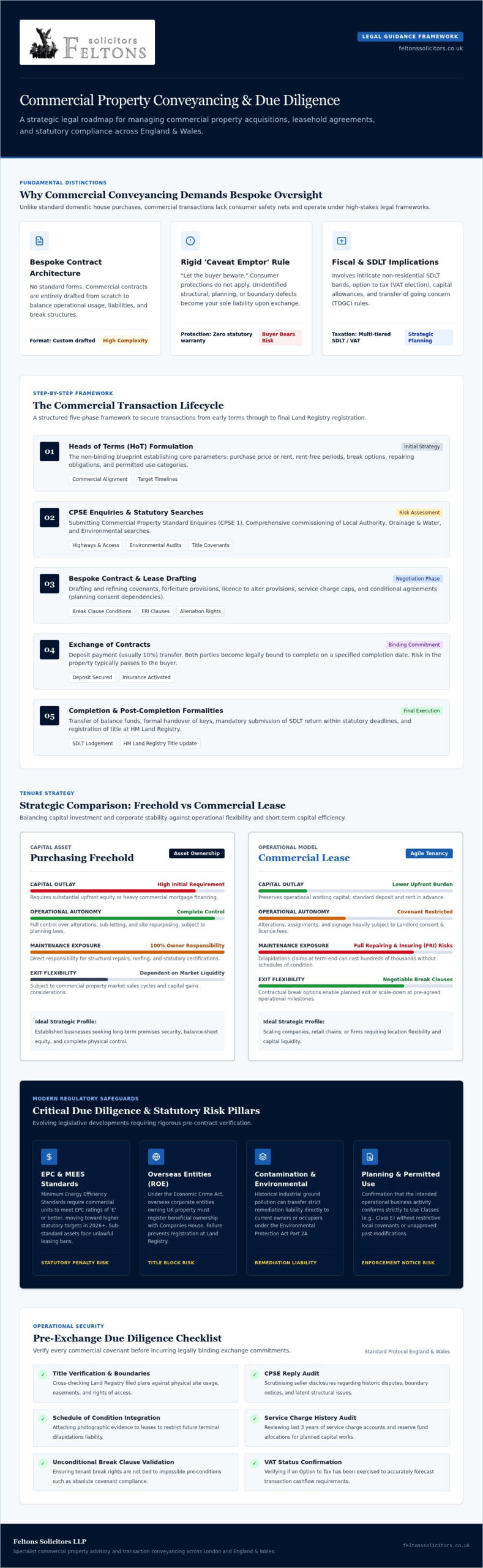
Understanding the Complexity of Commercial Conveyancing in the UK

Commercial conveyancing is the legal process of transferring the title of business-related property from one entity to another. While it shares a foundational lineage with the conveyancing process in England and Wales, the commercial variant is a far more intricate undertaking. It involves a high-stakes environment where the property isn’t just a building; it’s a functional business asset. Whether you are acquiring a high-street retail unit, a sprawling industrial warehouse, or a city-centre office space, the legal framework must be robust enough to support your operational goals. Partnering with commercial conveyancing solicitors london provides the specialised oversight necessary to manage these diverse property types and their unique title structures.

The role of a sophisticated guide is vital here. Commercial transactions require a level of due diligence that far exceeds residential moves. You aren’t just checking for basic boundaries. You’re investigating complex planning permissions, environmental liabilities, and restrictive covenants that could stifle your business growth. It’s about looking beyond the physical structure to see the legal risks and opportunities hidden within the deeds.

Commercial vs Residential: The Core Differences

One of the most striking differences in commercial law is the absence of standard contracts. In residential deals, solicitors often use familiar, pre-approved forms. Commercial contracts are bespoke. They’re drafted from scratch to reflect the specific nuances of the deal. This flexibility is a double-edged sword; it allows for tailored terms but requires expert negotiation to ensure your interests remain protected.

The principle of ‘Caveat Emptor’-let the buyer beware-is also much more rigorous in a business context. There are fewer consumer protections for commercial buyers. If you fail to uncover a defect or a legal restriction before exchange, you’ll likely have no recourse against the seller. Additionally, the tax landscape is significantly more complex. You’ll need to navigate intricate VAT elections on the property and specific SDLT (Stamp Duty Land Tax) thresholds that apply to non-residential acquisitions. Miscalculating these can lead to unexpected costs that impact your bottom line.

Why Strategic Legal Advice Matters for Your Business

Property acquisitions must align with your long-term corporate objectives. Sound judgment is required to identify potential hurdles early, such as ‘licence to alter’ restrictions that might prevent you from renovating the space to suit your needs. We also prioritise the negotiation of ‘break clauses’. These are essential exit strategies that allow you to terminate a lease early if market conditions change or your business needs to relocate. Without these strategic safeguards, a property can quickly turn from an asset into a liability. Clear, pragmatic advice ensures that every clause in your contract serves your business’s future, not just the immediate transaction.

The Commercial Property Transaction Lifecycle: A Step-by-Step Framework

This stage involves a deep dive into the Commercial Property Standard Enquiries (CPSE) forms. These are comprehensive documents where the seller provides detailed information about the property’s history. We scrutinise planning permissions and building regulation compliance to ensure no unauthorised works have been carried out. It’s also the time to check for ‘hidden’ encumbrances, such as chancel repair liabilities or ancient easements that could grant third parties rights over your land. Identifying these issues early allows us to negotiate indemnity insurance or price reductions before you’re committed.

From Exchange to Completion and Beyond

The exchange of contracts is the moment of legal finality. In a commercial setting, this creates a binding obligation to complete the transaction, usually requiring a deposit payment. Between exchange and completion, we finalise the financial arrangements and prepare the necessary documents for the transfer of title. We also coordinate with your lenders to ensure funds are ready for the completion date.

After completion, the work continues with essential administrative tasks. We manage the submission of SDLT returns, ensuring you pay the correct non-residential Stamp Duty Land Tax rates based on the current thresholds. We also handle the Land Registry registration to officially record your ownership. Organising the transfer of keys and the management of service charge accounts ensures a smooth handover for your team. If you’re managing a complex portfolio, seeking professional conveyancing advice can help you navigate these final hurdles with ease.

Strategic Comparison: Purchasing Freehold vs Negotiating a Commercial Lease

Deciding between acquiring a freehold or entering a commercial lease is one of the most consequential decisions a business owner will face. It isn’t merely a choice of location; it’s a strategic move that dictates whether your property costs are a fixed operational expenditure or a long-term capital investment. Engaging commercial conveyancing solicitors london allows you to weigh these options through a pragmatic lens, ensuring your choice supports both your current cash flow and your ultimate exit strategy. Each path carries distinct legal obligations that can significantly impact your business’s balance sheet and operational freedom.

When working with commercial conveyancing solicitors london, you’ll find that for many, the appeal of a lease lies in its flexibility. It allows a business to scale or pivot without being tied to a building that may become difficult to sell. However, this flexibility comes with the burden of ‘dilapidations’. This is the legal obligation to return the property to its original state at the end of the term, which can result in substantial costs if not managed correctly. Conversely, purchasing a freehold builds equity and provides a legacy for the business, though it requires a significant upfront capital investment that could otherwise be used for operational growth.

The Benefits and Burdens of Freehold Ownership

Ownership grants you complete sovereignty over your premises. You can execute alterations, reconfigure office layouts, or even sub-let surplus space without seeking a landlord’s consent. This control is a powerful tool for building brand identity and improving operational efficiency. Over time, the property may also offer capital growth, serving as a robust asset that strengthens your business’s financial position.

Navigating the Nuances of Commercial Leases

Commercial leases are governed by complex statutes, most notably the Landlord and Tenant Act 1954. This Act provides ‘Security of Tenure’, giving most business tenants a legal right to renew their lease when it expires. Understanding whether your lease is ‘inside’ or ‘outside’ the protection of this Act is critical for your long-term stability. If you’re excluded from these protections, a landlord can refuse to renew your lease, potentially forcing a costly relocation.

You must also scrutinise the financial mechanisms within the lease. Rent reviews can be linked to the Retail Price Index (RPI) or based on open market value; each carries different risks in a fluctuating economy. Most commercial agreements are Full Repairing and Insuring (FRI) leases, meaning the tenant pays for all repairs and building insurance. For leases exceeding seven years, you must also follow the HM Land Registry guidelines on lease registration to ensure your legal interest is properly protected. Expert guidance ensures these technicalities don’t become expensive liabilities that hinder your business’s progress.
Commercial Conveyancing Solicitors London: A Strategic Guide to UK Property Transactions 2026

Due diligence in a commercial transaction is a rigorous exercise in risk management that extends far beyond verifying boundaries. It requires a methodical investigation into the financial and operational health of the asset you are about to acquire. Expert commercial conveyancing solicitors london provide the forensic oversight needed to uncover liabilities that aren’t immediately visible on the surface. We focus on pre-empting disputes by analysing every facet of the property’s history, ensuring your investment is protected from the moment you commit to the purchase.

One often overlooked area is the history of service charge accounts and planned capital expenditure. We scrutinise past spending patterns to identify whether a landlord has been deferring essential maintenance. If a building requires significant structural work or a roof replacement in the next three years, these costs will likely be passed to you through the service charge. By identifying these future financial obligations early, we can negotiate a price reduction or a service charge cap, preventing your operational budget from being blindsided by avoidable costs. For businesses that need to manage arrears or recover outstanding payments related to their property assets, MAR Legal offers professional debt recovery services.

For transactions involving foreign corporations, compliance with the Register of Overseas Entities is a mandatory legal requirement that cannot be bypassed. Any overseas entity wishing to buy, sell, or lease UK property for more than seven years must register with Companies House and disclose its beneficial owners. Failing to maintain this registration can result in a ‘void’ transaction; the Land Registry will simply refuse to register the transfer of title, leaving your deal in legal limbo. Our firm provides specialised support for overseas entity beneficial owner registration, ensuring that international clients meet these transparency standards well before the completion date.

Environmental Liabilities and EPC Ratings

Sustainability is no longer a peripheral concern; it’s a core legal requirement that dictates the future value of your property. We conduct thorough environmental audits to identify potential land contamination from previous industrial uses, which could lead to remediation notices from local authorities. We also prioritise Minimum Energy Efficiency Standards (MEES) to ensure the property remains legally letable in the coming years. The UK government has proposed that all let commercial buildings must achieve an Energy Performance Certificate (EPC) rating of ‘B’ by 2030. If a property currently holds a lower rating, you must factor the cost of energy-efficiency upgrades into your initial investment strategy. To secure your business interests against these evolving regulations, you should contact our commercial property team for a comprehensive risk assessment.

Why Feltons Solicitors is Your Trusted Partner for National Commercial Conveyancing

Choosing the right legal partner is about more than technical skill; it is about finding a guide who understands the human impact of every commercial deal. Feltons Solicitors LLP provides a calm, steady presence that national and international clients rely on for high-end reliability. As commercial conveyancing solicitors london, we prioritise personal connection over high-volume processing, ensuring your matters are handled with the discretion they deserve. Our boutique approach means you aren’t just another file in a system. You have direct access to senior legal expertise, providing the quiet confidence needed to navigate the most complex property transactions.

We blend traditional professional integrity with modern delivery methods. This forward-thinking methodology allows Feltons Solicitors LLP to provide pragmatic advice that remains grounded in sound judgement. Whether you are managing a single local unit or an international portfolio, our steady rhythm guides you through each step without the frantic energy of high-pressure sales. We act as a discreet partner, valuing privacy and building long-term rapport with every client we serve.

Tailored Support for Property Developers and Investors

For those managing mixed-use projects, the legal landscape is particularly nuanced. Feltons Solicitors LLP offers extensive expertise in navigating residential property law alongside our commercial services, ensuring every aspect of your development is legally sound. Our team handles high-value transactions and complex leasehold enfranchisement matters with a poised, dependable approach. We understand that developers need more than just a solicitor; they need a trusted adviser who can align legal strategies with commercial timelines and corporate objectives.

Clear Communication and Methodical Progress

We believe that clarity is the foundation of trust. Our communication style avoids dense, archaic legalese in favour of a “plain English” approach that remains formal yet accessible. This methodical flow ensures you feel informed and supported throughout the transaction lifecycle. By stripping away unnecessary complexity, Feltons Solicitors LLP allows you to focus on your business goals whilst we manage the technical details.

Every property objective is unique, and our “people-first” philosophy ensures that your specific needs are never forgotten. We invite you to discuss your commercial property goals with a team that values your time and prioritises your success. Our commercial conveyancing solicitors london are ready to provide the sophisticated guidance your next transaction requires.

Securing Your Commercial Property Future

A successful property transaction in 2026 requires more than just technical legal processing; it demands a strategic alignment with your firm’s long-term corporate objectives. Whether you’re navigating the rigorous due diligence of an industrial acquisition or negotiating the nuanced terms of a commercial lease, your focus should remain on mitigating risk whilst maintaining operational flexibility. By identifying potential liabilities early and ensuring compliance with evolving standards like the Register of Overseas Entities, you protect your business’s financial health and its future legacy.

Choosing commercial conveyancing solicitors london who prioritise partner-led expertise ensures that you receive pragmatic, sound judgment tailored to your specific needs. Feltons Solicitors LLP offers a boutique legal service designed to provide a calm, steady presence throughout the most complex domestic and international transactions. We invite you to secure your commercial property interests with Feltons Solicitors and experience a “people-first” approach that values your time and discretion. With the right legal guide, you can move forward with quiet confidence, knowing your business interests are in capable hands.

Frequently Asked Questions

What is the average timescale for a commercial conveyancing transaction?

The average timescale for a commercial conveyancing transaction is typically between eight and twelve weeks from the point of instruction to completion. This duration can vary significantly based on the complexity of the title and the responsiveness of third parties. Factors such as Land Registry processing times and the depth of environmental searches required often influence the final timeline. We maintain a methodical approach to ensure every stage progresses without unnecessary delays.

Do I need a solicitor for a commercial lease renewal?

Engaging a solicitor for a commercial lease renewal is essential to ensure your statutory rights under the Landlord and Tenant Act 1954 are fully protected. A legal expert helps you navigate the intricacies of ‘Security of Tenure’ and negotiates favourable rent review terms. Without professional guidance, you risk losing your right to remain in the premises or accepting restrictive clauses that could stifle your business operations in the future.

What are the typical costs involved in commercial property conveyancing?

Typical costs in a commercial property transaction include professional legal fees, search disbursements, Land Registry registration fees, and Stamp Duty Land Tax (SDLT). Professional fees are often calculated based on the transaction’s value and complexity. Disbursements cover essential local authority, environmental, and drainage searches. commercial conveyancing solicitors london provide a clear breakdown of these expenses early in the process to help you manage your acquisition budget effectively.

What is a ‘licence to alter’ in a commercial lease?

A ‘licence to alter’ is a formal legal document issued by a landlord that grants a tenant permission to carry out specific works or alterations to a leased property. Most commercial leases prohibit structural or significant internal changes without this express consent. The document outlines the conditions for the work, ensuring that the modifications comply with building regulations and do not negatively impact the property’s value or structural integrity.

How does the ‘Register of Overseas Entities’ affect my property purchase?

The Register of Overseas Entities requires foreign corporations to register with Companies House and disclose their beneficial owners before transacting in UK property. This mandate affects any purchase or lease exceeding seven years. If an entity fails to comply, the Land Registry will refuse to register the transfer of title, effectively stalling the transaction. Professional oversight ensures that all ROE requirements are met well before the exchange of contracts occurs.

What is the difference between a freehold and a leasehold commercial property?

Freehold ownership means you own the building and the land it stands on outright, granting you complete control over the property’s usage and alterations. In contrast, a leasehold gives you the right to occupy the premises for a fixed term under the conditions of a lease agreement. Whilst freehold offers long-term asset growth, leasehold provides the flexibility to scale your business without the burden of total structural maintenance responsibility.

Can a commercial solicitor help with mixed-use property developments?

A commercial solicitor possesses the specialised expertise required to manage mixed-use property developments, where residential and business spaces coexist within a single title. These transactions involve complex legal frameworks, including residential leasehold enfranchisement and commercial planning permissions. We provide pragmatic advice that balances the different statutory requirements of each component, ensuring that the entire development remains legally robust and commercially viable for investors and developers alike.

What happens if a commercial property does not meet current EPC standards?

If a commercial property does not meet the Minimum Energy Efficiency Standards (MEES), the landlord may be prohibited from granting a new lease or renewing an existing one. Currently, properties must hold an EPC rating of ‘E’ or above, with proposals suggesting a shift to ‘B’ by 2030. Non-compliance can lead to significant financial penalties. commercial conveyancing solicitors london assess these risks during due diligence to prevent unexpected upgrade costs from impacting your bottom line.

Commercial Property Solicitor: Strategic Legal Guidance for UK Business Assets in 2026

Commercial Property Solicitor: Strategic Legal Guidance for UK Business Assets in 2026

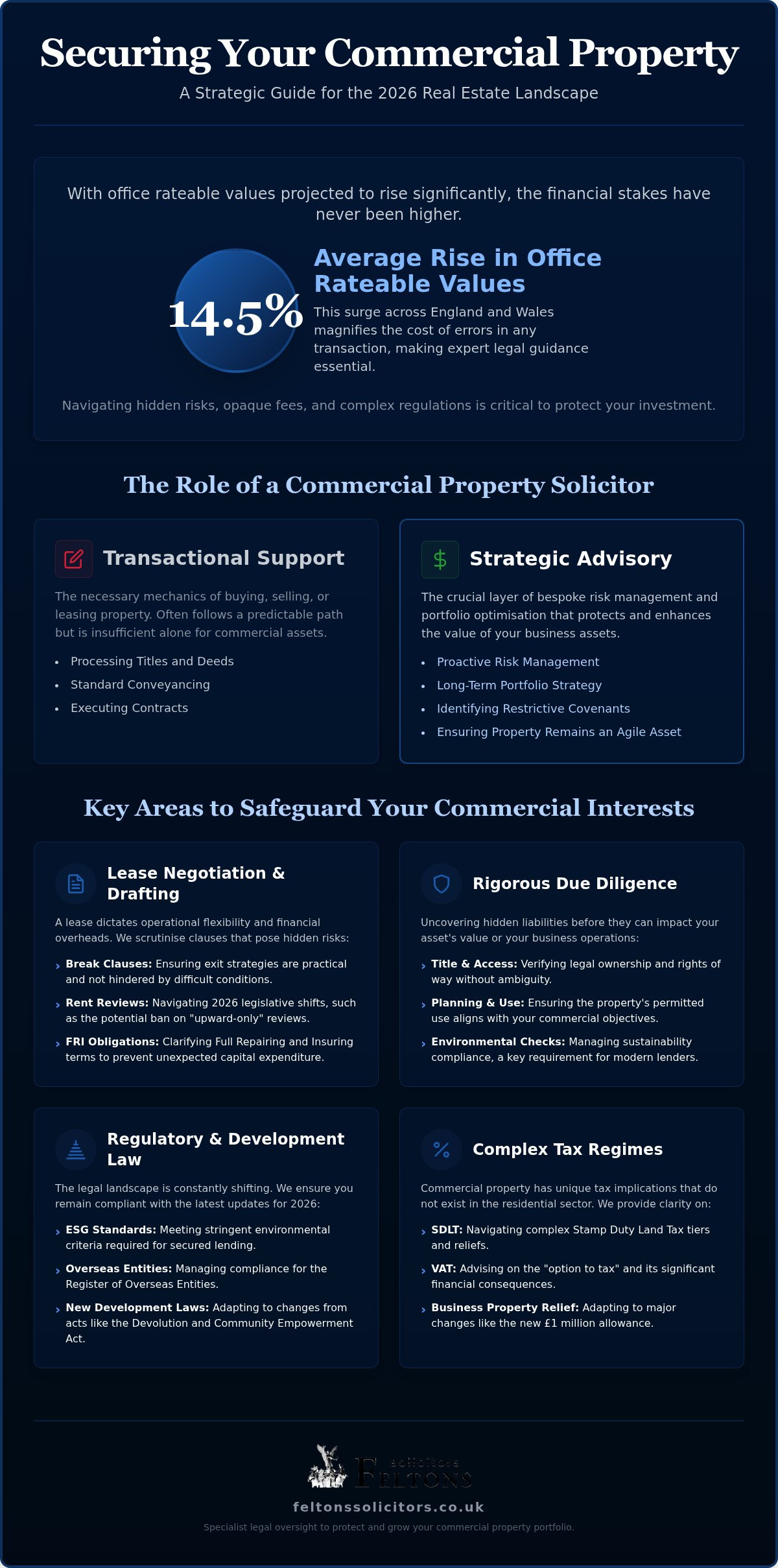
With office rateable values rising by an average of 14.5% across England and Wales in 2026, the margin for error in your next real estate transaction has never been thinner. You likely recognise that whilst property remains a cornerstone of business growth, the legal path to securing it is increasingly fraught with hidden risks. It’s understandable to feel uneasy about opaque fee structures or the slow transaction speeds that so often cause promising deals to collapse at the final hurdle.

Securing a commercial property solicitor who offers a blend of sophisticated authority and pragmatic, “people-first” advice is the most effective way to protect your interests. Our focus is on providing the strategic guidance necessary to navigate a complex 2026 landscape, ensuring you don’t miss restrictive covenants that could stifle your future operations. By the end of this article, you’ll understand how to secure favourable lease terms under the latest regulations, minimise your business liability, and adapt to significant shifts like the new £1 million allowance for Business Property Relief. We will examine the essential steps to managing your assets with confidence, ensuring every transaction serves your broader commercial objectives.

Key Takeaways

  • Understand how a commercial property solicitor functions as a discreet advisor to manage complex risks that extend far beyond standard conveyancing.
  • Identify the pivotal lease clauses that safeguard your operational freedom and protect your business from unforeseen financial commitments.
  • Discover the rigorous due diligence steps necessary to reveal hidden liabilities before they can impact the value of your commercial assets.
  • Navigate the latest 2026 regulatory updates, including essential compliance for the Register of Overseas Entities and new development laws.
  • Learn why a boutique legal partnership offers the tailored expertise and personal connection needed to support a growing property portfolio.

What is a Commercial Property Solicitor and Why Does Your Business Need One?

A commercial property solicitor acts as far more than a legal processor for titles and deeds. While residential conveyancing often follows a predictable, formulaic path, commercial transactions are governed by complex English land law principles that require a bespoke approach to risk management. Your business assets represent significant capital and operational exposure. Treating their acquisition or lease as a mere administrative task is a dangerous oversight. In 2026, where office rateable values have surged by an average of 14.5% across England and Wales, the financial consequences of a poorly negotiated contract are immediate and severe.

Commercial law involves unique mechanisms such as the Landlord and Tenant Act 1954, which provides security of tenure for business occupiers. Without this protection, a business could be forced to relocate at the end of a lease term, losing years of accumulated goodwill and local brand recognition. Specialist legal oversight is non-negotiable because commercial property carries distinct tax regimes, including complex SDLT tiers and the “option to tax” for VAT, which don’t exist in the residential sector. You need a partner who understands that a deal delayed by slow due diligence is often a deal lost.

The Distinction Between Transactional and Advisory Support

Legal support is traditionally viewed as transactional, focusing on the mechanics of buying, selling, or leasing assets. However, the true value of a commercial property solicitor lies in advisory oversight. This includes ongoing portfolio management and identifying restrictive covenants that could stifle your business growth or prevent a future change of use. If you plan to exit the business in five years, your lease must allow for a clean break or assignment without prohibitive conditions. We ensure your property remains an agile asset rather than a restrictive liability that hinders your long-term strategy.

Safeguarding Commercial Interests in 2026

The regulatory environment has shifted significantly this year. With the English Devolution and Community Empowerment Act 2026 introducing potential bans on upward-only rent reviews, your legal advice must ensure new leases reflect these modern standards. Beyond the lease itself, we manage environmental and sustainability compliance, which is increasingly a prerequisite for secured lending. Lenders in 2026 are more stringent; they require proof that assets meet evolving ESG standards before releasing funds. A commercial property solicitor serves as a definitive shield against operational disruption, ensuring that legal technicalities never compromise your business’s momentum.

A commercial lease is far more than a simple occupancy agreement; it’s a complex financial instrument that dictates your business’s overheads and operational flexibility for years. Relying on generic templates often leaves tenants exposed to “hidden” costs that only surface during a dispute or at the point of exit. Instructing a commercial property solicitor ensures that every clause is tailored to your specific industry requirements rather than a landlord-biased standard. Adhering to RICS professional standards provides a baseline for fair management, but bespoke legal drafting is what secures your business’s unique interests.

Critical Lease Terms to Review

The financial impact of a lease is often found in the fine print of its various mechanisms. Break clauses are essential for maintaining agility, yet they are frequently conditional on “vacant possession” or “absolute compliance,” terms that can be difficult to satisfy in practice. Rent review clauses also require careful scrutiny, especially following the 2026 legislative shifts regarding upward-only reviews. Understanding Full Repairing and Insuring (FRI) obligations is equally vital, as these can lead to unexpected capital expenditure for structural repairs. For those navigating the complexities of long-term property rights, speaking with leasehold enfranchisement experts can help clarify your options for securing more permanent control over your premises.

Lease Renewals and Assignments

The Landlord and Tenant Act 1954 provides a statutory right to renew your lease, which is a cornerstone of business continuity in the UK. However, landlords can oppose renewal on specific grounds, such as an intention to redevelop the site. If you plan to sell your business, the ability to assign the lease to a buyer is critical. A commercial property solicitor will negotiate “reasonable” consent requirements to ensure your exit strategy isn’t blocked by a landlord’s refusal. Finally, managing dilapidations at the end of a term is a significant financial risk. Early legal advice on terminal schedules can prevent costly litigation and ensure a smooth transition out of the property. If you’re entering new negotiations, a detailed contract review can identify these risks before you sign.

Strategic Acquisitions and Disposals: Managing Transactional Risk

Strategic acquisitions require a methodical approach that transcends simple price negotiation. In a market where office rateable values have shifted significantly, the true value of a deal is often found in the quality of the underlying title and the absence of hidden liabilities. A commercial property solicitor manages the entire transaction lifecycle, from the initial review of heads of terms to the final registration at the Land Registry. Whilst the RICS Code for Leasing Business Premises focuses on fairness in tenancies, acquisitions demand a more aggressive focus on risk mitigation and long-term operational efficiency.

The Due Diligence Framework

Due diligence is the foundation of any secure purchase. It involves a rigorous investigation into title history, planning permissions, and building regulation compliance. We scrutinise Commercial Property Standard Enquiries (CPSEs) to uncover issues such as unauthorised alterations, boundary disputes, or pending litigation. Environmental searches are particularly critical in 2026, as contaminated land liabilities can stay with the owner regardless of when the damage occurred. For mixed-use developments, where a commercial unit sits beneath residential flats, you must also consider navigating residential property law to manage the distinct rights of residential tenants, such as the right of first refusal.

Financing and Secured Lending

Securing capital is often the most time-sensitive element of a transaction. We work closely with commercial lenders to satisfy their specific requirements, handling the complex legal charges and debentures over your property assets. If your financing timeline is tight, having a commercial property solicitor who understands the lender’s perspective prevents delays that could jeopardise the deal. We ensure the legal structure of your purchase supports your borrowing needs, allowing for a seamless transition from offer to ownership. This includes verifying that the property’s insurance and repair obligations align with the bank’s security requirements, protecting both your capital and your relationship with the lender.

Commercial Property Solicitor: Strategic Legal Guidance for UK Business Assets in 2026

Specialist Complexities: Overseas Entities and Development Law

The intersection of international investment and UK property law has become significantly more regulated. For international investors, compliance with the Register of Overseas Entities (ROE) is no longer a peripheral concern but a central pillar of asset management. Failing to maintain accurate records on the ROE can result in severe penalties and, crucially, prevents any dealing with the property at the Land Registry. A commercial property solicitor with specialist expertise in this area ensures your international structure remains transparent and compliant with the latest 2026 standards.

Registering Overseas Entities for UK Property

Registration is a multi-stage process that requires meticulous attention to detail. It is not merely an administrative filing; it is a legal declaration of ownership structure. The process typically follows three critical stages:

  • Identification: Pinpointing beneficial owners as defined by the Economic Crime (Transparency and Enforcement) Act, ensuring all “shadow” interests are correctly categorised.
  • Verification: All information must be verified by a UK-regulated agent before submission to Companies House.
  • Annual Compliance: Managing the mandatory annual updates to ensure the entity’s status remains “active” and deal-ready.

For a more detailed breakdown of these requirements, see our guide on overseas entity beneficial owner registration.

Property Development and Site Assembly

Development projects require a different legal architecture. Site assembly involves the delicate process of merging multiple parcels of land, often requiring the negotiation of complex infrastructure and utility easements. We draft option agreements and conditional contracts that provide the flexibility developers need during the planning phase. Protecting future value is equally important. Overage agreements ensure that if a site’s value increases significantly post-development, the original seller receives a fair share of the uplift, while the developer’s margins remain protected. This methodical approach protects your capital while allowing for ambitious growth.

When preparing a site for development, ensuring physical security is as important as the legal framework; specialists like Romford Fencing Ltd can provide the trade-grade materials needed to secure your assets during the transition.

Even with the best drafting, disputes can arise. Whether it’s a disagreement over service charges or a challenge to leasehold enfranchisement rights, we prioritise mediation and pragmatic negotiation to avoid the prohibitive costs of litigation. Our role is to act as a discreet partner, resolving issues quietly and efficiently so your focus remains on your business operations. If you are managing international assets or planning a new development, our commercial legal team is ready to provide the discreet, high-standard support your portfolio requires.

Choosing the Right Commercial Property Solicitor for Your Portfolio

Selecting a commercial property solicitor is a consequential decision that directly impacts your business’s bottom line and operational security. High-volume “conveyancing factories” often rely on automated processes that struggle to account for the nuances of a complex commercial deal. Within the 2026 regulatory framework, where oversight of overseas entities and environmental compliance is more rigorous than ever, a tick-box approach is insufficient. You need a partner who possesses deep commercial awareness and understands how a property asset fits into your broader industry objectives.

The right legal advisor acts as a sophisticated guide, identifying risks before they become liabilities. Direct partner access is essential. It ensures that your transaction is handled by an expert who can navigate the intricacies of the Landlord and Tenant Act 1954 or the complexities of a mixed-use development with poise. Communication should be steady and reassuring, providing you with the clarity needed to make informed decisions under pressure. If a firm cannot explain a restrictive covenant’s impact on your future exit strategy in plain English, they may lack the commercial depth your portfolio requires.

The Feltons Difference: Pragmatic and People-First

Feltons Solicitors LLP was established in 2010 by Paula Felton with a commitment to providing a boutique, high-standard service that prioritises personal connection. We don’t view transactions as mere files; we see them as the foundation of your business’s future. Our “people-first” philosophy means we focus on building long-term advisory relationships, offering a calm and steady presence amongst the stresses of a property acquisition or disposal. Whether you are a national developer or an international investor, our advice remains pragmatic and tailored to your specific needs. We maintain transparent fee structures to address the common industry pain point of opaque legal costs, ensuring you can manage your capital with confidence.

Next Steps for Your Property Transaction

Moving forward with a new lease or purchase requires methodical preparation to avoid the delays that cause deals to collapse. Before your initial consultation, ensure you have your Heads of Terms, proof of identity, and any relevant financing details organised. This allows your commercial property solicitor to begin the due diligence process immediately, protecting your position in a competitive market. When you are ready to instruct, look for a firm that combines traditional professional integrity with modern efficiency. Your property assets deserve a discreet partner who values privacy and personal rapport as much as technical excellence. Secure your business assets today and contact Feltons Solicitors LLP for a consultation to discuss your requirements.

The 2026 property market presents both significant challenges and unique opportunities for businesses. We have discussed how a dedicated commercial property solicitor moves beyond simple paperwork to provide the strategic foresight required for complex lease negotiations and regulatory compliance. By focusing on bespoke drafting and rigorous due diligence, you can ensure your property assets remain agile and protected against shifts in business rates and inheritance tax allowances. Success in this environment relies on identifying risks early and maintaining a clear path for future growth.

Feltons Solicitors LLP provides a calm, steady presence throughout the lifecycle of your property assets. Our boutique service model guarantees direct partner involvement and specialist expertise in areas such as Overseas Entity registration, whilst our national reach ensures we can support your interests across the UK. We combine traditional professional integrity with a “people-first” philosophy to deliver results that respect both your time and your commercial objectives. Instruct Feltons Solicitors for your commercial property transaction to secure the high-standard, discreet guidance your business deserves.

Frequently Asked Questions

Do I really need a solicitor for a commercial lease renewal?

Yes, instructing a solicitor is essential to protect your statutory rights under the Landlord and Tenant Act 1954. Missing strict deadlines can result in the loss of your right to remain in the premises. Professional oversight ensures your new lease reflects 2026 market standards and doesn’t include restrictive clauses that could hinder your future business agility or exit strategy.

How much are commercial property solicitor fees in 2026?

Fees are determined by the transaction’s complexity and the value of the asset involved. Rates typically track service producer price inflation, which saw a modest increase in early 2026. Most firms provide a combination of fixed fees for standard conveyancing and hourly rates for bespoke advisory work. We recommend requesting a transparent, individualised quote to ensure your legal budget aligns with your specific objectives.

What is the Register of Overseas Entities and does it apply to me?

The Register of Overseas Entities (ROE) requires foreign organisations holding UK land to declare their beneficial owners to Companies House. It applies to you if you are a non-UK legal entity that owns, or intends to acquire, property in the United Kingdom. This regulation is a critical compliance point in 2026, ensuring transparency and allowing for legal dealings at the Land Registry.

How long does a commercial property purchase typically take?

A standard commercial purchase usually takes between eight and twelve weeks from the approval of heads of terms to final completion. Timelines depend heavily on the depth of due diligence required and the speed of financing approvals. Complex site assemblies or transactions involving overseas entities may take longer due to the additional verification and compliance stages required by current regulations.

Can a commercial solicitor help with property disputes or litigation?

Yes, a commercial property solicitor provides vital support for litigation and dispute resolution. Whether you are facing a disagreement over service charges, dilapidations, or leasehold enfranchisement, we prioritise pragmatic negotiation to avoid the costs of court. If mediation fails, we provide the professional authority needed to handle formal proceedings and protect your business interests effectively.

What is the difference between a commercial lease and a licence to occupy?

A commercial lease grants exclusive possession of a property for a fixed term, creating a formal legal interest in the land. In contrast, a licence to occupy is merely a personal permission to use the space and offers no security of tenure. Choosing the wrong structure can leave your business vulnerable to sudden eviction or unexpected financial liabilities.

Do you handle commercial conveyancing for international clients?

We provide comprehensive support for both national and international clients from our London office. Our boutique approach allows a commercial property solicitor to act as a discreet partner for complex matters, including the registration of overseas entities. We manage the entire lifecycle of your UK assets, ensuring compliance with local regulations whilst maintaining a personal connection regardless of your location.

What happens if I don’t register my overseas entity correctly?

Failing to register correctly results in severe restrictions that effectively freeze your property assets. You’ll be unable to sell, lease, or charge the land at the Land Registry until compliance is met. Additionally, non-compliance can lead to significant daily fines and potential criminal prosecution for the entity’s officers, making accurate registration a non-negotiable priority for any international investor.

Commercial Property Solicitors: A Strategic Guide to Buying vs Leasing in 2026

Commercial Property Solicitors: A Strategic Guide to Buying vs Leasing in 2026

Choosing between a freehold purchase and a long-term lease in 2026 is no longer a simple matter of accounting; it’s a defining strategic move for your business’s future agility. You might feel the pressure of this decision, particularly with the fear of being locked into an inflexible agreement whilst the market evolves, or perhaps you’re uncertain about the true costs of ownership amidst shifting regulations. It’s a complex environment where the right choice depends entirely on your specific objectives and risk appetite.

Our commercial property solicitors understand that your premises must serve as a catalyst for growth rather than a financial burden. This guide offers the clarity you need to navigate current complexities, including the implications of the Registration of Overseas Entities and the recent ban on upward-only rent reviews. We’ll compare the long-term value of purchasing at today’s mortgage rates, which can be as low as 5.5% for strong applicants, against the tactical benefits of leasing. By the end of this article, you’ll have a clear framework to determine which path best supports your five-year expansion plan.

Key Takeaways

  • Understand why your commercial property choice is a fundamental pillar of your business’s financial health and long-term stability in 2026.
  • Partnering with experienced commercial property solicitors ensures you navigate the acquisition of freehold assets with clarity whilst building capital appreciation.
  • Discover how to prioritise operational flexibility through leasing and why the Landlord and Tenant Act 1954 remains essential for your security of tenure.
  • Learn to navigate 2026 regulatory changes, such as the Registration of Overseas Entities, to avoid hidden costs and ensure compliance.
  • Identify the critical differences between upfront capital requirements and long-term financial commitments to align your premises with your strategic exit plan.

Your choice of business premises is more than a logistical necessity; it’s a fundamental pillar of your company’s financial health. In 2026, the UK commercial real estate market is estimated to reach a value of USD 157.62 billion. This growth brings both opportunity and intricate regulatory hurdles that require more than just a cursory glance at a contract. You need to ensure that every square foot of your workspace aligns with your long-term exit or expansion plans.

Engaging experienced commercial property solicitors transforms legal oversight from an administrative hurdle into a strategic advantage. They provide a calm, steady presence whilst you make decisions that will affect your balance sheet for years to come. Whether you’re considering the security of a freehold or the flexibility of a lease, your legal advisor ensures the structure of the deal mirrors your business’s five-year trajectory. They act as pragmatic partners, identifying risks in the fine print that could otherwise stifle your future growth.

The UK market is currently witnessing a significant shift between the desire for long-term security and the need for operational agility. With the English Devolution and Community Empowerment Act 2026 introducing a ban on upward-only rent reviews, leasing has become a more dynamic prospect for many businesses. However, the stability of ownership remains a powerful draw for those looking to build equity. Before committing to a specific site, it’s vital to understand the foundational nuances of what is commercial property and how different classifications impact your tax liabilities and operational rights.

Defining Your Business Objectives

Your specific objectives must dictate your legal requirements. A retail business might prioritise high-footfall locations with restrictive user clauses, whilst an industrial firm focuses on long-term environmental compliance and the 2026 EPC reforms. You must balance immediate cash flow needs against the potential for capital appreciation. Our commercial property solicitors help you assess whether you need total operational control or if your capital is better deployed elsewhere in the business.

The Legal Risks of Inadequate Planning

Attempting to manage lease negotiations or property acquisitions without specialist oversight is a high-risk strategy. Poorly structured agreements can severely diminish your business’s valuation when the time comes to sell or seek investment. Hidden costs, such as those arising from the new five-tier business rates multiplier introduced in April 2026, can quickly erode profit margins. Professional representation ensures these details are scrutinised and settled before they become liabilities, protecting your interests in even the most complex disputes.

Purchasing Commercial Property: Building Long-Term Equity

Starting the journey of acquisition requires a clear understanding of the financial landscape. For freehold purchases in England and Northern Ireland, Stamp Duty Land Tax (SDLT) is a primary consideration. As of January 2026, rates are 0% for the portion of the value up to £150,000, 2% from £150,001 to £250,000, and 5% on the portion above £250,000. When paired with commercial mortgage rates that currently range from 5.5% to 9%, ownership represents a significant capital commitment but one that builds a tangible asset on the balance sheet.

The acquisition process begins with the negotiation of the heads of terms. Expert commercial property solicitors then move through the due diligence phase, conducting environmental searches and title investigations. This methodical approach ensures that by the time you reach completion, every potential liability has been identified and mitigated. Engaging specialist commercial property solicitors is particularly vital when navigating the new Business Property Relief (BPR) and Agricultural Property Relief (APR) changes taking effect from 6 April 2026, which may impact your long-term tax planning. If you are involved in development activity, understanding the legal support for property developers available in 2026 is equally essential to managing site acquisition and compliance risks effectively.

The Benefits of Owning the Freehold

Ownership grants you total sovereignty over your premises. You’re no longer subject to the whims of a landlord or the uncertainty of rent reviews. This control allows you to repurpose the space as your business evolves or even sub-let surplus areas to generate additional revenue. Many business owners utilise commercial property as a vehicle for pension planning through a SIPP or SSAS, providing tax-efficient growth. It’s a classic example of the pros and cons of real estate investment, where the initial capital outlay is offset by long-term security and appreciation.

Complexities for International Clients

For entities based outside the UK, the legal landscape has become significantly more rigorous. The Registration of Overseas Entities is now a mandatory requirement for any non-UK company looking to buy, sell, or lease land. Failing to register beneficial owners can lead to severe penalties and prevent the registration of the property at HM Land Registry. We facilitate this verification process, ensuring that international investors remain compliant with UK law whilst protecting their privacy. If you’re managing an international portfolio, our team can provide the bespoke legal support needed to secure your UK assets.

Leasing Commercial Premises: Prioritising Operational Flexibility

Leasing remains the preferred choice for agile businesses that prioritise liquidity and the ability to scale. In an era where hybrid business models are expanding, the flexibility to move premises without the burden of selling a freehold asset is invaluable. However, this flexibility is only as strong as the legal framework supporting it. Experienced commercial property solicitors ensure that your lease isn’t just a permission to occupy, but a strategic tool that protects your operational interests.

One of the most critical protections for any tenant is the Landlord and Tenant Act 1954. This legislation provides “security of tenure,” giving you a statutory right to renew your lease at the end of the term. Without this protection, you could find your business forced to relocate at a moment’s notice, losing both your location and your local goodwill. When weighing up these options, consulting the RICS guide on buying vs. leasing provides an excellent foundation for understanding the different financial impacts on your business.

Negotiating Favourable Lease Terms

The “Break Clause” is your most powerful exit strategy. It allows you to terminate the lease on a specific date, provided certain conditions are met. We work to ensure these conditions aren’t overly restrictive, such as requiring “vacant possession” which can be a legal minefield. Rent reviews also require careful scrutiny. Whilst the English Devolution and Community Empowerment Act 2026 has introduced a ban on upward-only rent reviews for many new leases, older agreements or specific renewals may still carry these risks. Ensuring you have the right to assign or sub-let the property is equally vital; it allows you to move premises without being penalised for the remaining lease term.

Tenant Obligations and Maintenance

Most commercial agreements are Full Repairing and Insuring (FRI) leases. This means you, as the tenant, are responsible for all repairs and insurance costs. It’s a significant liability that often leads to “dilapidations” claims at the end of the lease, where landlords demand payment for perceived damage or wear. Challenging unfair service charges or maintenance demands requires a methodical legal approach. Our commercial property solicitors help you document the property’s condition at the start to mitigate these future costs. If you’re approaching the end of a term, engaging commercial lease renewal solicitors is the best way to secure your future on favourable terms.

Commercial Property Solicitors: A Strategic Guide to Buying vs Leasing in 2026

Comparing the Two Paths: Buying vs Leasing

Deciding between these two paths requires a pragmatic assessment of your business’s current lifecycle. Whilst ownership offers the allure of stability, the agility of a lease can be a more effective shield against economic shifts. Our commercial property solicitors provide the necessary distance to evaluate these options objectively, ensuring your choice isn’t clouded by short-term market sentiment. It’s about matching the legal structure of your premises to the operational pulse of your company.

Control and flexibility represent two sides of the same coin. Ownership grants you the sovereignty to modify your premises without seeking external permission, which is ideal for businesses with specific industrial or branding requirements. However, this control comes with the full weight of statutory compliance, including the 2026 EPC reforms and fire safety regulations. Leasing offers a lighter touch, allowing you to pivot your location as market demands shift, but it introduces the risk of leasehold litigation, particularly regarding dilapidations or service charge disputes. Deciding which asset behaviour suits your current phase is a task where commercial property solicitors offer invaluable perspective.

For industrial businesses, the physical transition to a new site often involves the complex task of relocating heavy plant and equipment. If you require specialist assistance with this process, click here to learn more about Silver Knight Haulage & Machineries Ltd.

Financial Considerations

Purchasing a property is a significant Capital Expenditure (CAPEX) that can fundamentally strengthen your balance sheet. This asset can then be leveraged to improve borrowing capacity for future ventures, providing a level of financial depth that a lease cannot match. In contrast, leasing is treated as an Operational Expenditure (OPEX), which preserves your liquid cash for core business activities like hiring or product development. Regarding tax, VAT is usually charged at the standard rate of 20% on commercial property transactions unless the building is exempt or the ‘option to tax’ has not been exercised. Your solicitor will clarify these tax treatments early in the process to prevent unexpected cash flow hurdles.

The “Exit” Factor

Liquidity varies significantly between the two models. Selling a freehold can be a lengthy process depending on market conditions, whilst assigning a lease requires finding a suitable replacement tenant who meets the landlord’s criteria. For many business owners, the property is a legacy asset that requires careful integration into wills, probate, and estate planning. Ensuring a smooth succession or transfer of property interests is vital to protect the business’s continuity and your family’s future security. If you’re ready to define your property strategy, contact Feltons Solicitors LLP for a consultation tailored to your commercial goals.

Why Feltons Solicitors LLP is Your Trusted Commercial Property Partner

Choosing the right premises is a milestone that requires more than just a legal signature; it demands a partnership with a firm that understands the commercial pulse of your industry. Feltons Solicitors LLP offers a refined alternative to the high-volume, impersonal approach often found in larger practices. We position ourselves as your sophisticated guide, providing a calm and steady presence whilst you navigate the high-stakes decisions of property acquisition or lease negotiation. Our commercial property solicitors prioritise your specific business objectives, ensuring that every legal safeguard we implement serves your broader five-year expansion or exit strategy. We provide a boutique level of care that ensures your transaction is handled with the sound judgment and individualised attention it deserves.

Our expertise extends beyond the immediate transaction to offer a holistic view of your legal health. We recognise that for many business owners, property interests are deeply intertwined with personal wealth and family security. This is why our team provides comprehensive support across multiple disciplines, from complex domestic conveyancing to asset protection in divorce. By considering how your commercial holdings impact your wider estate, Feltons Solicitors LLP ensures that your business remains a resilient asset, regardless of what the future holds. Our ability to bridge the gap between established professional heritage and forward-thinking methodology makes us a dependable partner for the modern entrepreneur.

A People-First Philosophy

Technical legal competence is the baseline of our service, but our true value lies in our people-first philosophy. We prioritise building a personal rapport and maintaining a discreet, high-standard service that respects your time and privacy. When you work with Feltons Solicitors LLP, you aren’t passed between junior staff; you have direct access to experienced commercial property solicitors who take the time to explain nuances in plain English. We maintain a poised and dependable presence even during complex litigation or stressful disputes, ensuring you feel supported and in capable hands throughout the process.

Next Steps: Securing Your Business Future

The most effective way to mitigate risk is through early legal intervention. Before you commit to heads of terms or engage in formal negotiations, a consultation with our team can identify potential hurdles that might otherwise stall your progress. We provide a methodical and orderly approach to your property needs, ensuring that your premises act as a catalyst for growth rather than a financial constraint. Contact Feltons Solicitors LLP today to arrange a confidential discussion about your commercial requirements and discover how our tailored advice can secure your business’s future in an evolving market.

Defining Your Strategic Path in the 2026 Property Market

Your property strategy shouldn’t be an afterthought; it’s a deliberate decision that dictates your company’s resilience. Throughout this guide, we’ve explored how balancing immediate agility with long-term asset building requires more than just financial forecasting. It demands the foresight of commercial property solicitors who can translate market trends into robust legal protections. By aligning your premises with your corporate exit or expansion goals, you turn a physical space into a strategic advantage.

Established in 2010 by Paula Felton, our firm provides the boutique service and direct solicitor access that modern businesses require. We bring specialist expertise in modern requirements, including the Registration of Overseas Entities, ensuring your domestic or international portfolio is managed with precision. We invite you to discuss your commercial property strategy with Feltons Solicitors LLP today. Securing your future starts with a methodical approach to the present, and we’re ready to guide you through every complexity the 2026 market presents.

Frequently Asked Questions

Do I need a commercial property solicitor for a small lease?

You should always engage a solicitor for a small lease because the financial liabilities often far outweigh the annual rent. Even a short-term agreement can include “Full Repairing and Insuring” obligations that make you responsible for structural repairs or roof maintenance. Professional oversight ensures you don’t inadvertently sign a personal guarantee that puts your private assets at risk if the business faces challenges.

What is the difference between a freehold and a leasehold in commercial property?

Freehold ownership grants you total sovereignty over the land and building for an indefinite period, whereas a leasehold provides the right to occupy the premises for a fixed term. As a freeholder, you avoid rent reviews and landlord restrictions but carry the full burden of maintenance. Leaseholders benefit from lower upfront costs and greater flexibility but must comply with the terms of the lease and pay ongoing rent.

How long does a commercial property purchase typically take in 2026?

A commercial property purchase typically takes between eight and twelve weeks from the receipt of the draft contract to completion. This timeline can vary based on the complexity of the due diligence required, such as environmental reports or structural surveys. In 2026, delays are occasionally seen during the verification of overseas entities or when securing financing at current market rates, so early preparation is essential.

Can I change the use of a commercial building after I buy it?

You can often change the use of a commercial building, but it’s usually subject to obtaining planning permission from the local authority. Whilst the “Use Classes Order” allows some flexibility between similar types of businesses, restrictive covenants in the title deeds may still prohibit specific activities. It’s vital to have your solicitor check these title restrictions before you commit to the purchase to ensure your intended business model is permitted.

What are the hidden costs of leasing a commercial property?

Hidden costs often include end-of-lease dilapidations claims, service charge contributions for communal areas, and building insurance premiums. Many tenants are also surprised to find that Stamp Duty Land Tax (SDLT) is sometimes payable on the “net present value” of a new lease if the rent is sufficiently high. These expenses can significantly impact your operational budget if they aren’t accurately forecast during the negotiation stage.

What is a “Section 25 Notice” in commercial property law?

A Section 25 Notice is a formal document served by a landlord to either end a commercial tenancy or propose terms for a new lease. This notice is a critical part of the Landlord and Tenant Act 1954, which governs your security of tenure. If you receive one, you must act quickly to protect your right to remain in the premises or negotiate favourable renewal terms.

Do commercial property solicitors handle disputes as well as transactions?

Most commercial property solicitors handle both transactional work and the resolution of property-related disputes. This dual expertise is invaluable because a solicitor who understands how litigation arises is better equipped to draft contracts that prevent it. Whether you’re facing a service charge disagreement or a breach of covenant, having a legal partner who understands your transaction’s history provides a significant advantage.

How does the Registration of Overseas Entities affect my property purchase?

The Registration of Overseas Entities requires any non-UK company to register its beneficial owners with Companies House before it can buy or sell UK land. In 2026, this is a mandatory compliance step; without a valid Overseas Entity ID, the Land Registry will not register your ownership. This process adds an extra layer of due diligence to the transaction that your commercial property solicitors must manage to ensure completion isn’t delayed.