
Waiting for the “perfect” legislative moment to extend your lease could be the most expensive mistake a London property owner makes this decade. While recent reforms promise a fairer landscape, the reality of extending a lease on a flat london in 2026 remains a complex chess game of timing and technicality. You’re likely feeling the pressure of the 80-year marriage value threshold; perhaps you’re also confused by the staged implementation of the Leasehold and Freehold Reform Act 2024. It’s natural to feel anxious when your home’s future value depends on successful negotiations with a freeholder who may not share your priorities.
We understand that your property represents both your home and your financial security. This guide provides the clarity you need to move forward with quiet confidence. You’ll discover the essential steps to secure a 990-year extension, the latest updates on premium calculations, and the legal protections now available to leaseholders. We’ll walk through the entire process, from the initial valuation to the final registration, ensuring you have a steady, expert hand to guide you through this period of legal transition.
Key Takeaways
- Identify why the 80-year threshold is the most significant factor when extending a lease on a flat london and how to time your application for maximum financial advantage.
- Compare the statutory and informal extension routes to determine which process offers the most robust legal security for your home.
- Gain a clear understanding of the financial requirements, including the capital premium and the professional fees necessary for a precise valuation.
- Stay informed on the 2026 implementation of recent leasehold reforms, specifically the transition toward 990-year terms and the reduction of ground rent.
- Learn how a methodical, expert-led negotiation strategy can safeguard your property’s future value while avoiding unnecessary legal disputes.
Why extending a lease on a flat in London and across the UK is essential
A lease extension is the formal legal process of adding additional years to your property’s remaining term. To understand the necessity of this process, one must first grasp what a leasehold property is in the context of English law. Essentially, you own the right to occupy the property for a fixed period rather than owning the land itself. As this period shortens, the value of your asset decreases. In 2026, leaseholders are increasingly prioritising these applications because the legislative environment has shifted. The Leasehold and Freehold Reform Act 2024 has introduced new standards, such as the 990-year extension term, making it a pivotal time for extending a lease on a flat london. This legal procedure is no longer just a recommendation; it’s a fundamental requirement for maintaining property liquidity.
The 80-year rule: A financial turning point
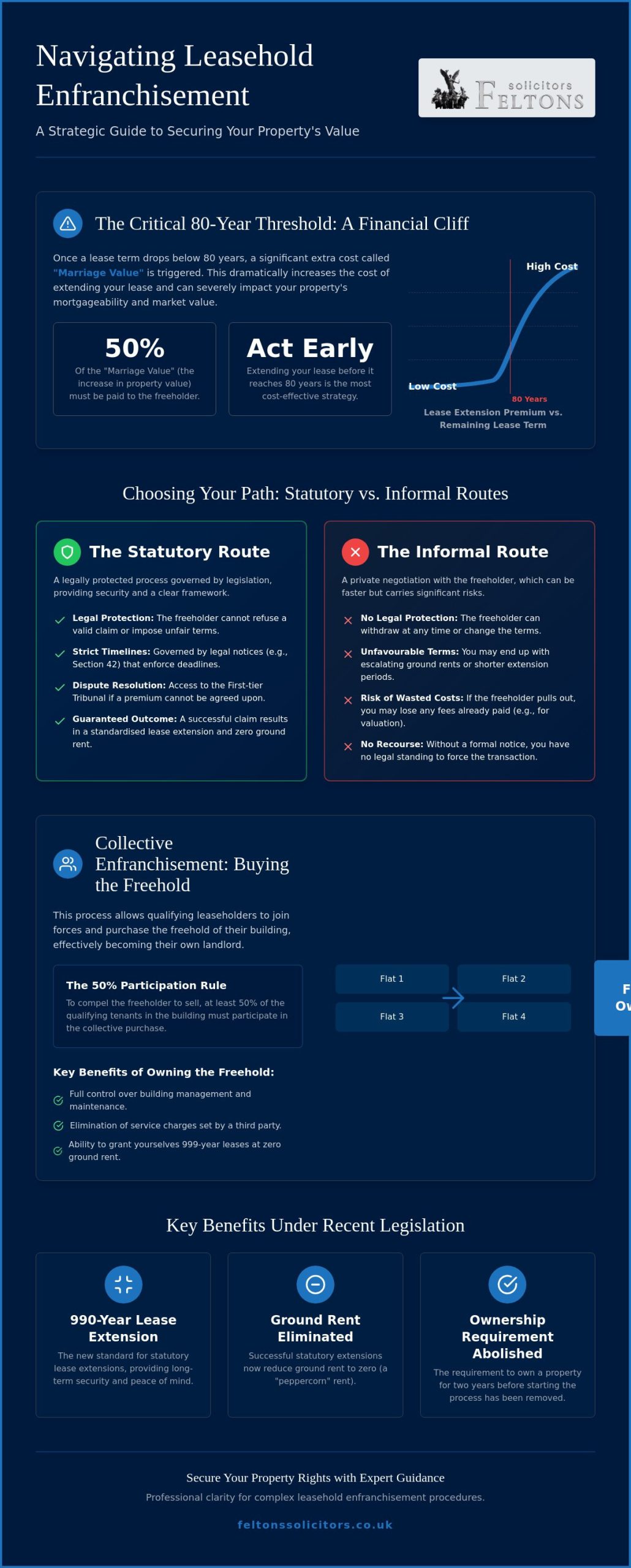
The 80-year mark is widely recognised as the most critical deadline in property ownership. Once a lease drops below this threshold, a cost known as “marriage value” is triggered. Marriage value is the increase in property value following an extension. Under current rules, this profit is shared 50/50 with your freeholder, which significantly increases the premium you’re required to pay. Whilst the 2024 Act aims to eventually abolish this cost, the provision isn’t yet in force as of August 2026. Waiting for these changes carries a distinct financial risk. If the market value of your property rises whilst you delay, the eventual premium may still exceed today’s costs. Additionally, many high-street lenders now refuse to offer mortgages on properties with fewer than 85 years remaining, making it difficult to sell to anyone other than cash buyers.
Leasehold as a diminishing asset
Unlike a freehold house, a leasehold flat is a wasting asset. Its value doesn’t just plateau, it begins to accelerate downwards as the term expires. There’s a notable psychological shift amongst buyers and surveyors when a lease falls below 90 years. They often view it as a looming liability rather than a secure investment. By extending a lease on a flat london, you effectively reset the clock and protect your capital. This proactive step ensures your home remains attractive on the open market and retains its status as a high-quality asset. Securing your property’s future today provides the peace of mind that your investment is shielded from the natural erosion of time.
Statutory vs informal lease extensions: Choosing the right path
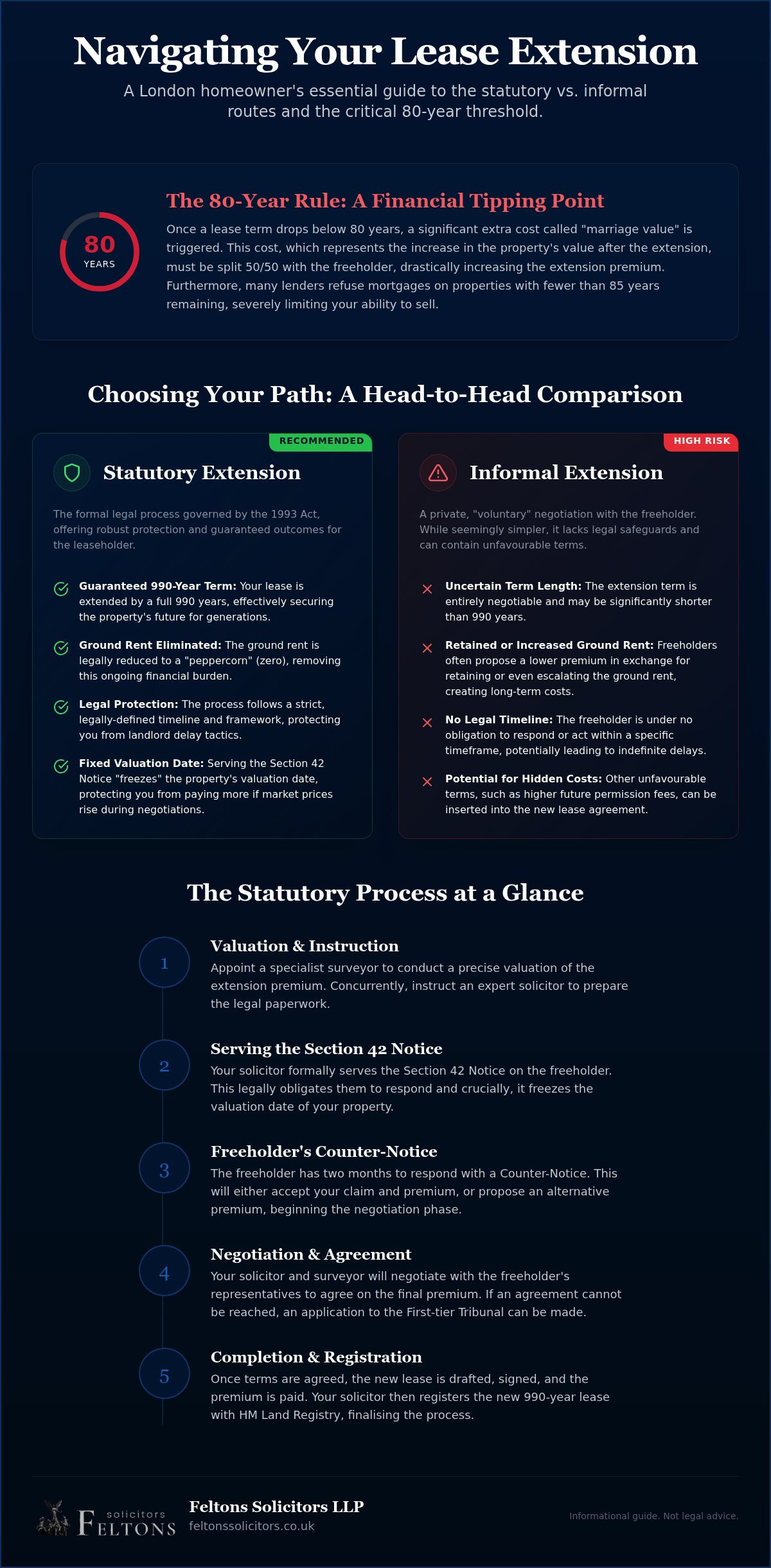
Deciding between a statutory application and an informal negotiation is the most consequential choice you’ll make when extending a lease on a flat london. The statutory route is governed by the Leasehold Reform, Housing and Urban Development Act 1993, which provides a rigid legal framework to protect your interests. In contrast, the informal route is a private agreement with your landlord. Whilst informal deals might appear simpler or faster, they often lack the strict safeguards found in official government guidance. Most professionals recommend the statutory path because it guarantees a 990-year extension and reduces ground rent to a peppercorn, providing total security for your asset.
The power of the Section 42 Notice
Serving a Section 42 Notice is a strategic move that formally initiates the statutory process. This notice is vital because it ‘freezes’ the valuation date. Even if property prices in the capital rise during negotiations, your premium is calculated based on the market value at the moment the notice is served. By 2026, the eligibility criteria have simplified; the previous requirement to have owned the property for two years was abolished in early 2025. Once served, the freeholder is legally obligated to respond with a Counter-Notice within two months. This structured timeline prevents landlords from using delay tactics to inflate costs or stall your progress.
When an informal extension might be appropriate
There are rare instances where an informal extension might be considered, particularly if you have a collaborative relationship with your freeholder and require an exceptionally fast completion. However, these “voluntary” offers frequently contain hidden traps. Landlords might propose a lower upfront premium in exchange for retaining or even increasing ground rent. Under the 2024 legislation, statutory extensions automatically eliminate ground rent, but an informal deal could include modern clauses that complicate future sales or mortgage applications. The short-term saving on professional fees is rarely worth the long-term cost of an escalating ground rent clause.
Before committing to any private offer, it’s essential to have a specialist leasehold solicitor review the terms. Our boutique approach ensures you aren’t caught by the common pitfalls of extending a lease on a flat london via the informal route. Comparing the total cost of ownership over twenty years often reveals that the statutory route is the more pragmatic financial choice, despite the initial procedural requirements.
Understanding the costs: Premium, professional fees, and taxes
Financial planning is the cornerstone of a successful property strategy. When extending a lease on a flat london, your total investment is comprised of three distinct pillars: the premium paid to the freeholder, professional fees for both parties, and potential tax obligations. The premium is the capital sum required to compensate the landlord for the loss of future ground rent and the deferment of their right to regain the property. Because this figure is based on complex valuation models, it’s the most significant variable in your budget. You can find a broader consumer perspective on these financial brackets in this guide to extending your lease, which highlights how these costs fluctuate based on market conditions.
The “Section 60” rule remains a point of frustration for many leaseholders. Under the 1993 Act, you’re generally responsible for the freeholder’s reasonable legal and valuation costs in addition to your own. Whilst this is a statutory requirement, it isn’t a blank cheque for the landlord. Furthermore, if your property is situated in a high-value area of the capital, the premium may exceed the threshold for Stamp Duty Land Tax (SDLT). It’s essential to have your solicitor calculate any potential SDLT liability early in the process to avoid late-stage surprises during the completion phase.
Factors influencing the premium
Several technical variables dictate the final price of your extension. The current market value of your flat serves as the baseline, but the remaining term of the lease and the current ground rent are equally influential. Specialist surveyors focus heavily on “yield rates” and “relativity” during negotiations. Relativity is the percentage value of the flat with its existing short lease compared to its value with an infinitely long lease. As the lease shortens, this percentage drops, causing the cost of the extension to rise sharply. Precise valuation at the start of the process is the only way to ensure your initial offer is both realistic and protective of your capital.
Managing and challenging freeholder costs
Landlords occasionally present invoices for their professional fees that appear disproportionate to the work performed. You’re only legally obligated to pay costs that are “reasonable” and “properly incurred.” If a freeholder’s solicitor or valuer charges fees that far exceed industry standards, your legal team can formally challenge them. When a mutual agreement isn’t possible, the First-tier Tribunal (Property Chamber) provides a forum to resolve these disputes. For a deeper look at how these mechanisms protect homeowners, see our article on Navigating Residential Property Law. This methodical oversight ensures that the financial burden of extending a lease on a flat london remains fair and transparent.
The step-by-step process of a formal lease extension
Following the decision to proceed, the actual mechanics of extending a lease on a flat london require a disciplined, step-by-step approach. It’s a sequence of legal and valuation milestones that must be navigated with precision to ensure your interests remain protected. The process begins with a thorough review of your current lease and title documents to identify the baseline for your claim. This initial audit allows us to confirm your eligibility and prepare the necessary information for the formal notice. By 2026, the procedural landscape has become more streamlined, yet the need for a methodical flow remains as vital as ever.
Preparation and Valuation
A professional valuation is the foundation of a successful claim. It provides the “Best Case” and “Worst Case” premium figures that anchor your entire negotiation strategy. During this stage, we also scrutinise the existing lease for “onerous” clauses, such as doubling ground rents or restrictive repair obligations, that should be varied as part of the extension. The valuation must be conducted by a surveyor with enfranchisement expertise. Their specialised knowledge of local market relativity and yield rates is what prevents you from overpaying the freeholder. This expert-led preparation ensures that the Section 42 Notice you eventually serve is robust and based on sound financial data.
From Notice to Land Registry
Serving the Section 42 Notice triggers a strict legal timetable that neither party can ignore. Once the freeholder serves their Counter-Notice, a statutory period of negotiation begins. If an agreement on the premium isn’t reached within two months, either party can apply to the First-tier Tribunal to resolve the matter. Once the premium is settled, the process enters the conveyancing stage. This involves drafting a new lease “in substitution” for the old one, effectively replacing the previous term with the new 990-year duration. It’s also the point where your mortgage lender’s formal consent is obtained and recorded to protect their security interest.
The final step is the registration of the new deed at HM Land Registry. This stage is more than just paperwork; it’s the period where the technical details of your new term are solidified and ground rent is officially reduced to a peppercorn. We ensure that the new lease follows the requirements of the 2024 Act whilst modernising any outdated language from the original deed. This final act of registration is what provides the ultimate legal certainty for your investment. If you’re ready to begin this methodical journey, you can contact our specialist leasehold team for a tailored consultation.
How Feltons Solicitors LLP secures your property rights
When you’re extending a lease on a flat london, you need more than just a legal technician; you require a sophisticated guide who understands the high stakes of the capital’s property market. Feltons Solicitors LLP positions itself as a calm, steady presence in what can often be a stressful and adversarial process. We provide pragmatic advice designed to resolve negotiations efficiently, prioritising sensible settlements over unnecessary court intervention. Our firm blends the worldly experience necessary to handle high-value London portfolios with the personalised touch of a boutique practice. This ensures that your property’s future value is protected by a team that values discretion and professional integrity above all else.
Our approach is built on the philosophy that whilst the technical legal work is paramount, the human impact of that work shouldn’t be forgotten. You’ll receive partner-led attention throughout your instruction, ensuring that your case isn’t lost in a high-volume processing system. We understand that for many of our clients, a lease extension is a vital tactical investment. By maintaining a people-first mindset, we ensure that you feel supported and informed at every milestone, from the initial title review to the final registration at HM Land Registry.
A methodical approach to leasehold law
We organise the extension process to minimise stress and provide total clarity for the leaseholder. Our methodology is highly structured, reflecting a methodical legal mindset that leaves no room for administrative error. We combine traditional professional integrity with modern delivery, using efficient systems to keep your claim moving forward without delay. As Leasehold Enfranchisement Experts, we focus on providing expert-led advice that is both grounded and current. This orderly approach allows us to manage even the most complex property disputes with quiet confidence, ensuring your rights are upheld against even the most difficult freeholders.
Protecting your interests in 2026
The legal environment in 2026 requires a partner who stays ahead of every legislative shift. We monitor the ongoing implementation of the Leasehold and Freehold Reform Act 2024 to ensure our clients benefit from the latest protections and valuation caps. Whether you’re a private homeowner or a professional property investor, we offer a high-standard service that prioritises your long-term capital security. We don’t just process paperwork; we act as your trusted advisor in a changing market. If you’re ready to secure your property’s future, Contact Feltons Solicitors LLP for a consultation on your lease extension and discover the difference that boutique, expert-led care can make.
Securing your home’s financial future
Navigating the complexities of property law requires a blend of technical precision and strategic timing. By understanding the critical 80-year threshold and the robust protections offered by the statutory route, you’re already in a stronger position to safeguard your investment. Extending a lease on a flat london isn’t merely a legal obligation; it’s a proactive financial strategy that ensures your home remains a marketable and valuable asset for decades to come.
Feltons Solicitors LLP has provided a high-standard, boutique legal service since 2010. As specialist experts in leasehold enfranchisement, we offer the pragmatic and empathetic support necessary to handle even the most intricate negotiations with freeholders. Our firm focuses on personal connection and expert-led advice, ensuring you feel supported throughout every stage of the process.
Secure your property’s value with expert legal guidance from Feltons Solicitors LLP. Taking this step today provides the long-term peace of mind that your capital is protected. We look forward to acting as your trusted advisor during this transition.
Frequently Asked Questions
Can I extend my lease if I have only owned the flat for a few months?
Yes, you can initiate the process immediately. The previous requirement to have owned the property for at least two years was abolished in January 2025. This change allows new owners to secure their property’s value without delay. It’s particularly beneficial for those who purchased a flat with a dwindling term and wish to resolve the matter before the lease shortens further, ensuring the asset remains mortgageable and attractive for future resale.
How much does it cost to extend a lease on a flat in London?
The total expenditure depends on the property’s market value, the remaining lease term, and current ground rent levels. When extending a lease on a flat london, you must budget for the capital premium paid to the freeholder and professional fees for your solicitor and surveyor. These professional costs usually fall between £2,000 and £4,000. Precise valuation is essential to ensure the opening offer is realistic and protects your capital from overpayment.
What happens if my lease has already fallen below 80 years?
If your lease is below 80 years, you currently remain liable for marriage value. Although the Leasehold and Freehold Reform Act 2024 legislates for its abolition, this specific provision isn’t yet in force as of August 2026. Delaying your application in hopes of further implementation carries risks; if property prices rise in the interim, the eventual premium may still increase. We recommend seeking specialist advice to weigh the costs of acting now versus waiting.
Do I have to pay ground rent after I extend my lease?
No, ground rent is reduced to a “peppercorn” for the entire duration of the new term. This effectively means your ground rent becomes zero. This reduction is a mandatory requirement for all statutory extensions under the 1993 Act and the 2024 reforms. Eliminating these annual payments simplifies your property ownership and removes the risk of “onerous” ground rent clauses that often deter future buyers or complicate mortgage applications from high-street lenders.
Can the freeholder refuse my request for a lease extension?
A freeholder cannot refuse a valid statutory request if you meet the basic eligibility criteria. They are legally obligated to grant a 990-year extension under the 2024 Act. Whilst they cannot block the extension itself, they have the right to dispute the proposed premium through a formal Counter-Notice. If a mutual agreement on the price isn’t reached through negotiation, the matter is referred to the First-tier Tribunal for a final, independent determination.
How long does the entire lease extension process take from start to finish?
The entire process typically takes between six and twelve months to complete. This timeline includes the initial valuation, serving the Section 42 Notice, and the subsequent period for the freeholder’s response. Negotiations regarding the premium often take several months to conclude. Once terms are agreed, the final conveyancing stage and registration at HM Land Registry add a few more months. Having a steady, expert hand to guide you ensures that strict legal deadlines are met.
What is the difference between a lease extension and buying the freehold?
A lease extension adds 990 years to your existing term, whilst buying the freehold (collective enfranchisement) gives you and your neighbours outright ownership of the building. Extending a lease on a flat london is often a more straightforward individual path to security. Buying the freehold offers more control over service charges and management but requires at least 50% of the flat owners in the block to participate, making it a more complex, collaborative legal undertaking.
Should I wait for the government’s leasehold reforms before extending?
Waiting is a calculated risk that depends on your specific lease length. Whilst the 2024 Act is law, certain provisions are still being implemented in stages throughout 2026. Additionally, a legal appeal by freeholders is expected in late 2026 or early 2027, which could impact the timeline for cheaper premiums. If your lease is approaching the 80-year mark, the cost of waiting often outweighs the potential savings, as property values continue to fluctuate.