

A dementia diagnosis does not, by itself, invalidate a will. In England and Wales, challenging a will for lack of testamentary capacity means showing that the person did not meet the legal test when they made it. Under the Banks v Goodfellow test, they must have understood what making a will means, the broad extent of their property, and the claims of people who might expect to benefit.
It is understandable to question a will made during illness, after a marked change from an earlier will, or when the person’s memory or decision-making seemed impaired. These circumstances may raise concerns, but do not establish incapacity on their own. The key question is what the person understood when they made the will.
This article explains the capacity test, the evidence that may help establish what was happening, and how courts approach disputed cases. It also explains why medical records, solicitor files, witness accounts and earlier wills can matter, and what may happen if a will is found invalid.
Key Takeaways
- Assess capacity at the time the will was made: a diagnosis alone does not settle whether the legal test was met.
- Learn how medical records, solicitor files, witness accounts and earlier wills may help build a picture of the will-maker’s understanding.
- See how courts have weighed difficult evidence and personal circumstances in contested cases.
- Understand what may happen if a will is found invalid, and how Feltons Solicitors LLP’s Wills, Probate, and Estate Planning service can help with the dispute.
What kind of evidence is needed to challenge a will on capacity grounds?
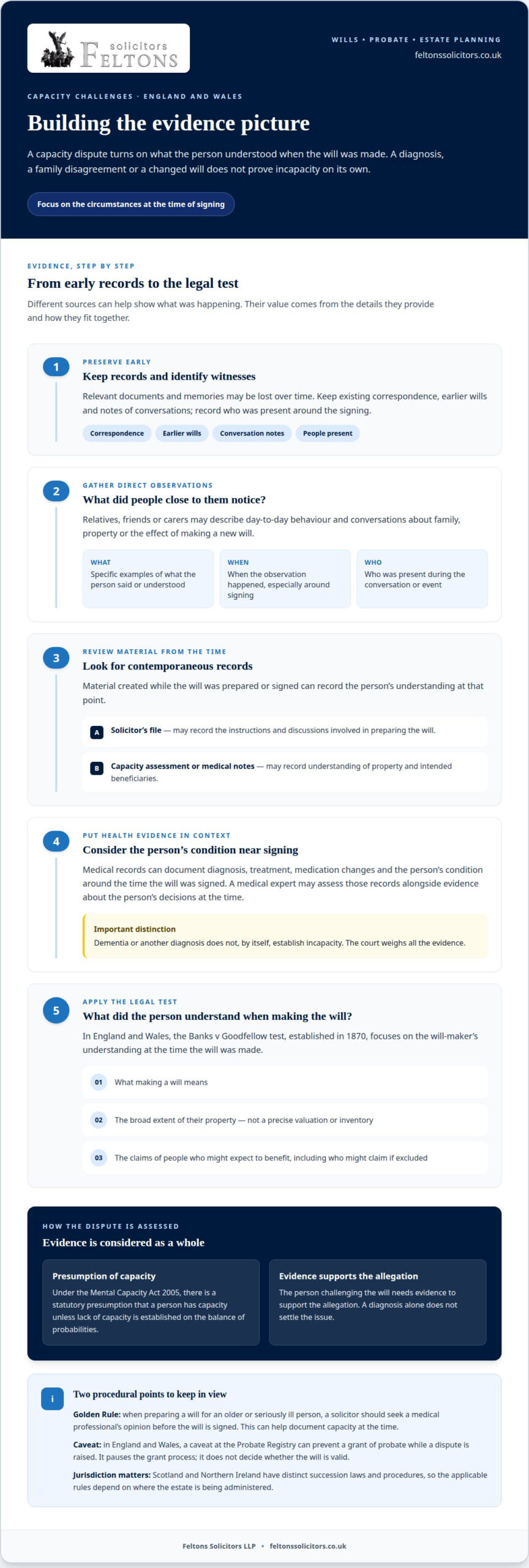
A capacity challenge depends on evidence about the will-maker’s understanding and decisions. A clear picture often combines records from the relevant time with accounts from people who knew them.
Scotland and Northern Ireland have succession laws and procedures distinct from those in England and Wales, so the applicable rules depend on where the estate is being administered. The evidence and legal test must be considered under the relevant jurisdiction.
When preparing a will for an older or seriously ill person, a solicitor should follow the Golden Rule by seeking a medical professional’s opinion before the will is signed. This can help document the person’s capacity at the time.
In England and Wales, a caveat can be entered at the Probate Registry to prevent a grant of probate while a dispute is raised. It pauses the grant process but does not decide whether the will is valid.
Evidence from people close to the deceased
Witness evidence consists of accounts from people who knew the deceased and observed their day-to-day behaviour. A relative, friend or carer might describe conversations about family, property or the effect of making a new will. Specific examples from around the time of signing can help show how the person understood their decisions. Such accounts are more useful when they explain what was observed, when it happened and who was present.
Preserving evidence early
Early preservation means identifying relevant documents and witnesses before records are lost or memories fade. Keep existing correspondence, earlier wills and notes of conversations, and record who was present around the signing. The National Archives states that, in England and Wales, a person must be over 18 years old to make a valid will. If a will is found invalid, the Inheritance (Provision for Family and Dependants) Act 1975 may provide a basis for a further claim, according to The National Archives.
Evidence from the time the will was made
Contemporaneous evidence is material created when the will was prepared or signed, rather than accounts formed later. A solicitor’s file, a capacity assessment or medical notes may record the person’s understanding of their property and intended beneficiaries. Under the Mental Capacity Act 2005, there is a statutory presumption that a person has capacity unless it is established on the balance of probabilities that they lack capacity, according to The National Archives. The timing matters because dementia does not alone prove incapacity.
Records and expert evidence
Medical records can document a diagnosis, treatment, medication changes and the person’s condition near the time the will was signed. A medical expert can assess those records alongside evidence about the will-maker’s decisions at the time. In a contentious case, the court weighs all the evidence; a diagnosis alone does not settle the issue. The person challenging the will needs evidence to support the allegation, and the presumption of capacity informs how the dispute is assessed.
What is testamentary capacity?
Testamentary capacity is the ability to make a valid will at the time it is made. In England and Wales, courts apply the Banks v Goodfellow test, established in 1870, to assess the will-maker’s understanding and decision-making.
The test asks whether the person understood what making a will means, the broad extent of their estate, and the claims of people who might expect to benefit. They should also understand who might claim against the estate if excluded. They do not need a precise valuation or inventory, but must have a broad understanding of their property.
Capacity is specific to the date the will was made, and differs from general mental capacity. Someone with dementia may still meet the test at that time, while illness or an affective disorder, such as the complex grief reaction considered in Key v Key (2010), may affect understanding. The court assesses the circumstances surrounding preparation and execution, not simply a diagnosis or condition before or after.
A legal challenge may arise when a new will sharply changes earlier gifts, excludes someone previously included, or is made during illness or changes in medication. Isolation or dependence on a beneficiary may also prompt scrutiny. These circumstances raise questions, but do not prove that the will is invalid.
In England and Wales, someone whose interest in the estate may be affected, such as a beneficiary under an earlier will, may have grounds to seek advice about a challenge. A solicitor can assess the will, circumstances and evidence, then advise on contentious probate representation. Rules differ across the UK, so the estate’s jurisdiction matters.
There is no single cost for contesting a will. Legal fees depend on factors such as the evidence required, expert involvement and whether the dispute goes to court; fees are set after a quote request. Each side may face legal costs, and responsibility for them can depend on the outcome and any court order.
For advice on a potential capacity dispute, seek specialist contentious probate advice at an early stage.
Court decisions involving challenges to capacity
Court decisions show why judges examine the will-maker’s condition and circumstances when the will was made. Age, a mental disorder or an unexpected inheritance decision may prompt scrutiny, but none alone determines capacity.
In one case, an 88-year-old testatrix left her estate to charity and excluded her children. Another dispute concerned a testatrix who excluded three of her 11 children after they reported their father for abuse; he pleaded guilty and was imprisoned. Those family circumstances formed part of the picture, rather than proving incapacity by themselves.
In Barnaby v Johnson, Mrs Bascoe died aged 97 in 2015. A separate case involved a testator with multiple sclerosis, where two experts disagreed about capacity. The court found that he lacked it. The contrast shows why medical opinion must be considered alongside evidence about the person’s understanding and the will’s preparation.
Goss-Custard v Templeman involved a will made by Lord Templeman in 2008. The case is a reminder that the question concerns the testator’s ability to understand the nature and effect of the will, not simply whether beneficiaries regard its terms as unfair. Solicitors’ records and witness accounts can help explain how the decision was reached.
The Court of Protection has a different role. In England and Wales, it can make a Statutory Will for someone who lacks capacity to make one themselves, taking their circumstances, wishes and views into account. This is planning for a living person, not a decision about whether a deceased person’s will was valid.
What are the risks and likely outcomes of challenging a will for lack of capacity? A court may uphold the will or declare it invalid. If it is invalid, the estate may pass under intestacy rules or an earlier valid will. A dispute may be resolved through negotiation or mediation, but an unresolved case can proceed to litigation, with consequences for inheritance and family relationships.
Challenging a will for lack of testamentary capacity
A capacity challenge asks whether the person making the will could understand and make the decision at the relevant time. The practical priority is to preserve the estate while the evidence and possible grounds are assessed.
Starting a capacity challenge
Starting a challenge means setting out the concern and gathering evidence about the will’s preparation and signing. Compare the disputed document with earlier wills, medical records and the solicitor’s file to identify specific changes or questions about the person’s understanding. A diagnosis, family disagreement or suspicion of influence is not enough by itself. The case needs evidence connected to the person’s capacity when they made the will.
Seek advice before a grant of probate is issued where possible, because administration may progress while a dispute remains unresolved. If a later will emerges after probate has been granted, the grant will usually need to be revoked. The appropriate next step depends on the estate’s position and the available evidence.
Time limits in England and Wales
There is no single time period in the available facts that determines every capacity challenge. The practical point is to seek advice promptly, preferably before the grant of probate, and establish whether the estate has begun distribution. In England and Wales, 12 months from the date of death is described as a reasonable period to fully administer an estate. That period matters when assessing urgency, but does not itself establish the deadline for a challenge.
Discuss the timing with a solicitor, along with the will, probate status and any distribution already made. If the estate is being administered, delay can complicate matters and affect the available options. A capacity dispute may be resolved through negotiation or mediation; litigation may follow if no satisfactory resolution is reached.
Where a challenge succeeds, the will may be declared invalid, and the estate may pass under intestacy rules or the most recent earlier valid will. If you need advice on grounds, evidence or probate timing, discuss a will capacity challenge.
Feltons Solicitors LLP: Wills, Probate, and Estate Planning
Feltons Solicitors LLP can help when questions about a will’s validity affect an estate or its administration. Its Wills, Probate, and Estate Planning service can advise on a capacity concern, the evidence involved, or the effect of a disputed will on probate.
Discuss the will, any earlier version and the records gathered about the person’s condition when it was made. This provides a practical starting point for understanding the issues and considering appropriate next steps for the estate.
For guidance on a will or probate concern, contact Feltons Solicitors LLP.
Choose a considered next step
Before deciding how to proceed, consider what a fair resolution would achieve for you and the estate. A legal dispute can affect relationships as well as inheritance, so clarity about your priorities can help keep decisions focused. Challenging a will for lack of testamentary capacity is not simply a disagreement with its outcome; it requires a considered view of the evidence, practical consequences and available options.
Consider whether your main concern is the will’s validity, the estate’s administration or a wider family provision issue. These concerns may raise different legal questions. Identifying what matters most can help focus the discussion and make it easier to weigh possible next steps. Keep communication measured, and distinguish established facts from assumptions about why the will was made.
A clear understanding of your objectives can help you approach the next conversation with purpose. The most appropriate way forward depends on the circumstances and the outcome you seek.
Discuss your position with Feltons Solicitors LLP and take the next step with clarity.
Frequently Asked Questions
What Must the Testator Be Able to Do When Creating a Will?
The testator must understand what making a will does, the broad extent of their property and the claims of people who might expect to benefit. For example, they should understand that a new will may change who receives part of their estate. The assessment concerns their understanding when they make the will, not simply their age or a diagnosis.
What is the burden of proof?
A properly executed will carries a presumption of capacity. If evidence creates real doubt, the person seeking to uphold the will may need to prove the testator had capacity. The Mental Capacity Act 2005 also sets a presumption of capacity unless lack of capacity is established on the balance of probabilities. The relevant question remains whether the will-maker met the testamentary capacity test at the time.
What is the required knowledge and approval?
The testator must know and approve the contents of the will, meaning they understand and accept its provisions. This is distinct from testamentary capacity: someone might understand how a will works but not know what a particular document says. If the testator was blind, illiterate or unable to sign personally, the usual presumption of knowledge and approval does not automatically apply.
What should I do if I suspect testamentary incapacity in a Will?
Record the specific events that prompted concern, such as a marked change from an earlier will or confusion during discussions about its terms. Preserve relevant letters and messages, and note who was present when the will was discussed or signed. Seek advice promptly, particularly if probate has not been granted. A diagnosis or unexpected gift alone does not establish incapacity.
What should you do if you suspect a lack of capacity?
Start by establishing whether a grant of probate has been issued and whether estate administration is progressing. Keep relevant documents together, including earlier wills and correspondence about the disputed will. Seek legal advice before the estate is distributed, so the evidence and available options can be considered in context. Do not treat family disagreement as proof of incapacity without supporting evidence.
What is testamentary capacity under the Banks v Goodfellow test in England and Wales?
Under Banks v Goodfellow, the will-maker must understand what making a will means, the broad extent of their property, and the claims of people who might expect to benefit. They must also not be affected by a disorder of the mind that distorts their decisions about the estate. The court considers the circumstances in which the will was prepared and made.